


When a customer clicks “Add to Cart” on your Shopify store, they’re making an act of trust based exclusively on your Shopify product data — your listings, images, and words. In a physical store, the customer can touch, feel, or try the product, but online, they can only interpret your images and words. This creates what many e-commerce brands underestimate – the expectation gap. It’s the difference between what a customer believes they are buying and what they actually receive.
And here’s the uncomfortable truth – the gap doesn’t have to be big to cause real damage. One small mistake in a size measurement can turn a perfect-fit shelf into something unusable. A copied color description from another product can quickly turn customer excitement into disappointment the moment the package is opened.
These mismatches are not rare. According to the NRF research, US retailers had 15.8% of total sales returned in 2025 (about $850 billion), with returns via online channels reaching 19.3%. On platforms like Shopify, e-commerce return rates can climb even higher for apparel and accessories – 25–40% or more. These are largely caused by fit issues, color, and “not as described” complaints that stem directly from poor Shopify product data.
This article explains why meticulous Shopify store management is not an administrative task but your primary, proactive defense against costly refunds and bad customer reviews.
The Financial Hit: How E-commerce Return Rates Drain Your Revenue
Returns may seem like a background expense, but they are silently killing your Shopify store. High e-commerce return rates are not just about the lost sales. It’s the money you lose with each returned order. A single return includes:
- Shipping to a customer – You already paid to send the product to the customer.
- Return shipping – Either you cover the cost, or you further upset customers by asking them to pay.
- Packaging materials – Used twice: once to ship out, once to send back.
- Restocking labor – Staff must inspect, repackage, and update inventory.
- Risk of damage – Items may come back worn or unsellable.
- Inventory holding costs – When the item is in transit, it can’t be sold to anyone else.
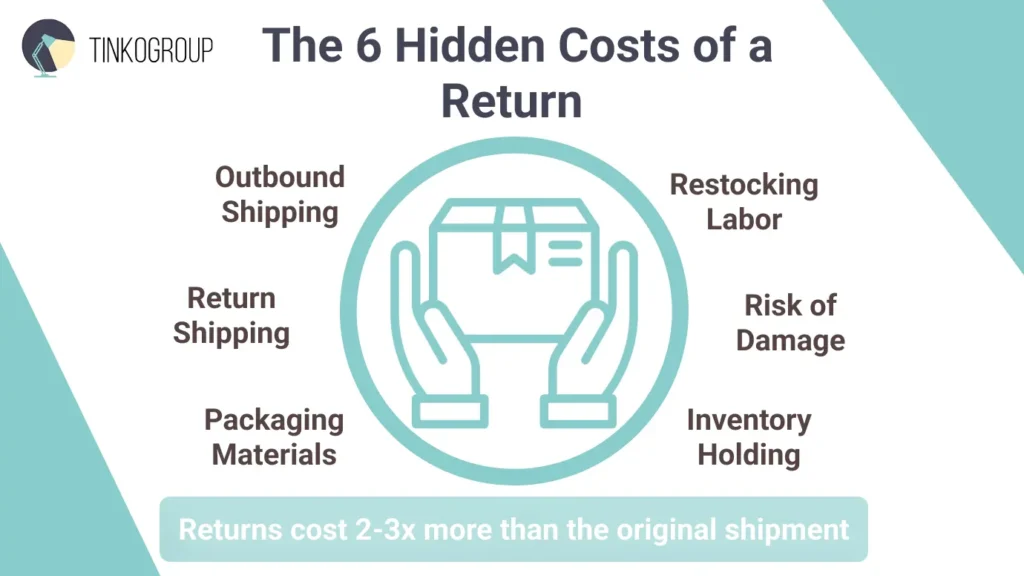
By the time a return is processed, it often costs two to three times more than the original shipment. Let’s put this into real numbers.
Industry estimates suggest that processing a single return costs $15–$30 per item. It includes return shipping, labor, restocking, and potential damage. And that’s on top of the refund itself.
Now imagine a Shopify store with $300,000 monthly revenue. Let’s say, 20% of orders are returned, and this results in:
- $60,000 in refunds every month.
- Plus roughly $14,000–$27,000 per year in return handling and processing costs.
And this sum still doesn’t include paid ads, tied-up inventory, or items that can’t be resold.
Most of these returns can be prevented, as they are usually caused by bad or missing Shopify product information. It’s cheaper to fix product data before a sale. Every dollar you spend on data arrangement brings good returns. Plus, it’s 5 to 25 times cheaper to retain a customer than to get a new one. That means accurate Shopify data entry is one of the smartest investments you can make for your Shopify store.
The Reputation Hit: Why Bad Customer Reviews Stick Forever
Losing money from returns is bad, but the bigger problem is how bad product data can damage your store’s reputation.
Imagine this: a customer orders a “stain-resistant office chair” from your store. The listing copied specs from an old supplier website. When the chair arrives, a coffee spill leaves a permanent stain because the fabric isn’t stain-resistant. The customer is upset and writes a 1-star review: “Misleading product descriptions. Don’t trust this store.”
That review doesn’t disappear after a refund. It remains on Google, Trustpilot, and your product page, and thousands of potential buyers see it. One “not as described” complaint signals dishonesty and sticks in customers’ minds. The actual outcome of bad customer reviews:
- A single 1-star “Not as described” review can cut purchase intent by over 20%.
- Three or more similar reviews can reduce it by nearly 60%.
- 94% of consumers admit that a bad review has convinced them to avoid a business.
This is how a product quality issue turns into a trust issue. Poor Shopify product data fuels these reviews. And the irony is that the customer would have been happy if the listing were accurate. Instead, every misstep becomes public, lowers star ratings, visibility, and raises ad costs.
Accurate product descriptions build credibility. Honest information, clear specs, and real images build customer trust, reduce complaints, and increase conversions.
The Hidden Costs: Ad Spend & Support Time
Poor Shopify product data causes more harm than returns – it drains two of your most expensive resources: paid advertising and customer support.
Ads are expensive. Every click you pay for costs money, whether on Google, Meta, TikTok, or through influencer campaigns. It can be anywhere from $0.50 to $5 or more per click. Now imagine a potential customer clicks on your “60-hour battery wireless earbuds” ad and sees a listing that says 28 hours. Or the photos show blue, but the dropdown only offers green. They leave immediately.
These are interested customers you paid to attract. When product data is inaccurate or unclear, they bounce. In these cases, 70–80% of people leave right away. That pushes your acquisition costs up 30–50% and gives you far fewer people to retarget. A $5,000 monthly ad budget can easily burn $1,500 or more on clicks that go nowhere, and over a year, that adds up to thousands.
Customer support suffers too. Poor descriptions generate additional questions: “Is this jacket really waterproof?” or “Does this fit wide feet?” Each inquiry takes 5–15 minutes. Fifty tickets a day means 250 hours per week.
Shopify product accuracy solves both problems. Detailed specs, size charts, color-accurate swatches, and clear variant notes answer customer questions before they arise. Accurate listings maximize every marketing dollar and reduce 20–30% of inquiries. Better data also reduces bounce rates and increases conversions.
Common Data Errors in Shopify Product Details to Watch Out For
Most teams understand that bad Shopify product details hurt sales. And many mistakes are repeated again and again. These may not be obvious, but they quietly affect trust, conversions, and customer confidence. Here are the areas that you need to review first.
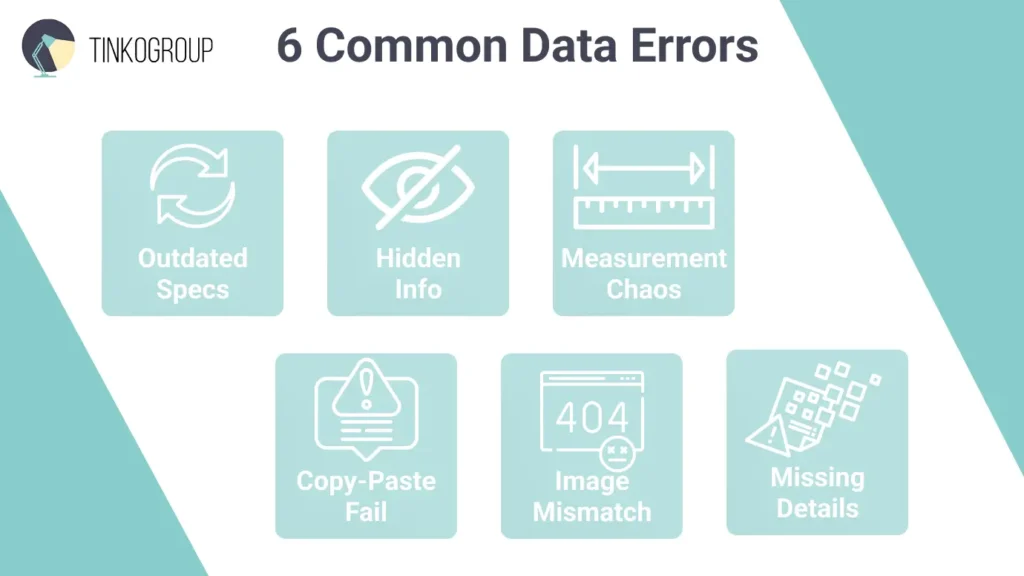
Outdated Specifications
This is one of the most frequent issues we see. A product gets updated, but the listing doesn’t. Photos, descriptions, or specs reflect an older version, even though you’re selling the newer one. This happens often with electronics, apparel, and supplements. Customers who research before buying will notice the mismatch right away. When they do, they assume the product is outdated or that the store isn’t careful. In either case, trust is lost.
Information That’s Hard to Find
Even accurate data can fail if you don’t organize it properly. Shoppers don’t read product pages word for word – they scan them. When an important detail like size, materials, or compatibility is hidden in dense text, customers easily miss it. Clear bullet points, tables, and headings make a big difference, especially on mobile. If shoppers can’t quickly get the answers they need, they go away.
Inconsistent Measurements
Measurement errors confuse shoppers. Mixing units, skipping labels, or using wrong conversions makes people guess, especially online buyers. You should stay consistent, label everything clearly, and check your conversions. Clear measurements make buying easier.
Copy-Paste Mistakes
You can copy descriptions across similar products, but it’s risky. It’s easy to forget to update a color name, feature list, or compatibility detail. These small errors are easy to overlook internally, but customers notice them instantly. Once they see one mistake, they start questioning the rest of the page.
When Images and Text Don’t Match
Product photos should match the description. When colors look different, accessories are shown but not included, or images make the product seem larger or smaller than it is, shoppers get confused. If they are not sure what they’ll receive, they will not make a purchase.
Missing Decision-Making Details
Some details aren’t mandatory, but they matter. These are care instructions, assembly requirements, and other performance details. When you leave out this information, shoppers pause, second-guess, or abandon the purchase altogether.
How to Fix It: The QA Process
Finding problems in Shopify product data is only half the battle. It’s really hard to keep hundreds or even thousands of product listings accurate. You should have a strong data quality assurance process for this.
Why Automation Isn’t Enough
Many store owners assume they can fix data issues with automated tools. They use scrapers that pull specs from manufacturer websites, plugins that format descriptions, or AI that generates content. These tools are helpful, but they have limits.
Automation can tell you if a field is filled, but it can’t confirm the content is correct. For example, a “material” field may be complete, but it could say “100% polyester” when the actual product is cotton. AI-generated descriptions can be grammatically perfect but factually wrong. Most importantly, machines can’t visually verify photos. They won’t catch if images don’t match the description, if a size chart is confusing, or if dimensions are presented in a way that misleads customers.

Reliable Data Services Delivered By Experts
We help you scale faster by doing the data work right - the first time

The Human-in-the-Loop Approach
The most reliable method combines automated checks with human review. This human-in-the-loop process works like this:
- Automated first pass. Software flags missing fields, obvious errors, and formatting issues.
- Human verification. Specialists review each product and recheck if photos match descriptions, specs correspond to manufacturer documents, and other critical information that a customer needs for a purchase.
- Expert sampling. For technical or complex products, experts confirm specs are accurate and complete.
Keep Shopify Product Details Fresh
Shopify product data is not something you may set and forget. Regular maintenance is needed here:
- New products. Run a full QA review on every new SKU before it goes live.
- Seasonal audits. Schedule regular reviews to catch inconsistencies.
- Post-return checks. High-return items must go through immediate audits.
- Manufacturer updates. When suppliers change specs, update listings immediately.
Why These Quality Checks Pay
QA measures can feel costly, but poor product information quality has real consequences: returns, support tickets, and lost conversions all add up. When you invest in professional data QA, it pays for itself many times over. Specialists bring experience, scalable processes, and quality checks to keep your catalog accurate and consistent. Businesses that treat product data as a strategic advantage see stronger conversions, reduce refunds, and have more loyal customers.
Strong Shopify catalog management also helps businesses maintain consistency across growing inventories, making it easier to scale product operations without sacrificing customer experience.
Conclusion
So, now you know a bit more about the financial hit from returns, the lasting impact of negative reviews, wasted ad spend, hours lost to support customer queries, and the common errors that erode customer trust. But it all comes down to one principle – accurate product data builds trust. Trust builds loyalty. Loyalty builds growth.
Every choice a customer makes on your Shopify store is a trust act. Will the product match the description? Will the size fit? Will it perform as promised? Your Shopify product data is the foundation. Get it right, and customers buy confidently, get exactly what they expected, and return. Get it wrong, and you create skeptics who return items, leave warnings, and never come back.
Poor product data isn’t just a financial problem. Returns, support costs, and wasted ads hurt, but the higher cost is a missed opportunity. Every loyal customer lost, every positive review that never happens, every repeat purchase that never occurs comes down to broken trust.
The solution isn’t complicated, but it requires commitment. Systematic quality assurance with smart automation and careful human checks will cope with the task.
In e-commerce, the difference between a struggling store and a thriving one often comes down to one factor: accurate product descriptions. Get your data right, and you turn browsers into buyers and buyers into loyal advocates. Is your Shopify store losing money to avoidable returns and bad product data? A full audit can uncover the risks. Let Tinkogroup experts transform your catalog into your greatest asset.
Why does poor Shopify product data lead to high return rates?
Inaccurate or incomplete Shopify Product Data creates an expectation gap between what customers think they’re buying and what they actually receive. This leads to “not as described” returns, especially for size, color, and functionality issues.
What are the highest hidden costs of product returns for Shopify stores?
Returns don’t just mean refunds. They include outbound and return shipping, restocking labor, packaging, potential product damage, and inventory holding costs. In many cases, a return can cost 2–3 times more than the original shipment.
How can Shopify stores reduce returns and improve customer trust?
The most effective approach is a structured QA process: combine automation with human review, ensure accurate specs and images, and regularly audit listings. High-quality Shopify Product Data reduces returns, lowers support workload, and builds long-term customer trust.