


Mankind is oversaturated by technological services, but we still eagerly consume fresh, innovative solutions. We live in an era of “app fatigue,” yet every time a disruptive product hits the App Store, we download it. Why? Because a startup is more than just a newly founded business; it is a manifestation of an innovative approach designed to fill a specific market gap that legacy corporations are too slow to see.
The statistics are staggering: every second, three startups are launched globally. That’s over 250,000 new ventures every single day. However, in a world where “innovative idea equals power,” the execution of that idea is what defines success. Ideas are a commodity; execution is the currency.
Many founders lie awake at night asking the same question: “May my ridiculous idea lead me to a unicorn?” The answer is a resounding yes, but with a crucial caveat: only if you have the right people to build it. Today, the traditional bridge between a “garage idea” and a billion-dollar valuation is no longer a suite of high-priced executives in a glass office. Increasingly, that bridge is built, coded, and designed by freelancers. This shift has allowed founders to maximize Remote Work Productivity from day one.
The Phenomenon of the “Unicorn”: More Than Just a Mythical Valuation
A startup that exceeds a valuation of $1 billion is “galloped” into the elite Unicorn Club. The term, coined in 2013 by venture capitalist Aileen Lee, was originally intended to highlight the statistical improbability of such success. At that time, only 0.07% of software startups reached this milestone. Today, while the number of unicorns has grown, the prestige and the “why” behind their growth remain a blueprint for every ambitious founder.
Why Should a Founder or Freelancer Care?
Whether you are an entrepreneur aiming for the top or a freelancer looking to work with the next big thing, understanding the Unicorn trajectory is vital:
- For Founders: It’s about “blitzscaling” — prioritizing speed over efficiency in an environment of uncertainty.
- For Freelancers: Being part of a Unicorn’s early journey often means working on cutting-edge technology and building a portfolio that commands top-tier rates in the future.
Deep Dive: Historical Lessons from the Giants
To understand the future, we must deconstruct the “ridiculous” beginnings of today’s market leaders. These companies didn’t just scale; they redefined their industries.
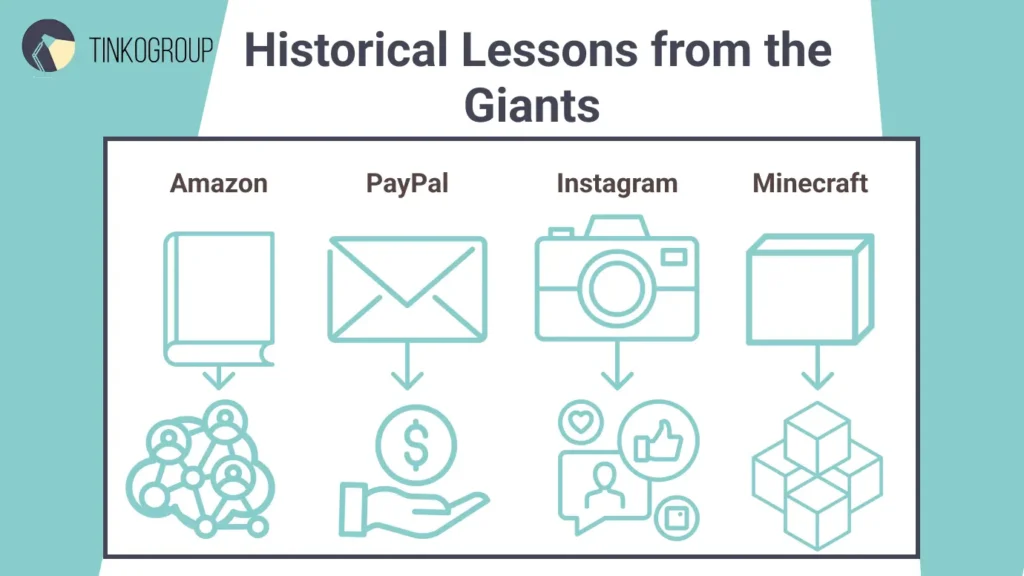
Amazon: The Risk of the “Everything Store”
When Jeff Bezos launched Amazon from his garage in 1994, the internet was a lawless frontier. People were terrified to put their credit card details into a browser. Bezos didn’t start with “everything”; he started with books because they were easy to ship and had a universal appeal.
- The Pivot to Unicorn: Amazon’s success wasn’t just about selling products; it was about building the world’s most sophisticated logistics and cloud infrastructure (AWS). They used a lean mindset to dominate a niche before swallowing the entire retail market.
PayPal: Disrupting the “Untouchable” Banking System
In 1998, the idea of sending money via an email account felt like a scam. Traditional banks laughed at the concept of “digital wallets.” PayPal survived because they solved a specific problem for eBay power users who needed a faster way to settle auctions.
- The Lean Lesson: They focused on a small, passionate user base. By the time the world realized digital currency was the future, PayPal had already built the “network effect” that made them indispensable.
Instagram: The Power of Visual Simplicity
While the giants of the time (like Facebook and Flickr) were cluttering their interfaces with features, groups, and complex settings, Instagram did the opposite. They realized that mobile users wanted one thing: to make their mediocre phone photos look like professional art.
- The Unicorn Move: By focusing exclusively on mobile-first and filters, they captured the millennial attention span. When Facebook bought them for $1 billion in 2012, they had zero revenue. Mark Zuckerberg wasn’t buying a business; he was buying the future of attention.
Minecraft: Community-Driven Development
In an era of high-definition graphics and Triple-A studios like EA Games, Minecraft looked like a relic from the 80s. Yet, its “bad” graphics were its greatest strength—it allowed for infinite creativity and could run on almost any device.
The Scaling Secret: Mojang (the creator) didn’t spend millions on marketing. They let the community build the game’s value. Microsoft’s $2.5 billion purchase proved that a “low-tech” look backed by a “high-engagement” engine is a recipe for a Unicorn.
The Power of “Ridiculous” Ideas: Case Studies in Niche Success
Before we dive into the technical mechanics of why startups hire freelancers, let’s look at how even the most bizarre ideas found their market. In the startup world, “ridiculous” is often just another word for “ahead of its time” or “highly specialized.”
The following companies prove that there is a customer for almost everything, provided you can reach them efficiently and present the solution professionally.

Reliable Data Services Delivered By Experts
We help you scale faster by doing the data work right - the first time

Hushme: The “Bane Mask” for the Modern Office
Imagine sitting in a quiet, open-plan office, and you need to discuss a sensitive legal contract or a private medical matter. You don’t want to run to a phone booth. Hushme created a personal acoustic transformer—essentially a high-tech muzzle that muffles your voice and protects your privacy.
- The “Ridiculous” Factor: It looks like something out of a sci-fi movie, and many initially mocked the design.
- The Market Reality: With the rise of remote work and the “Zoom culture” in shared spaces, the need for speech privacy became a million-dollar problem.
- The Freelance Role: To bring such a specialized hardware product to life, the founders didn’t need a thousand full-time engineers. They needed expert Industrial Designers, Acoustic Engineers, and Crowdfunding Specialists on a project basis to launch on platforms like Kickstarter.
Vitality Air: Capitalizing on the Atmosphere
Can you really sell “thin air”? A Canadian company, Vitality Air, started as a joke on eBay when the founders sold a bag of air for 99 cents. Today, they sell 8-liter canisters of fresh Rocky Mountain air for roughly $25 a bottle.
- The “Ridiculous” Factor: It sounds like a scene from Spaceballs.
- The Market Reality: In cities like Beijing or Delhi, where the air quality index (AQI) often hits dangerous levels, fresh air isn’t a joke—it’s a luxury wellness product. They now sell over 10,000 bottles a month.
- The Freelance Role: Scaling a product like this requires Global Logistics Consultants and Localized Marketing Experts who understand the cultural nuances of the Asian luxury market—tasks perfectly suited for high-level freelancers.
DiedInHouse.com: The Ultimate Due Diligence
Would you buy a house if you knew something tragic happened there? Most people wouldn’t, but finding that information is surprisingly difficult. DiedInHouse.com solves this by searching millions of records to see if a property has a “dark” history.
- The “Ridiculous” Factor: It sounds like a tool for ghost hunters.
- The Market Reality: Disclosure laws vary by state. For a buyer, this is a vital tool for price negotiation and peace of mind.
- The Freelance Role: A business built on data. Instead of a full department, the founder utilized automation tools similar to those provided by top data labeling companies to keep overhead minimal.
Herds for Hire: The Eco-Friendly Lawnmower
Why invest in expensive, noisy, carbon-emitting machinery when nature has already perfected the lawnmower? Herds for Hire (and similar services like Rent-a-Goat) provide goat rental for land clearing.
The Freelance Role: While the goats do the physical labor, the business side—Booking Systems, Web Development, and Digital PR—is often managed by a lean team of remote contractors.
The “Ridiculous” Factor: “I’m hiring a goat to do my gardening.”
The Market Reality: Goats are better than machines for steep terrain and invasive species (like poison ivy) that machines can’t handle. It’s a sustainable, organic solution for municipalities and large estates.
Why Startups are Interested in Hiring Freelancers
Statistically, only 10% of startups survive beyond their first three years. While many point to “market fit” as the culprit, a deeper dive into the autopsies of failed ventures reveals two recurring ghosts: “Running out of cash” (Burn Rate) and “The wrong team” (Hiring Friction). In the modern ecosystem, freelancers and Virtual Assistants (VAs) aren’t just “helpers” — they are a high-octane competitive advantage that allows a 3-person startup to perform like a 30-person corporation.
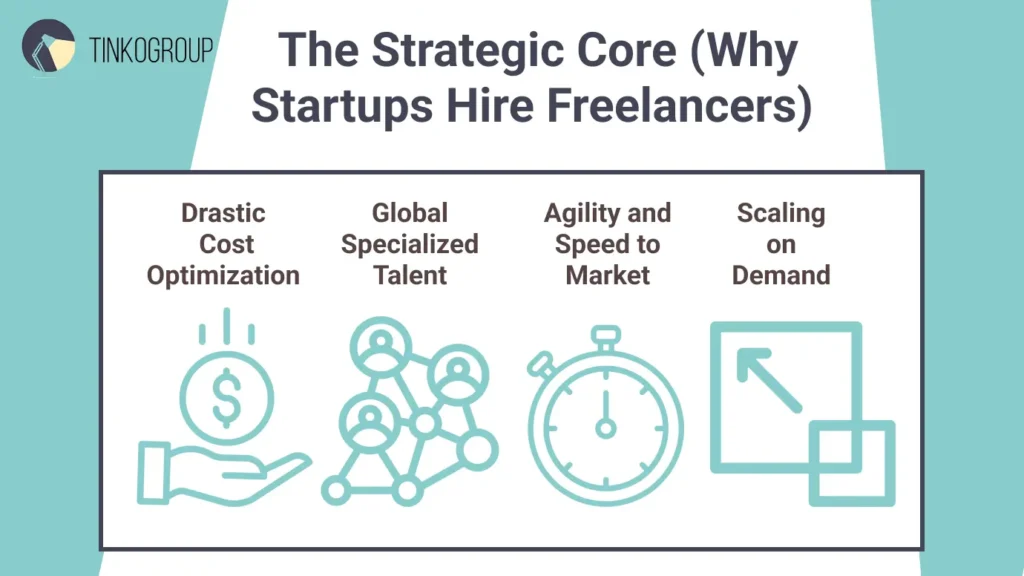
A. Drastic Cost Optimization: The “Burn Rate” Extender
For a seed-stage startup, cash is oxygen. Hiring a full-time senior developer in a tech hub like Silicon Valley, London, or Berlin is an immense financial burden.
- The Hidden Costs of Full-Time: Beyond the $150k+ salary, you have payroll taxes (approx. 15-20%), health insurance, 401k matches, office equipment, and the “rental” of their desk space.
- The Freelance Solution: By hiring freelancers, you eliminate “dead time.” You don’t pay for lunch breaks, water-cooler chats, or slow Tuesdays. You pay for the output.
- Global Rate Arbitrage: A specialist in Eastern Europe or South America might offer the same (or superior) technical expertise as a local hire but at a cost that extends your startup’s “runway” from 6 months to 18 months. This extra year is often exactly what a company needs to find its “Unicorn” trajectory.
B. Access to Global Specialized Talent: Breaking Geographical Barriers
If you only hire within a 30-mile radius of your office, you are fighting for talent with giants like Google, Meta, and Amazon. You will lose that war.
- The World is Your Office: Remote hiring allows you to tap into “hubs of excellence.” Need world-class Machine Learning engineers? Look to Ukraine or Poland. Need top-tier UI/UX designers? Scandinavian freelancers are world-renowned.
- The AI Advantage: For modern startups, data is the new oil. However, raw data is useless without high-quality labeling. Partnering with specialized freelancers or top data annotation companies in Europe ensures that your AI models are trained on precision-level data from day one. You get the expertise of a specialized firm without the long-term commitment of a departmental hire.
C. Agility and Speed to Market: The “Plug-and-Play” Mindset
In the startup world, “the first to market wins.” Traditional hiring is slow; it involves weeks of interviews, background checks, and then a 1-month “onboarding” period where the employee is learning, not producing.
- Hit the Ground Running: Freelancers are professional “problem solvers.” They are used to jumping into different codebases and workflows. They don’t need to be “acculturated” to your office vibes; they need a Jira ticket and a deadline.
- Reduced Management Overhead: Professional freelancers often come with their own project management styles and tools. They are self-starters who don’t require the hand-holding that junior in-house staff often need.
D. Scaling on Demand: The Elastic Workforce
Startup growth isn’t a straight line; it’s a series of jagged spikes.
The “Retrench” Scenario: Once the feature is live and in maintenance mode, you don’t need that high-intensity team anymore. Scaling down a freelance team is a simple “end of contract” conversation—scaling down an in-house team is a morale-killing layoff process. This elasticity allows startups to be aggressive when needed and lean when necessary.
The “Push” Scenario: Imagine you just landed a major partnership and need to roll out an integration in two weeks. You can instantly onboard three freelance developers to crush the sprint.
Beyond the Basics: Deep Integration of Freelancers
E. Diversity of Thought and Innovation
When everyone in your office went to the same three local universities and drinks at the same three bars, “groupthink” sets in. Freelancers from different cultures and professional backgrounds bring divergent thinking. A freelancer who has worked with five other startups in your niche can tell you, “We tried this at my last project, and it failed because of X. Try Y instead.” This consulting value is often included in their hourly rate.
F. Focusing Founders on “High-Value” Tasks
Founders often fail because they get bogged down in “admin hell”—booking flights, managing basic social media, or basic data entry.
Virtual Assistants (VAs): By hiring a VA for 10 hours a week, a founder can reclaim 40 hours a month. If a founder’s time is worth $500/hour, that’s a $20,000 value creation for a few hundred dollars in freelance fees.
5. Integrating Remote Talent into Your Unicorn Culture
To build a billion-dollar company with freelancers, you must manage them effectively.
- Shared Vision: Don’t just give them a task; explain the “Why.” When a freelancer understands the mission, they provide insights, not just code.
- Modern Tooling: Utilize Slack, Notion, and Jira to create a “digital office” where information flows freely.
- Data Quality First: Especially for AI-driven startups, ensure you use professional data annotation services to build a foundation of accuracy that will scale with your user base.
Conclusion: Build Your Future, One Milestone at a Time
Launching a startup is a rollercoaster. To reach the top, you need a powerful team whose members believe in your vision. Startups are interested in hiring freelancers because it is the most efficient, flexible, and innovative way to build a company in the 21st century.
Our advice for the dreamers: Generate ideas. Don’t hide your ambitions. Risk, share, and build your remote team. Be creative, be powerful, and believe in what you do. We wish for your startup to become a Unicorn company very soon. If you are ready to accelerate your growth with a professional team, contact us today to discuss how we can support your vision.
What are the benefits for unicorn startups in hiring freelancers?
Hiring freelancers offers unicorn startups flexibility to scale their workforce as needed, access specialized skills for complex projects, and reduce overhead costs. Freelancers bring fresh perspectives and creativity, enhancing competitiveness in dynamic markets.
How do unicorn startups typically integrate freelancers into their teams?
Unicorn startups integrate freelancers by clearly defining goals and using communication tools. Regular check-ins maintain alignment, and pairing freelancers with in-house teams fosters collaboration. Tailored onboarding ensures an understanding of culture and workflows, enabling efficient teamwork.
What types of projects are unicorn startups most likely to outsource to freelancers?
Unicorn startups outsource specialized and short-term projects like software development, graphic design, content creation, and digital marketing. They also hire freelancers for market research, data analysis, UX/UI design, web development, SEO, and app development.
What are the common challenges unicorn startups face when working with freelancers?
Working with freelancers presents challenges for unicorn startups: communication barriers across time zones, ensuring quality, meeting deadlines, integrating into company culture, and safeguarding sensitive information. Addressing these requires strong project management and trust-building efforts.