
In 1822, when Charles Babbage first presented his concept for the Difference Engine, the world viewed it as a mechanical curiosity—a steam-powered dream of automating the tedious labor of mathematical calculation. Babbage set the stage for a revolution, but it was a revolution that would take nearly two centuries of vacuum tubes, silicon transistors, and fiber optics to fully realize. For generations, the boundary between “human thinking” and “machine processing” seemed impassable, a line drawn in the sand by our own biological uniqueness.
The first true crack in that foundation appeared in 1997. The world watched in collective shock as Garry Kasparov, perhaps the greatest chess player to ever live, fell to IBM’s Deep Blue. At the time, this was hailed as the absolute pinnacle of Artificial Intelligence. It was a moment of existential crisis: if a machine could outmaneuver the most brilliant human strategist in a game of pure logic, what else could it do? Yet, Deep Blue was essentially a “brute-force” calculator, capable of predicting moves but incapable of understanding the beauty of the game.
However, as we stand in 2026, those milestones feel like ancient history—relics of a primitive digital era. We have moved far beyond the age of machines that simply follow instructions. We are now in the era of Generative AI and Autonomous Agents that don’t just calculate; they create, reason, and adapt. The “Deep Blue” of 1997 would be outperformed by a modern smartphone’s background process today.
Today’s Artificial Intelligence is no longer a confined entity on a chessboard. It is a pervasive, invisible architecture that powers our global economy, deciphers the secrets of the human genome, and collaborates with us in our most creative endeavors. The confrontation has shifted: it is no longer about whether a machine can beat a human, but about how the human brain will evolve alongside its most powerful creation.
Round 1: The Raw Power of Artificial Intelligence – The Silicon Titan
When we discuss Artificial Intelligence in the mid-2020s, we are no longer referring to the rigid, rule-based systems of the past. We are talking about an era of Large Language Models (LLMs), multi-modal neural networks, and self-evolving generative systems that operate at a computational scale no biological entity can match. The “power” of AI today is not just about doing things faster; it is about doing things that were previously considered mathematically impossible for a human team.
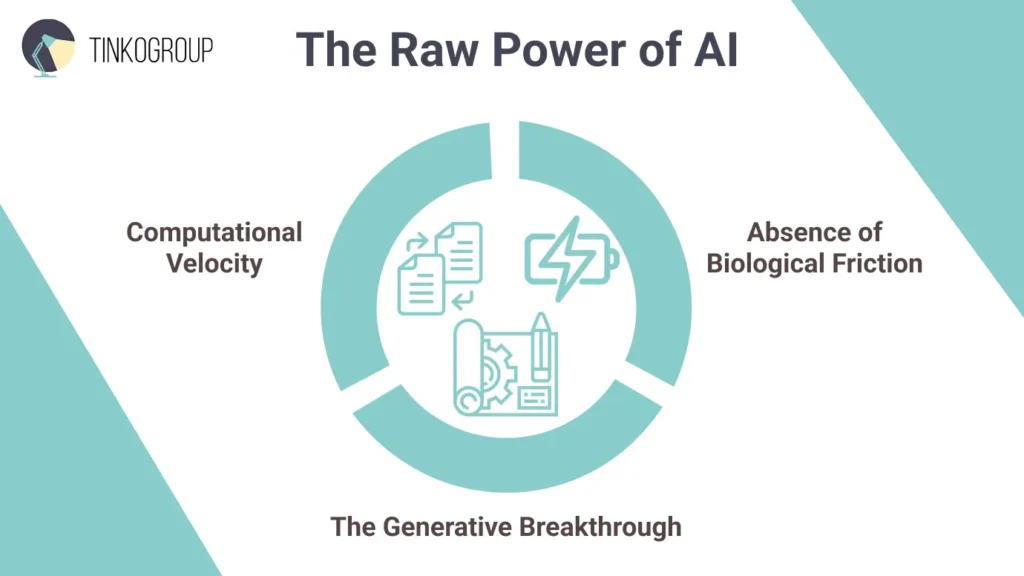
1. Computational Velocity and the “Big Data” Sovereignty
The human brain is an incredible parallel processor, yet it suffers from a fundamental “input-output bottleneck.” We can only read at a certain speed, process one complex thought at a time, and our short-term memory is notoriously limited.
In contrast, modern AI systems, fueled by hyper-scale GPU clusters and specialized AI chips (NPUs), have achieved what we call “Data Sovereignty.” They can ingest, tokenize, and synthesize the entire written history of humanity—from ancient philosophy to this morning’s global financial reports—in a matter of weeks. For a business like Tinkogroup, this shifts the paradigm of strategy:
- Predictive SEO & Hyper-Analytics: Instead of reacting to search trends, AI scans millions of multidimensional queries to define a proactive SEO strategy in seconds, anticipating shifts in consumer intent before the users themselves are even aware of them.
- Micro-Fluctuation Analysis: In global finance, AI analyzes microscopic market fluctuations and “dark pool” data to predict crashes or surges with a degree of accuracy that makes traditional human brokerage look like guesswork.
- Cognitive Offloading: By automating the “monotone” administrative tasks—such as data entry, complex scheduling, and initial technical drafting—AI restores thousands of hours to human creators, allowing them to focus on high-level innovation rather than digital maintenance.
2. The Absence of Biological Friction and Decision Fatigue
The most profound limitation of the human brain is its biological overhead. We are high-maintenance machines. We require REM sleep to prevent cognitive decline, a constant supply of glucose to power our neurons, and a stable emotional environment to remain productive. Whether it is Model Training or security monitoring, the system provides the exact same level of analytical precision at 4:00 AM as it does at noon.
Artificial Intelligence is entirely free from this “biological friction.” It does not suffer from Decision Fatigue— the phenomenon where the quality of human choices deteriorates after a long series of decisions.
- Constant Precision: An AI diagnostic tool or a security monitoring system provides the exact same level of surgical, analytical precision at 4:00 AM on a Monday as it does at noon on a Friday.
- Reliability in Crisis: In high-stakes environments, such as medical data analysis or cybersecurity, this 24/7 unwavering reliability is not just a convenience—it is a life-saving necessity. While a human operator might miss a single suspicious packet of data due to a momentary lapse in concentration, the machine never blinks.
3. The Generative Breakthrough: Scaling the “Final Fortress”
For decades, we consoled ourselves with the idea that creativity was the “final fortress” of humanity—a sanctum that no algorithm could ever enter. The emergence of Generative AI has dismantled that myth.
Today, AI doesn’t just “copy”; it synthesizes and iterates. It generates high-fidelity architectural blueprints, writes sophisticated multi-layered code, and designs visual identities that resonate with human psychology.
Rapid Prototyping: What used to take months of sketching and revision—whether it’s a new website UI or a complex marketing funnel—can now be prototyped in minutes, allowing for a level of experimentation and “fail-fast” innovation that was previously cost-prohibitive.
Round 2: The Biological Masterpiece – Why the Human Brain is Unbeatable
Despite the staggering rise of Artificial Intelligence and models boasting trillions of parameters, the human brain remains the most efficient, resilient, and mysterious “computer” in the known universe. While silicon excels at calculation, our “wetware”—the biological material of the mind—possesses qualities that the world’s most advanced laboratories are still decades away from replicating.
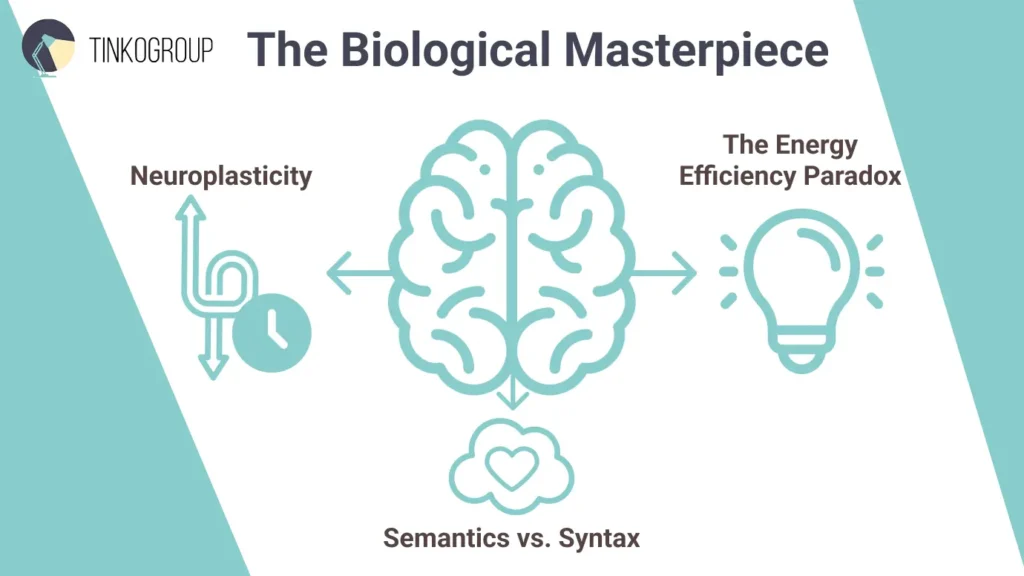
1. The Energy Efficiency Paradox: 20 Watts vs. Megawatts
The most striking disparity between Artificial Intelligence and human biology lies in power consumption. To sustain a high-level LLM (Large Language Model), technology giants must build massive data centers that consume megawatts of electricity—enough to power a small metropolitan city—while requiring millions of gallons of water for liquid cooling systems to prevent hardware meltdown.
In contrast, the human brain performs world-class creative, logical, and motor tasks on a mere 20 watts of power—roughly the energy required to run a dim hallway light bulb.
- The ATP Miracle: Our neurons operate through complex electrochemical exchanges (ATP hydrolysis) that are billions of times more efficient than the heat-generating electron flow in a silicon chip.
- Sustainable Intelligence: At Tinkogroup, we recognize that the future of technology must move toward this “Low-Power, High-Impact” model. The human brain is the ultimate proof that supreme intelligence does not require a massive carbon footprint; it requires elegant, optimized architecture.
2. Neuroplasticity: The Art of Instant Adaptation
In the world of Artificial Intelligence, a model is largely “static” once its training phase is complete. To learn a new fundamental concept, the model often requires a costly retraining cycle or fine-tuning on massive new datasets. Its “weights” are essentially frozen in time.
The human brain, however, is a masterpiece of Neuroplasticity.
- Real-Time Rewiring: Our synaptic connections physically strengthen or weaken in real-time based on a single experience. This allows a human to learn a new language, adapt to a personal loss, or pivot a business model in the wake of a global crisis without needing a “system reboot.”
- Navigating the “Black Swan”: AI thrives on historical data. If an event has no precedent—a “Black Swan” event—AI often fails because it has no patterns to fall back on. Humans excel in these moments of total uncertainty. We use intuition, cross-domain analogy, and creative improvisation to solve problems that have never existed before.

Reliable Data Services Delivered By Experts
We help you scale faster by doing the data work right - the first time

3. Semantics vs. Syntax: The Depth of Meaning
This is the fundamental divide in cognitive science. Artificial Intelligence is a master of syntax—it excels at recognizing the mathematical structure, grammatical rules, and statistical probability of information. This is why tools like a Computer Vision Annotation Tool is so effective at organizing data, but they lack the visceral understanding of human semantics.
- The Feeling Behind the Data: An AI can analyze 10,000 poems about love and generate a technically perfect sonnet, but it has never felt the sting of heartbreak or the warmth of a sunset.
- Human Semantics: Humans own semantics—the actual meaning, emotional weight, and visceral feeling behind the information. In the world of marketing and leadership, this is the “Secret Sauce.”
- Resonance and Inspiration: A marketing campaign designed by a human at Tinkogroup resonates because it taps into shared human experiences. A leader inspires a team because they communicate through a lens of shared values and empathy. AI provides the “what,” but only the human brain can truly provide the “why.”
Round 3: 2026 and the Future of Labor – From Displacement to Augmentation
The prediction that automation would displace nearly half of human work activity by 2055 has shifted from a distant “what-if” scenario to a tangible, ongoing transition. However, as we cross into 2026, the narrative of “job destruction” is being replaced by a much more nuanced reality: The Great Re-skilling.
History has shown that technology does not simply erase roles; it transforms the very nature of value. While Artificial Intelligence can execute tasks, it cannot own responsibility. This distinction is where the future of human labor lies.
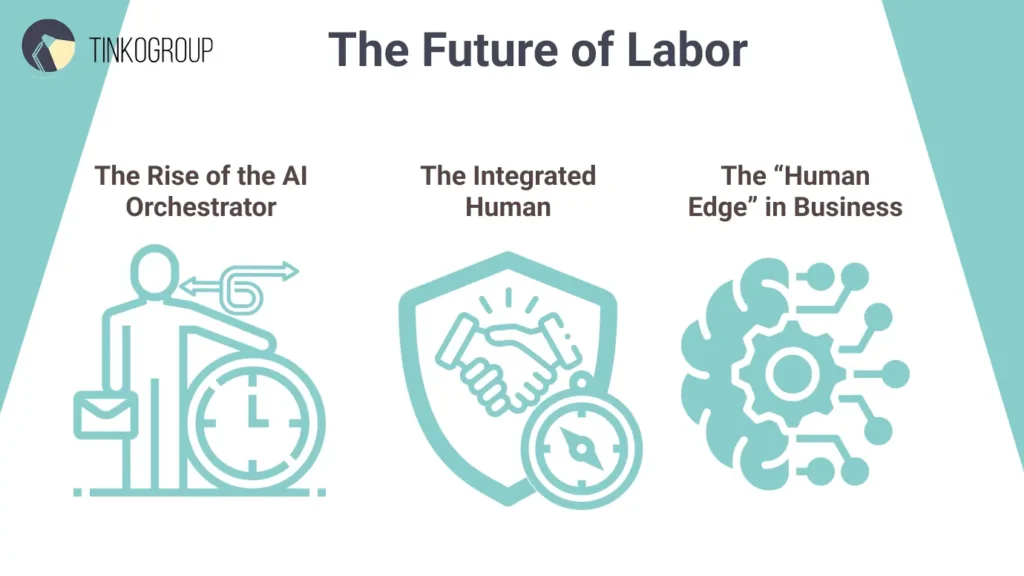
1. The Rise of the AI Orchestrator: Unskilled vs. Strategic Labor
In the previous decade, “data entry” and “basic copywriting” were entry-level stepping stones. Today, these tasks are almost entirely consumed by autonomous agents. But this has created a skyrocketing demand for a new professional class: The AI Orchestrator.
- Beyond the Operator: A traditional “operator” follows a manual. An AI Orchestrator designs the system where multiple AI agents work in harmony to achieve a high-level business goal.
- The New Skill Stack: At Tinkogroup, we see this shift firsthand. Value is no longer found in the ability to do the work, but in the ability to direct the work. This requires a hybrid expertise: a deep understanding of AI capabilities combined with high-level technical project management and process engineering.
- Value Capture: Organizations that master this orchestration by mid-2026 are projected to capture 2–3x more value than those still using AI as a simple “search and replace” tool.
2. The “Human Edge” in Business: Ethics, Intuition, and Social Negotiation
As AI floods the market with “competent-but-generic” output, the premium on uniquely human capabilities has never been higher. There are three “Fortresses of Humanity” where silicon remains fundamentally inadequate:
- Ethical Judgment: AI can process rules, but it cannot navigate moral ambiguity. Deciding how to handle a data breach or ensuring a brand’s identity remains culturally sensitive requires a moral compass that algorithms lack.
- Deep Intuition & The “Gut Feeling”: High-stakes decisions—such as whether to trust a new partner or how to pivot a brand’s soul during a PR crisis—rely on Passive Knowledge. This is the sum of a lifetime of human experiences, emotions, and subtle cues that cannot be tokenized or fed into a neural network.
- Complex Social Negotiation: AI can draft a contract, but it cannot “read the room.” It cannot empathize with a client’s unspoken fears or use a joke to break the tension in a boardroom. Leadership, at its core, is a social contract built on trust, and trust is a biological currency.
Verdict: The Era of the Augmented Human
We find ourselves in a fascinating Phenomenon. Why is it that as our machines become more “intelligent,” we often take for granted the unbelievable capacity of the brain that created them?
Every line of code, every sophisticated neural network, and every “wow” trend in the world of technology is a consequence of human ingenuity. Artificial Intelligence is not our replacement; it is our mirror. It reflects our desire to transcend our own limits and solve the unsolvable.
Final Conclusion: Everything Depends on You
In this fight between the silicon chip and the human neuron, the winner is not a specific entity. The winner is the Integrated Human—the individual who trains their brain like a muscle and treats technology like an exoskeleton.
At Tinkogroup, we believe the future belongs to those who stay human while mastering the machine. Leave the competition far behind by doubling down on your empathy, your ethics, and your creative vision. The machine provides the power, but you provide the purpose. Unlock the full potential of your digital presence by partnering with experts who understand the synergy of intelligence. Check out our Services here.
What are the primary differences between human skills and machine capabilities?
Human skills and machine capabilities differ fundamentally. Humans excel in creativity, emotional intelligence, adaptability, and fine motor skills. Machines handle pattern recognition and data analysis but lack intrinsic creativity, genuine emotional understanding, and ethical reasoning.
How do machines and AI impact the job market and employment rates?
Machines and AI impact the job market by displacing repetitive jobs in areas like manufacturing and data entry and creating opportunities in AI development, data analysis, and robotics. Many jobs transform, requiring new skills. This can increase economic growth but may widen economic inequality.
What human skills are most resistant to automation and why?
Specific human skills resist automation because they rely on human intuition and interaction. Creative and critical thinking, emotional intelligence, and judgment are hard for machines to replicate. Interpersonal skills in jobs like sales and HR also remain challenging for automation.
What are the potential benefits of combining human skills with machine capabilities?
Machines handle repetitive tasks, allowing humans to focus on complex, creative work, enhancing efficiency. AI provides data-driven insights for better decisions. Technologies like AR/VR augment human abilities, leading to improved outcomes, increased productivity, and new opportunities.