

Digital systems have captured the world, but it is worth remembering how far we have come. How did people cope with communication difficulties centuries ago? The earliest mail carriers worked on foot, using animals, carriages, and even dogsleds. Later, steamships, trains, and trucks speeded up the delivery.
Nowadays, if you send a letter from New York to San Francisco, the recipient gets it in seconds; in 1850, people had to wait for 6 weeks. This leap in efficiency is exactly why businesses now prioritize digital speed, often utilizing data entry services to keep their records moving as fast as their communication.
The first step in e-communication was done in 1971 with a simple “QWERTYUIOP” message. Today, every user has a unique identity, often tied to a specific data annotation job. While we call the “@” sign “at” in a business context, cultures worldwide have gotten creative, calling it the “monkey’s tail,” “sleeping cat,” or “little worm.” Regardless of the nickname, this symbol is the gateway to your most valuable marketing tool: the email list.
Strategic Benefits of Email Communication for Modern Business
For a pragmatic organization, a high-quality email list is not just a communication tool; it is a high-yield strategic asset that offers unparalleled advantages in a competitive market. When managed correctly, it serves as the foundation for long-term customer retention and operational clarity. In an era where social media algorithms can hide your content from your own followers, email remains the only direct, unfiltered channel you truly own.
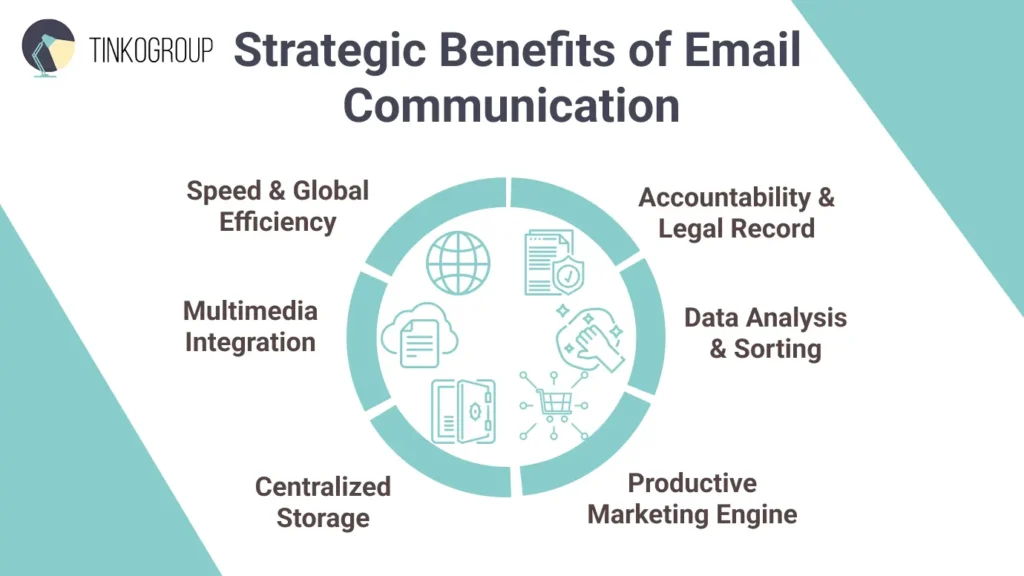
- Unmatched Speed & Global Efficiency: People can exchange online messages in seconds. It does not matter whether you are in the neighboring building or on another continent. This instant connectivity eliminates the “waiting periods” that used to stall international trade, allowing for real-time collaboration. This speed is a cornerstone of modern data entry services, where rapid communication ensures that information is processed and updated without delay.
- Rich Attachments & Multimedia Integration: This is a big bonus as you may attach text, audio, and video files. Unlike paper correspondence, digital mail allows you to share complex data instantly. When companies deal with high-volume media projects, they often rely on specialized audio annotation tools to categorize and manage these files effectively before sharing them with stakeholders or training models.
- Centralized Information Storage: All you need is in your email box — schedules, files, and discussions. Your inbox acts as your personal information storage, ensuring that vital details are always close at hand and searchable. This accessibility is crucial when building a scalable annotation pipeline, as it allows project managers to track every iteration of a project’s history.
- Accountability & Legal Record: There is no need to write the information you get on paper. If there is a dispute, everything is fixed in a written form, serving as immutable evidence. This paperless trail ensures a high level of data annotation quality by maintaining a clear, timestamped history of all professional instructions and quality assurance feedback.
- The Power of Data Analysis: It is easy to sort and organize the space in your email box, allowing you to save time and focus on growth. By applying high-level NLP data labeling principles to how you categorize customer feedback or inquiries within your CRM, you can transform a chaotic inbox into a goldmine of business intelligence.
- The Engine of Productive Marketing: An owned email list remains the most cost-effective and efficient business tool for direct marketing. It is a fast, reliable, and flexible tool to touch your audience, educate them about your products, and encourage sales. Because you control the data, you can segment your audience and send personalized updates that resonate far more than a generic social media post.
By leveraging these benefits, a business moves from being a passive participant in the digital economy to a “tycoon” of its own information. Email provides a structured environment where confirmations, updates, and newsletters create a consistent loop of engagement with your audience.
However, even the best email strategy depends on the quality of the data behind it. Building and maintaining a verified contact database helps businesses reduce bounce rates, improve deliverability, and ensure their messages reach real decision-makers.
We help you scale faster by doing the data work right - the first
time

Reliable Data Services Delivered By Experts

Facts About Email Addiction: The High Cost of Being “Always On”
The email system has evolved into a force so ubiquitous that it is often difficult to distinguish between professional pragmatism and clinical addiction. While having a high-quality email list is the ultimate goal of every marketing department, the psychological toll on the individual user is becoming increasingly evident. We have moved past simple communication into an era of deep, almost obsessive involvement with our digital devices. This “always-on” culture creates a cycle of productive procrastination, where we feel busy because we are answering emails, yet we aren’t necessarily moving the needle on our most important projects.
Consider the staggering scale of our global email dependency and the facts that prove we might be losing control:
- A World Overflowing with Digital Personas: Currently, there are over 4.6 billion email accounts worldwide, serving a population of roughly 2.7 billion users. This means the average professional is juggling multiple digital identities—personal, work, junk, and project-specific. Managing this sheer volume of incoming information requires sophisticated NLP data labeling strategies just to keep folders organized, searchable, and relevant. Without a systematic approach to sort the “noise” from the “signals,” the modern inbox becomes a source of constant “information overload” rather than a tool for success.
- The Erosion of Private Boundaries: Our addiction isn’t limited to the office cubicle or the home office; it has invaded our most private, intimate moments. Research indicates that 70% of us check our email while watching TV, 62% do so while still in bed (often before even saying “good morning”), and a surprising 45% admit to checking messages in the bathroom. This behavior reflects a psychological need for constant stimulation and a fear of missing out (FOMO). Even more concerning is that 18% of people check their inbox while driving, highlighting a level of compulsion where the digital world takes precedence over immediate physical safety.
- The Invisible Labor and Economic Cost: Employees now spend an average of 13 office hours per week just managing their email correspondence. When you calculate this over a year, it amounts to months of potential productivity swallowed by the inbox. This massive investment of time is exactly why modern companies are looking for ways to scale data annotation and automate repetitive administrative tasks. By outsourcing the granular data work, brands can reclaim those lost hours, allowing their core teams to shift away from the “inbox grind” and toward higher-level strategic work and creative problem-solving.
- Historical and Cultural Integration: The influence of email is so profound that it has altered the very fabric of how we record history. In 2004, the “@” symbol was officially added to the Morse Code, the first change to the code in decades, to accommodate the digital era. Furthermore, Pope John Paul II became the first Vatican Pope to actively communicate via electronic mail, signaling that even the world’s most traditional institutions have had to adapt to this digital addiction to stay relevant in a connected world.
- The Marketing Opportunity in the Addiction: If this list describes your daily routine, you are likely part of the “addicted” demographic. However, from a business perspective, this constant connectivity is a golden opportunity. Because people are perpetually tethered to their devices, a well-curated email list acts as a reliable, direct line to your audience. It allows you to touch base, educate your customers, and encourage sales at almost any moment of the day. The challenge for the modern business owner is to remain pragmatic—leveraging text classification to understand customer needs while ensuring they don’t become a slave to the “ping” of every new notification.
Why Your Brand Needs a High-Quality Email List to Scale
In the volatile world of digital marketing, where social media algorithms change overnight and advertising costs continue to skyrocket, one asset remains king: the email list. For a brand looking to move beyond survival and into a phase of aggressive scaling, the quality and structure of this list are far more important than the quantity of followers on a third-party platform. Your email database is the only audience you truly own, providing a direct, unfiltered line to your customers’ most personal digital space—their inbox.
To truly understand why a high-quality email list is essential for scaling, we must look at how it functions as a strategic business engine:
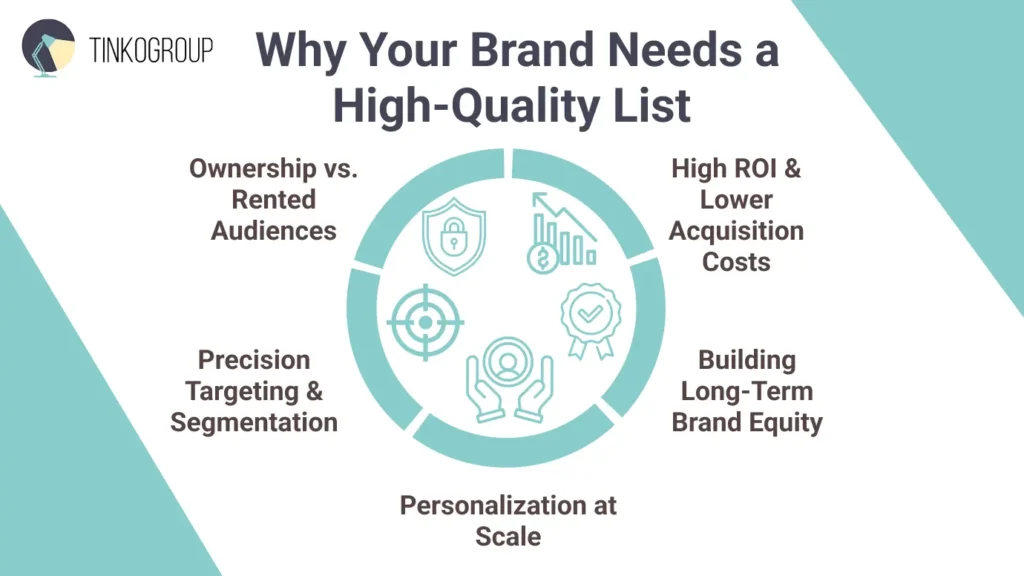
- Ownership in an Era of “Borrowed” Audiences: When you build a following on Instagram, LinkedIn, or TikTok, you are essentially “renting” your audience. If those platforms change their rules or limit your reach, your business can vanish overnight. An email list, however, is a permanent digital asset. By ensuring your list is built on a foundation of correct annotations and verified customer data, you create a stable environment that is immune to the whims of Big Tech.
- Precision Targeting and Segmentation: Scaling isn’t just about reaching more people; it’s about reaching the right people with the right message. A sophisticated list allows you to use text classification to segment your audience based on their behaviors, preferences, and past purchases. Instead of a “spray and pray” approach, you can send personalized updates, newsletters, and special deals that speak directly to the customer’s needs, significantly increasing your conversion rates.
- The Power of Personalization Through Data: Modern customers expect a tailored experience. To achieve this at scale, your brand needs to move beyond generic blasts. By integrating your list with a scalable annotation pipeline, you can analyze customer sentiment and feedback to refine your offers. A well-organized email list acts as a feedback loop: it allows you to educate people about your brand, confirm their interests, and use those insights to encourage future sales.
- High ROI and Lower Acquisition Costs: It is much cheaper to sell to an existing subscriber than to acquire a new customer through paid ads. A curated email list is a fast, reliable, and flexible tool that offers one of the highest returns on investment in the marketing world. When your data is handled with the same care as NLP labeling tools—clean, categorized, and up-to-date—every “touch” with your audience becomes more profitable.
- Building Long-Term Brand Equity: Email is a reminder to come back to your brand. Consistent, high-quality communication turns one-time buyers into lifelong advocates. By ensuring your dataset quality is high and your contact information is accurate, you avoid the “spam” trap and build a reputation for reliability and value.
Scaling a brand requires more than just a great product; it requires a robust system for maintaining customer relationships. A professional email list provides that system. It turns your audience into a predictable source of revenue, allowing you to plan your growth with confidence rather than crossing your fingers and hoping for a viral post.
Reliable Data Services: How Tinkogroup Optimizes Your Communication
At Tinkogroup, we don’t just process numbers; we build the architectural framework that allows your business to communicate with surgical precision. We understand that behind every high-converting email list is a massive amount of technical labor that must be executed perfectly. In an age where a single data error can land your marketing campaign in the spam folder—or worse, result in a compliance violation—our expert team handles the complexities of information management so you can scale faster and with total peace of mind.
To transform your communication from a source of “digital noise” into a high-octane business engine, we provide a suite of specialized data services designed for the modern enterprise:
- Data Integrity and List Verification: The success of your outreach depends entirely on the cleanliness of your database. We specialize in removing “data rot”—duplicates, inactive addresses, and improperly formatted entries that skew your analytics. By ensuring your data annotation quality is top-tier from the start, we protect your sender reputation and ensure that your messages actually reach the people intended to see them.
- Scalable Infrastructure for Growing Brands: As your company expands, so does the complexity of your information flow. Managing a few hundred emails is simple; managing hundreds of thousands requires a scalable annotation pipeline. We help you design and maintain these systems, ensuring that as your volume grows, your accuracy remains at 100%. This is particularly vital for companies moving into AI-driven personalization, where every customer interaction must be accurately logged and categorized.
- E-commerce Integration and Management: For brands running on global platforms, data consistency is non-negotiable. Our team excels in consistent Shopify product upload and management, ensuring that the information in your store perfectly matches the offers in your email newsletters. Whether you are debating manual vs. automated Shopify data entry, we provide the human-in-the-loop expertise necessary to catch the nuances that automated scrapers often miss.
- Compliance, Privacy, and Trust: In today’s legal landscape, how you handle personal information is a matter of survival. We are a GDPR-compliant data company (and CCPA-compliant), meaning we prioritize data privacy in AI annotation and all forms of list management. We implement rigorous security protocols to ensure that your customers’ sensitive information is handled with the highest level of confidentiality, fostering trust between your brand and your audience.
- Specialized Content Categorization: Beyond basic addresses, we help you understand the content of your communication. By utilizing advanced NLP labeling tools and named entity recognition, we can help you tag and categorize customer feedback, support tickets, and inquiries. This allows you to turn a chaotic inbox into a structured dataset that informs your future product development and marketing strategies.
Don’t let your growth be hindered by disorganized information. Whether you are building an AI model or a global marketing empire, the weight of every keystroke matters. We help you scale faster by doing the data work right—the first time. Entrust your growth to the professionals and start building a high-performance email list with Tinkogroup today — we handle the complexity of the data so you can focus on the results.
What defines email pragmatism versus email addiction?
Email pragmatism involves using email as a practical tool for efficiently checking and responding to emails to achieve specific goals. Email addiction is compulsive behavior driven by an overwhelming need to constantly check and respond to emails, often disrupting work-life balance and productivity.
What strategies can help individuals maintain a healthy balance with email usage?
Maintaining a healthy email balance involves setting specific check times, prioritizing urgent emails, using management tools for efficiency, and setting boundaries like disabling notifications after work hours. Direct communication for urgent matters reduces reliance on constant email checking.
How can email pragmatism enhance communication efficiency in business?
Email pragmatism enhances communication efficiency by focusing on clear, concise messaging tailored to specific purposes. It promotes effective use of subject lines, prioritization of content, and straightforward language to convey information efficiently.
What role does technology play in fostering email addiction?
Technology fosters email addiction with constant accessibility, notifications prompting immediate responses, and mobile apps blurring work-life boundaries. Automated emails and subscriptions add to the overload. Recognizing these factors enables strategies for healthier digital habits.