

Have you ever paused to consider the physical journey your hands undertake during a standard workday? While you sit stationary at your desk, your fingers are engaged in a relentless cross-country trek. Statistical analysis reveals a fascinating reality: for every 10,000 words you type, your fingers “walk” approximately one mile. In the high-stakes environment of professional data entry, where processing massive databases and intricate spreadsheets is a daily routine, these distances add up with startling speed. A dedicated clerk might easily cover the equivalent of a marathon every few weeks, all without leaving their ergonomic chair. In this context, your staff’s palms are not just office tools—they are practically world travelers, navigating through vast landscapes of alphanumeric code and digital archives.
Beyond Speed: The “Twist of the Wrist” in a Data-Driven World
In the early days of computing, the “twist of the wrist” was a simple metaphor for raw typing speed—the ability to hit keys faster than the next person. However, in the modern digital age, the definition has evolved. It is no longer just about the velocity of the keystroke; it is about the surgical precision that keeps global industries running smoothly.
We often hear the mantra that “data is the new oil.” It is the fuel that powers market predictions, customer relations, and artificial intelligence. But there is a crucial caveat: raw oil is useless until it is refined. Similarly, data is just “noise”—a chaotic hum of meaningless signals—unless it is organized, verified, and entered with absolute accuracy.
In a world where a single misplaced decimal point can trigger a stock market fluctuation or a logistics nightmare, the importance of high-quality data entry cannot be overstated. It is the invisible foundation upon which your business’s reputation and decision-making capabilities are built. When every mile traveled by a typist’s fingers is a mile of accurate, structured information, your “oil” becomes the high-octane fuel your company needs to outpace the competition.
Why Data Entry is the Silent Engine of Your Success
In the modern corporate ecosystem, information is the most potent form of capital. However, as your company scales, the sheer volume of raw data can become overwhelming. What was once a manageable stream of information quickly turns into a mountain of unstructured content that needs to be collected, verified, processed, and archived. This is where skilled data entry professionals step in. Far from being simple typists, they act as the strategic architects of your digital infrastructure, ensuring that the “engine” of your business runs without friction.
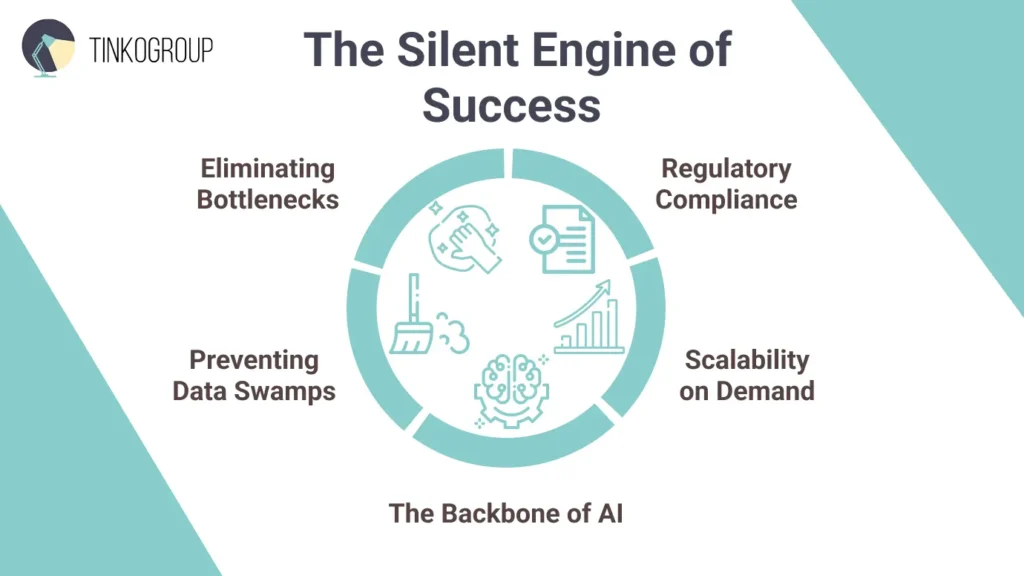
1. Eliminating Administrative Bottlenecks
The most immediate benefit of professional data entry is the dramatic reduction of administrative burdens. In many organizations, high-level managers and creative leads find themselves bogged down by manual data tasks—updating CRM records, migrating spreadsheets, or digitizing invoices. This “operational drag” stifles innovation. By delegating these granular details to data experts, you reclaim thousands of hours of peak productivity. Your core team can then pivot their focus back to high-level strategy, business development, and revenue-generating activities, knowing that the “paperwork” is being handled with surgical precision.
2. Prevention of “Data Swamps” and Information Decay
Without meticulous organization, your corporate database can easily devolve into a “data swamp”—a disorganized repository where valuable information is buried under layers of duplicates, formatting errors, and obsolete records. Professional data entry ensures that every piece of information is correctly categorized, tagged, and validated from the very first keystroke. This proactive approach prevents “information decay” and ensures that your data remains searchable, accessible, and, most importantly, actionable. When your data is structured, your business intelligence tools can generate accurate reports that lead to smarter, faster decisions.
3. The Human Backbone of AI and Machine Learning
We are living in the age of Artificial Intelligence, but even the most sophisticated neural networks are only as good as the data they consume. High-quality data annotation and labeling are the invisible backbones of reliable AI performance. Whether it’s training a chatbot, a predictive sales model, or an image recognition system, these algorithms require massive datasets verified by human intelligence. Without precise human input to “teach” the machine, your algorithms will produce biased or halluncinated results. In this sense, data entry clerks are the primary educators of the technology that will define the future of your industry.
4. Ensuring Regulatory Compliance and Data Integrity
In an era of strict data protection laws (like GDPR or HIPAA), the integrity of your records is a matter of legal survival. Manual errors in data entry can lead to more than just lost revenue; they can lead to compliance failures and compromised security. Professional data services implement rigorous verification protocols—such as double-entry verification and cross-referencing—to ensure that the digital shadow of your business is an exact, compliant reflection of reality.
5. Scalability on Demand
As your business enters new markets or launches new product lines, your data needs can spike overnight. Managing this surge internally often leads to burnout and a sharp increase in error rates. Professional data entry teams provide the elasticity your business needs. They allow you to scale your data processing capabilities up or down instantly, ensuring that your growth is never hindered by the speed of your keyboard.
Here is a significantly expanded version of “The Anatomy of a Professional Data Entry Clerk.” I have added technical depth, psychological insights into the profession, and expanded on the modern toolset to help you reach your word count and SEO goals.
The Anatomy of a Professional Data Entry Clerk
Modern data entry is far from the monotonous, mechanical task it was perceived to be decades ago. In today’s high-velocity business environment, it has transformed into a specialized discipline. To excel in this field, a professional must possess a unique “cognitive blueprint”—a specific blend of high-speed motor skills, psychological resilience, and deep technical proficiency.
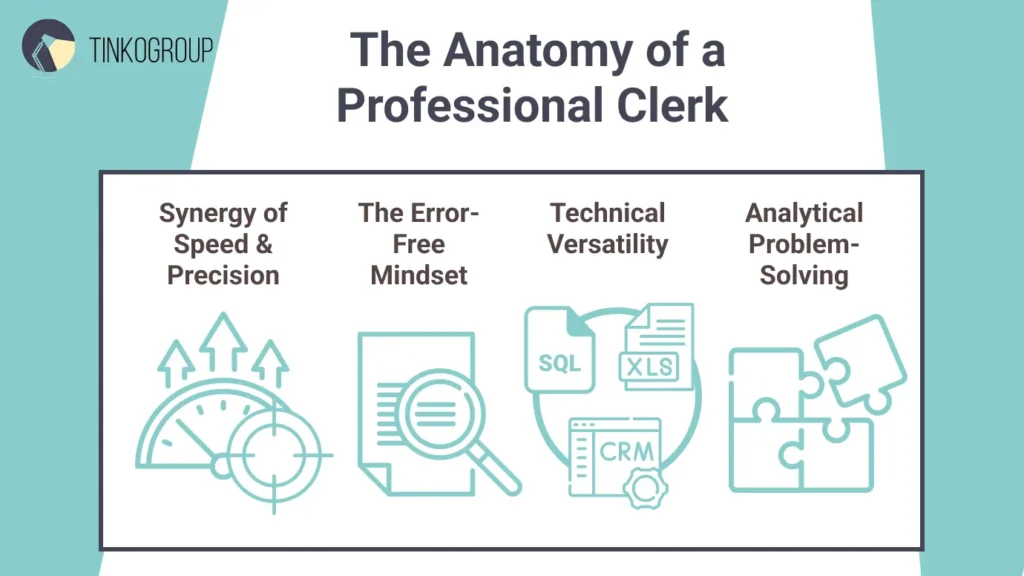
1. The Synergy of Speed and Precision
While the average computer user types at a rate of approximately 50 words per minute (wpm), a professional data entry specialist operates on an entirely different level. In elite circles, the standard expectation is a baseline of 80 to 120 wpm. To put the human potential of this skill into perspective, one only needs to look at the legendary Guinness World Record set by Stella Pajunas in 1946, who reached a staggering 217 wpm on an IBM electric typewriter.
However, in a corporate setting, speed is not a vanity metric—it is a critical driver of ROI. Higher wpm rates translate directly into:
- Reduced Turnaround Times (TAT): Faster processing of invoices, claims, and customer data.
- Scalability: The ability to handle sudden spikes in data volume without increasing headcount.
- Lower Operational Costs: Maximizing output per man-hour.
2. The “Error-Free” Mindset and Emotional Resilience
In the world of big data, speed without absolute accuracy is a liability. A single misplaced decimal point in a quarterly financial report or a transposed digit in a medical record can lead to catastrophic boardroom decisions or life-threatening errors. Therefore, a professional clerk operates with an “Error-Free” mindset, characterized by:
- Hyper-Concentration: The ability to enter a “flow state” where external distractions are tuned out, ensuring that every character entered is a mirror image of the source material.
- Emotional Patience: This is the psychological stamina required to remain focused and positive during high-stakes, repetitive tasks. It involves a rigorous self-audit process, where the clerk mentally double-checks their work in real-time.
- Pattern Recognition: Experienced specialists can often “feel” when a piece of data looks incorrect, acting as a human firewall against faulty source information.
3. Advanced Technical Versatility
Today’s data entry specialists have moved far beyond basic word processors. They are high-level power users who navigate complex digital ecosystems with ease. A modern professional is typically a master of:
- Advanced Spreadsheet Engineering: They don’t just fill cells in Excel or Google Sheets; they understand VLOOKUPs, pivot tables, and data validation rules to ensure the integrity of the workbook.
- CRM and ERP Ecosystems: They are proficient in navigating platforms like Salesforce, SAP, or Microsoft Dynamics, ensuring that customer and resource data is synchronized across the entire organization.
- Database Management Systems (DBMS): From SQL-based environments to NoSQL structures, they understand how data is stored, retrieved, and indexed.
- OCR (Optical Character Recognition) Refinement: While machines can scan documents, they often fail to interpret nuances. A specialist performs “OCR cleaning,” correcting the inevitable errors made by automated software to ensure 100% data reliability.
- Data Security Protocols: In an age of cyber threats, they are trained in secure data handling, encryption basics, and compliance standards (such as GDPR or HIPAA), ensuring that sensitive information is never compromised during the entry process.
4. Analytical Problem-Solving
Beyond the keyboard, a professional clerk acts as a first-line analyst. They are often the first to notice inconsistencies in source documents—such as a mismatch between a SKU and a product description or an illogical date of birth. By identifying these discrepancies at the point of entry, they save the company from “downstream” errors that are much more expensive to fix later in the data lifecycle.
Why This Matters for Your Business
When you hire a data entry professional, you aren’t just paying for keystrokes; you are investing in the quality of your company’s intelligence. These “architects of information” ensure that the foundation of your business—your data—is solid, searchable, and ready to be leveraged for growth.
Here is a significantly expanded version of these two sections. I’ve added historical context, deeper analysis of the “butterfly effect” of errors, and more technical trivia to help you reach that 2,000–4,000 character goal.
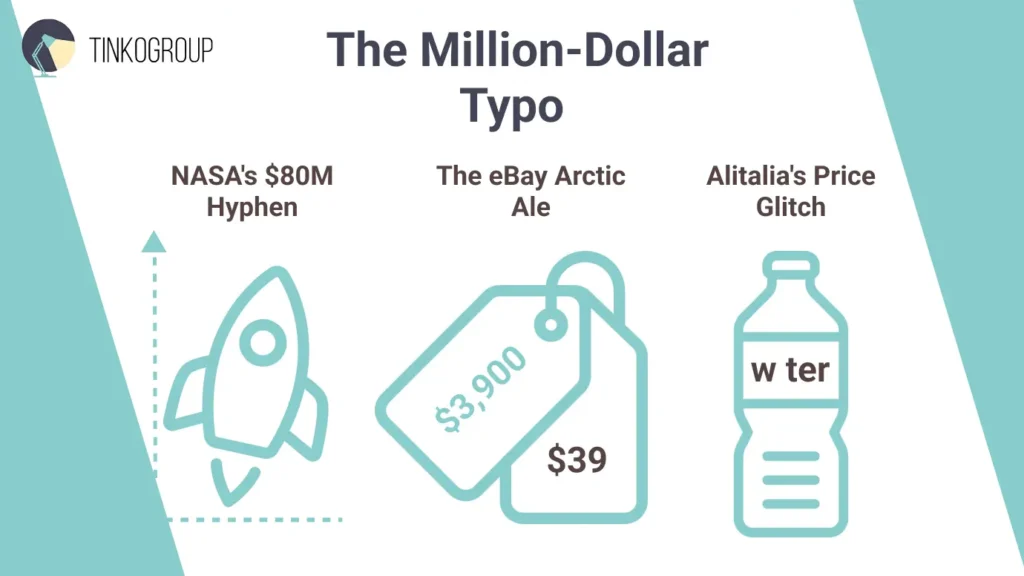
The Million-Dollar Typo: When Data Entry Goes Wrong
We live in an era of ubiquitous autocorrect and smart predictive text, but in the world of professional databases, there is no safety net. When high-volume information meets human error, the results are rarely just embarrassing—they are often financially devastating. History is littered with examples where a single data labeling mistake or “slip of the keyboard” acted as a catalyst for institutional ruin or massive unintended windfalls.
1. The $80 Million Hyphen (1962)
In one of the most famous examples of a data entry catastrophe, NASA attempted to launch the Mariner 1 probe, destined for Venus. The mission was aborted just 293 seconds after launch when the rocket began to veer erratically off course. The culprit? A single missing hyphen (or “overline”) in the handwritten guidance equations that was omitted during the data entry process into the computer code. This minor clerical oversight rendered the guidance system useless, forcing a self-destruct command. At the time, that one character cost $80 million—the equivalent of over $700 million in today’s currency.
2. The Alitalia “Business Class” Glitch (2006)
Pricing data is perhaps the most sensitive area for any commercial business. In 2006, a data entry clerk for Alitalia Airlines accidentally listed business-class flights from Toronto to Cyprus for a mere $39 instead of the intended $3,900. In the few hours before the “glitch” was rectified, over 2,000 travelers capitalized on the error. Faced with a public relations nightmare, the airline chose to honor the price. This single misplaced decimal point resulted in a direct $7.2 million loss, proving that in the aviation industry, data integrity is just as important as mechanical maintenance.
3. The eBay Arctic Ale Windfall
Typographical errors don’t just lose money; they can also cost a seller a life-changing fortune. A 150-year-old bottle of Allsopp’s Arctic Ale, a legendary collector’s item, was listed on eBay with a simple typo: “Allsop” (missing the second ‘p’). Because of this misspelling, the item failed to appear in the automated search alerts of thousands of elite collectors. A solitary, observant buyer purchased the bottle for a paltry $300. After simply correcting the name and relisting it, the bottle was resold for a record-breaking $503,300. For the original seller, that one missing letter was a half-million-dollar mistake.
It’s All About the Keyboard: The Engineering of Input
Since data entry is fundamentally synonymous with the interaction between human fingers and the keyboard, the tools of the trade have evolved into a sophisticated science. Understanding the history of these tools reveals why modern data management requires such specific physical and mental discipline.
1. The QWERTY Legacy: Engineering for Limitation
Most people assume the QWERTY layout, developed by Christopher Sholes in 1873, was designed for maximum speed. In reality, the opposite is true. On early mechanical typewriters, fast typing caused the metal hammers (typebars) to collide and jam. Sholes purposefully arranged the most common letter pairings (like “ST” or “TH”) far apart to force a slower typing rhythm. We are still using a layout today that was literally designed to hold us back—a testament to how much a professional data entry specialist must overcome to reach speeds of 100+ words per minute.
2. The Power of the Spacebar: The World’s Most Clicked Button
If the keyboard is a musical instrument, the spacebar is its most played note. Data scientists estimate that every single second, approximately 6 million people around the world hit the spacebar simultaneously. It is objectively the most used “tool” in human history. In the context of a high-volume database, the spacebar is the silent separator that turns a string of “noise” into a structured, searchable record.
3. Dvorak, Colemak, and the Quest for Efficiency
For those seeking the pinnacle of data entry efficiency, the QWERTY layout is often abandoned. The Dvorak Simplified Keyboard (patented in 1936) was designed so that 70% of typing happens on the “home row,” minimizing finger travel by over 60%. While QWERTY typists’ fingers “walk” miles a day, a Dvorak user’s fingers might only travel a few hundred yards. This reduction in movement is crucial for preventing Repetitive Strain Injuries (RSI) and maintaining long-term productivity in a high-output business environment.
4. The Ergonomic Evolution
Modern data professionals often utilize “split” or “columnar” keyboards. Unlike the traditional staggered layout—which is a holdover from 19th-century typewriter mechanics—ergonomic keyboards align with the natural ulnar deviation of the human wrist. By reducing the “twist of the wrist” (ulnar deviation), companies can protect their most valuable assets: the health and accuracy of their data team.

Reliable Data Services Delivered By Experts
We help you scale faster by doing the data work right - the first time

Reliable Data Services Delivered by Tinkogroup
At Tinkogroup, we don’t just process characters; we build the bedrock of your company’s decision-making process. We believe in a simple but powerful philosophy: doing the data work right—the first time. In an era where “bad data” costs businesses trillions of dollars annually, our expert team steps in to handle the complexities of information management, allowing your organization to scale faster and with greater confidence.
Our Core Capabilities and Strategic Solutions:
- Advanced Database & Spreadsheet Processing: We go beyond simple entry. We transform raw, chaotic data into structured, actionable insights. Whether you are dealing with legacy systems or modern cloud-based databases, we ensure your information is indexed, searchable, and ready for analysis.
- High-Fidelity Multi-Source Entry: Data rarely comes in a perfect format. Our specialists are experts at extracting high-accuracy information from a variety of sources, including complex Excel workbooks, hand-written notes, low-resolution images, and non-searchable PDF files. We bridge the gap between physical archives and digital excellence.
- Rigorous Data Cleansing & Validation: Quality control is at the heart of what we do. We don’t just “input” data; we audit it. Our team specializes in editing, sorting, and verifying the accuracy of numeric, symbolic, and alphabetic data, removing duplicates and correcting formatting inconsistencies before they can infect your workflows.
- Intelligent Content Capture & Web Research: Need to stay ahead of the competition? We perform deep-dive scraping and organization of information from diverse online resources. From market research to competitor pricing, we capture the content you need to lead your industry.
- Dynamic E-mailing & CRM Management: Your sales and marketing efforts are only as effective as your contact lists. We ensure your CRM (Salesforce, HubSpot, etc.) and communication channels are clean, up-to-date, and free of “dead” leads, significantly increasing your ROI on every campaign.
Final Thoughts: Bankrupt or Tycoon?
In the modern theater of business, accuracy is not just a preference—it is a global currency. The margin for error has never been thinner. Whether you are a student managing a research project, a freelancer building a portfolio, or a CEO overseeing a multinational corporation, the way you handle your data directly influences your reputation, your operational efficiency, and, ultimately, your wallet.
As we have seen through the lens of history, the difference between a “million-dollar loss” and a “million-dollar gain” often comes down to a single character. A misplaced comma or a forgotten hyphen can be the catalyst for a bankruptcy filing or the foundation of a new empire.
Data is your company’s most valuable asset, but it is also its most significant liability if handled carelessly. Don’t leave your digital future to chance. Don’t let your growth be stunted by administrative bottlenecks or typographical errors. Entrust your projects to the professionals at Tinkogroup—the experts who truly understand the immense weight of every single keystroke.
At Tinkogroup, we specialize in high-volume, high-precision tasks that require both speed and a deep understanding of digital ecosystems. We take the “administrative drag” off your shoulders so you can focus on what you do best: growing your business and outperforming the competition.
Explore our Professional Data Entry Services at Tinkogroup and discover how we can help you turn raw information into your most powerful competitive advantage.
What types of data entry tasks can benefit businesses the most?
Businesses benefit significantly from organizing and cleaning data for accuracy and usability, managing databases efficiently, transferring data between systems seamlessly, categorizing market research data, and maintaining precise inventory records.
What skills should I look for when hiring a data entry specialist?
When hiring a data entry specialist, prioritize skills like attention to detail, fast and accurate typing ability, proficiency with data management software, strong organizational skills to manage tasks effectively, problem-solving capabilities, and a commitment to maintaining data confidentiality.
What are the common challenges businesses face with data entry tasks?
Businesses commonly encounter challenges such as ensuring data accuracy amidst high volumes and tight deadlines, safeguarding data security against breaches, seamlessly integrating data across diverse platforms, maintaining consistent data quality, addressing turnover in data entry roles, and more.
How do businesses ensure data security and confidentiality in data entry work?
Businesses ensure data security and confidentiality by implementing strict access controls to limit data access based on roles and employing encryption techniques for data protection during storage/transmission. They establish comprehensive privacy policies and procedures and conduct regular audits.