


POS tagging in NLP (part-of-speech tagging) assigns a grammatical category, such as noun, verb, adjective, or adverb, to every token in a text. For enterprise AI teams, that label is more than a linguistic detail. It is a structured annotation layer that feeds downstream work such as text classification, information extraction, machine translation, and search. Whether a team trains its tagger or uses POS-tagged data to evaluate and fine-tune larger NLP systems, results depend on one factor above all: the consistency of the underlying annotation. This piece covers how POS tagging in NLP works, the approaches and tools used in production, and where quality and scaling problems arise.
Why POS Tagging Matters for Enterprise NLP
Large pretrained language models learn much of English syntax implicitly, so POS tagging in NLP is no longer the headline step of a modern pipeline. Explicit, human-verified POS labels still matter in three places: training and evaluating domain-specific taggers, feeding features into NLP pipelines, and auditing dataset quality. Enterprise applications, especially in legal, fintech, and medical text, need a level of linguistic precision that basic automated tools do not reliably provide. By choosing professional human-in-the-loop annotation, you gain:
- Elimination of Ambiguity: expert review resolves polysemy that automated tools often miss, for example, “lead” as a noun versus a verb.
- Reduced Training Costs: consistent data typically means faster model convergence and less time spent debugging.
- Industry-Specific Expertise: custom guidelines for legal, fintech, and medical English.
- Competitive Advantage: consistent tags support better chatbot intent handling and sentiment analysis.
Part-of-speech tagging plays a key role in a wide range of NLP applications. It may seem like a technical detail that is easy to overlook, but it determines how accurately and contextually a system can interpret text. This linguistic structure is especially important for downstream NLP tasks such as text classification, where models must correctly understand word roles to assign meaning, intent, or category.
How POS Tagging Works in NLP
A production-grade workflow for POS tagging in NLP, whether automated, manual, or hybrid, usually has four stages.
Step 1: Context-Aware Tokenization
Text is split into tokens: words, symbols, and punctuation. Document context matters here. Contractions, hyphenated terms, and technical abbreviations need explicit rules, because token boundaries define what can be tagged.
Step 2: Multi-Layered Tagging Methodology
Most projects combine three layers: rule-based validation for strict adherence to formal grammar, statistical analysis for probability-based ambiguities, and expert human verification of edge cases that automated taggers, including libraries such as spaCy or NLTK, often misinterpret.
Step 3: Resolving Linguistic Ambiguity
Context-aware tagging is what allows systems to distinguish meanings in sentences like:
- Book: “I read a book” (Noun) vs. “Please book a ticket” (Verb).
- Flies: “Time flies fast” (Verb) vs. “The flies are annoying” (Noun).
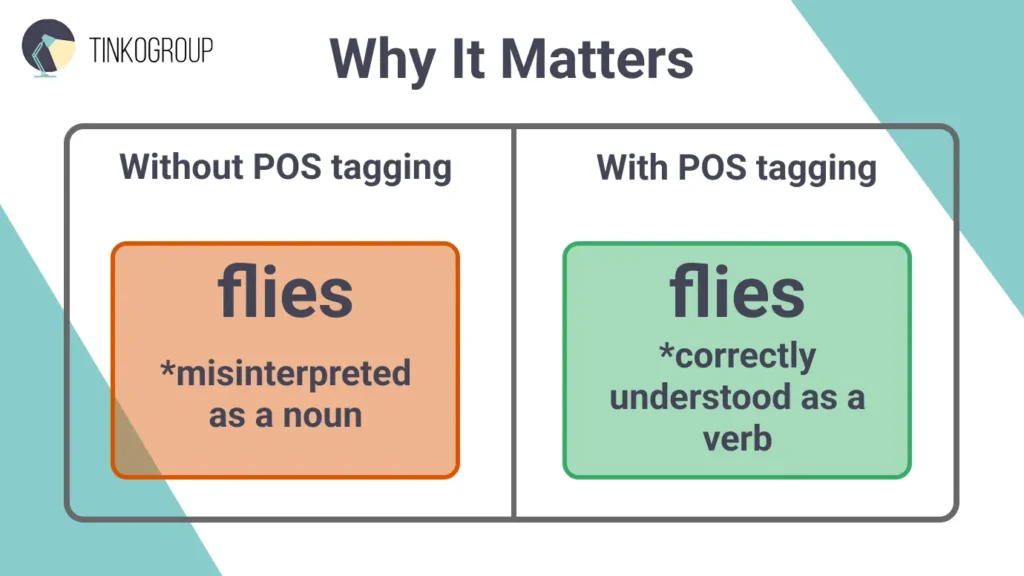
Without POS information, a pipeline can misread such distinctions, which leads to errors in tone analysis or voice assistant commands.
Step 4: Validation and Quality Control
Tagged output is checked against annotation guidelines through sampling, double annotation, or automated consistency checks, and disagreements are adjudicated. This step is where human expertise decides the quality of the final dataset. It is covered in more detail in the section on POS tagging and machine learning below.
How POS Tagging Improves Model Accuracy and Context Understanding
POS tagging gives models the grammatical role of each word, which helps them separate actions, objects, and descriptions and read intent more reliably. In “The company will lead the project” and “The pipe is made of lead,” the same word form plays different roles, and the tag tells downstream components whether it denotes an action or a material. POS tagging in NLP does not resolve every ambiguity: telling a river bank from a financial bank is a task for word sense disambiguation and entity recognition.
Types of POS Tagging in NLP
POS tagging can be performed in different ways, each with its own characteristics, strengths, and limitations. The choice of method depends on the task, data volume, accuracy requirements, and project resources. In real projects, the types of POS tagging in NLP are often combined.
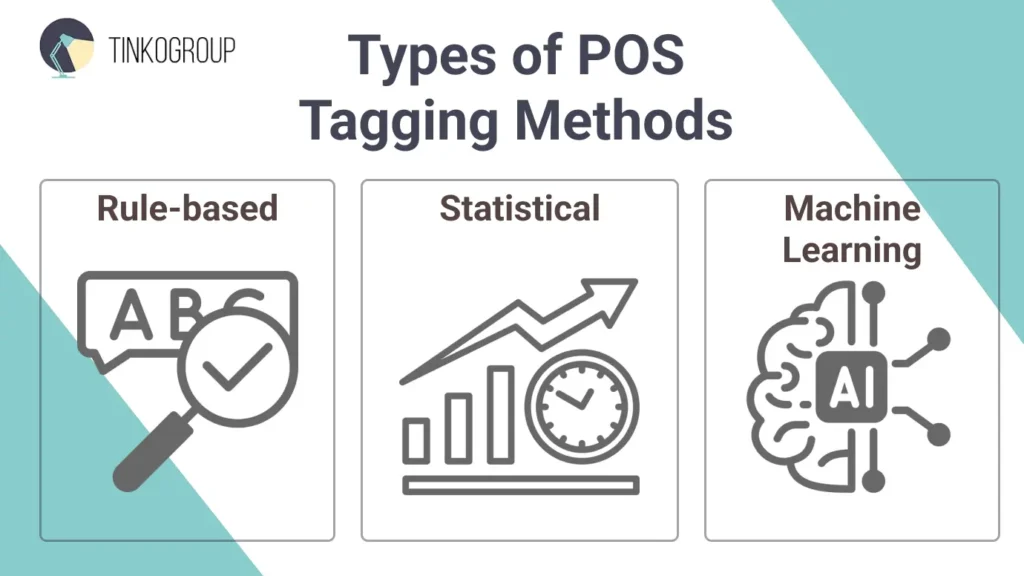
Rule-Based POS Tagging
Rule-based taggers combine dictionaries of possible tags with hand-written rules that use neighboring words to choose among them. They are transparent and need little training data, but they are hard to scale and need constant updates for new words and slang.
Example: The word “run” in the dictionary can have the tags: Noun, Verb. The system selects the tag according to the rule based on the neighboring words: “I run daily” → Verb, “I went for a run” → Noun.
Statistical POS Tagging
Statistical taggers learn from annotated corpora and choose the most probable tag sequence. The best-known models are Hidden Markov Models (HMM) and Conditional Random Fields (CRF). They handle ambiguity better than rules alone, but they need a large annotated corpus and are less interpretable.
Example: The word “book” can be a noun or a verb. A statistical tagger weighs how often each tag occurs next to the neighboring words and which tag sequences are most probable, so “a book” and “to book” receive different tags.
Machine Learning and Deep Learning POS Tagging
Neural taggers use BiLSTM or transformer-based (BERT-type) encoders, in which each token’s representation reflects the whole sentence. They cope better with ambiguity, long context, and new words, and they scale across languages. The trade-offs are compute cost, lower interpretability, and strong dependence on label quality, because a model learns annotation noise as readily as signal.
Example: In “I need to book a flight” and “I read a book about flights,” a contextual model assigns “book” its tag from the whole sentence rather than from a dictionary entry.
The choice of tagset also matters. Universal Dependencies defines a fixed set of 17 universal part-of-speech tags, which languages may use selectively, while treebank-specific schemes such as the Penn Treebank tagset are more fine-grained. The tagset should follow the downstream use case.
Pros and Cons of Each Approach
| Approach | Pros | Cons |
| Rule-based | Simple, interpretable, does not require large amounts of data | Limited by rules, poor at handling context and ambiguity |
| Statistical (HMM, CRF) | Takes context into account, works with ambiguous words | Requires large amounts of marked-up data, less interpretable |
| ML / Deep Learning | High accuracy, scalability, takes long context into account | Requires resources and large amounts of high-quality data; more difficult to explain decisions |
In real-world projects, approaches are often combined: rules help beginners and small projects, while statistics and neural networks are used for high-precision POS tagging in productive AI systems.
POS Tagging in NLP: Real-World Applications
POS tagging in NLP is not just an academic concept. In practice, Part-of-speech information feeds many tools and services that businesses and users rely on every day, from machine translation to voice assistants and automatic content moderation.
Google Translate
In machine translation, word-class information has long helped systems interpret context. For example, the English word “book” can be a verb or a noun, and “I will book a ticket” must be translated into German with a verb form. Current neural systems such as Google Translate learn much of this implicitly, so explicit tagging now matters mainly for building and evaluating translation data and for low-resource languages.
Grammarly
Grammar and style checking services such as Grammarly work with grammatical structure, and word-class information is one signal such tools can use to analyze sentences. Knowing where verbs, nouns, adjectives, and adverbs are helps identify errors in agreement, incorrect word forms, and word order violations. For example, in the sentence “She go to school every day,” a checker can recognize that “go” should be a third-person verb form and suggest “goes.”
Siri / Alexa / Google Assistant
Voice assistants and chatbots use POS information to interpret user commands. The difference between a verb and a noun is critical here: the command “Book a table” must be recognized as an action, not an object. Accurate part-of-speech tagging helps AI execute requests correctly, whether it is booking a table, playing music, or setting a reminder.
Business Chatbots
Business chatbots for customer support and sales also depend on accurate tagging. The system has to understand the meaning of the request and distinguish between objects and actions. For example, “I want to cancel my order” is interpreted as an order cancellation action, not just a mention of the word “order.” This improves the user experience and reduces the load on live operators.
Search and Text Analytics
In search, word class helps interpret short queries: “Book flights Berlin” is an action request, while “flight book Berlin” points to a product. Tagging does not separate meanings within one word class, such as “apple” the fruit, and “Apple,” the company, which falls to entity recognition. In sentiment analysis, word class helps tell attitude (“I love this product”) from other uses of the same word and link opinion words to the features they describe.
Content Moderation
Content moderation platforms can use POS tagging in NLP as one signal to distinguish insults, spam, or potentially dangerous content. “I will kill you” and “Kill the weeds in the garden” both use “kill” as a verb, so tagging alone does not settle intent. The surrounding structure (subject, object, modality) helps classifiers recognize context and reduce false positives.
Part of Speech Tagging Example
To understand how Part-of-Speech Tagging works, let’s look at a simple example. Part-of-speech tagging allows a machine to see each word and its grammatical role and then use that information to analyze, translate, or generate text.
For example, consider a complex legal sentence: “The Lessee shall indemnify the Lessor against all liabilities.” In a professional POS tagging workflow, each word is assigned a specific functional tag to ensure the AI model understands the legal obligations correctly:
Table: Word → POS tag
| Word | POS Tag | Description |
| The | Determiner | Defines the following noun |
| Lessee | Noun | Subject (the entity with the obligation) |
| shall | Verb (Modal) | Indicates a formal requirement or duty |
| indemnify | Verb (Main) | The specific action/legal process |
| the | Determiner | Defines the following noun |
| Lessor | Noun | Object (the entity receiving protection) |
| against | Preposition | Establishes the relationship between action and risk |
| all | Determiner | Quantifier indicating scope |
| liabilities | Noun | The legal subject matter |
Capitalized defined terms such as “Lessee” show why guidelines matter: depending on the tagset, they may be tagged as common or proper nouns, and the decision must be applied consistently across the dataset. For enterprise applications in legal or fintech text, that consistency is what makes automated contract analysis and risk assessment reliable.
POS Tagging Tools and Libraries
Many ready-made libraries handle POS tagging in NLP, from academic experiments to industrial pipelines. The choice depends on the project’s goals, languages, and requirements for speed and quality. Published scores come from standard corpora, so test any tool on your domain data before production.
NLTK
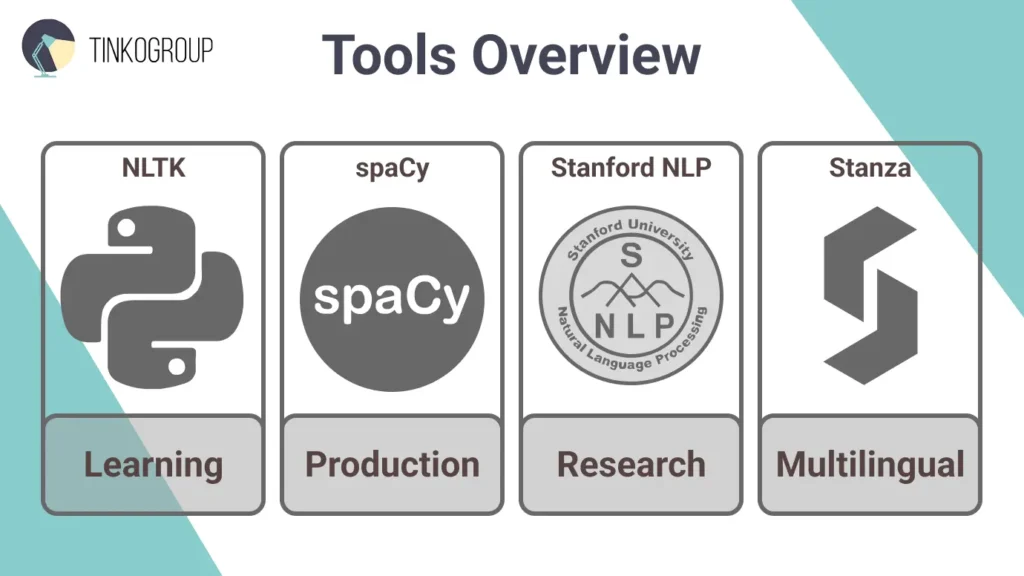
Natural Language Toolkit (NLTK) is one of the oldest NLP libraries, with built-in tokenizers, POS taggers, and lexical resources such as WordNet. It is well suited to learning, experiments, and baselines. Its speed and performance are limited, so in business applications it is more often used for prototypes and research.
spaCy
spaCy is one of the most widely used libraries for POS tagging in production pipelines. It is optimized for speed and scale, which is why it is often used in real-world products such as chatbots, search engines, and content systems. It supports pretrained pipelines for many languages and integrates with machine learning frameworks.
spaCy’s documentation lists tagger accuracy of 97.8% for its transformer-based English pipeline on the OntoNotes 5.0 corpus, and the model card for the CPU-optimized pipeline lists about 97.3%. Results on specialized or noisy text depend on how closely it matches the training data.
Stanford CoreNLP
Stanford CoreNLP is a long-established Java library, often used for research and for projects that need reproducibility and explainable models. Its POS tagger is a maximum entropy (log-linear) model. It is less convenient to integrate into Python, so many teams use it through a REST API or the Python client provided by Stanza.
Stanza
Stanza is the Python toolkit from the Stanford NLP Group, built on PyTorch. It provides a fully neural pipeline trained on Universal Dependencies treebanks and other corpora, and its current documentation lists pretrained models for 80 human languages. It is especially useful for multilingual projects where morphological detail matters, typically at a higher compute cost than lightweight taggers.
When to Use which Tool
- NLTK is suited to learning, courses, and experiments. If you are an NLP student or want to quickly understand how part of speech tagging works, start with NLTK.
- spaCy is a common choice for business applications that need speed and scalability, such as chatbots, analytics systems, and recommendations.
- Stanford NLP is suitable for research and Java environments where reproducibility and explainability matter, not just speed.
- Stanza is a strong candidate for multilingual projects and morphologically rich languages, typically at a higher compute cost than lightweight taggers.
Thus, the choice of tool depends on the balance between speed, accuracy, and context of use. In real products, a hybrid approach is often used: for example, preprocessing in spaCy and detailed analysis in Stanza, followed by human verification of uncertain cases.
POS Tagging and Machine Learning
Modern language processing systems rely on machine learning. When we discuss Part-of-Speech Tagging, it is machine learning algorithms in NLP that allow models to see patterns in text, understand context, and grasp the grammatical structure of sentences. However, at the heart of any model lies one thing: high-quality annotated data. Without accurate annotation, even a complex algorithm cannot learn to distinguish parts of speech reliably.
How Annotated Data Enables POS Tagging Models
Each machine learning POS tagging model is trained on a large set of texts in which every word already carries its part of speech. The more data there is and the higher its quality, the more accurate the model will be. If a system is trained on millions of sentences where “run” and “book” appear as both verbs and nouns, it gradually learns to identify parts of speech from context rather than from a dictionary.
Why Quality Annotation Improves Accuracy
The accuracy of POS tagging in NLP directly depends on the quality of the annotation. If there are errors in the data — words are tagged incorrectly or tags are inconsistent — the model will begin to reproduce these errors in its predictions.
High-quality annotation is achieved when there are clear annotation guidelines, and the annotation team is trained and uses multi-level quality assurance. Typical controls include double annotation on a sample, inter-annotator agreement measurement, adjudication of disagreements, and gold-standard checks. Domain-specific terminology should be settled in the guidelines before large-scale work begins. Poorly labeled datasets can lead to significant issues in production. To avoid common pitfalls, check out our guide on the Top 7 Data Labeling Mistakes That Hurt Your Machine Learning Model Performance.
For example, in English, a simple confusion between a gerund and an active verb can change the meaning of a phrase. In languages with rich morphology (German, Russian, Finnish), such errors increase significantly if there are no clear rules and QA procedures.
Good annotated data not only improves the accuracy of the POS tagger but also reduces the need for model retraining, cuts down on refinement costs, and increases the stability of results on new data. Because language and data sources change, periodic review of model errors against fresh, human-verified samples helps to decide when retraining or a guideline update is needed.

Reliable Data Services Delivered By Experts
We help you scale faster by doing the data work right - the first time

Connection to Data Annotation Providers
In practice, creating high-quality datasets for POS tagging in NLP requires experience, methodology, and a team capable of working with large volumes of text. This is where professional data annotation outsourcing companies such as Tinkogroup come into play.
Tinkogroup helps businesses and AI teams build reliable annotation pipelines — from training data annotation preparation to multi-level quality control. Their experts create scalable processes for custom data tagging and POS marking, allowing customers to launch projects faster and get accurate, training-ready models.
By combining human expertise and automation (human-in-the-loop), Tinkogroup supports continuous data improvement, helping clients develop AI-based products in business applications, from chatbots to content analysis systems.
Challenges and Limitations
Despite impressive progress in part-of-speech tagging, even the most advanced models for POS tagging in NLP face limits. Language is a living, changing system where context, culture, and intonation play a huge role. Machines still struggle with ambiguity, informal expressions, and languages with complex grammar, and at enterprise scale these problems become data-quality and consistency problems.
Ambiguity
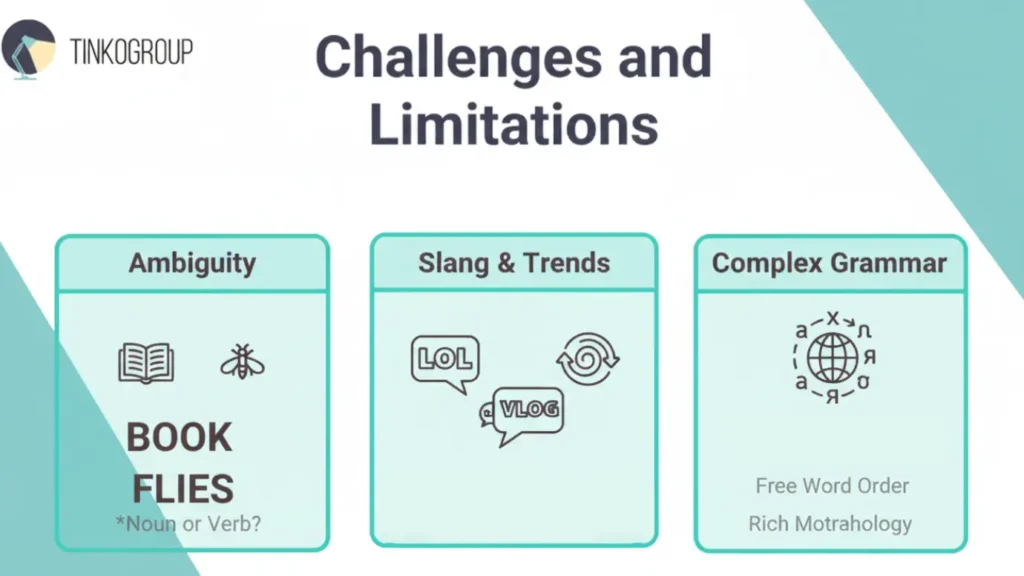
One of the main challenges for POS tagging in NLP is ambiguity. In English (and other languages), many words can play different roles depending on the context, as the “book” and “flies” examples above show.
For humans, the meaning is obvious from the context, but the model has to figure it out based on probabilities and past examples. Even modern architectures like Transformers and BERT make mistakes if the context is too short or ambiguous. This is why it’s crucial to understand how annotation bias builds unfair AI from the ground up and how to mitigate it during the tagging process.
Slang, Abbreviations, New Words
Modern language is constantly changing. Every day, dozens of new expressions, memes, and abbreviations appear on social networks and messengers. This is a real puzzle for POS taggers.
Words like “LOL,” “DM,” “vlog,” or “AI-powered” are not always found in dictionaries, which means that the model may misclassify them. Even if the system is trained on huge corpora, the emergence of new words requires regular data updates and model retraining.
In addition, slang often violates grammatical norms. Phrases like “That’s lit!” or “He kinda sus” create confusion: models don’t know how to tag “lit” or “sus” because they can behave like adjectives but don’t fit into standard grammatical rules.
As a result, POS tagging in NLP becomes not just a classification task but a task of cultural adaptation — the model must understand a language that lives and evolves alongside society.
Languages with Free Word Order and Complex Morphology
While the sentence structure in English or Spanish is relatively stable, languages such as Russian, Finnish, Hungarian, or Turkish pose real challenges. In these languages, word order can change without losing meaning, and endings carry the main grammatical load.
For example, in Russian, the phrase “The boy sees the dog” can be rearranged as “The dog is seen by the boy” — the meaning is the same, but the order is different. This is a challenge for a POS tagger: it must analyze endings, not just word position.
In addition, such languages have dozens of declensions, conjugations, and forms, which dramatically increases the number of unique word forms. For NLP part-of-speech tagging, this means the need for large corpora and accurate morphological annotation.
Even modern neural network models trained on millions of sentences can make mistakes if they lack contextual clues. Therefore, for languages with complex morphology, the quality of training data annotation and the availability of expert linguists who help models understand the structure of the language are especially important.
Domain-Specific Terminology
Legal, fintech, medical, and technical texts contain defined terms, abbreviations, and unusual syntax that general-purpose taggers rarely see. Without domain-specific guidelines and annotators who understand the text, the same term can be tagged differently across a dataset.
Annotation Consistency and Quality Control
At scale, the main risk is drift rather than the occasional error: annotators interpret guidelines differently, guidelines change mid-project without relabeling earlier data, or QA is applied to samples that are not representative. Consistency requires a defined review hierarchy, measurable agreement targets, and a feedback loop from QA findings into guideline updates.
Global Compliance & Regional Expertise
Tailored POS Tagging in NLP for US and UK Enterprises
At Tinkogroup, we align our annotation processes with the high data standards required by North American and British AI sectors. We specifically optimize our Part-of-Speech tagging pipelines for:
- US-Based AI Development: We provide high-precision English POS tagging that accounts for American business terminology, local idioms, and North American legal syntax.
- UK & Canadian Projects: Our team delivers consistent NLP data marking tailored to regional linguistic variations, ensuring your model performs accurately across different Western markets.
- Compliance-Ready Annotation: We ensure that all POS tagging in NLP services for our Western clients is performed in secure environments, respecting global data handling ethics and standards.
Conclusion
Part-of-Speech tagging in NLP is a fundamental element of modern Natural Language Processing. It helps models understand language structure, grasp the meaning of phrases, and distinguish between the meanings of words depending on context. Without accurate POS tagging, it is impossible to build high-quality machine translation systems, voice assistants, chatbots, or search algorithms.
POS tagging is not just markup but a process that combines linguistics and machine learning, enabling models to understand human speech. It enables deep text analysis, communication automation, and meaning extraction from data.
Yet, the key to the success of such systems is high-quality annotated data. The more accurate and in-depth the markup, the better the model understands the language and the higher its performance. This is where a professional data annotation partner for US and UK markets plays a crucial role.
Tinkogroup helps companies build scalable, accurate, and flexible data annotation pipelines for POS Tagging, NER, Sentiment Analysis, and other NLP tasks. We combine modern tools and rigorous quality processes to provide our clients with reliable datasets for training their models.
If you want to improve the accuracy of your NLP models and build a sustainable annotation infrastructure, learn more on our Data Annotation Services page.
What is the main purpose of POS tagging in NLP?
The main goal of POS tagging is to identify the grammatical role of each word (noun, verb, adjective, etc.) in a sentence. This gives AI models structured information about word roles, which helps resolve ambiguity and supports tasks such as text classification, information extraction, and translation data preparation.
How does POS tagging improve machine learning model accuracy?
By assigning specific tags to words, POS tagging provides context that simple text analysis lacks. A tagger learns whatever patterns its training data contains, so consistent, guideline-based annotation helps models avoid errors on words with multiple meanings (e.g., “book” as a noun vs. “book” as a verb), while inconsistent labels are reproduced in the model’s predictions.
Which tool is best for POS tagging in a production environment?
There is no single best choice. NLTK is excellent for learning and prototyping, spaCy is widely used in production because of its speed, scalability, and pretrained neural pipelines, and Stanza is often considered for projects that need multilingual coverage and morphological detail. Test candidates on a sample of your own domain text and use human verification to measure real accuracy before deciding.