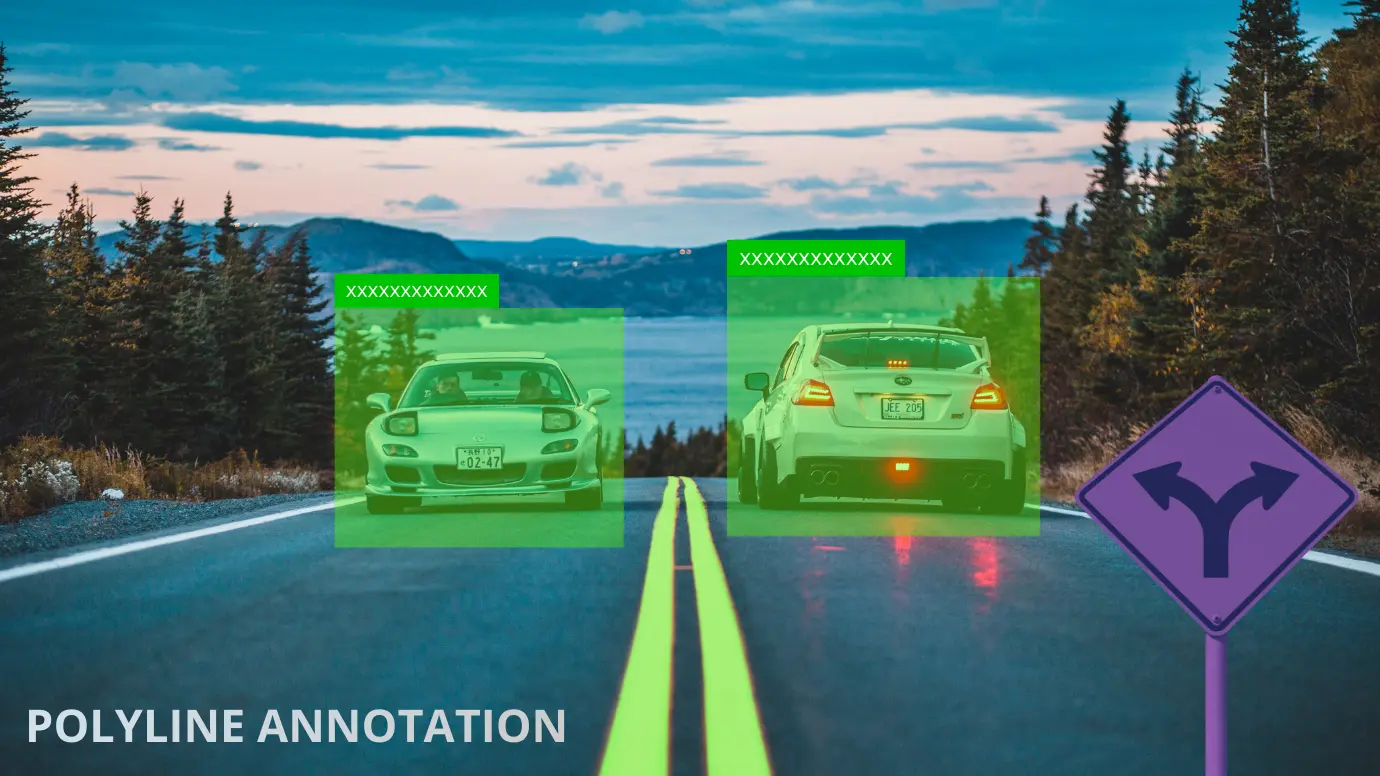

Data annotation is the process of creating labels on images, videos, or other types of data, which transforms raw information into material suitable for training algorithms. Without such labeling, artificial intelligence models cannot distinguish objects or understand their shape or position in space.
Polyline annotation is one of the key annotation methods. It involves using connected lines to accurately mark the contours or paths of objects. This method differs from simpler approaches, such as rectangular frames or polygons, in that it allows you to fix linear elements where the trajectory is important, rather than the area.
The polyline annotation computer vision technique is especially in demand in applications where the accuracy and shape of an object are critical. For example, for autonomous driving systems, it is important to correctly identify road lines and lane boundaries, and in cartography, rivers, roads, and pipelines. The use of polylines provides high accuracy and allows models to make more correct decisions in real-world conditions.
What is Polyline Annotation?
Polyline annotation is a method of marking objects in which the outline or path of an object is marked using connected line segments. Unlike bounding boxes or polygons, polylines capture the trajectory, line, or boundary of an object rather than its entire area. This approach allows artificial intelligence models to “see” the exact shape and direction of objects, which is especially important for linear or elongated structures such as road lanes, cables, pipelines, or lines on sports fields.
Difference Between Polyline and Polygon Annotation
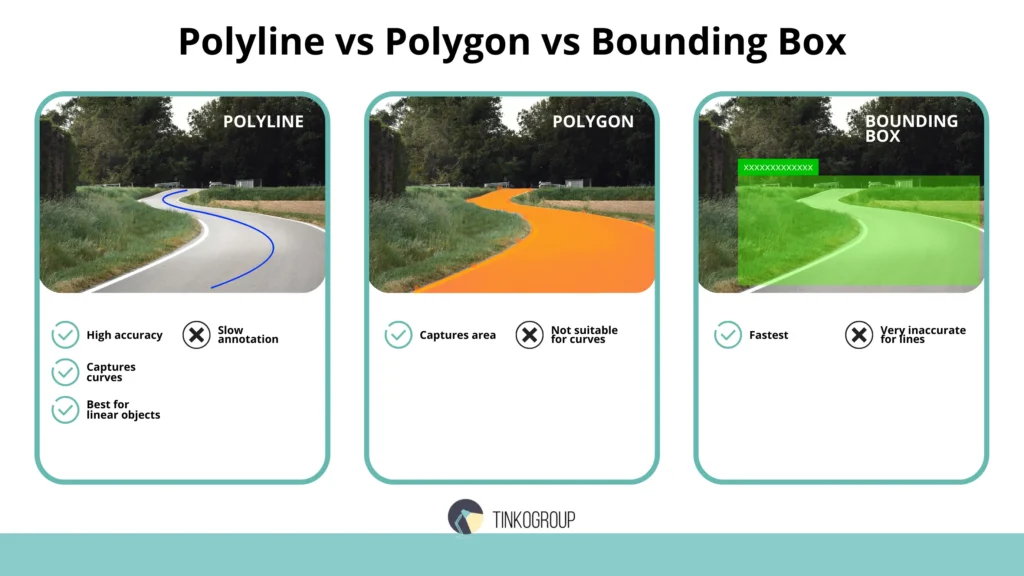
The main difference between polylines and polygons is that polylines only display the path or outline of an object, while polygons create a closed area.
- Polygon annotation is suitable when the area of an object is important, for example, for marking buildings, parking areas, or bodies of water.
- Polyline annotation is relevant where the shape of the line is key, rather than its area: road markings, power lines, river contours, venous networks in medical images.
Polylines accurately follow the bends and curves of an object, which rectangles and standard polygons cannot achieve. In addition, they allow models to better distinguish between adjacent lines, avoiding overlaps and distortions, which is critical for autonomous systems and engineering applications.
Let’s imagine a situation on the road for an autonomous driving system:
- Using Polyline annotation, road lanes, crosswalks, and road boundaries are marked with lines that follow the exact trajectory. This allows the algorithm to correctly determine the position of the car relative to the road and other objects.
- Using Bounding Boxes in this case would result in generalized, less accurate markings, where details of lane curvature and intersections could be lost. Polygons are also not always effective, as their filled area does not reflect the actual path of the lane.
A similar situation can be observed in other areas: for tracing pipelines, power lines, or sports fields, polylines allow models to take into account the exact location and bends, which is impossible when using more crude methods.
Why Precision Matters in Certain Industries
The accuracy of polylines is critical in several key industries:
- Autonomous driving. Small errors in lane or road boundary markings can lead to incorrect model decisions, creating potentially dangerous situations.
- Energy and utilities. When marking cables, pipelines, or power lines, any inaccuracy can complicate maintenance and increase the risk of accidents.
- Medicine. When annotating blood vessels and organs, even a millimeter error can distort the diagnosis or surgical plan.
- Cartography and GIS. Accurate mapping of roads, rivers, and bridges is important for geographic information systems, where errors in the trajectory of objects can lead to incorrect route calculations or territory analysis.
Polyline annotation is not just one of many annotation methods — it is a tool for ensuring high accuracy and reliability of artificial intelligence models, especially where the shape and path of an object are critical to the result.
Polyline Annotation vs Other Annotation Methods
There are several methods for annotating data, and the choice of approach depends on the task and the characteristics of the objects. Polyline annotation stands out among them in that it allows you to fix lines and contours, rather than areas or individual key points. This method is especially useful when it is important to accurately convey the shape and direction of an object. To understand its advantages, it is worth comparing polylines with other common approaches.
Comparison with Bounding Boxes, Polygons, Keypoints
Each of the main annotation methods has its own characteristics and areas of application. Bounding boxes are quick to create and are suitable for tasks where only the general location of an object is important, such as detecting cars or people in an image. Polygons completely outline the object and fix its area — they are convenient for buildings, parking lots, or water bodies. Keypoints are used to mark individual significant points, such as human joints or control points on the road.
Polyline annotation, unlike these methods, allows you to accurately display lines and trajectories, which is necessary for road lanes, cables, pipelines, and sports fields. This approach provides models with a more detailed understanding of the structure and direction of objects.
Pros and Cons of Using Polyline
The use of polyline annotation has a number of significant advantages that make this method indispensable in a number of areas. The main advantage is high accuracy when tracing linear objects. Polylines allow you to accurately record bends, intersections, and turns, which is especially important for tasks such as autonomous driving, where road markings determine the trajectory of a vehicle. In medicine, accurate marking of vessels and organs helps models correctly interpret complex structures, and in cartography, the lines of rivers, roads, and bridges are displayed without distortion, which increases the accuracy of geographic information systems.
Another advantage is the flexibility of the method. Polylines are suitable for objects of any length and shape, from short lines on a sports field to long pipelines or electrical cables. This method provides models with not just a rough representation of an object, but detailed information about its trajectory and structure, which is impossible with rectangles or key points. In addition, polylines make it possible to correctly record intersections and parallel lines, which is critical for complex scenes with multiple objects.
However, polyline annotation also has its drawbacks. The annotation process is extremely labor-intensive and requires a high level of concentration. Even experienced annotators can make mistakes when working with long or complex lines, especially when objects intersect or have small details. This makes the process time-consuming and resource-intensive, especially with large amounts of data.
Another disadvantage is the high demand for quality control. Any inaccuracies in the markup can negatively affect the training of the model, reducing its accuracy and reliability. In autonomous driving, energy, or medical applications, even small errors can have serious consequences, so polylines require constant verification and validation by specialists.
In addition, processing moving objects in video adds complexity. Lines must smoothly follow the trajectories of objects in each frame, which increases the workload on annotators and raises the risk of inconsistencies between frames. Semi-automated tools can speed up the process, but they cannot replace human control, especially in critical areas.
Situations where Polyline Is the Only Suitable Choice
There are tasks where using polyline annotation is practically the only possible solution. The main reason is the need to accurately reflect the line, trajectory, or contour of an object, rather than its area. In such cases, rectangles or polygons cannot convey curves, intersections, or the sequence of lines, which makes polylines indispensable.
In the field of autonomous driving, polylines are used to mark road lanes, intersection boundaries, and pedestrian crossings. Accurate lines help models correctly assess the position of a car on the road, predict the movement of other participants, and make safe decisions. Simple marking with rectangles or polygons does not provide the necessary information in this case: it does not take into account the curvature of the lanes, their intersections, and their location relative to other objects.
In cartography and geographic information systems, polylines are necessary for displaying rivers, roads, bridges, and paths. They allow models to accurately see the direction, bends, and branches of objects. For example, a river with numerous bends and tributaries cannot be correctly marked with a polygon — the filled area will not convey the actual path of the water flow. Polylines enable models to take into account complex shapes, intersections, and sequences of lines.
In energy and utilities, polylines are used to designate cables, pipelines, and power lines. Their accurate recording is critical for planning maintenance and preventing accidents. Any inaccurate representation of the route can lead to errors in work planning and increases the risk of damage. Other marking methods are simply not suitable for these tasks, as it is the line and its continuity that are important.
In medicine, polylines are indispensable for tracing veins, arteries, and organ contours. Even a millimeter of inaccuracy can affect the diagnosis or surgical plan. Rectangles or polygons are not capable of showing thin and complex vascular structures, and key points only provide individual reference marks without providing a complete understanding of the structure.
Even in sports analytics, polylines are the only suitable tool. The trajectories of players, the ball, or the field lines must be recorded as continuous lines. Without this, it is impossible to accurately analyze the strategy and dynamics of the game, assess areas of activity, and predict possible scenarios.
Small Table with Feature Comparison
Below is a visual comparison of polylines with other marking methods:
| Feature / Method | Polylines | Polygon | Bounding Box | Keypoints |
| Captures linear paths | ✅ | ❌ | ❌ | ❌ |
| Represents area | ❌ | ✅ | ✅ | ❌ |
| Handles moving objects | ✅ | ❌ | ✅ | ✅ |
| Annotation speed | Average | Slow | Quick | Quick |
| Accuracy requirement | High | Average | Average | High |
| Best for elongated/curved objects | ✅ | ❌ | ❌ | ❌ |
Key Use Cases & Industries
Polyline annotation has applications in many industries where accurate recording of lines and object contours plays a critical role. The method enables artificial intelligence models to recognize complex shapes and trajectories, which is impossible when using simple rectangles or polygons. Below are the key areas of application with a detailed analysis.
Autonomous Vehicles
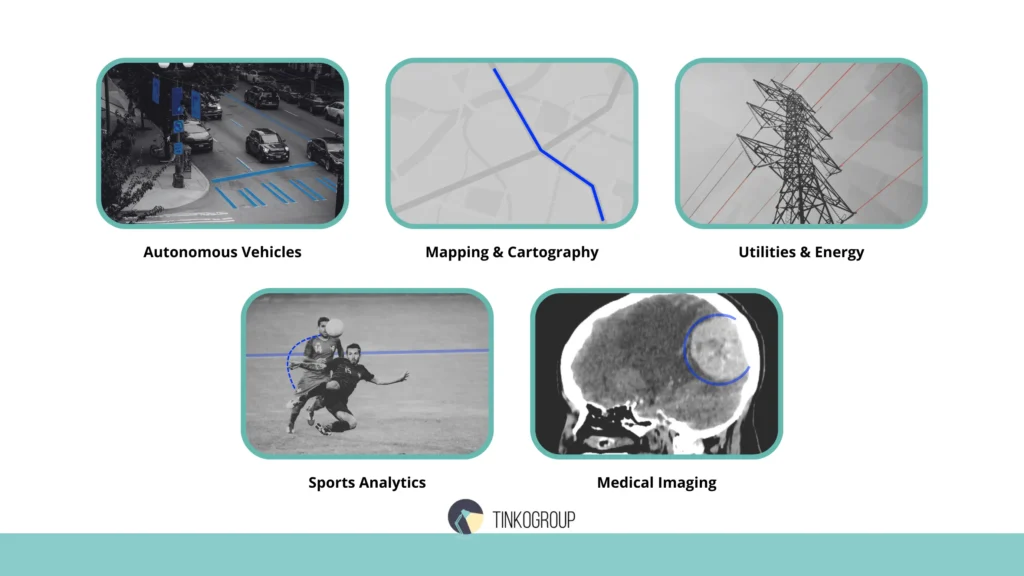
In the field of autonomous transport, every error in perceiving the road environment can be dangerous, which is why polyline annotation is particularly valuable here. Annotating lanes, intersection boundaries, crosswalks, and other linear elements allows algorithms to accurately assess the road situation.
For example, when driving on a city street with multiple lanes and intersections, the system must take into account:
- Separation lines between lanes, including curves at turns.
- Pedestrian crossings, which may be partially obscured by trees or cars.
- Parking and waiting area boundary lines, which help assess available space.
- Road signs, which are sometimes located near lane boundaries and require accurate contour localization.
Polyline annotation allows models to see all these details as continuous lines, which improves prediction accuracy and reduces the likelihood of accidents. Even small deviations from the actual line can lead to incorrect vehicle trajectories, so marking accuracy is critical.
Mapping & Cartography
In cartography and geographic information systems, a precise line is not just a markup, but a source of data for analysis and planning. Polyline annotation is used for:
- Recording roads, sidewalks, and bike paths, taking into account curves, branches, and intersections.
- Outlining the coastlines of rivers and lakes for hydrological models, flood analysis, and infrastructure planning.
- Marking bridges, tunnels, and other linear structures, including height and angles of inclination.
- Marking the boundaries of forest areas and protected areas where the exact trajectory is more important than the area.
High-quality polyline markings help create accurate 3D maps, predict traffic flows, and plan infrastructure construction and upgrades.
Utilities & Energy
For utility and energy companies, the accuracy of linear feature markings directly affects the safety and efficiency of service. Polylines enable models to:
- Track the trajectory of high-voltage lines and cables to plan detours and maintenance work.
- Determine the exact location of pipelines, including bends and intersections, which is important for diagnostics and accident prevention.
- Analyze water supply and sewerage networks, identify potential risk areas, and predict load.
- Visualize the distribution of electrical and gas networks on maps for rapid response in emergency situations.
Every inaccuracy can lead to costly consequences, so using polyline annotation ensures accurate route recording and reduces the risk of errors.
Sports Analytics
In sports analytics, polylines are used for in-depth analysis of gameplay. Markings allow models to:
- Accurately record field boundaries, zone lines, and boundary markers, which is important for automatically determining fouls and points.
- Track the trajectories of players and the ball, which helps coaches analyze tactical schemes, player effectiveness, and areas of activity.
- Create analytical visualizations for strategic planning and predicting team behavior.
Polyline annotation in sports applications allows models to see the full movement of players and field lines, which is impossible to achieve using rectangles or points.
Medical Imaging
In medical imaging, the accuracy of lines directly affects diagnosis and treatment planning. Polyline annotation is used for:
- Tracing veins and arteries with high accuracy, allowing models to detect narrowings, blood clots, or other abnormalities.
- Marking the boundaries of organs and tissues, including the complex contours of the liver, kidneys, heart, and lungs.
- Planning surgical procedures, where it is important to consider the trajectory of instruments and minimize intervention.
- Training models to analyze MRI, CT, and X-ray images, where each line reflects real structures in the body.
The use of polylines improves the accuracy of automated diagnostics, allows models to correctly identify critical areas, and reduces the likelihood of errors in medical image processing.
Additional Polyline Annotation Examples and Context
Polyline annotation also has applications in other areas:
- Robotics: lines are used for robot movement routes and obstacle analysis.
- Environmental monitoring: tracing the boundaries of forests, rivers, and nature reserves to observe changes and analyze human impact.
- Aerospace industry: marking flight paths for drones or satellites.
In all these cases, the accuracy of polylines allows models to take into account complex shapes, curves, and intersections of objects, which is critical for correct analysis and decision-making.
Challenges in Polyline Annotation
Polyline annotation is highly accurate, which makes it both a valuable and complex tool for data annotation. Working with lines and contours requires attention to the smallest details, and mistakes can have far-reaching consequences. The difficulties in this process are related not only to technical aspects, but also to the human factor.
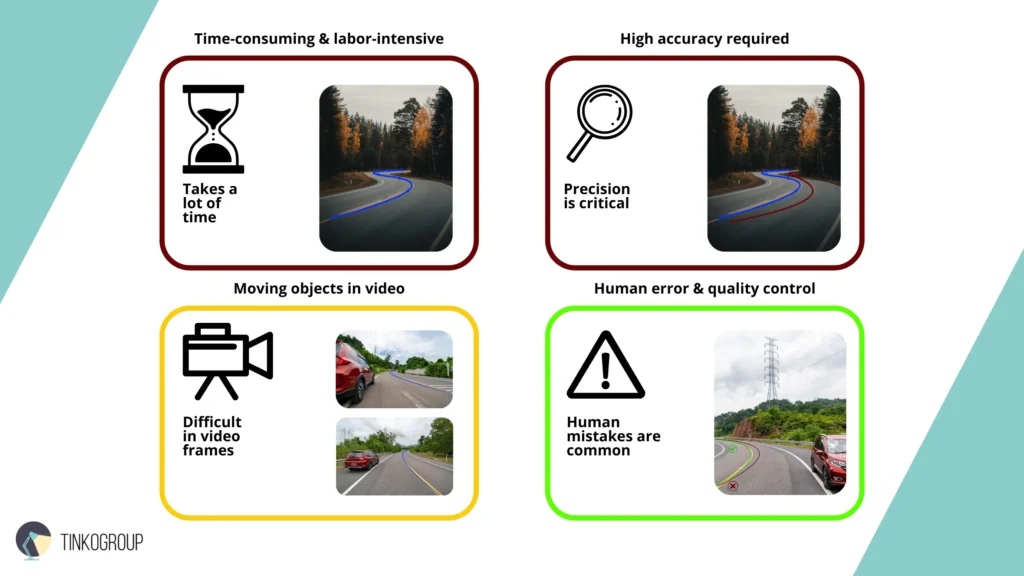
Time-Consuming and Labor-Intensive
The process of marking polylines often turns into a long and monotonous task. Annotators have to carefully monitor each bend, accurately repeat the contours of objects, and take into account line intersections. This is especially noticeable in large projects, such as annotating kilometers of roads for autonomous transportation systems or branched pipeline networks. The time required grows exponentially with the number of objects and the complexity of the scene. Even small sections of video can take hours of work if high-precision marking is required, making project scaling a difficult task.
At the same time, the process itself cannot be fully automated: semi-automatic tools speed up the work, but require constant monitoring and adjustment. Without such verification, there is a high risk of errors that accumulate and reduce the quality of the entire training sample.
High Need for Accuracy
Every line in polylines matters. In autonomous driving systems, an error of just a few centimeters can lead to an incorrect vehicle trajectory, and in medical imaging, to an incorrect diagnosis. Unlike simple marking methods, polylines do not allow for generalizations: every curve and bend must be displayed as accurately as possible.
In addition, the accuracy of the marking is directly related to the subsequent effectiveness of the model. If the algorithm is trained on data with inaccurate lines, its ability to correctly interpret complex objects is reduced. This creates a chain of errors: from annotation to model predictions and decisions based on them.
Handling Moving Objects in Video Annotation
Marking moving objects adds a new level of complexity. Each line must smoothly follow the object’s trajectory throughout the video. The slightest discrepancies between frames can cause the line to “jump,” distorting the training data.
In transportation analytics, this manifests itself, for example, when recording road markings while the camera is moving along with the car. In sports analytics, polylines must accurately follow the movements of players and the trajectory of the ball, otherwise statistics and tactical predictions become unreliable. Working with video requires high concentration and the ability to anticipate the trajectory of an object, as well as the use of tools that can offer semi-automatic line correction.
Human Error and Quality Assurance Issues
The human factor remains one of the main problems. Repetitive work is tiring, reduces attention, and increases the likelihood of errors. Sometimes even experienced annotators can miss a bend, connect lines incorrectly, or accidentally shift the contour by a few millimeters.
Therefore, large projects require a multi-level quality control system. This includes reviewing the work by other specialists, cross-checking data, and correcting identified errors. Without strict QA practices, the quality of annotated data declines, which negatively affects the accuracy and reliability of models.
In addition, complex scenes with a large number of intersections or tiny objects create additional difficulties. For example, a network of veins in a medical image or power lines on a dense city map require extreme care and experience. Any inaccuracy can have a disproportionately large impact on the performance of the model, especially if it is trained on large amounts of data.

Reliable Data Services Delivered By Experts
We help you scale faster by doing the data work right - the first time

The Future of Polyline Annotation
The future of data annotation using polyline annotation is closely linked to the development of artificial intelligence tools and automation methods. With the growth of data volumes and the complexity of objects, manual annotation is becoming increasingly costly, which is driving the adoption of semi-automated and intelligent systems. Despite technological advances, the role of humans remains critical, as the accuracy of lines and contours determines the effectiveness of models.
Semi-Automated Annotation with AI-Assisted Tools
One of the key areas is the introduction of AI-assisted tools that speed up the polyline annotation in AI process and reduce the workload on annotators. These tools can automatically suggest lines on images or videos based on pre-trained models. Annotators check and correct the suggested lines, which reduces working time and the likelihood of errors.
The use of such tools is particularly effective in areas with large amounts of similar data, such as when labeling road infrastructure for autonomous transport or analyzing hundreds of medical images. A semi-automatic system allows you to focus on complex areas that require manual precision, while simple and repetitive lines can be entrusted to the algorithm.
Active Learning and Model-Assisted Annotation
What about the polyline annotation in machine learning? Active learning and model-assisted annotation techniques open up new opportunities for improving efficiency. Models are first trained on small samples of manually annotated data, after which they suggest annotations for new images. Annotators check and correct the lines, and the corrections are fed back into the model to improve subsequent predictions.
This approach saves resources and speeds up the creation of high-quality datasets. It is particularly useful for tasks involving highly complex objects, such as tracing vein networks in medical images or complex road junctions with multiple lanes and intersections. Active learning makes the process iterative, continuously improving the accuracy and adaptability of the model.
Potential Decrease in Manual Work, but Ongoing Need for Human Validation
Despite automation and intelligent tools, it is impossible to completely abandon manual verification. Even the most sophisticated algorithms can make mistakes in complex scenes, when objects intersect, or in poor visibility conditions.
Human validation remains necessary to guarantee annotation accuracy in AI models. In the future, the proportion of manual work may decrease, but quality control in polyline annotation and verification of key lines will remain mandatory. In some critical areas, such as autonomous driving and medicine, ignoring this stage is unacceptable, as errors can have serious consequences.
Trends in Scaling Annotation Teams
With the development of technology and the growth of data volumes, there is a trend towards scaling annotation teams. Companies are implementing hybrid teams, where part of the work is done by automated tools, and people control quality and deal with complex cases.
Platforms are emerging that allow tasks to be distributed among specialists by region and the results to be combined into a single database. This makes it possible to work with huge volumes of images and videos simultaneously, maintain quality standards, and accelerate model training. In the future, we can expect to see an increase in the number of hybrid teams, where automation and human control work closely together to ensure efficient and reliable labeling.
Conclusion
Polyline annotation remains one of the most accurate and sought-after methods of data annotation in modern artificial intelligence systems. It enables models to see lines, contours, and trajectories of objects with high accuracy, which is critical for areas such as autonomous driving, medical imaging, cartography, and sports analytics. Despite the labor intensity and the need for careful verification, the use of polylines allows the creation of high-quality training datasets that increase the reliability and accuracy of models.
The future of annotation lies in a combination of intelligent tools and human control. AI-assisted tools, active learning, and model support can significantly speed up the process, reduce routine work, and increase the efficiency of annotation teams. At the same time, control by specialists remains a key element in ensuring annotation accuracy in AI models.
Tinkogroup offers professional annotation services, combining experienced teams of annotators and modern AI tools to create accurate and reliable datasets. The company’s specialists work with all types of data — from images and videos to complex 3D models — ensuring high-quality annotation and control at all stages of the process. Using such polyline image annotation services allows companies to launch models faster, reduce the risk of errors, and focus on developing their products.
Learn more about Tinkogroup’s capabilities and order professional polyline annotation services on the official service page.
What is the main advantage of Polyline annotation?
The primary benefit is its unmatched precision in marking linear and curved objects. Unlike bounding boxes, polylines accurately trace the exact trajectory and shape of objects like road lanes or medical vessels, which is critical for high-stakes AI models.
When should I choose Polyline over Polygon annotation?
Choose Polyline when the path or boundary of an object is more important than its total area. It is the ideal choice for thin, elongated structures such as power lines, pipelines, and geographical contours where a closed shape (polygon) would be inaccurate.
Why is human validation necessary for Polyline annotation?
Polyline marking is highly labor-intensive and sensitive to even millimeter-sized errors. While AI tools can assist the process, human experts from companies like Tinkogroup ensure the final data is reliable, especially in complex scenes involving moving objects or overlapping lines.