
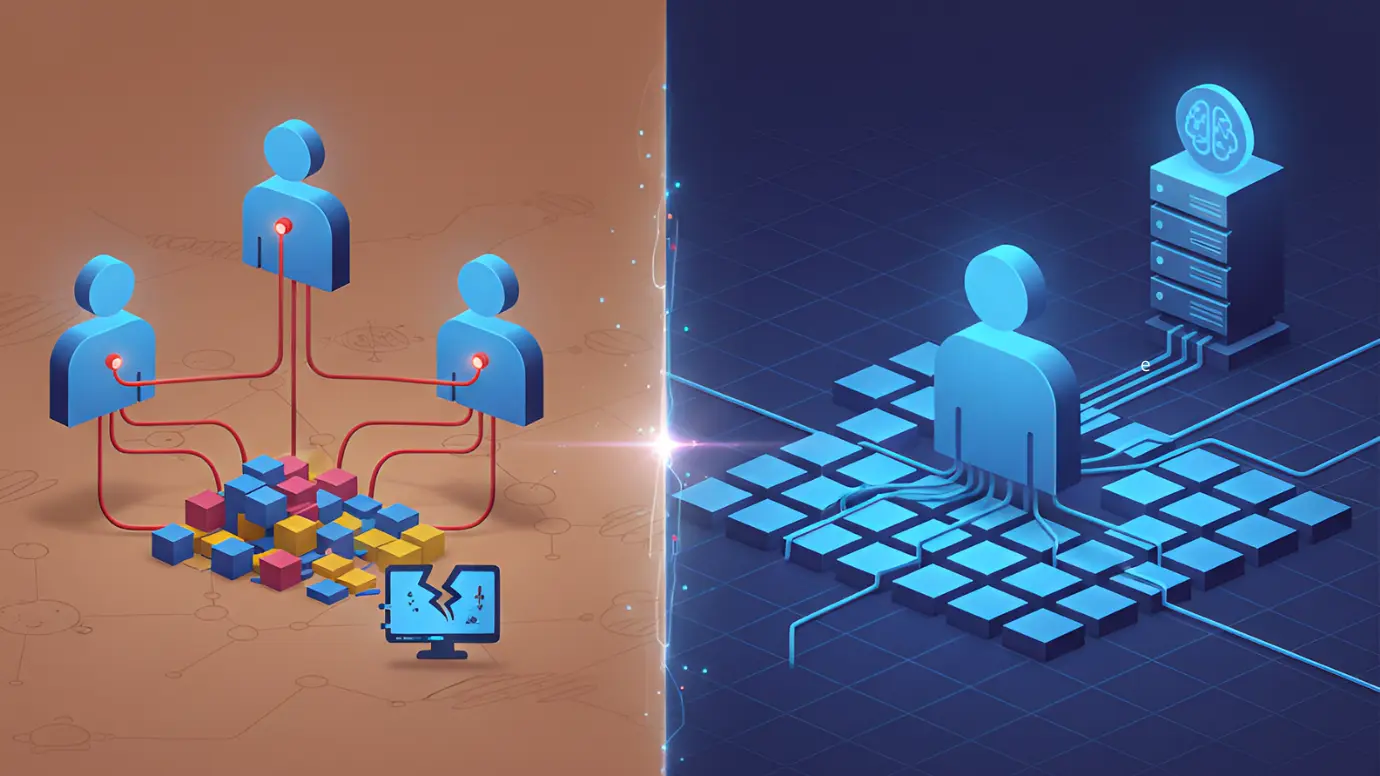

The forecast that freelancers would become the primary workforce by 2027 is proving true, but with a significant twist for the tech industry. In the fast-paced world of Artificial Intelligence, the “solopreneur” model is hitting a ceiling. While several years ago, hiring a few virtual assistants for data entry was enough, today’s complex ML models demand something more robust: a managed workforce.
If you want to avoid the common pitfalls of hiring, it is time to move beyond the gig economy. Collaboration with a professional team isn’t just an expense — it’s the most strategic investment you can make to ensure your model reaches production-ready quality.
The Freelancer Trap: Why Individual Hiring Fails at Scale
Many business owners start with individual freelancers to save costs. However, as your project grows, so does the “management tax.”
- Fragmentation: Managing five freelancers means five different communication styles and five different quality standards.
- The Interpretation Gap: Without a centralized lead, instructions often get “lost in translation,” leading to inconsistent data labeling.
- Security Risks: Scaling AI projects often involves sensitive data. Managing NDAs and secure access for a rotating door of individuals is a logistical nightmare.
As a leader, your time shouldn’t be wasted on micro-managing small tasks. You need a system that functions productively while you focus on high-level strategy and innovation.
The Hidden Friction of the Gig Economy
While the gig economy offers a vast pool of talent, it carries “hidden friction” that can grind a high-stakes AI project to a halt. When you rely on a decentralized group of individuals, you aren’t just hiring workers; you are unknowingly becoming a full-time project manager, recruiter, and quality assurance lead.
The “Management Tax”
In the beginning, hiring one or two freelancers seems easy. But when your project requires scaling, the math changes. Managing 20 individual freelancers is not 20 times harder than managing one — it’s exponentially more complex.
- Recruitment Fatigue: You spend more time interviewing and onboarding new people than actually moving the project forward.
- The Communication Vacuum: Without a unified team structure, you are forced to repeat the same instructions, clarify the same edge cases, and fix the same errors over and over again.
Quality Inconsistency (The Data Noise)
For AI and machine learning, consistency is everything. If three different freelancers interpret a labeling guideline in three different ways, your model receives “noisy” data. Inaccurate labeling is one of the top data labeling mistakes that can sabotage your model’s performance.
The Result: You spend more on “cleaning” the data than you did on the original annotation.
Lack of Accountability
A typical freelancer works for their reputation, but they are also juggling multiple clients. If a freelancer disappears or misses a deadline due to a personal emergency, your entire pipeline stops. In a managed workforce model, the responsibility for “bench strength” and reliability sits with the provider, not the client.
Security and IP Risks
As a business owner, you cannot afford to have your proprietary data or project details scattered across various unmanaged home networks. A professional managed team provides GDPR-compliant data company
standards and CCPA-compliant data company protocols by default.
What is a Managed Workforce and Why Does Your AI Model Need It?
A managed workforce is a professional service model where a third-party provider takes full responsibility for a specific business process—from recruiting and training to quality control and technical infrastructure. Unlike the gig economy, where you manage the people, with a managed workforce, you manage the results.
For AI companies, this isn’t just a convenience; it’s a necessity. Training an AI model requires thousands of hours of highly consistent data labeling. A managed team acts as a specialized extension of your own office, providing the structure that individual freelancers lack.
The Core Pillars of a Managed Workforce
To understand why this model is superior for scaling, let’s look at what’s “under the hood”:
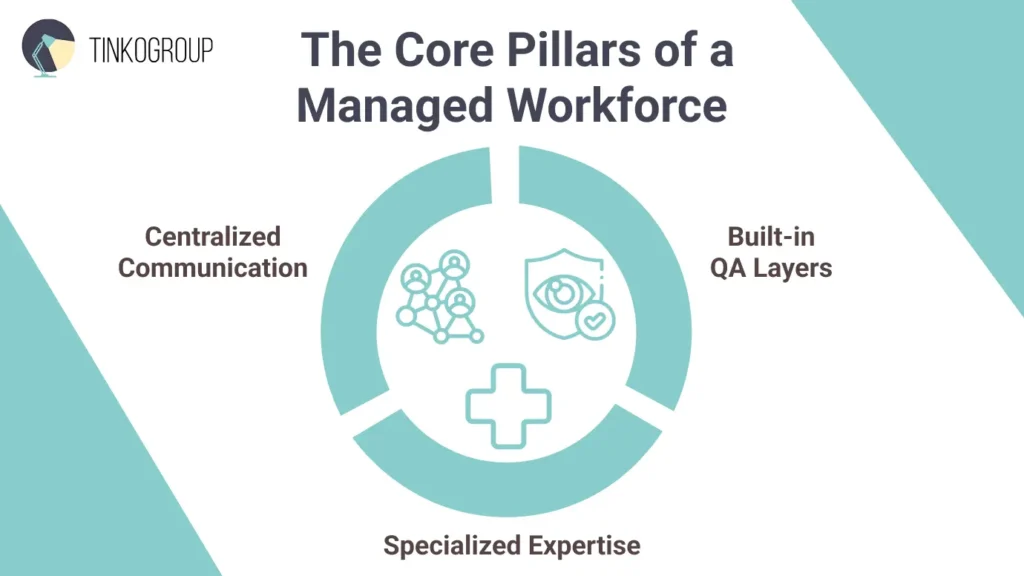
- Dedicated Project Management: You communicate with one Lead. They handle the “translation” of your technical requirements to the entire team, ensuring everyone is on the same page.
- Multilayered Quality Assurance (QA): Professional teams have a built-in “second pair of eyes” policy. Before any data reaches your model, it is vetted by internal auditors who catch errors that a lone freelancer might miss.
- Domain Expertise: A managed workforce isn’t composed of “generalists.” These are specialists who have been trained in specific niches—like medical imaging, LiDAR for autonomous driving, or sentiment analysis for LLMs.
Why Your AI Model Depends on It
- Data Lineage and Consistency: A managed workforce ensures that correct annotations are maintained across millions of items.
- Rapid Ramp-up: Need to scale from 5 to 50 annotators in a week? A managed provider has a “bench” of trained experts ready to jump in. Doing this on your own through freelance platforms would take months of interviewing.
- Zero Infrastructure Overhead: You don’t need to provide the software, the security protocols, or the workstations. The managed team comes with its own “toolbox.”
The Tinkogroup Advantage: We don’t just provide “hours”; we provide “outputs.” By combining a managed workforce with expert supervision, we eliminate the noise that usually plagues outsourced data.
Scaling Without the Stress: Managed Workforce vs. In-house Hiring
When companies outgrow freelancers, they face a classic dilemma: “Should we build our own internal team or partner with a managed workforce?”
While having an in-house team feels like having “total control,” the reality of scaling often brings unforeseen stress and financial overhead. For AI projects that can fluctuate in volume, the managed model often proves more sustainable.

Reliable Data Services Delivered By Experts
We help you scale faster by doing the data work right - the first time

The True Cost of In-house Teams
The salary of an annotator is just the tip of the iceberg. When you hire internally, you are also paying for:
- HR and Recruitment: The time spent sourcing, interviewing, and background-checking candidates.
- Office and Hardware: Providing high-end workstations, secure internet, and office space.
- Benefits and Taxes: Social security, insurance, and the administrative burden of payroll.
- Management Overload: Every 10 annotators require a team lead. Who manages the managers?
Flexibility: The “Elastic” Advantage
AI development is rarely a linear process. You might have a month where you need 50 people for a massive data sprint, followed by two months of model testing where you only need 5.
- In-house: You are stuck with the overhead. Firing and rehiring is expensive and damages your company’s reputation.
- Managed Workforce: You scale up or down based on your current project phase. You only pay for the output you need, making your burn rate far more efficient.
Comparing the Three Models
| Feature | Freelancers | In-house Team | Managed Workforce |
| Setup Speed | Instant | Slow (Weeks/Months) | Fast (Days) |
| Quality Control | Client’s Responsibility | High (but expensive) | Built-in (QA layers) |
| Scalability | High friction | Low/Difficult | Seamless |
| Security | Minimal | High | High (Enterprise-grade) |
| Cost | Low (initial) | Very High | Optimized |
Focused on What Matters
As a business owner, your focus should be on your AI’s architecture and your product’s market fit—not on whether the office coffee machine is working or if an annotator’s Wi-Fi is down. By choosing a managed workforce, you outsource the operational headaches, allowing your core engineering team to focus on innovation.
Transitioning to Excellence: 3 Steps to Upgrade Your Workflow
Moving from a fragmented freelance model to a structured managed workforce doesn’t happen overnight, but it is simpler than you might think. To ensure a smooth transition that doesn’t disrupt your ongoing development, we recommend a three-step approach.
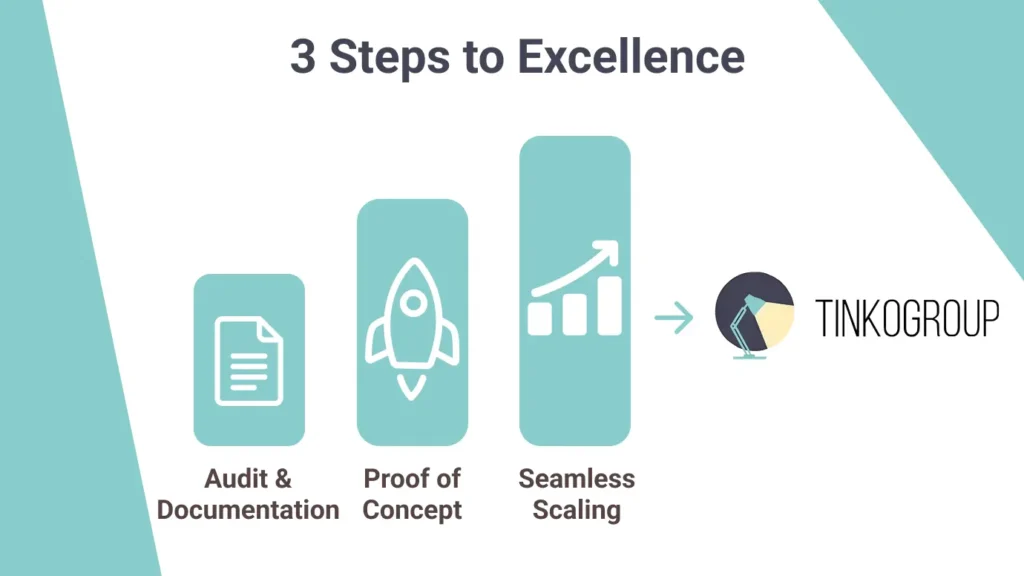
Step 1: Audit and Documentation
Before you hand over the keys to a managed team, you need to consolidate your “tribal knowledge.”
- Define Guidelines: Take your current labeling instructions and turn them into a formal SOP (Standard Operating Procedure).
- Identify Edge Cases: List the “grey areas” your freelancers struggled with. This will be the first thing your new managed team lead will address.
- Security Requirements: Determine what level of data access the team needs.
Step 2: The Pilot Sprint (The “Proof of Concept”)
Never transition 100% of your workflow at once. Start with a pilot project—a small, representative batch of data (e.g., 500 images or 1,000 text strings).
- Test the QA Loop: Use this stage to see how the managed team handles feedback.
- Measure Throughput: Establish a baseline for how fast the team can deliver without compromising accuracy.
- Refine Communication: Set up the “Slack/Email/Jira” rhythm with your dedicated Project Manager.
Step 3: Gradual Scaling and Optimization
Once the pilot project proves successful, start migrating your workload in phases.
- Knowledge Transfer: As the managed team becomes more familiar with your niche, they will begin to suggest improvements to your guidelines, acting as a partner rather than just “hands.”
- Full Integration: At this stage, your internal engineers should no longer be checking individual labels. They should only be reviewing the high-level quality reports provided by the managed workforce lead.
Why This Transition Matters
By following these steps, you transform your data pipeline from a source of stress into a predictable, high-speed engine. You move from “hoping the freelancers get it right” to “knowing the team will deliver.”
Conclusion: Your Data Success Starts with the Right Partnership
The landscape of work has shifted. Just as the creators of Apple’s operating system or the visionaries behind Adobe Acrobat relied on specialized external talent to bring their ideas to life, today’s AI pioneers need a robust foundation to scale.
Relying on a fragmented group of freelancers is a starting point, but it isn’t a long-term strategy. To build an AI model that truly “runs the world,” you need the consistency, security, and scalability of a managed workforce. By moving away from the “hidden friction” of the gig economy and embracing a managed service model, you reclaim your most valuable resource: time.
At Tinkogroup, we understand that project success starts with the client’s vision and ends with expert execution. We help you scale faster by doing the data work right — the first time.
Ready to see the difference between “freelance” and “managed”? Don’t take our word for it — test our quality for yourself. Experience how a professional managed team can transform your data pipeline.
What is the difference between a managed workforce and a traditional BPO?
While a traditional Business Process Outsourcing (BPO) often focuses on volume and low-cost labor, a managed workforce is a more integrated partnership. It includes dedicated project management, specialized training for technical tasks like data labeling, and a focus on quality metrics that align directly with your AI model’s performance.
Is a managed workforce more expensive than hiring freelancers?
Initially, a managed workforce may have a higher hourly rate than individual freelancers. However, when you factor in the “hidden costs” of freelancer turnover, recruitment time, quality errors, and the need for internal management, a managed workforce typically offers a much lower Total Cost of Ownership (TCO) at scale.
Can I start with a small team and scale up later?
Yes, that is one of the primary benefits. Most managed service providers (like Tinkogroup) allow you to start with a small pilot team to establish the workflow and then rapidly scale up to dozens or hundreds of annotators as your project demands grow.