


In the era of artificial intelligence and top data processing companies, when the volume and variety of data are growing exponentially. The quality of data processing is becoming one of the main factors in the success of digital projects. Sloppy data processing and errors at the system input stage lead to distorted analytical conclusions, reduced model quality, and loss of competitive advantage.
Companies that choose external partners for data processing should focus not only on promises of “speed” or “low cost”. But it should focus above all on process maturity, proven security standards, and the ability to scale services to real workloads.
This article discusses key data processing vendors in the BPO and outsourcing segment, their capabilities, strengths, and actual offerings.
How to Evaluate a Data Outsourcing Provider
Choosing a data processing contractor is not an operational decision but an architectural one. A mistake at this stage is costly: pipelines are rewritten, trust in analytics is lost, technical debt grows, and product launch is delayed. Choosing the right partner requires evaluating not only processing capabilities but also broader data governance, quality control, and scalability requirements. Businesses comparing providers may find this overview of top data management companies for high-volume projects useful when assessing long-term operational fit.
Over the past ten years, the outsourced data processing market has changed radically. Previously, companies mainly outsourced data entry and simple transactional operations. Today, we are talking about preparing datasets for AI, building scalable ETL architectures, complying with regulatory requirements, and ensuring end-to-end process transparency.
Therefore, the evaluation of a data processing company must be systematic. Below is a detailed analysis of the criteria that really influence the result.
Accuracy as a Basic KPI
Any data processing services provider declares a high level of accuracy — 98%, 99%, sometimes 99.5%. However, analysts look not at the figure in the presentation but at the method used to achieve it.
- What to check:
- Is there multi-level quality control?
- Initial check by the contractor
- Selective audit by a senior specialist
- Statistical control of the sample
- Automatic validation scripts
- Are automated verification tools used?
Strong data processing vendors combine manual and automated data processing. A completely manual process is not scalable. A completely automated process does not ensure semantic accuracy.
- Are there measurable SLAs?
- Error rate by data type
- Error correction time
- Escalation procedures
- Is an audit trail provided?
In AI projects, it is important to understand who changed the data and when. Companies that are not willing to disclose their quality control methodology usually operate at the transactional BPO level. But they are not suitable for strategic projects.
Architectural Compatibility and Integration
Modern online data processing rarely exists in isolation. It is embedded in an ecosystem:
- cloud storage (Snowflake, BigQuery, Redshift)
- orchestration (Airflow, Prefect)
- transformations (dbt)
- BI tools (Power BI, Tableau, Looker)
The analyst evaluates:
- Is there API access?
- Are streaming scenarios supported?
- Is it possible to work with S3, Azure Blob, GCP Storage?
- Is there experience integrating with existing pipelines?
The contractor only works with Excel files and FTP transfers. This is a sign of low technological maturity.
Security and Compliance
For many companies, this is a critical filter. The following are checked:
- ISO 27001;
- GDPR procedures;
- HIPAA (if medical data is processed);
- SOC2;
- NDA and DPA;
- role-based access control;
- encryption of data at rest and in transit
Having a certificate does not guarantee process maturity. The analyst pays attention to:
- regularity of audits;
- incident response procedure;
- internal access management policy.
For financial and medical companies security is not an option, but an obligation.
Scalability
Many data processing companies look convincing during the pilot phase. But the real test begins when volumes grow.
Key questions:
- How quickly can the team be expanded?
- Is there spare capacity?
- Are automated data processing tools used to reduce manual labor?
- Is there experience working with millions of records per day?
Scalability is not just about the number of people. It is about:
- standardized SOPs;
- automated templates;
- repeatability of processes;
- training new specialists without compromising quality.
Without this, an increase in data volume leads to an increase in errors.
Type of Specialization
Not all data processing vendors are the same. They can be divided into several categories:
- Classic BPO. Focus on mass data entry, form processing, transactions.
- AI-oriented companies. Specialization in annotation, dataset preparation, NLP markup. An example would be companies similar in model to data enrichment companies.
- Hybrid models. Combine transactional processing and integration with analytics.
The choice depends on the tasks at hand. A company that only works with manual input is not suitable for an ML project. Banking operational support does not require a complex ML provider.
Cost of Ownership, Not Just Price
Outsourced data processing that is too cheap often means:
- high employee turnover
- inconsistent quality
- hidden costs for correcting errors
An analyst evaluates:
- how much 1,000 processed records cost
- how much it costs to correct 1% of errors
- what is the cost of project delays due to poor data quality
The real cost of a project is not the contract price. But the impact is on downstream analytics and business decisions.
Management and Communication
Successful B2B data processing is impossible without transparent communication.
It is important to check:
- whether a dedicated account manager has been assigned;
- whether regular reports are provided;
- how quickly incidents are responded to;
- whether there is a ticketing system in place;
- whether they operate in the required time zone.
Communication failures are often the reason for contract termination.
Document and Complex Scenarios
If the project includes document processing services, it is worth clarifying:
- whether OCR/ICR engines are used;
- whether there is post-processing control;
- how handwritten documents are processed;
- whether multilingual data is supported.
Companies with large flows of PDFs and scans must have robust automation tools. And also they must have experience with manual verification.
Risk Management
Any mature supplier should have:
- backup teams;
- a business continuity plan (BCP);
- a disaster recovery policy;
- a quality monitoring system.
If a supplier cannot describe their contingency plan, this is a red flag.
When Outsourcing is Truly Justified
Outsourced data processing is appropriate when:
- there is no internal operations team;
- rapid scaling is required;
- the project is temporary or seasonal;
- savings on fixed costs are needed.
However, when strategically dependent on data, companies often benefit from a hybrid model. There is core expertise in-house, operational load outsourced.
Final Checklist for Technical Managers
Before signing the contract, the analyst recommends requesting:
- description of the QA process;
- examples of quality reports;
- security certificates;
- description of the integration architecture;
- SLA and penalties;
- scaling plan;
- example of a pilot project;
- contacts of existing customers (if possible).
The selection of a company from the list of top data processing companies should be based not on marketing claims, but on verifiable processes. High-quality data processing is the foundation of analytics, AI, and business solutions.
A properly selected data processing company becomes part of the architecture. An incorrectly selected one becomes a source of constant technical debt.
Overview of Leading Suppliers
The data processing outsourcing market has become significantly more mature and segmented. Whereas previously most players offered similar services for data entry and structuring. Today’s top data processing companies differ in terms of their specialization, technological depth, and level of integration into their clients’ AI and BI infrastructure.
Some companies have evolved from classic BPO and remain strong in large-scale transactional data processing and document processing services. Others have focused on intelligent automation. They introduce elements of automated data processing and integration with cloud platforms. A separate category is providers close to the data enrichment companies segment. Its focus is on preparing data for machine learning and analytical models.
This review looks at the main data processing vendors in the international market. It uses publicly available data. It covers service descriptions, certifications, tech focus, positioning, and industry specialization. The goal is to show how operating models process maturity. And each provider could fit real B2B situations.
Next, we give a detailed analysis of the companies. We reviewed their key strengths, and limits from the view of technical and operations teams.
Tinkogroup — a Specialized Provider of Data Processing for AI and Analytics
Tinkogroup positions itself as a company focused on preparing, structuring, and controlling the quality of data for AI projects and analytical systems. Unlike traditional BPO players, the main focus is not simply on mass data entry. But it is on improving the accuracy and suitability of data for downstream use in BI, ML, and automated decision-making systems.
A key feature of the model is its focus on data hygiene. The format standardization, duplicate elimination, reference normalization, logical validation, and array integrity control. This brings the company closer to the segment of technology-oriented data processing vendors rather than traditional back-office outsourcing.
The list of services includes:
- comprehensive data processing services for AI and analytics;
- structuring and cleaning large data sets;
- support for ETL processes;
- partial automation through automated data processing tools;
- quality control with multiple levels of verification.
The company operates in the B2B data processing model, focusing on SaaS products, e-commerce, fintech, and projects where scalability. And process reproducibility is important.
Players specializing exclusively in document processing services or basic data entry. Tinkogroup emphasizes integration into the client’s analytical pipelines. This is important for companies that use cloud storage, BI platforms, and ML tools.
In terms of scalability, the company is suitable for projects with medium and growing data volumes. At the same time, it does not position itself as a mega-large BPO operator with thousands of employees. But rather its position as a flexible technology partner capable of adapting processes to a specific client architecture.
Compared to classic outsourced data processing companies, Tinkogroup is closer to a hybrid model. It is a combination of operational processing and analytical data preparation.
Potential strengths:
- attention to accuracy and quality control;
- focus on ai scenarios;
- process flexibility;
- integration with BI and analytical systems.
Limitations to consider when evaluating:
- less extensive range of BPO services compared to large international operators;
- limited public information about the scale of infrastructure and certifications.
Thus, it is logical to consider Tinkogroup in the context of projects where data purity and support for analytical scenarios are critical, rather than just mass online data processing or transactional input.
Flatworld Solutions — a Large Bpo Provider Offering a Wide Range Of Services
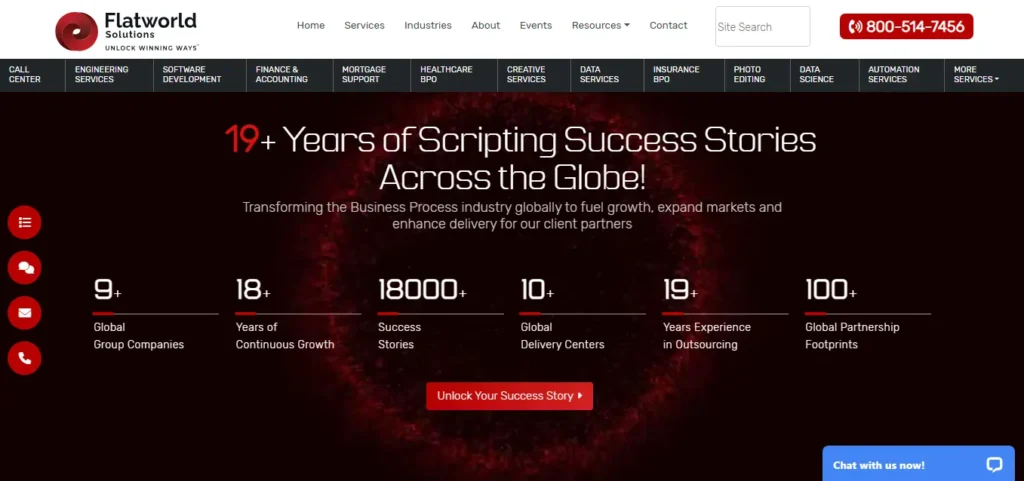
Flatworld Solutions is a large and versatile business services outsourcer offering data processing, BPO, IT outsourcing, and workflow automation. The company is actively developing hyperautomation offerings, combining RPA, ML/NLP tools, and traditional BPO mechanisms.
Flatworld offers:
- basic data processing services, including data processing, conversion, OCR engines, and standardization;
- analytical support through BI tools;
- business process automation services, which are important for integration with data processing pipelines;
- quality support at 98%+.
This makes the company attractive for a business that needs a combination of operational support and technological automation. But it is hard to find detailed data processing SLAs in open sources. Analysts need to take this into account when choosing a provider.
SunTec India — a Mature Outsourcer with Experience in Data Lifecycle Management
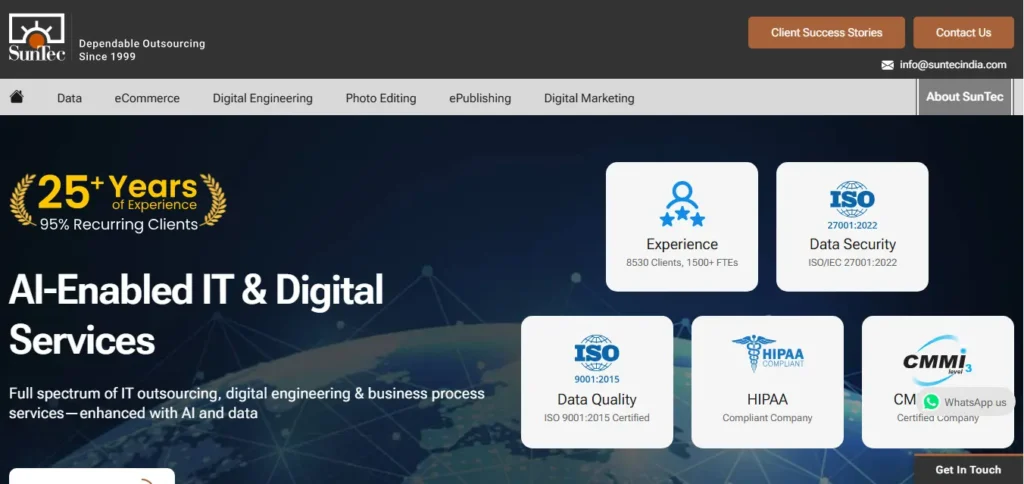
SunTec India has been operating in the market for over 25 years and combines traditional outsourced data processing services with modern automation technologies and data lifecycle management. The company is focused on large-scale customer service, has hundreds of FTEs on staff, and holds a wide range of certifications (ISO/IEC 27001, ISO 9001, HIPAA, CMMI).
The range of services includes:
- data lifecycle: collection, cleaning, verification, annotation, and management;
- online and offline data entry;
- automation of data entry and use of tools to reduce errors;
- processing of various types of documents (PDF, forms, tax documents, and others).
SunTec has proven its ability to work with diverse data sets, integrate automation into processes. And they ensure stable delivery of results to clients’ BI networks with high customer retention rates.
HabileData — Focus on Data Preparation and Cleaning
HabileData is one of India’s oldest BPO service providers, with over 25 years of experience working with large companies around the world. Its core competencies include high-level data cleansing, standardization, validation, and processing services, including the processing of forms, product catalogs, invoices, checks, and other business data.
HabileData’s services include:
- data cleansing — eliminating errors, duplicates, normalizing and maintaining consistency;
- transactional and document data processing;
- continuous service and monitoring support;
- outsourced data processing, allowing you to focus on strategic business tasks.
HabileData also offers related services, including web research and data collection, which is useful for preparing large training datasets for analytics and AI.
Hitech BPO — a Wide Range of Operations
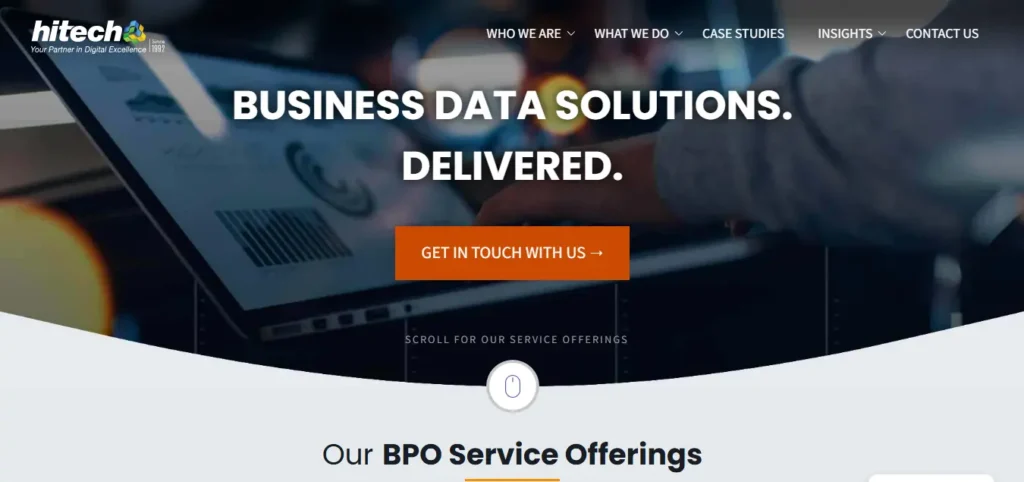
Hitech BPO is a traditional outsourcer offering a wide range of data processing and related services. The company works with data processing, conversion, and cleansing, web research, data catalog management, image retouching, and other related processes that are often required in complex BI initiatives.
Features:
- many years of experience (since the early 1990s);
- proven ability to process millions of transactions annually;
- coverage of several industries, including consulting, marketing, technology, and finance.
Hitech BPO is attractive to technical leaders as a provider that can handle the “dirty” work of data entry and processing. But it has less focus on deep integration with AI core or ML pipelines compared to data science-focused companies.
Invensis — a Mature Partner for Long-Term Projects
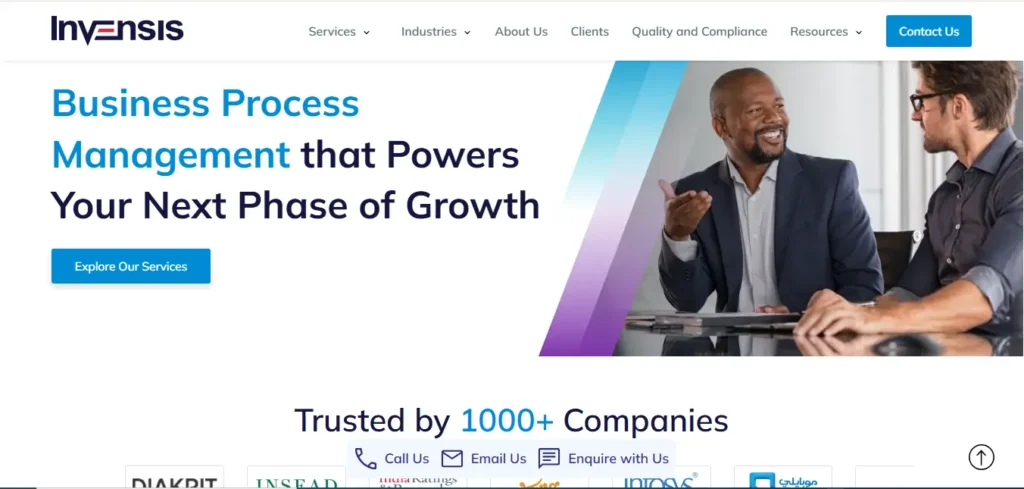
Invensis is one of the most stable players in the data processing company market, with over 25 years of experience. The company manages large teams of specialists and offers end-to-end solutions for data processing, cleaning, capture, conversion, visualization, and storage.
Invensis’ strengths:
- a systematic approach to processing — from collection to visualization;
- use of modern tools (Spark, Hadoop, cloud platforms, etc.);
- certified practices, including ISO and GDPR;
- support for integrations and API connectors.
Invensis is capable of operating as a classic B2B data processing provider, with an emphasis on analytical value rather than just transactional input.
InputiX — a Traditional Outsourcer with Automation Elements
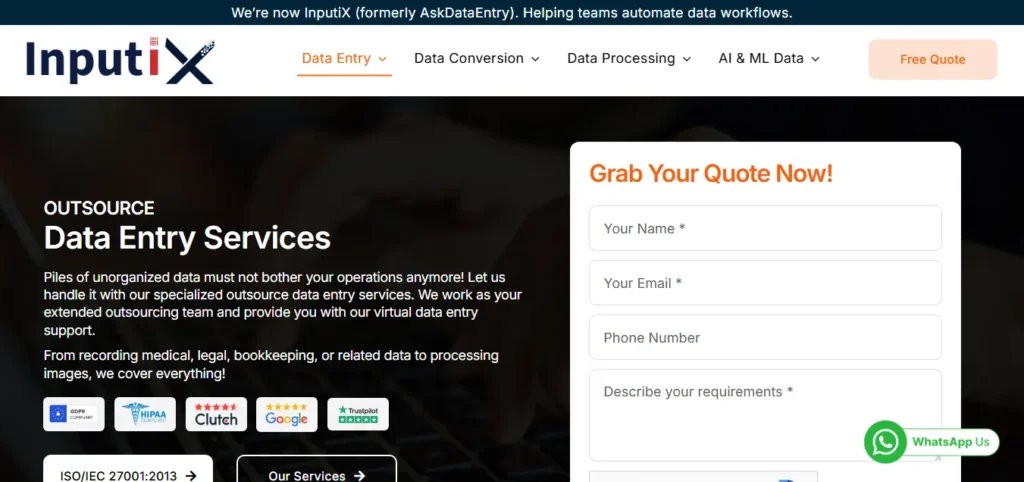
InputiX (formerly AskDataEntry) focuses on data entry and processing tasks, transforming unstructured arrays into organized digital forms. The company offers a wide range of input operations — from OCR and ICR to processing checks, forms, and images.
Key features:
- support for online data processing via secure VPN sessions;
- a wide range of input tasks, from accounting records to CRM information;
- a combination of automated tools and manual verification;
- security and protocol compliance guarantees.
InputiX operates primarily in the data entry and structuring segment, with a focus on improving accuracy and reducing errors in basic business operations.
Comparative Analytics on Key Parameters
Comparative analytics based on key parameters is necessary. Because the top data processing companies list alone does not provide an understanding of which contractor is suitable for a specific architecture and business task. In recent years, the data processing market has become highly segmented. Some companies remain classic BPO operators. Others have moved into automation. And still others have focused on AI data preparation. Therefore, they need to be compared based on several practical criteria, rather than marketing claims.
The first parameter is depth of specialization. Tinkogroup is closer to AI and analytics tasks. The company focuses on data preparation, quality control, structuring, and working with training datasets. At the same time, Flatworld Solutions, SunTec India, and Invensis act as universal data processing vendors with a wide range of services. From basic data entry to analytical support. HabileData, Hitech BPO, and InputiX are more focused on transactional and document data processing. Including document processing services and mass online data processing.

Reliable Data Services Delivered By Experts
We help you scale faster by doing the data work right - the first time

The second important factor is the level of automated data processing. Without automation, scaling becomes expensive and unstable. Flatworld Solutions actively promotes hyper-automation, SunTec India integrates data lifecycle management tools, and Invensis claims to use modern platforms and cloud infrastructure. Tinkogroup uses a combined approach — partial automation with enhanced manual quality control. Hitech BPO and InputiX rely more on OCR and manual verification. It is suitable for structured tasks. But limits growth rates for large volumes.
The third parameter is quality control. In B2B data processing, even a one percent difference in accuracy can mean thousands of errors when dealing with millions of records. Tinkogroup emphasizes data hygiene and multi-level verification. SunTec India and Invensis rely on standardized processes and certifications. HabileData specializes in cleaning and deduplication. Classic BPO players provide standard control procedures that are sufficient for operational tasks, but not always for critical AI scenarios.
Scalability also varies. Flatworld Solutions, SunTec India, and Invensis are suitable for enterprise workloads due to their team size and global presence. HabileData and Hitech BPO are stable for high-volume transactions. Tinkogroup is more flexible and suitable for projects with medium and growing volumes, especially if integration with analytical infrastructure is important.
In terms of security and compliance, SunTec India and Invensis have the most clearly stated international standards. Large BPO operators have formalized security processes, but in any case, they require a separate technical audit. For projects with regulatory risks, this factor can be decisive.
The data processing market is heterogeneous. If you need mass outsourced data processing and document processing services — it makes sense to consider large BPO players. If the task involves preparing data for AI and analytics — it makes sense to choose companies that focus on quality and structuring, including Tinkogroup. There is no universal leader. The choice depends on the type of data, accuracy requirements, workload, level of automation, and the strategic role of data in the business.
Conclusion
Choosing the right data processing contractor is a strategic decision that directly affects the quality of analytics, the effectiveness of AI projects, and the company’s business processes. The market is heterogeneous. Large BPO operators are strong in mass outsourced data processing and document processing services. Specialized players (such as Tinkogroup) focus on preparing data for analytics, AI, and BI integrations with an emphasis on accuracy, standardization, and automation.
Tinkogroup helps companies build reliable data pipelines by providing multi-level verification, cleaning, and structuring of information. It reduces errors, speeds up processing, and integrates seamlessly with existing analytical infrastructure. By focusing on meticulous manual control and human expertise, Tinkogroup ensures the level of precision required for both medium-sized and growing projects that demand high-quality data. To ensure your business operates with flawless datasets, you can explore our comprehensive data processing services designed for complex analytical tasks.
What is the industry benchmark for data accuracy in AI projects?
While many providers claim 99% accuracy, the real benchmark is defined by a multi-level quality control process. High-quality AI models require not just raw data entry, but logical validation and statistical sampling to eliminate systemic bias before the data reaches the training phase.
When is it better to choose a specialized vendor over a large BPO operator?
A specialized vendor is preferable for AI-driven and analytical projects that require deep data hygiene, formatting, and structural integrity. Large BPO operators are better suited for massive, repetitive transactional tasks (e.g., simple form entry) where volume is more critical than complex architectural compatibility.
How does data processing outsourcing affect long-term technical debt?
Choosing a provider based solely on low cost often leads to “dirty” data, forcing engineers to rewrite pipelines and clean datasets manually later. A partner that ensures architectural compatibility and provides an audit trail prevents technical debt by delivering ready-to-use data for BI and ML ecosystems.