

The ethical AI supply chain is no longer a niche concept — it has become one of the most urgent questions the AI industry cannot avoid. For years, progress meant faster models, larger datasets, and lower costs. Behind that progress stood thousands of people – data annotators, content reviewers, and quality specialists. Their work shaped the systems we now call “intelligent,” but their working conditions remained almost invisible.
That silence is breaking. New regulations, including the EU AI Act, and growing ESG expectations pose a simple but often uncomfortable question for companies: who built your data and under what conditions? Regulators, enterprise clients, and the public want to be sure that companies treat their AI workforce with dignity. So, the conversation is shifting from data volume to manual data processing ethics.
Against this backdrop, Tinkogroup, an AI data services company, has completed an independent evaluation of the ethical AI supply chain by Fairwork. It’s the globally recognized independent labour standards project based at the Oxford Internet Institute and the WZB Berlin Social Science Center.
We operate from Estonia with a Ukrainian-led team of 55+ specialists, many of whom work in a challenging geopolitical environment. We do not claim perfection, but still choose to be transparent about data annotation labor standards. During the evaluation, we implemented 15 concrete policy changes. And it’s only the start of our transformation.
At Tinkogroup, we are sure that voluntary auditing is no longer a signal of intent. It is becoming a real competitive advantage in B2B data services.
The Fairwork Framework: Why It Matters for AI
AI systems grow, and quality and data quality assurance mean much more than simply high performance. Companies now need to ask a bigger question: What are the working conditions for the people building these systems? Fairwork has built a framework that evaluates companies against core principles of responsible AI sourcing. This framework covers the five main Fairwork AI principles:
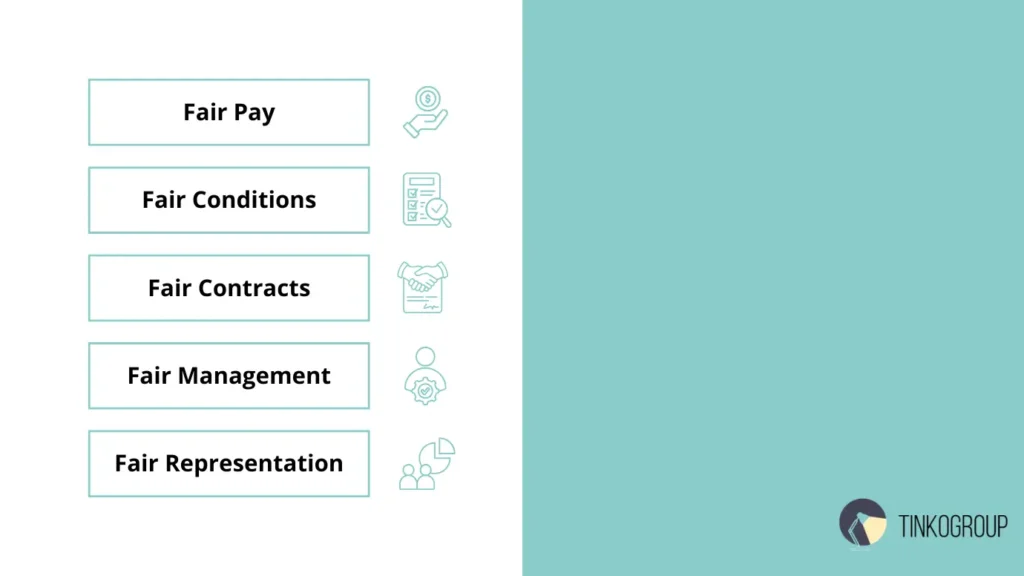
Fair Pay means companies must guarantee that their workers earn at least the local minimum wage and, ideally, a living wage. It is not enough to pay on time; wages must be adequate, workers should know how their pay is calculated, and they must have a documented channel to discuss discrepancies.
Fair Conditions is about the real challenges of the job. Fairwork requires companies to identify and reduce risks to workers’ physical and mental health. Employers should create official policies to protect their workforce from harm. These protections are especially important for data annotators who often face upsetting content.
Fair Contracts require companies to write clear, easy-to-understand agreements that reflect real working conditions. The contract must describe the real work being done, without hidden roles or misleading terms. If the company needs to make a change to the contract, it must inform workers in advance.
Fair Management means companies must be open about how they make decisions, track performance, and handle disputes. They must use management tools fairly and transparently. Also, there should not be room for bullying or high-pressure tactics.
Fair Representation means workers can speak up. A company has more power than one person, and the goal is to balance things out. This could be a union or a group that speaks for the whole team.
This framework works because it rests on serious academic research. The Oxford Internet Institute and the WZB Berlin Social Science Center run Fairwork. It studies working conditions in the digital and gig economy across more than 40 countries, using interviews and surveys with thousands of workers to rate companies and assess labor standards.
In the context of AI, Fairwork emphasizes that fairness is a must not only at the level of major tech companies but across the entire supply chain of human labor behind AI systems, including data annotators and outsourcing firms.
An ethical AI supply chain framework is critical because AI does not replace human work. It changes work and often hides it. Every functioning AI model relies on people who label data, verify outputs, and fine-tune systems. These are annotators, reviewers, and quality checkers. They are the actual workforce behind the screen.
Tinkogroup’s team is part of this global workforce. Our daily decisions directly affect how AI behaves in the real world. The Fairwork audit makes our work visible and evaluates Tinkogroup against human-in-the-loop ethics.
Deep Dive: The 15 Radical Transformations
Between our initial self-assessment and the final Fairwork report, Tinkogroup introduced 15 documented policy changes. Below, we highlight four areas that represent fundamental shifts in how we operate.
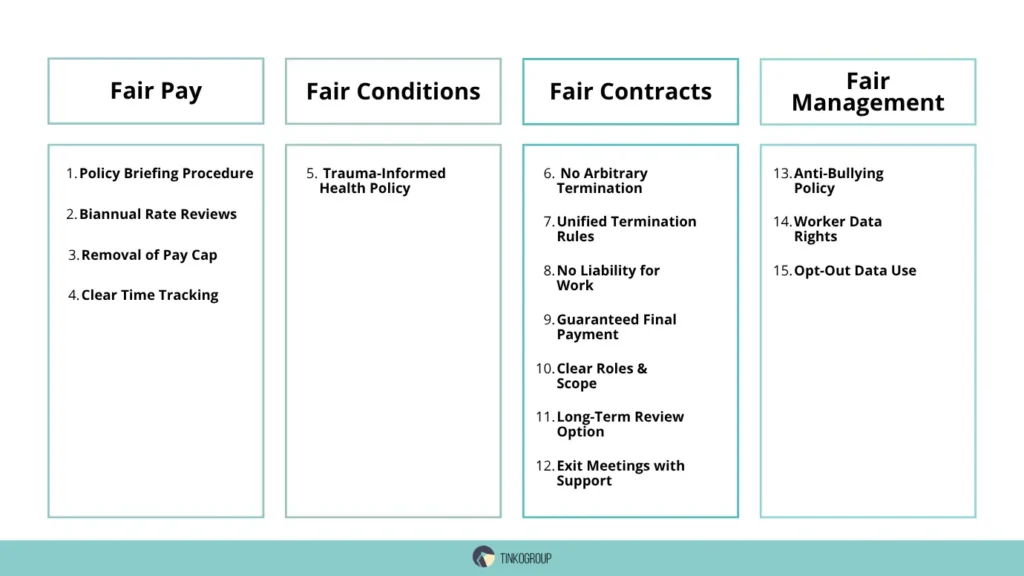
Fair Pay: Four Changes to Transparency and Compensation
Change 1. Policy Briefing & Acknowledgment Procedure
Tinkogroup implemented a clear system to ensure workers actually understand the company rules. New hires get acquainted with these policies when they start, current workers review them every year, and everyone confirms in writing that they’ve read them.
Change 2. Biannual Rate Reviews
The company now checks and updates workers’ pay twice a year. Before, there was no set system, so pay could stay the same for a long time. Now, we adjust pay regularly based on performance, market changes, or higher living costs.
Change 3. Removal of the 10% Cap on Pay Increases
We removed a rule that capped yearly pay raises at 10%. It sounds small, but when prices went up quickly, wages couldn’t keep up. Now, there is no limit for pay increases, so they can better match real economic conditions.
Change 4. Clear Time Tracking Rules
Workers weren’t always sure what counted as paid work. Now the rules clearly explain what time can be logged and how to record it. This makes things less confusing, and workers are always sure they get paid for all the work they actually do.
Fair Conditions: One Major Change
Change 5. Occupational Safety and Health (OSH) Policy
This is one of the most important improvements. Data annotators often deal with sensitive or disturbing material. This includes text, images, or video content that can be psychologically hard to review. Fairwork places strong emphasis on this reality through its “Fair Conditions” principle. Standard OSH protocols treat this as an ergonomic issue and recommend screen breaks, wrist rests, and so on. That is often insufficient for an ethical AI supply chain.
We’ve introduced a trauma-informed health policy that treats mental well-being as a non-negotiable requirement. Now, we categorize every project by its “psychological load.” If a task is intense, it automatically means shorter shifts, mandatory breaks, and task rotation so no one gets stuck on it for too long. We’re also training our leads to talk about these things and spot red flags before someone is burnt out. The goal is to ensure that, at the end of the day, our people can “switch off” without bringing work home with them.
Fair Contracts: Seven Improvements
Change 6. Removal of “Termination for Any Reason”
We removed a rule that allowed the company to fire workers without a reason. Now, workers have more job security, and they can only be let go for clear, stated reasons.
Change 7. Consistent Termination Rules Across Documents
Previously, various documents contained conflicting rules regarding termination. Now, all contracts use the same terms, and things are clearer and more consistent.
Change 8. No Liability for Incomplete Work
Workers are no longer financially responsible for unfinished work if their contract ends. This removes a major risk during termination.
Change 9. Guaranteed Payment Up to Termination
Workers now get paid for all the work they finish before their contract ends. This makes their pay clear and protects them financially.
Change 10. Clear Roles and Responsibilities
Contracts now include specific job titles and task descriptions rather than vague, overly broad definitions. Employees know exactly what they are agreeing to do.
Change 11. Long-Term Engagement Review
After three years with the company, workers can request a review of their job status. The company doesn’t have to change anything, but this gives long-term workers a chance to raise the issue of job security.
Change 12. End-of-Engagement Meetings with Representation
Long-term workers now have formal exit meetings and can bring a representative. This adds fairness and support during a critical moment.
Fair Management: Three Changes
Change 13. Fair Treatment of Workers Policy
Bullying and harassment often remain unreported in a remote environment and often become normalized. We introduced an Anti-Bullying and Anti-Harassment Policy that covers harassment, discrimination, and workplace behavior. It includes clear reporting channels, investigation timelines, and a structured appeals process. There is also a guarantee that workers won’t face retaliation for raising concerns. Plus, workers can now review performance metrics through regular feedback processes.
Change 14. Worker Data Rights Policy
The company now clearly explains what worker data it collects and how it is used. Tinkogroup now guarantees every worker the right to review, correct, and delete their personal data held in our systems. This includes communication logs, performance metrics, and any stored identification documents. It’s a rare but very important move in the industry.
Change 15. Opt-Out from Non-Essential Data Use
Workers can now say no to extra data use, like analytics or profiling, without it affecting them. This means only necessary data is used, and workers have more control over their personal information.

Reliable Data Services Delivered By Experts
We help you scale faster by doing the data work right - the first time

Confronting the Structural Challenges
AI workforce transparency demands honesty. Fairwork’s evaluation did not say everything is perfect, and we did not expect it to. Fairwork has measured us against a living wage standard and social protections. The report highlights that our company does not yet meet Fairwork’s highest standards in these two key areas. Transparency means we should talk about these challenges as openly as we talk about our progress.
The Earnings Gap: Living Wage in a Wartime Economy
The Fairwork report notes that while Tinkogroup pays above Ukrainian legal minimums, a gap remains relative to a full living wage (as calculated by local cost-of-living indices). We don’t dispute this finding. Context matters, but it is not an excuse. Ukraine’s economy has been battered by war. Inflation is volatile, energy costs have surged, and many of our team members work from cities under regular missile threat. In that environment, “living wage” calculations shift monthly.
Our commitment is transparent. We have created a 12-month plan to close at least 80% of the living wage gap. We will do this by raising base pay and adding performance-based bonuses. Fairwork will review our progress again in Q1 2027.
Social Protections: The Paid Leave Challenge
Currently, not all Tinkogroup workers receive formal paid sick leave or vacation accrual. This reflects our hybrid structure: some team members are employees (with full protections), and others operate as formal contractors under Ukrainian law, which is a legal category that historically excludes such benefits.
Fairwork recommends moving toward universal standards of an ethical AI supply chain. So, we plan:
- A pilot program for independent contractor protections.
- A phased transition to employee status for long-term contractors (12+ months continuous service).
- Partnership with Ukrainian legal experts to design a compliant, portable benefits model.
“Tinkogroup demonstrated meaningful engagement with the Fairwork process and introduced 15 documented changes to policies and employment terms during the evaluation period,” and will continue working to implement further improvements identified in the report.
Resilience in Times of Crisis: The Ukrainian Context
To understand Tinkogroup, you need to understand what it means to build an ethical company in Ukraine in 2026. The core of our team consists of Ukrainians working in conditions of war and disruption. That choice says a lot about the commitment and resilience of our specialists. Our Ukrainian Heart drives us to prove that you can lead with ethics, even in the most challenging times. Air-raid sirens can interrupt meetings, power cuts can affect schedules, and uncertainty is part of our daily lives. Still, we continue to deliver strong work for global clients.

We fully understand why formal labour standards are so important. Clear contracts, fair pay rules, and written protections reduce confusion and stress. They give workers something to rely on when everything around them is unstable. Tinkogroup’s commitment to an ethical AI supply chain is not a slogan. It’s a firm decision to treat people fairly and build something stable, even in difficult conditions. It is about respect for the people doing the work.
The Fairwork recognition also matters to the team. It shows that their working conditions are independently checked and approved. In an uncertain environment, external trust and reassurance are important.
Impact on Clients & Global AI Ethics
People in AI ethics often use the term ethical debt. It is similar to technical debt in software. When teams build systems quickly without checking the conditions behind the data, problems build up over time. In AI, this happens when companies ignore how people produce training data. Later, this can create issues with compliance, legal review, and reputation.
The Fairwork evaluation reduces this risk for Tinkogroup’s partners. It shows that the data meets technical standards and comes from working conditions that an independent third party has checked. This gives CTOs and project managers clear evidence of an ethical AI supply chain.
Regulations are getting stricter every year. The EU AI Act compliance makes companies fully responsible for high-risk AI systems, including the quality of training data and parts of their supply chain. New EU rules also require companies to look at labour conditions beyond physical work and into digital labour. ESG in tech has become more important, and companies must now explain how they treat workers across their operations.
Tinkogroup’s Fairwork evaluation supports this shift. It provides a third-party record of labour practices and a clear plan for further change. Companies can use this information in ESG reports, compliance work, and internal ethics reviews.
Conclusion & Future Outlook
Tinkogroup does not claim to have fully solved ethical AI data work. Instead, we chose a more difficult but more honest path. We invited an independent organization to review our operations, published the findings openly, and committed to a clear public plan for improvement.
Our participation in Fairwork is not the end of the process. It is the start. Fairwork will return to review our progress on key issues, including the living wage gap, paid leave, and stronger worker representation. Tinkogroup is ready for all the accountability that awaits us.
To our team in Ukraine and beyond: we deeply value each member’s contribution. Thank you for your honesty during the worker interviews, for your patience as we rewrote policies, and for your daily courage. This report is yours.
To our clients and partners, we invite you to read the full Fairwork report below and ask us hard questions about our roadmap.
And to the broader AI industry: the era of “efficiency at any cost” is ending. The question is not whether you will be audited. It is whether you are ready for this step.
Download the full Fairwork report here.
Are you ready to join the conversation on the ethical AI supply chain? Follow Tinkogroup on LinkedIn.
What is an ethical AI supply chain?
An ethical AI supply chain ensures that all human labor behind AI systems — including data annotation, review, and quality assurance — is performed under fair, transparent, and safe working conditions. It extends ethical responsibility beyond algorithms to the people who build and train them.
Why does the ethical AI supply chain matter for businesses?
It reduces legal, reputational, and compliance risks, especially under regulations like the EU AI Act. Companies that prioritize ethical data sourcing can demonstrate transparency, strengthen ESG reporting, and build long-term trust with clients and stakeholders.
How can companies improve their ethical AI supply chain?
By adopting independent frameworks like Fairwork, implementing clear policies on pay, contracts, and worker protection, and committing to regular audits and transparency. Continuous improvement — not one-time compliance — is key to building a truly ethical system.