


In 2026, the top data entry companies market continues to evolve, driven by shifting business priorities toward accuracy, data security, and scalability flexibility. Operations managers, data ops teams, administrators in healthcare and finance, and startup founders are looking to choose data entry outsourcing partners not only based on price. But it is also based on the real value they bring. Beyond the obvious cost savings, the strategic benefits of high-quality data entry services include reduced errors, accelerated decision-making, and increased corporate data security.
How to Choose a Data Entry Outsourcing Contractor
Over ten years of working with operational teams, the author of this review has seen one recurring mistake: companies choose contractors based on price per line rather than cost per error. In data entry outsourcing, an error in a single field can affect reporting, billing, compliance, or clinical decisions. Therefore, choosing a partner among data entry outsourcing companies should start not with price. Start with risk assessment.
Below is a systematic approach used by mature Data Ops teams when selecting a data entry services provider.
Start with an Audit of Your Own Processes
Before entering the data entry companies USA market, a company must answer three basic questions:
- What types of data are processed?
- What is the current error rate?
- Where do delays occur?
If the process is not described internally, the contractor will not be able to optimize it. The best data entry companies don’t just accept files — they ask uncomfortable questions about data logic, fields, sources, deadlines, and usage scenarios.
Evaluate the Quality Model (QA Framework)
A high-quality data entry company can always demonstrate:
- a documented quality control process;
- a double entry or double verification scheme;
- accuracy levels for the last 6–12 months;
- the method used to calculate accuracy;
- the error correction procedure.
It is important to understand the difference between:
- declared accuracy (e.g., 99%);
- verified accuracy with reports;
- guaranteed accuracy according to SLA.
Mature outsourced data entry services use multi-stage control: operator → verifier → selective audit → final validation. If a company cannot describe the process step by step, this is a risk signal.
Check Security and Compliance with Standards
For the healthcare, finance, and legal sectors, security is not a marketing point. But it is a legal obligation.
When choosing a data entry services provider, you need to request:
- HIPAA compliance (if there is medical data);
- ISO 27001 or equivalent;
- access management policy;
- data encryption in transit and storage;
- NDA and DPA;
- incident response procedure.
Reputable data entry outsourcing companies provide security documentation without resistance. If the documents are “in preparation,” it is better to continue your search.
Assessing Manual Data Entry Skills
Despite advances in OCR and AI, manual data entry remains critical for:
- handwritten forms;
- insurance claims;
- medical records;
- legal documents;
- complex non-standard tables.
It is important to understand:
- how operators are trained;
- whether there is specialization by industry;
- how much time is required to onboard a new team;
- whether there are backup employees.
Companies that rely entirely on automation without manual verification often demonstrate increased speed at the expense of quality.
Scalability and Resilience to Workloads
Many companies face seasonal peaks. For example:
- tax season;
- open enrollment in healthcare;
- mass data migrations.
Good data entry companies in the USA can:
- quickly expand their team;
- reallocate resources;
- ensure continuity of work in case of failures.
Ask a direct question: “How many records do you process during a peak month?” An experienced provider will answer with numbers, not generalities.
Technological Integration
Modern online data entry services should support:
- API integrations;
- secure file transfer channels;
- cloud storage;
- CRM systems;
- ERP platforms.
A contractor who requires files to be sent manually without a secure channel creates additional risk.
It is also important to understand whether the following are used:
- OCR;
- RPA;
- automatic validation;
- AI prompts for operators.
But technology should not replace control — it should reinforce it.
Transparent pricing
There are three common models in data entry outsourcing:
- price per record;
- hourly model;
- fixed project cost;
Operations managers should consider not only the cost per line, but also:
- the cost of correcting errors;
- internal communication time;
- delays;
- additional auditing.
Sometimes a more expensive data entry company turns out to be more economical due to a lower error rate.
Industry Experience
Specialization matters. Healthcare requires:
- understanding of terminology;
- HIPAA compliance;
- accurate handling of PHI.
Finance requires:
- character-level accuracy;
- auditability;
- change traceability.
- E-commerce requires:
- speed;
- working with catalogs;
- processing SKUs and attributes.
The best data entry outsourcing companies are not universal in everything — they have strong industry focus areas.

Reliable Data Services Delivered By Experts
We help you scale faster by doing the data work right - the first time

Pilot Project
Experienced Data Ops managers almost always launch a pilot project. What is evaluated in a pilot project:
- actual accuracy;
- response speed;
- quality of communication;
- SLA compliance;
- level of documentation.
A pilot project identifies weaknesses faster than any presentation.
Communication and Operational Maturity
High-quality data entry companies are distinguished not only by their accuracy, but also by:
- speed of response;
- transparency of reporting;
- willingness to discuss problems;
- availability of an account manager.
If a contractor avoids discussing mistakes, this is a warning sign.
Comparison of In-House Teams and Outsourcing
Before choosing among data entry companies in the USA, it is important to compare:
In-house data entry:
- fixed salaries;
- vacation pay;
- staff turnover;
- infrastructure;
- training.
Data entry outsourcing:
- flexible costs;
- scalability;
- external expertise;
- reduced administrative burden.
For fast-growing companies, outsourcing often proves to be a more sustainable model. Businesses comparing providers across different markets can also explore data entry companies in Europe to assess regional options for scalable and accurate data management.
Realistic Expectations
No data entry company can guarantee absolute accuracy. It is important to understand:
- the acceptable error rate;
- correction procedures;
- response time to incidents.
Mature customers incorporate the contractor control process into their overall data management strategy.
Final Checklist for Selecting a Contractor
Before signing a contract, check:
- Is there a documented QA system?
- Is accuracy confirmed by actual reports?
- Does security comply with standards?
- Is there experience in your industry?
- Whether the pricing model is transparent?
- Whether a pilot has been launched?
- Whether the contractor understands your business goals?
Choosing among the top data entry companies is not just about purchasing a service. It is a decision about who to entrust with the foundation of your operational data.
Companies that take a systematic approach to choosing a contractor do not usually change it every year. They build long-term partnerships where outsourced data entry services become part of an overall data management strategy, rather than just a support function.
Top Data Entry Companies in the US: An Overview of Proven Providers
The top data entry companies market in 2026 has become significantly more mature and competitive. Ten years ago, companies chose contractors based on the principle of “who is cheaper and faster”. But today, priorities have changed. Accuracy, security, process transparency, and the ability to scale without compromising quality have come to the fore.
For operations managers, Data Ops leaders, and administrators in healthcare and finance, choosing among data entry companies in the USA is a strategic decision. An error in a single record can affect financial statements, insurance payments, or clinical data. Therefore, it is not just a matter of purchasing data entry services, but of reducing operational risks.
Below is an analytical overview of the leading data entry outsourcing companies that demonstrate robust quality control processes, a mature security model, and a real ability to work with large volumes of data in 2026. The list includes companies with different profiles, from technology-oriented players to specialists in manual data entry and comprehensive online data entry services.
Each company was evaluated based on the following criteria:
- accuracy and QA methodology;
- compliance with security standards;
- industry specialization;
- scalability;
- transparency of the operating model.
This list is not an advertising rating. But it reflects the real position of players in the data entry outsourcing market in terms of process maturity and practical value for business.
Tinkogroup
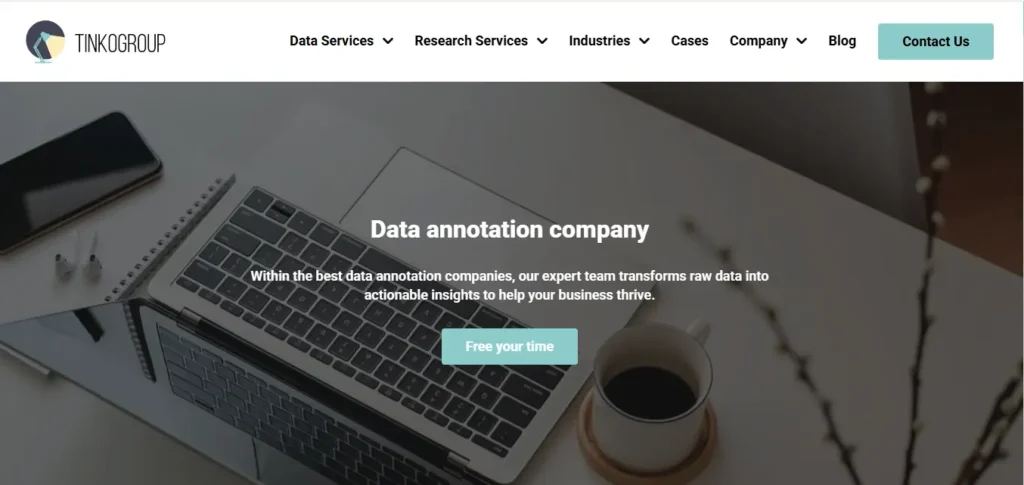
Tinkogroup positions itself as a provider of comprehensive data entry services focused on business tasks of all sizes, from startups to enterprise-level. Their website contains a detailed description of services for data entry, validation, and standardization from various sources: checks, handwritten forms, PDFs, spreadsheets, and CRM systems.
Key features:
- Security expertise. The website emphasizes compliance with security standards such as GDPR and HIPAA compliance, which is important for processing confidential data from the medical and financial sectors.
- Wide range of formats. The company states that it works with various formats, including Excel, Word, PDF, electronic forms, and non-standard sources.
- Flexible service models. Processes can be adapted to customer needs and integrated with existing systems via API or secure data exchange channels.
- Case studies and reporting. The website features examples of cooperation with companies from various industries and project reports, which indicates the maturity of the processes.
This makes Tinkogroup a suitable candidate for organizations looking for a strategic partner for data entry, rather than just a contractor for a specific task.
TechSpeed
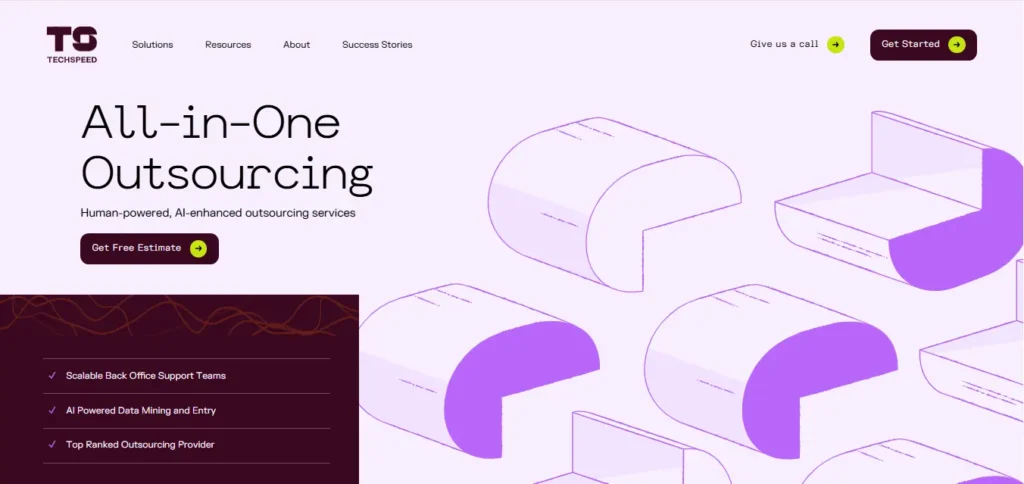
TechSpeed is a traditional BPO (Business Process Outsourcing) company offering outsourced data entry services as part of a wide range of back-office support services. Its main areas of expertise include:
- Paper and electronic form processing. TechSpeed takes data from physically completed forms, surveys, questionnaires, and invoices and converts it into structured digital formats.
- Classification and categorization. Support for data classification by category, key fields, and logical rules.
- OCR support. The website mentions the use of OCR technology for automatic text reading, after which the data is manually verified to improve accuracy.
- The company emphasizes its many years of experience working with large volumes of data and draws attention to cases where it has processed hundreds of thousands of records for non-profit and commercial clients.
TechSpeed is suitable for companies that need reliable basic data processing within the framework of classic BPO.
ARDEM
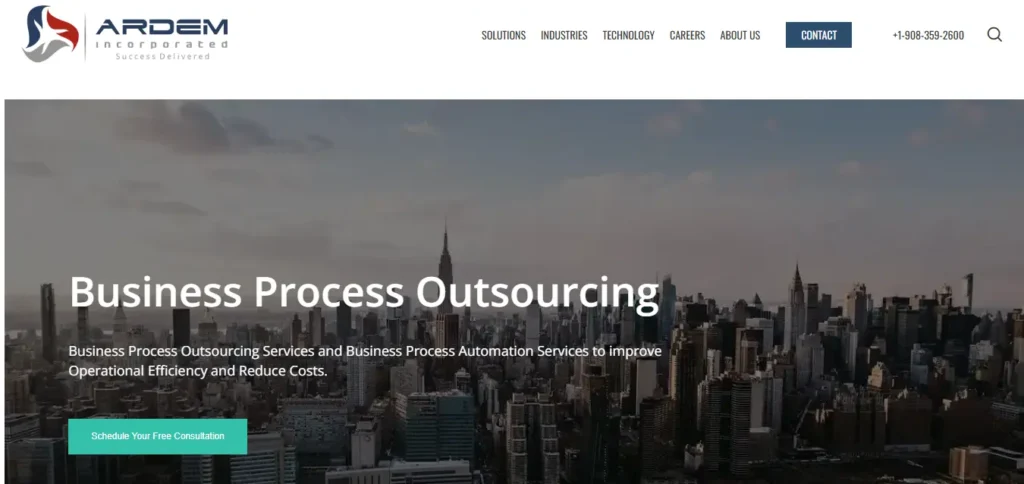
ARDEM is a provider that actively promotes a hybrid approach, where automation and manual data processing work together. The company’s website describes the following:
- Hybrid model. Automation tools (AI, RPA) are used for pre-processing, and then the data undergoes manual validation. It increases speed without compromising quality.
- Customizable solutions. ARDEM offers to tailor the process to specific scenarios, including the processing of logistics data, insurance forms, financial records, and other types of information.
- Strong technology layer. The company emphasizes that it uses digital tools to speed up data entry. But it does not replace human expertise with them.
Important: ARDEM focuses not only on data entry. But it also focuses also on additional business information processing services. It makes the approach more comprehensive than pure data entry services.
SunTec Data
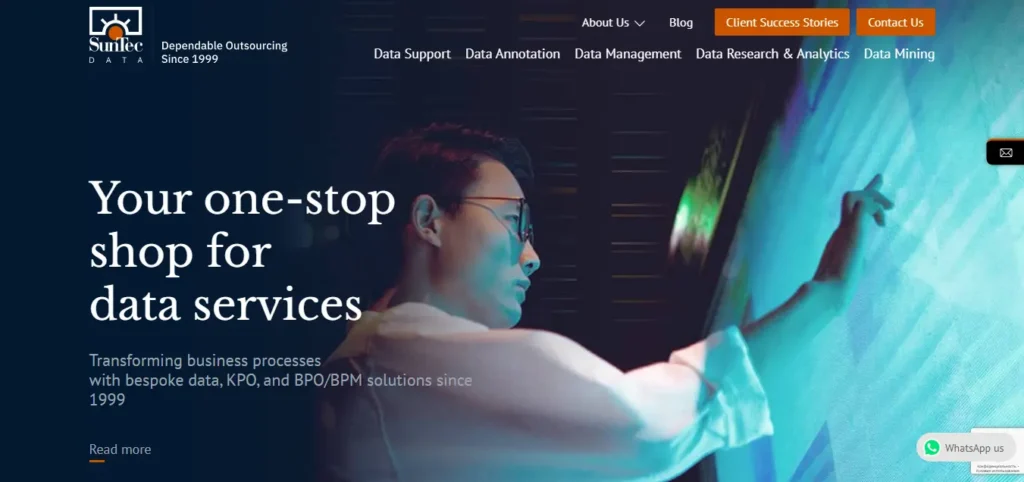
SunTec Data positions its offerings as part of a broader set of data support services, including:
- Data cleansing and enrichment. Data cleansing, duplicate removal, and normalization of information for further processing.
- CRM data processing. Data entry into CRM systems, customer data management, and format standardization.
- E-commerce and financial data support. Processing records for online stores, product catalogs, and financial reports.
- SunTec Data focuses on providing ISO-level security and compliance for customers in healthcare, finance, and other regulated industries.
Important note: the company’s website provides information not only about data entry. But also about data management services in general.From preparation to transfer to target systems.
Managed Outsource Solutions
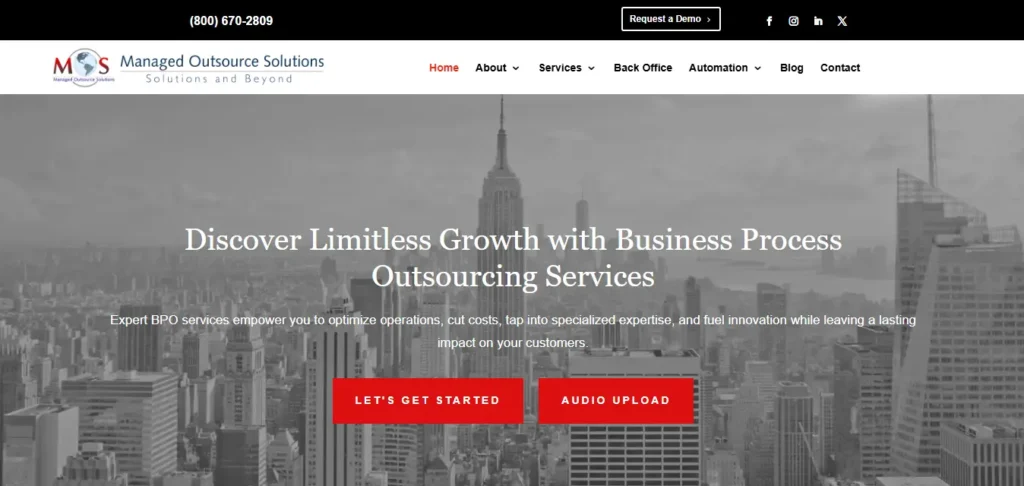
Managed Outsource Solutions (MOS) offers outsourced data entry services that combine manual entry and intelligent automation. Key aspects:
- DeepKnit AI. The company uses its own AI tools to automatically process and predict errors, reducing manual workload.
- CRM and electronic formats. Data entry from Excel, images, PDF, and support for CRM integrations.
- Flexible support models. MOS focuses on adapting to customer needs, including changes in data volumes and increasingly complex forms.
- The website emphasizes that AI mechanisms are used to improve quality and speed, but the key part is the people who provide quality control.
MOS is suitable for companies looking for a balance between automation and control, especially when it comes to processing large amounts of data.
Invensis
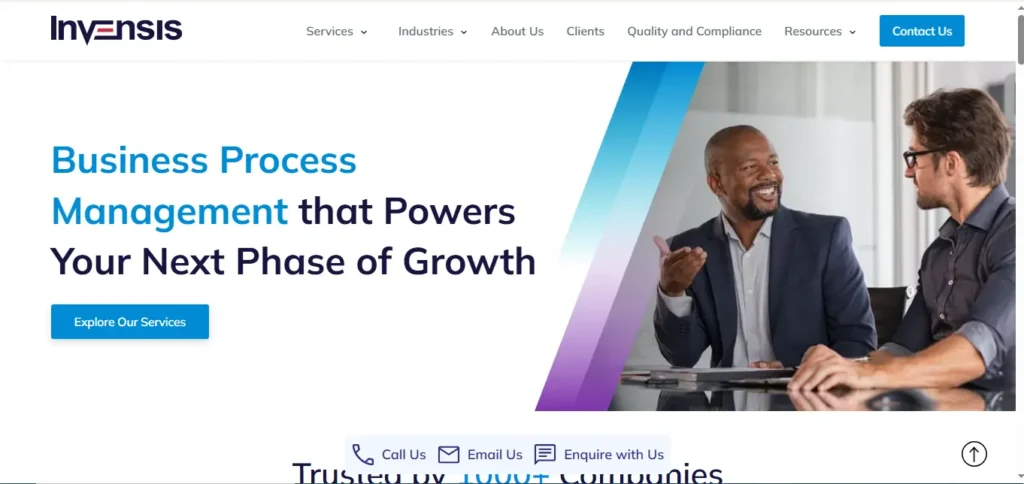
Invensis positions its data entry outsourcing services as part of a broader, fully integrated BPO ecosystem rather than as a standalone operational function. The company presents data entry as one component within a structured service environment. It includes back-office support, finance and accounting services, customer support, and other process-driven solutions. This integrated positioning appeals to organizations looking for long-term outsourcing partnerships rather than isolated project-based engagements.
One of the key strengths emphasized on the website is the company’s extensive operational experience. Invensis has been active in the outsourcing industry for many years and highlights its work with international clients across multiple sectors. This longevity signals operational maturity, established delivery frameworks, and the ability to manage complex, large-scale engagements. For enterprise clients, years of experience often translate into refined workflows, documented procedures, and reduced implementation risk.
Another important feature is the use of double-keying and structured verification methodologies. The company references multi-level quality control processes designed to ensure high data accuracy. Double-keying. The data is entered independently by two operators and then reconciled. It remains one of the most reliable methods for minimizing manual entry errors. It is combined with supervisory checks and predefined quality benchmarks. This approach supports consistent output quality, particularly for high-volume or compliance-sensitive projects.
Invensis also supports a wide range of input sources. It includes paper forms, scanned documents, electronic files, PDFs, and spreadsheets. This flexibility allows clients to outsource both legacy document backlogs and ongoing digital workflows. The ability to handle diverse data formats is particularly relevant for organizations undergoing digital transformation while still managing historical physical records.
Tab Service Company
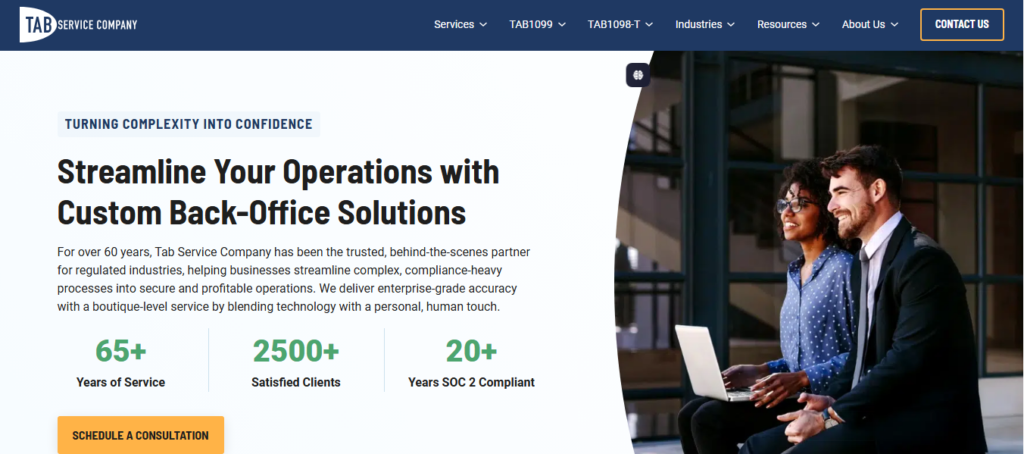
Tab Service Company is one of the most established organizations in the data entry and data capture market. It has decades of operational experience supporting structured document processing and information management initiatives. The company’s positioning is built around process stability, regulatory compliance, and verifiable accuracy rather than aggressive automation or experimental technology models.
One of the most important aspects highlighted on the website is compliance with SOC 2 and HIPAA standards. This is particularly significant for organizations operating in regulated industries such as healthcare, insurance, and financial services. Here the protection of sensitive information is not optional but mandatory. SOC 2 compliance signals that internal controls related to security, availability, and confidentiality are independently audited. HIPAA compliance, in turn, is critical when handling protected health information (PHI). For clients, this reduces vendor risk and simplifies due diligence during procurement and compliance reviews.
Another core strength emphasized by the company is its two-step data verification methodology. This structured approach involves multi-level validation to minimize input errors and ensure consistency across datasets. In environments where even small inaccuracies can affect reporting, billing, claims processing, or regulatory filings, a formalized verification model significantly improves reliability. Rather than relying solely on automation, the company integrates controlled human validation to maintain high levels of precision.
The website also notes that each project is assigned a dedicated project manager. This model supports structured communication, clearer accountability, and tighter quality control. A dedicated manager oversees workflow coordination, timeline management, quality checkpoints, and client communication. For enterprise clients, this structure provides greater transparency and reduces operational friction, particularly in long-term or high-volume engagements.
Comparative Table of Services
Selecting a data entry outsourcing partner requires more than reviewing marketing descriptions or isolated service pages. Decision-makers need a structured way to compare providers across operational, technical, and compliance-related dimensions. A comparative table makes these differences visible and measurable. It helps organizations move from general impressions to practical evaluation.
The table below outlines the core service components of each provider. It includes scope of data entry services, verification methodologies, automation usage, security standards, project management structure, and system integration capabilities. These factors are typically central to procurement decisions, especially in industries where accuracy, regulatory compliance, and data integrity directly affect business performance.
This table does not say which company is the best. It shows what each company is good at. Some companies focus on careful manual work. Some use AI to help. Some work with very big businesses. Some follow strict rules for safety and privacy. When you look at everything side by side, it is easier to understand which company fits your needs. You can choose the one that works best for your tasks, your size, and your future plans.
| Company | Accuracy | Automation | Scale | Industries |
| Tinkogroup | high | moderate | flexible | all |
| TechSpeed | high | moderate | high | everything |
| ARDEM | high | high | high | industrial |
| SunTec Data | high | average | average | e-commerce, finance |
| MOS | medium-high | high | high | CRM, ecommerce |
| Invensis | high | moderate | very high | global |
| Tab Service | very high | low | average | healthcare, legal |
What Is Important To Consider After Analyzing Websites
When choosing a data entry services provider based on their website, it is worth checking not only the list of services, but also:
- proof of quality (case studies, metrics, reviews),
- security and certifications,
- description of error control methodology,
- availability of automation tools,
- willingness to adapt processes to your tasks.
Website analysis shows that companies’ approaches vary: some focus on technology (e.g., AI and RPA), some on mature control processes, and some on the specifics of industry tasks.
Conclusion
Choosing the right data entry outsourcing partner is not simply a matter of cost reduction. It is a strategic decision that directly impacts data quality, reporting accuracy, operational efficiency, and regulatory compliance. As organizations increasingly rely on structured, reliable data to drive analytics and decision-making, even minor input errors can cascade into significant financial or operational risks.
When choosing a company, businesses should look at a few simple things. They should check if the company works in a clear and honest way. They should see how the company checks for mistakes. They should also make sure the company keeps data safe and can work well with their current systems.
Automation can make work faster. But in areas like healthcare, finance, insurance, and legal services, careful manual data entry is often more reliable. When data is complex or sensitive, it is important to check it more than once to avoid mistakes.
This is where Tinkogroup can help. The company focuses on accurate manual data entry. They use several steps to check the data and make sure it is correct. Their goal is to keep data safe, clean, and reliable. Instead of offering the same service to everyone, Tinkogroup creates a workflow that fits each client’s needs and rules.
What are the key factors to consider when choosing a data entry company?
When selecting a data entry company, focus on accuracy, security standards like HIPAA or SOC 2, scalability, verification processes, and the ability to integrate with your existing business systems.
How do outsourced data entry services ensure data accuracy?
Outsourced data entry services use multi-level verification, double-keying, and a combination of manual and automated processes to minimize errors and maintain high-quality data.
Can online data entry services handle sensitive information securely?
Yes, reputable online data entry services comply with security standards such as HIPAA, GDPR, and SOC 2, ensuring confidentiality and secure handling of regulated or sensitive data.


