

A missing sanctions record or an outdated supplier profile can cost millions in regulated industries. For companies operating in highly regulated industries, it can quickly become a serious risk if it’s inaccurate, outdated, or incomplete. One wrong record or an unverified detail can lead to major fines, legal problems, and seriously hurt a company’s reputation. In healthcare, insurance, and utilities, “dirty data” can directly affect trust, business stability, and the ability to stay compliant.
The financial consequences are already measurable. Organizations are already facing significant costs due to poor data control and compliance failures. According to the IBM Cost of a Data Breach Report 2025 the average cost of a data breach is $4.44 million. Healthcare ranks as the most expensive industry – an incident costs $7.42 million. The impact of dirty data is also devastating in the insurance and utilities sectors.
There is little margin for error. GDPR in Europe, HIPAA, and ESG regulations have raised compliance expectations across industries. Regulators increasingly expect organizations to demonstrate proactive compliance controls.
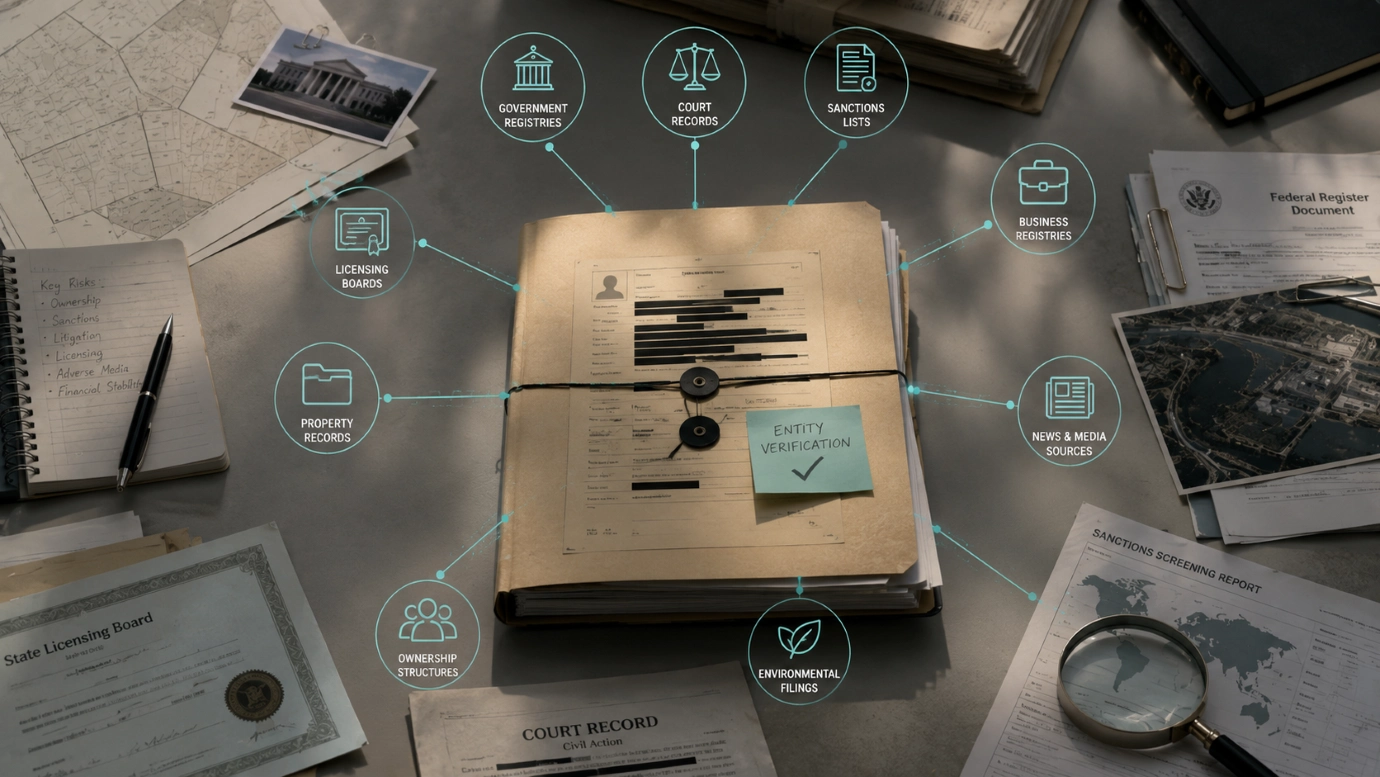
Compliance research exists to reduce these risks. It verifies entities, suppliers, assets, and relationships against regulatory requirements. It goes far beyond a basic background check or a Google search. Compliance research studies public records, government databases, corporate registries, judicial archives, environmental filings, social signals, and technical intelligence.
The intelligence community calls it Open-Source Intelligence (OSINT). This includes KYC/KYB checks, AML monitoring, due diligence, PEP screening, adverse media tracking, and sanctions enforcement.
In 2026, organizations in insurance, healthcare, and utilities use OSINT-based compliance research as a key safeguard against fraud, regulatory penalties, and reputational risk across global markets.
Healthcare: Ensuring Data Integrity and Provider Safety
Healthcare is perhaps the most sensitive industry for research compliance. Providers, payers, and pharmaceutical companies operate under overlapping federal and state mandates, including HIPAA, the False Claims Act, the Stark Law, the Anti-Kickback Statutes, and state medical licensing laws.
Credential Verification Beyond the Paper Trail
Healthcare compliance research starts with a simple question: are healthcare providers really who they claim to be? The National Provider Identifier (NPI) system, managed by the Centers for Medicare & Medicaid Services (CMS), is only the first step. An NPI simply confirms that a provider is registered in the system. It does not tell you whether their medical license is still active, if they’ve been disciplined, or whether they’ve been banned from working with federal healthcare programs.
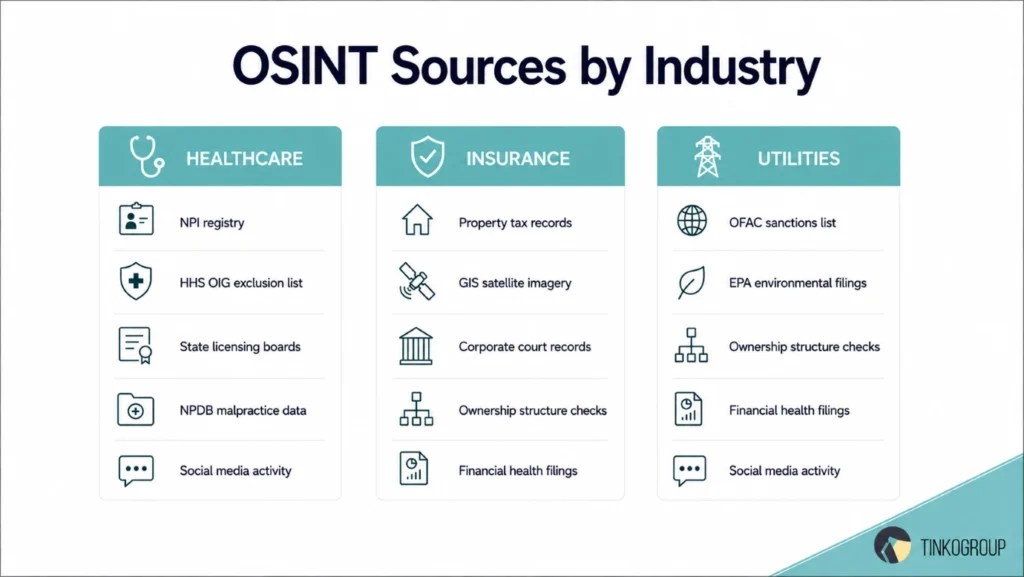
OSINT-based risk assessment research goes much further and combines several public sources:
- State medical licensing boards, which show whether a license is active and list any disciplinary actions or restrictions.
- The HHS OIG exclusion list (LEIE), which identifies providers who are not allowed to bill Medicare or Medicaid.
- SAM.gov, which lists individuals and companies blocked from working on federal contracts.
- DEA registration records for providers who can prescribe controlled substances.
- Malpractice databases like the National Practitioner Data Bank (NPDB) are used to track serious claims and disciplinary history.
These sources don’t always match perfectly, and nobody updates them in real time. Information often arrives missing, delayed, or inconsistent across systems. Compliance researchers compare multiple sources side by side and spot gaps or inconsistencies that automated checks often miss. OSINT tools help researchers identify “shadow” records. They can reveal providers sanctioned in one jurisdiction who later attempt to operate elsewhere under a different name or business entity.
Compliance Research for Pharmaceutical Companies
Digital marketing and distribution compliance also pose another threat to pharmaceutical manufacturers. Pharmaceutical companies are mostly online and on social media. Because companies produce and share content rapidly. Influencers often mix information and advertising, and unauthorized sellers can appear online and disappear before regulators react. This environment creates new compliance challenges. Thus, the FDA and EMA strictly regulate life-saving drug advertising and distribution.
Compliance research in the pharmaceutical industry goes far beyond paperwork. OSINT enables compliance teams to monitor forums, social media platforms, online marketplaces, and affiliate websites to identify false medical claims, misleading promotions, or unauthorized distributors selling products illegally.
OSINT also supports supply chain oversight. Many pharmaceuticals require strict temperature-controlled logistics, known as the “cold chain.” Researchers review logistics documentation, shipment records, and weather data to check if providers store and transport products correctly from production to delivery.
Human research compliance allows pharmaceutical companies to avoid major risks. It reveals unauthorized online sellers distributing expired products and counterfeit medications appearing on hidden marketplaces and unofficial channels.
In 2025, the US Department of Justice carried out its biggest healthcare fraud crackdown. It charged 324 people in schemes involving more than $14.6 billion in alleged fraud. Regulators suspended or revoked the billing rights of many healthcare providers linked to these schemes.
The DOJ investigation highlighted an important weakness in traditional compliance programs. A single background check performed years earlier is no longer enough. That’s why many organizations now rely on ongoing checks and OSINT-based monitoring. Instead of a one-time review, they continuously recheck providers to catch exclusions, disciplinary actions, or license changes early, before they turn into serious compliance risks.
Insurance: Underwriting Accuracy and Fraud Prevention
Fraud remains one of the largest financial risks for insurers worldwide. Insurance fraud loss is between $300 billion and $1 trillion annually. So, insurers need razor-sharp underwriting standards to avoid fraudulent claims. Compliance research and OSINT give insurers a more accurate view of risk.
Sound underwriting depends on three key elements: property values, business history, and claim validity. Traditional internal checks and credit reports aren’t sufficient. Insurers now use web research services and open-source intelligence to get a complete picture of risk before issuing policies.
How Compliance Research Verifies Property Values, Business History, and Claims
Underwriting a commercial property policy is a data-heavy process. Insurers typically rely on tax assessor data and MVRs (Motor Vehicle Records), but these often contain old information. OSINT provides “truth at the moment of binding.”
OSINT researchers use internet research services to cross-check recent sales data and verify property values. They also use GIS (Geographic Information System) satellite imagery to identify unpermitted property additions, for example, a swimming pool or a workshop that was not declared in the insurance application.
OSINT for business uses corporate registries, court records, news articles, and professional networks like LinkedIn to spot warning signs. These can include frequent ownership changes, legal disputes, bankruptcies, or unclear company structures. Web research can also reveal links to risky partners or individuals connected to past violations.
OSINT also helps insurers check whether a claim is genuine. For example, if someone files a claim for storm damage, insurers can check weather data to see whether severe weather actually occurred in that area on that date. In some cases, public photos or social media posts can also help confirm the story behind a claim.
Red Flags Compliant Research and OSINT Reveal
Effective compliance research identifies risks before a policy is approved. Insurers increasingly focus on prevention rather than investigation. They use OSINT and manual data collection to identify risks before claims occur.
In insurance, the most common red flags are:
- Differences between declared income and lifestyle shown on social media.
- A history of frequent small claims or repeated policy cancellations.
- Newly created online accounts with little digital history.
- Negative media coverage or links to previous fraud investigations.
- Different addresses appearing across public records.
Researchers combine automated OSINT tools with human analysis. Automated systems scan large volumes of public information in minutes. This includes social media activity, corporate records, news reports, and adverse media databases. Platforms such as Maltego and Recorded Future help organize this data into a single workflow.
Insurers are now trying to prevent fraud before it happens, instead of dealing with it later.
Compliance research allows companies to improve pricing accuracy, reduce financial losses, and strengthen compliance with AML and KYC regulations before risks become expensive problems.
Jack Higgins in the UK was found guilty of insurance fraud in 2025. He claimed £59,987 for a fake car crash in California. He said he had rented a luxury car and crashed it, but investigators found that he hadn’t visited the US. The rental company he mentioned did not exist, and the damage photos came from an online auction site. The case demonstrates how compliance research can expose fraud that standard checks miss.
Utilities: Supply Chain Transparency and ESG
Utility companies that supply electricity, gas, and water now deal with much stricter rules than before. They face new environmental standards, security requirements for critical infrastructure, and tighter supply chain rules. Utilities are “critical infrastructure,” and the compliance requirements are exceptionally high here, especially regarding who they do business with.
Vetting Vendors for Critical Infrastructure
When a utility company hires a vendor to supply equipment for things like power stations or water treatment plants, price or delivery is only part of the deal. The largest risks often emerge after procurement decisions have already been made.
A vendor with financial problems could stop work halfway through. A contractor with past environmental violations could create legal and safety risks. And a supplier linked to sanctioned companies could put the utility in legal trouble.
OSINT-based vendor checks reduce these risks as they verify:
- Financial health – company filings, public debt records, credit data, and news about layoffs or closures.
- Sanctions checks – OFAC sanctions lists, SAM.gov debarment records, and other international watchlists.
- Environmental history – EPA records, state regulator databases, and past court cases related to pollution or violations.
- Ownership checks – research into who actually owns the company behind complex corporate structures.
This gives utilities a clearer view of vendor risk before signing contracts.
Monitoring Regional Regulatory Changes
Energy and water regulations are volatile. A compliance rule that the EPA (Environmental Protection Agency) or the local Public Utilities Commission (PUC) passed today may be overturned by a court tomorrow.
Research teams no longer need to wait for trade publications. They can monitor government websites and legislative RSS feeds directly. This allows them to identify changes in emissions caps or water discharge limits much earlier.
For instance, a utility must prove that its fuel mix meets a new 2030 carbon intensity standard. Researchers pull live data from regional grid operators and environmental agencies. They calculate the actual carbon score of purchased power. This reduces the risk of labeling fossil-fuel energy as green energy by mistake. Without it, ESG compliance becomes guesswork.
The Role of OSINT in Modern Compliance Workflows
Many teams assume OSINT simply means searching Google or checking public databases. In practice, compliance-grade research is much more complex. “Open-source” only describes where the information comes from. It does not mean the research itself is simple. The real skill lies in handling this information correctly. Researchers need to know where to find it, how to verify it, and how to connect different data points. Compliance research also requires clear legal boundaries and documented procedures. For organizations that need this level of expertise, internet research companies for regulated industries can provide specialized support for compliance-sensitive research projects.
Why Surface-Level Search Is Not Enough
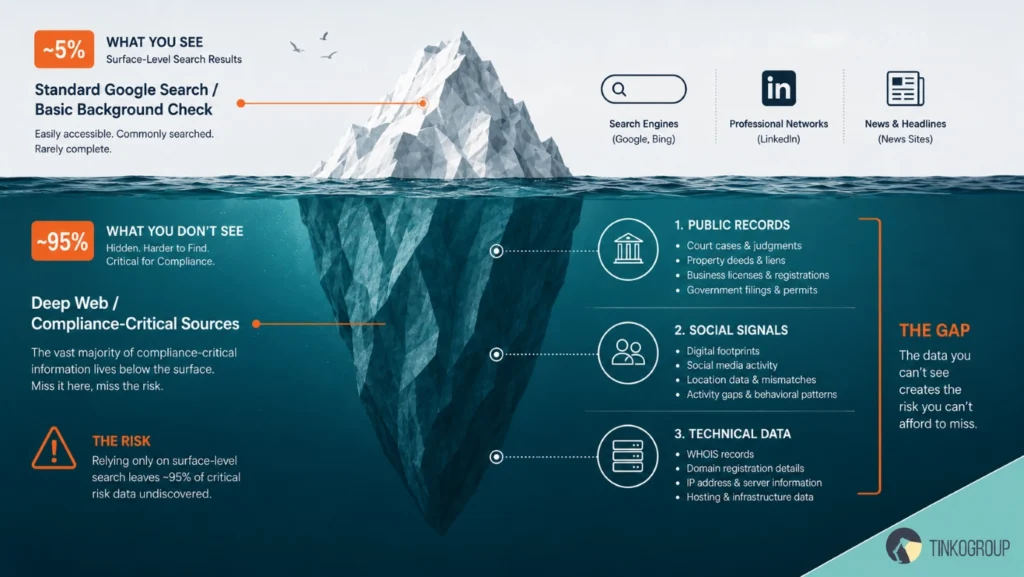
Traditional search engines you use every day see less than 5% of the entire internet. The other 95% is the “deep web.” The deep web is not anything illegal or hidden. Here, governments, courts, and businesses store their real records. Here, you can find details about lawsuits, property deeds, and professional licenses. A normal Google search cannot reach them.
Compliance research means a layered search. It requires structured B2B data collection from multiple independent sources rather than a single database.
1. Public records. These include court cases, property records, company ownership documents, and professional license databases. A company may look clean on its website, but public records could show lawsuits, unpaid taxes, or revoked licenses.
2. Social signals. This does not mean research should read someone’s personal posts. They should check verifiable digital traces. For example, a vendor claims to have a large warehouse. But Google Maps shows a small house. Or a contractor lists ten years of experience, but LinkedIn shows a three-year gap. These are red flags that only deeper research can find.
3. Technical data. This category includes domain registration records (WHOIS), website server locations, and security certificates. If a supplier says they have been in business for twenty years but their website domain was registered two months ago through a privacy service, that is suspicious. Technical data reveals these lies.
Professional Internet research services transform fragmented public data into structured reports. This makes it easier to identify fake companies, sanctions exposure, and litigation risks before signing contracts.
How to Follow the Law (GDPR and HIPAA) for Research
OSINT is powerful, but you should use it legally and respect people’s privacy according to modern laws:
GDPR applies to anyone in Europe. You are free to collect public information if you have a legitimate reason, for example, to prevent fraud or check sanctions lists. But you cannot:
- Use that data for marketing later.
- Keep it forever without a good reason.
- Forget to tell people (in some cases) that you are collecting their public data.
HIPAA applies to healthcare in the US. You can check a doctor’s license or a hospital’s registration, as those are public. But you cannot use OSINT to scrape patient reviews, match health outcomes, or collect any medical information from forums or social media. That is a serious crime.
The safest way is to hire trained human experts for compliance research. They know exactly which sources are legal, how to document everything, and when to stop. AI tools don’t understand privacy laws the same way people do.
Why Human Experts are Essential for Compliance
Artificial intelligence tools are now widely used across compliance and legal operations. Many believe that large language models can replace human compliance researchers. They are quick, cheap, and always available. However, it’s risky to trust AI tools for regulated industries.
The Risk of AI Hallucinations in Legal Documents
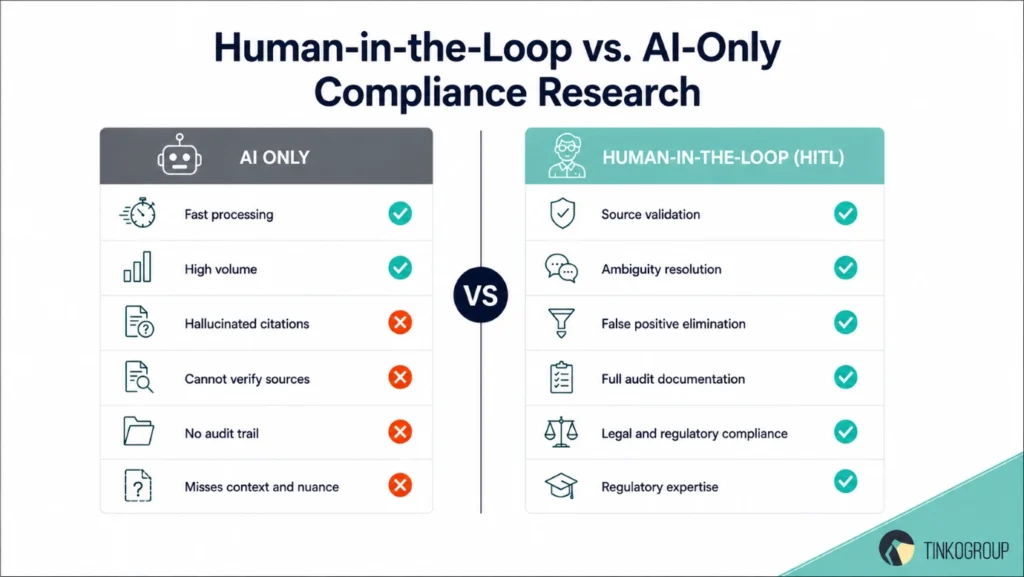
AI is becoming a standard tool in legal and compliance workflows. Human oversight remains essential for accuracy and regulatory safety. Regulated industries cannot rely on AI alone. Errors in AI-generated analysis can create serious legal and financial consequences. AI models hallucinate because they cannot distinguish truth from fiction. AI can predict the next most probable word but not verify facts.
As a result, AI tools frequently fabricate information that appears real but is entirely false. In regulated industries, accurate regulatory data verification still depends on trained human analysts who can validate sources and interpret context correctly
Imagine a compliance officer asks AI to check if a vendor appears on a sanctions list. The AI may respond that the company is not on the OFAC, EU, and UN lists. But AI never actually checks those lists. It generates a plausible sentence. In reality, the vendor is under sanctions, and six months later, regulators fine the company $2 million. The AI faces no consequences, but the human does.
AI models can invent fake court cases, make up license numbers, and create realistic-looking citations to non-existent laws. Courts have already sanctioned legal professionals for submitting AI-generated materials without verification.
In 2025, the US court sanctioned a law firm after its lawyers submitted a legal filing containing fake case citations generated by ChatGPT. The citations looked real but did not exist in any legal database. The court found that the lawyers failed to verify the sources before submitting them. The firm paid opposing legal fees, refunded client costs, and made a donation to a legal aid organization.
AI also struggles with context. It cannot tell the difference between “John Smith, convicted felon” and “John Smith, local teacher” if both names appear in different records. It cannot read a poorly scanned PDF from 1998. It cannot understand that a minor traffic violation is irrelevant, but a hidden money laundering indictment is critical. This issue is one of the greatest challenges in AI in legal research and regulatory compliance, where human judgment is still essential.
Why Only Humans Can Ensure 100% Accurate Data
AI is still fine to use with Human-in-the-Loop (HITL). In this duo model, AI and automation handle thousands of records, search databases, and flag potential matches. Then, a trained human expert makes the final judgment.
A human researcher does what AI cannot:
- Validate sources. A human can clearly differentiate an authentic government website from a scam resource.
- Resolve ambiguity. A human can quickly match the birth date and middle name of John Smith in the sanctions list to a particular applicant.
- Eliminate false positives. The AI flags 100 potential risks. The human knows which 99 are irrelevant and which 1 needs attention.
- Understand nuance. A dismissed lawsuit is different from an active indictment. AI often misses this distinction.
Human-in-the-Loop models improve both speed and accuracy. Automation identifies potential matches, while human experts make the final decision. Plus, humans document every step and create an audit trail that will withstand scrutiny by any regulator.
Human judgment remains the final safeguard in regulated industries. Automation can speed up investigations, but accountability still sits with people. In compliance operations, accuracy usually outweighs speed. One AI hallucination can cost millions, and one human expert can prevent that loss.

Reliable Data Services Delivered By Experts
We help you scale faster by doing the data work right - the first time

Building Audit-Ready Custom Databases
Regulators do not trust memories or screenshots. They demand a complete, unbroken chain of custody. Store every piece of information you collect so it proves three things: what you found, when you found it, and where it came from.
Here is how to build a database ready for an audit:
- Store everything with a timestamp. Every record you save must include the exact date and time of collection. Your database should automatically log when each piece of evidence was captured. This documentation proves to regulators that you acted on current information.
- Preserve the original source. Never copy and paste data without saving the original link or file. Your database must contain the direct URL (or a permanently archived version) for every source.
- Keep version history. You will check the same vendors every month or quarter. Your database must track changes over time. Version history allows you to show trends and prove continuous monitoring.
- Log negative evidence. You must also store proof of what you did not find. If you searched five different databases for criminal records and found nothing, record it in your database. Otherwise, a regulator could assume you never looked.
- Organize by entity and searchable metadata. Your database should allow anyone to search by company name, license number, date range, or risk level.
- Prepare an audit package. Before an audit, check if your database can generate a complete package for any entity: the executive summary, the detailed findings, every source with timestamps, and the negative evidence log. That package is your proof of due diligence.
You don’t need expensive software for custom database building. It is a disciplined system that turns your compliance research from a chaotic pile of notes into an organized asset.
Conclusion
In regulated industries, every important decision depends on the quality of the underlying data. A missing sanction record or an outdated supplier profile can quickly become a compliance issue. “Dirty data” represents a direct threat to financial stability, regulatory compliance, and organizational reputation. For companies in insurance, healthcare, and utilities, every new business partner introduces additional compliance risk. And robust compliance research powered by OSINT becomes a key solution to potential compliance issues.
Surface-level verification leaves organizations vulnerable to fraud, compliance failures, and regulatory penalties. Organizations that use layered OSINT consistently catch risks earlier and face fewer regulatory penalties.
AI tools improve efficiency, but they cannot replace validation and human judgment. AI hallucinations can invent sanction hits, fabricate court cases, and confidently deliver wrong answers. Human-in-the-loop workflows provide a significantly higher level of accuracy and accountability. Only human researchers can resolve ambiguity, eliminate false positives, and document every step for a regulator.
Most compliance teams don’t need to build their systems from scratch. Tinkogroup specializes in deep compliance research that follows international standards for regulated industries. We don’t rely on automated scrapers that risk AI hallucinations or compliance violations. We combine advanced OSINT methodologies with rigorous “human-in-the-loop” validation. Our team ethically verifies credentials, suppliers, sanctions lists, and negative news. We analyze public data and social media to identify risks early.
We build organized and up-to-date custom databases that are ready for audits. This means you get documented research that you can use as proof for regulators or auditors. Tinkogroup helps companies get complete information, so when compliance questions come, you already have clear, verified answers ready to show.
Ready to strengthen your compliance program and reduce regulatory risk? Don’t leave your organization exposed to hidden threats. Contact Tinkogroup today and discover how our professional internet research can transform your risk management strategy. Take the next step toward proactive compliance.
Why is compliance research important in regulated industries?
Compliance research helps organizations verify vendors, partners, healthcare providers, and other entities against legal and regulatory requirements. In industries such as healthcare, insurance, and utilities, it reduces exposure to fraud, sanctions violations, licensing issues, and reputational risks by validating information from multiple trusted sources.
What sources are commonly used during compliance research?
Effective compliance research combines data from public records, government databases, corporate registries, sanctions lists, court filings, licensing boards, environmental filings, and other OSINT sources. Researchers may also review ownership structures, adverse media coverage, and technical intelligence to identify hidden risks that are not visible through standard search engines.
Why is Human-in-the-Loop (HITL) compliance research more reliable than AI-only research?
AI can quickly process large volumes of data, but it cannot independently verify sources or fully understand legal and regulatory contexts. Human-in-the-Loop compliance research combines automation with expert review, which helps organizations reduce false positives, validate findings, resolve ambiguous records, and keep audit-ready documentation for regulators and auditors.