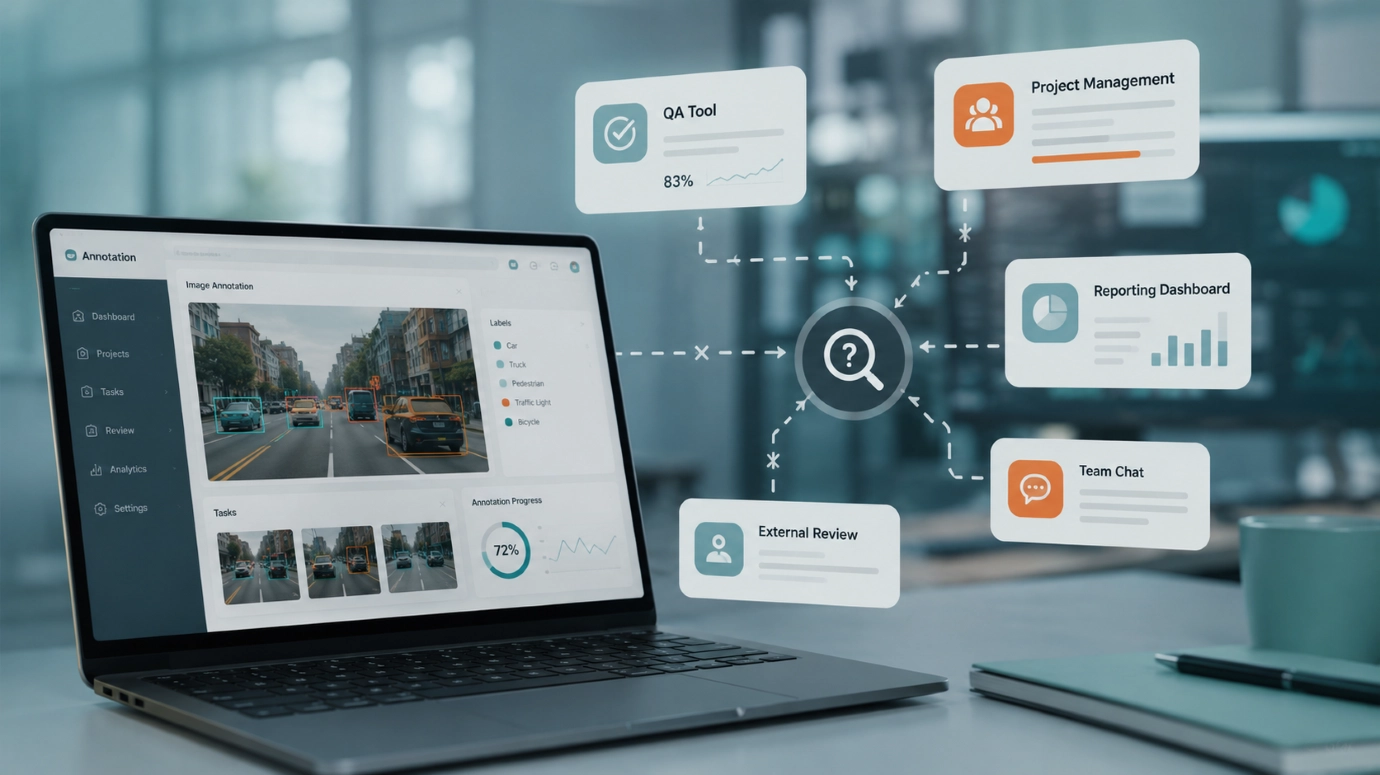

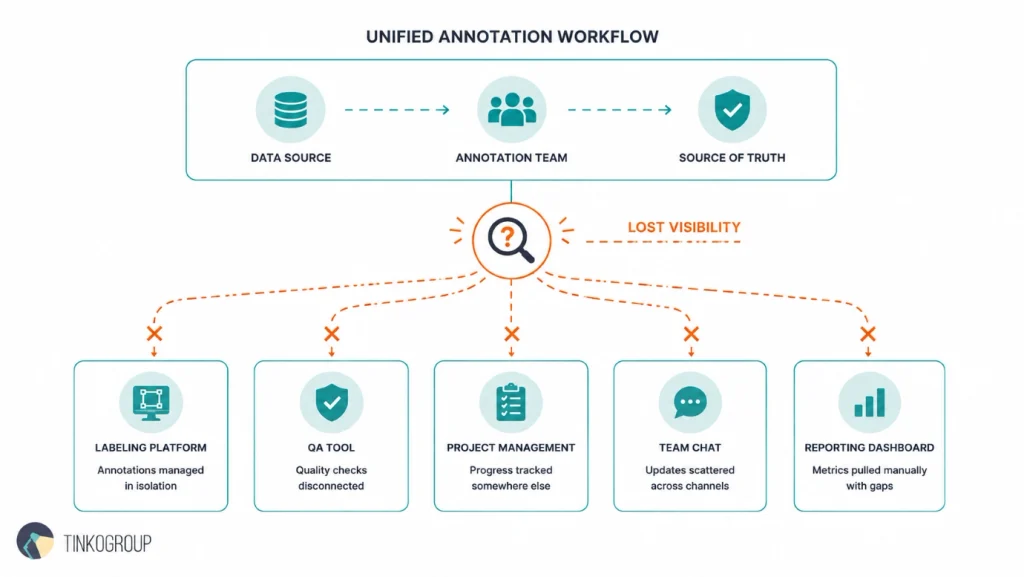
Annotation workflow fragmentation rarely looks like a problem at first. On paper, an enterprise annotation program can look like a well-oiled machine: a labeling platform, a QA platform, a project management tool for delivery tracking, a chat app for escalations, spreadsheets for reviewer performance, and a separate dashboard for model feedback. Every system works fine by itself. But no single screen has the answer when a manager needs a quick answer to a simple question: what dataset is blocked, why is it blocked, and who owns the next action.
This is annotation workflow fragmentation, the point at which an ever-growing stack of specialized tools stops adding capability and begins to cost visibility. It’s seldom one bad decision. It builds up gradually, tool by tool, until data assets, annotator identities, and task context are in separate application layers that no longer speak to each other.
The consequences manifest in normal operational terms. Decisions are slower because you have to pull status from five places before anyone can report it. Reporting is duplicated because the two systems have different definitions of “done.” Escalations are missed because they are in a chat thread and not a task record. Ownership becomes unclear when no single system keeps track of who owns what next step. That’s not a tooling inconvenience for a data operations leader – that’s delivery risk.
How Annotation Workflows Become Fragmented
Fragmentation does not happen overnight. It develops gradually as data annotation operations expand to meet new model requirements, new data modalities, and larger labeling workforces.
In the beginning of a machine learning project, a single labeling platform is often enough to handle the work. There is one interface for a small group of internal annotators to work in, and simple spreadsheets or built-in dashboards help the program manager keep track of progress. The channels of communication stay clear, the data schemas stay consistent, and the operational footprint stays small.
When a business uses artificial intelligence on a larger scale, the data it needs becomes a lot more complicated. For a single multimodal model, the team might have to handle high-resolution video streams, spatial LiDAR point clouds, and unstructured text all at the same time.
The company uses a number of different specialized vendors because there aren’t many commercial labeling platforms that can perfectly handle all types of data. One vendor might be great at drawing 3D boxes around data for self-driving cars, while another might offer specialized medical clinicians for NLP labeling in healthcare. This is where annotation tool sprawl begins.
As this sprawl intensifies, it creates a heavily disconnected software stack across the enterprise. Each external platform operates on its own proprietary data formats, user access controls, and API logic. As a result, the enterprise completely loses a single source of truth for its training assets.
One vendor’s platform uses its own timers and logic for automatic idling to keep track of annotator throughput. At the same time, an outside project management system keeps track of completed tasks by having team leads update tickets by hand. The metadata is spread out, which makes it very hard to compare what the labeling vendor says to what the internal engineering team sees in their database.
Communication quickly becomes siloed inside specific tools, away from the core data assets. As an example, an internal quality assurance manager could use a special QA tool to report a mistake with a label. Meanwhile, the offshore labeling team is seeking assistance through a separate corporate chat app or an email thread. The commentary loses context because it does not connect to the task ID. This disconnection forces data engineers to write custom scripts just to sync data and comments between systems.
Every one of those scripts becomes another piece of infrastructure someone has to maintain, debug, and update whenever a vendor changes its export format. A 2025 survey of 400 senior technology executives by MIT Technology Review Insights and Snowflake found that 45% of organizations name integration complexity as a top challenge for their data engineering teams, and 38% struggle with tool sprawl and fragmentation. When your tools cannot talk to each other, your teams cannot talk to each other either.
This tool-centered approach also creates huge cultural gaps within the data operations team as a whole. Annotators who work in Tool A don’t talk to validation specialists who work in Tool B very often. Over time, these teams come to different conclusions about the labeling guidelines.
A guideline update regarding how to handle occluded objects might land in the annotation project management system but fail to sync to the asset tracking layer of an external labeling platform. The result is a continuous cycle of rework, where teams must re-annotate entire batches of data simply because someone updated the instructions in one tool but not in the tool where they actually did the work. This is how annotation workflow fragmentation quietly takes hold, one unsynced update at a time.
The Hidden Costs of Too Many Annotation Tools
When an AI annotation workflow relies on too many components, operational complexity increases rapidly. This is annotation workflow fragmentation in its earliest, most visible form. The most immediate casualty of this growth is annotation process visibility. When data spreads across five different platforms, answering a simple question about project health turns into a massive chore.
It’s hard for a program manager to see how many tasks are really ready for model training, where the problems are, or which group of annotators makes the most mistakes. The data is hard to see because there are many different user interfaces, custom terminologies, and exporting methods that don’t work together.
This lack of clean visibility leads to several hidden operational costs that quietly drain enterprise resources:
- Delayed decision-making. To make a weekly status report for executives, managers have to manually pull data from several systems, normalize the schemas, and clean it up in Excel.
- Inconsistent performance reporting. The data science team measures quality using model validation metrics, while the annotation vendor measures quality based on internal consensus scores, leading to conflicting views of dataset readiness.
- Frequent workflow bottlenecks. Labeled data batches wait in export queues for no reason because the tool that does the downstream validation doesn’t have an automated way to move them to the next step in the process.
- Duplicated work. Unsynchronized project management systems cause different annotation teams to accidentally claim and label the exact same dataset across different platforms.
- Weakened data governance. Using multiple unmapped tools to move sensitive business data increases security risks and can create compliance gaps under GDPR or HIPAA, because every extra tool is another place where data is stored and accessed. Our guide to data annotation security covers the controls that close those gaps.
Each of these costs is a symptom of the same root problem: annotation workflow fragmentation.
A tool can showcase impressive features in a demo and still slow the organization down if it doesn’t fit into a unified workflow. The friction of jumping between interfaces quickly wipes out any efficiency gain a single feature provides. For example, if an AI-assisted labeling tool saves annotators three seconds per image but the project manager spends four hours every Friday reformatting files to move them to the validation suite, then there is no net operational gain.
In addition to the time you lose right away, keeping up with multiple software licenses costs a lot of money. Companies that sell business software charge more for things like data seats, API access, and security integrations with advanced features.
Companies that purchase three labeling tools, two project management platforms, and a separate analytical dashboard incur an additional administrative cost beyond the license fees. This includes the hours engineers spend fixing broken API endpoints, maintaining custom data-conversion scripts, and investigating why a set of labels disappeared during automated transfers between tools.
Why Fragmentation Slows Annotation Operations
Operational speed depends entirely on how quickly data and feedback move through a cycle. Fragmented workflows break this cycle by inserting manual steps into everyday tasks, creating immense operational drag. The machine learning engineering loop stops when data can’t move smoothly from one stage to the next. This means that expensive computers and well-paid data scientists have to wait for training inputs. Fragmentation is one cause of slow delivery among several; queue design, prioritization, and review capacity are covered in our guide to annotation pipeline latency.
Annotation workflow fragmentation shows up most clearly in the speed of everyday operations. Consider a standard task routing and quality assurance loop. In an integrated system, a dataset moves seamlessly from ingest to labeling, then to QA, and finally to export. In a fragmented environment, this progression breaks down completely.
A project manager must manually download a batch of JSON files from the labeling platform, reformat the schemas using custom Python scripts, and upload them into a separate QA system. If the script has just one parsing error, it could corrupt the metadata for the labels. This would mean that production would have to stop while engineers looked for the bug.
Escalation handling is tedious and slow for the team due to disconnected tools. When an annotator is confronted with a tricky edge case, a hidden object in a self-driving car dataset, for example, or a strange medical term in a clinical text, they need help right away from a subject-matter expert. In a unified environment, they flag the case, and a manager corrects it right away, updating the rules for everyone immediately.
In a fragmented system, the annotator flags the image in one tool, takes a screenshot, and posts it into an enterprise chat application. The program manager answers the question hours later. After that, the annotator has to look for that task ID again in the labeling tool in order to make the change, which takes a huge amount of mental effort.
This lack of annotation workflow efficiency stalls vital retraining feedback loops. When data scientists discover that a deployed model is failing on certain production inputs, they need to push those samples back to annotators immediately. When that request must navigate multiple disconnected project management tools and vendor platforms, weeks can pass before the fix is implemented. Because of this delay, the production model doesn’t work well enough for too long, which hurts the business units that depend on the AI predictions.
The speed of an AI program depends not on how fast an annotator can click a mouse, but on the turnaround time of the entire feedback loop. The systemic drag also distorts data lineage. When teams modify labels across multiple systems without a centralized ledger, they erase the historical record of why a label was changed.
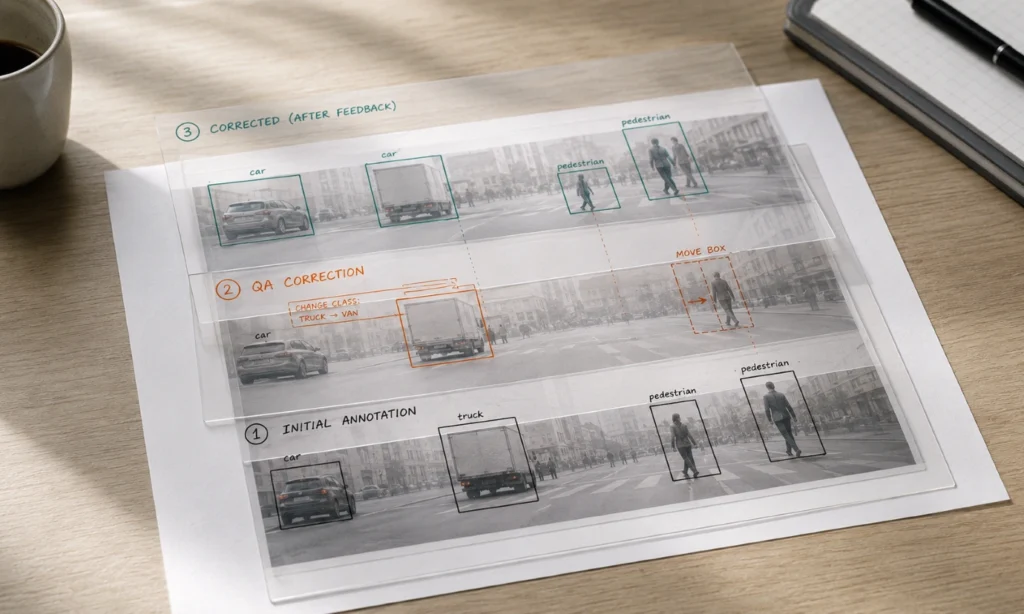
A validation specialist may alter a bounding box in a secondary QA tool, but that change may never sync back to the primary database. The engineers will train the models on data that goes against the original labeling instructions the next time they run. This contradiction adds noise to the training set, so data scientists have to spend hours fixing model convergence problems that are really problems with data governance.
Building a Single Operational View Across Annotation Programs
Enterprise organizations need to stop buying more software if they want to get back control of their data supply chains. Instead, they should focus on strong workflow governance. This does not mean forcing teams to abandon their favorite tools or replacing every piece of software your teams currently use. It means putting together a solid operational layer that links all of your current tools into a single, complete view. If you are designing the stages themselves, start with our guide to building a data annotation pipeline; this section covers how to govern the tools around it.
To get this one view, you need a structured way of designing processes that goes beyond individual software features:
- Centralize your reporting metrics. Establish a single dashboard that pulls data via APIs from every labeling platform. This way, you can keep track of throughput, rejection rates, and delivery dates in one place, making sure that all teams use the same data definitions.
- Standardize your data gateways. Create strict rules for how data enters and leaves any tool. Never let data move between platforms through manual file downloads or ad-hoc file shares. Every transfer must go through monitored, automated pipelines with built-in validation checks.
- Align your quality definitions. Use identical quality metrics across all internal and external teams. A “completed” task must mean exactly the same thing to your internal data scientists, your offshore vendors, and your QA auditors.
- Enforce clear ownership models. Assign explicit owners to every stage of the data lifecycle. Set up one person to import raw data, another to handle labeling operations, and a third to ensure adherence to the final policy.
- Implement centralized instruction repositories. Stop hosting labeling guidelines on local documents or siloed wikis. Keep a single, versioned document that connects to all annotation tools. This way, everyone who is annotating can see changes as they happen. Our guide on how to draft effective annotation guidelines covers version control for guidelines.
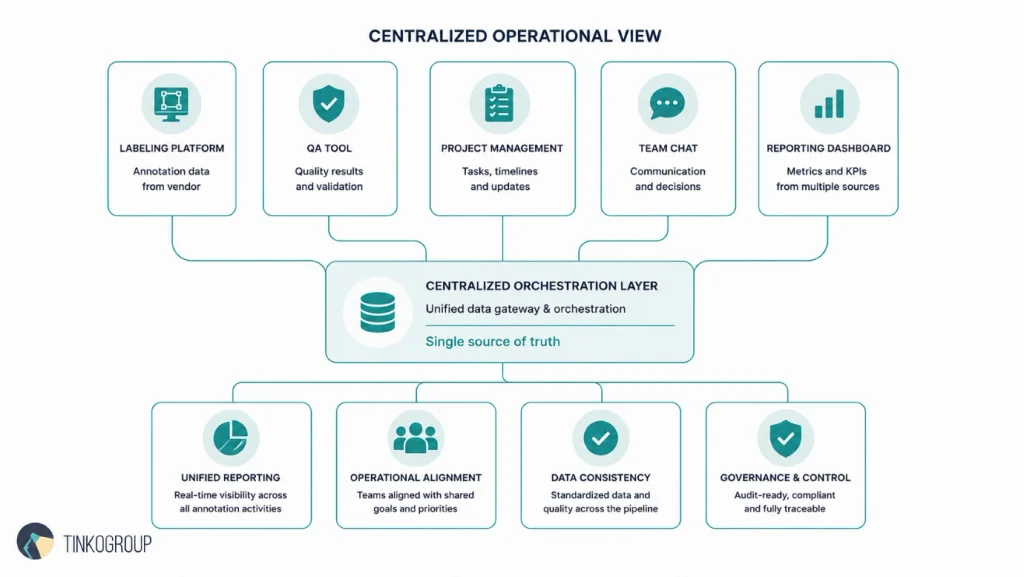
You can protect your company’s technology investments and get rid of the hassle of disconnected systems by focusing on deep coordination instead of software replacement. The goal is to build an abstraction layer above the software stack. This layer makes it possible for executives to oversee the whole data annotation pipeline as if it were a single factory floor instead of a group of separate workshops run by different people.
This approach also simplifies vendor management. When an enterprise establishes a unified operational view, onboarding a new labeling vendor becomes much faster. The new vendor simply plugs into the existing data gateway and adopts the standardized reporting metrics.
The company no longer has to learn how to use the vendor’s project management tools or adapt to their unique reporting formats. When an enterprise can compare vendor performance, quality scores, and unit costs in a single dashboard, the power shifts back to the enterprise.
What Mature Annotation Programs Measure Instead of Tool Count
Immature AI programs often evaluate their operational health by looking at their tech stack. They focus on how many advanced features their platforms have, how many automated labeling models they have deployed, or how many vendors they can access. In contrast, mature enterprise programs focus entirely on annotation process control. They see software as basic infrastructure and measure how well teams work, how well information flows, and how stable the system is.
These are not industry-standard KPIs, but we recommend tracking five process metrics that reflect real operational health:
- Process visibility index. The share of data assets whose exact location, status, and historical lineage can be tracked instantly throughout their lifecycle without having to open multiple systems.
- Issue resolution speed. The average amount of time it takes for an expert to answer an annotator’s edge-case question and apply the answer to the whole active dataset.
- Workflow consistency rate. The variance in throughput, cost, and quality across different labeling groups, platforms, and geographic locations working on the same project.
- Cross-team communication velocity. Time needed to send feedback from the production model logs to front-line annotators so that a new training batch can begin.
- Operational accountability score. A measure of how often teams meet their planned deadlines for delivering data without having to do anything by hand or make emergency engineering fixes.
When businesses optimize these metrics, they build operations that can handle changes in the market and in technology. They can swap out a labeling tool or add a new vendor without breaking their entire pipeline. Their control comes from their process design, not from their software licenses. They understand that a tool is only as good as the governance framework that surrounds it.
Mature programs also track the depreciation of data value over time. Training data has a limited lifespan. Teams must label edge cases discovered in production today and feed them back into the model immediately.
Mature companies make sure their AI applications stay accurate in changing real-world settings by keeping track of the time it takes from when they detect an anomaly in the data to when the updated training data is ready for the model. Their data pipeline gives them a competitive edge by reducing the time data spends sitting idle in separate software silos.
How Tinkogroup Supports Annotation Workflow Governance
At Tinkogroup, we base our operations on one strict rule: process management must be part of the business, not the specifics of an outside software application. The framework developed for annotation workflow management directly targets the elimination of pipeline fragmentation. It relies on programmatic centralization, continuous auditing protocols, and decoupled quality checkpoints rather than marketing features.
We help businesses set up an effective data annotation AI workflow by standardizing the steps that connect people, tools, and models. No matter how many external vendors or purpose-built labeling platforms you have in your ecosystem right now, our approach helps make sure that your human-in-the-loop operations run smoothly. We view annotation as a business process that requires strong governance, engineering discipline, and accountability throughout. Where a project needs extra review layers or domain-expert sign-off, we build them into custom annotation workflows instead of adding another disconnected tool.
Whether you’re a US-based AI company consolidating a single pipeline or a European enterprise coordinating distributed annotation teams across time zones, the same governance principles apply. The system operates across four operational pillars that keep process control with the client, not with any single vendor’s software.
Centralized Oversight Across Disconnected Stacks
Instead of checking each vendor’s dashboard separately, every labeling program reports throughput, status, and performance data into one enterprise operational record. In practice, this is annotation workflow orchestration: every vendor reports into one ledger instead of five separate dashboards.
This centralization establishes a consistent operational baseline. It lets people in charge of data operations keep an eye on the overall speed of the program without having to log into each vendor’s software. It replaces the different platforms’ inconsistent analytics with a single, standardized log of throughput and resource use.
Operational Visibility and Lineage Reconstruction
True visibility requires that every single data asset remains traceable across its entire lifecycle. Every payload keeps the same identifier from ingestion through final delivery, even as it moves between different labeling systems.
This tracking protocol logs every structural state change, including:
- The exact timestamp of raw data ingestion into the initial staging queue;
- The specific configuration of the interface parameters seen by the annotator;
- The internal user identifier of the front-line worker who executed the primary label;
- The precise variations made during the downstream validation and auditing cycles.
If an asset experiences metadata corruption or structural mutation during an automated migration step, the orchestration ledger flags the anomaly. This tracking prevents corrupted assets from entering the training pipelines and saves the engineering time that would otherwise go into debugging model convergence failures. That level of annotation operational visibility means no dataset can drift out of compliance without anyone noticing.
Decoupled QA and Escalation Handling
Traditional quality assurance models suffer when the specific labeling interface hardcodes the validation tools. This framework separates the auditing step from the annotation environment: labeled payloads move through an independent validation layer before anything reaches the training repository.
Escalations also follow the same separation. If an annotator marks an edge case, the task leaves that one tool and enters a shared queue visible to a reviewer. A reviewer notes the decision, a QA lead checks it against the current guideline, and the project manager informs the client of resolution, all on the same task record, not four disconnected ones. This is the difference between an escalation that is resolved once and one that is relitigated in every tool it touches. Our guide to annotation adjudication covers this process in detail.
Cross-Functional and Process Standardization
Expectations from engineering often do not match the actual output of large annotation teams, usually because of long feedback delays. The framework establishes a direct link between model validation logs and live labeling instructions. So when engineers identify a specific failure mode, the affected data pools get flagged and reprioritized within hours instead of weeks.
This is annotation process standardization in practice: every payload follows the same rules no matter which vendor produced it.
Every data payload entering or leaving an external tool passes through the same validation step, so proprietary vendor formats get converted into one shared data structure, including label classes, attributes, and coordinate systems. That separation between the data structure and the labeling software is what allows a client to swap vendors without breaking the pipeline.
Conclusion
Amassing a large collection of specialized software platforms does not guarantee a successful or efficient annotation program. Often, adding too many tools simply leads to annotation workflow fragmentation. This fragmentation hides bottlenecks, creates communication silos, increases data security risks, and slows down the delivery of critical training data to machine learning models.
Businesses must put operational visibility, annotation team coordination, and strict accountability over individual software features in order to build scalable AI models that deliver real business value. Real operational control doesn’t come from limiting your team’s options or cutting back on the tools you use. Setting up a strong, centralized layer of annotation workflow optimization that keeps your data clean, your metrics in sync, and your teams working together is how you get it.
That governance layer is what keeps the tools serving the workflow, not the other way around, for enterprise annotation operations using managed annotation services across multiple vendors.
Companies should look at both the dashboards for individual apps and the architecture of their data operations as a whole. To be truly efficient, information must flow smoothly between systems, institutional rules must be clear, and every asset must be tracked from receipt to use. By focusing on workflow governance, a company can turn its data labeling process from a disorganized bottleneck into a highly predictable AI innovation engine.
Take a look at your current data pipelines. Do your tools give you a clear, real-time view of your operations, or are your teams drowning in manual file transfers, custom conversion scripts, and fragmented chat threads? Book a workflow review for your annotation program.
What is annotation workflow fragmentation?
Annotation workflow fragmentation is the state where labeling, QA, project tracking, escalations, and reporting live in separate tools that do not share data. Each tool works on its own, but nobody can see the status of a dataset, the owner of the next step, or the history of a label in one place.
How do you fix a fragmented annotation workflow without replacing every tool?
Add a governance layer on top of the tools you already use: one reporting dashboard fed by APIs, automated data gateways instead of manual exports, shared quality definitions, a single versioned guideline, clear owners for each stage, and escalations that stay attached to the task record.
What are the signs of annotation tool sprawl?
Typical signs are weekly reports assembled by hand from several systems, different definitions of “done” across teams, edge-case questions answered in chat instead of in the task, custom scripts that move data between tools, and rework after a guideline update reaches only some of the teams.