
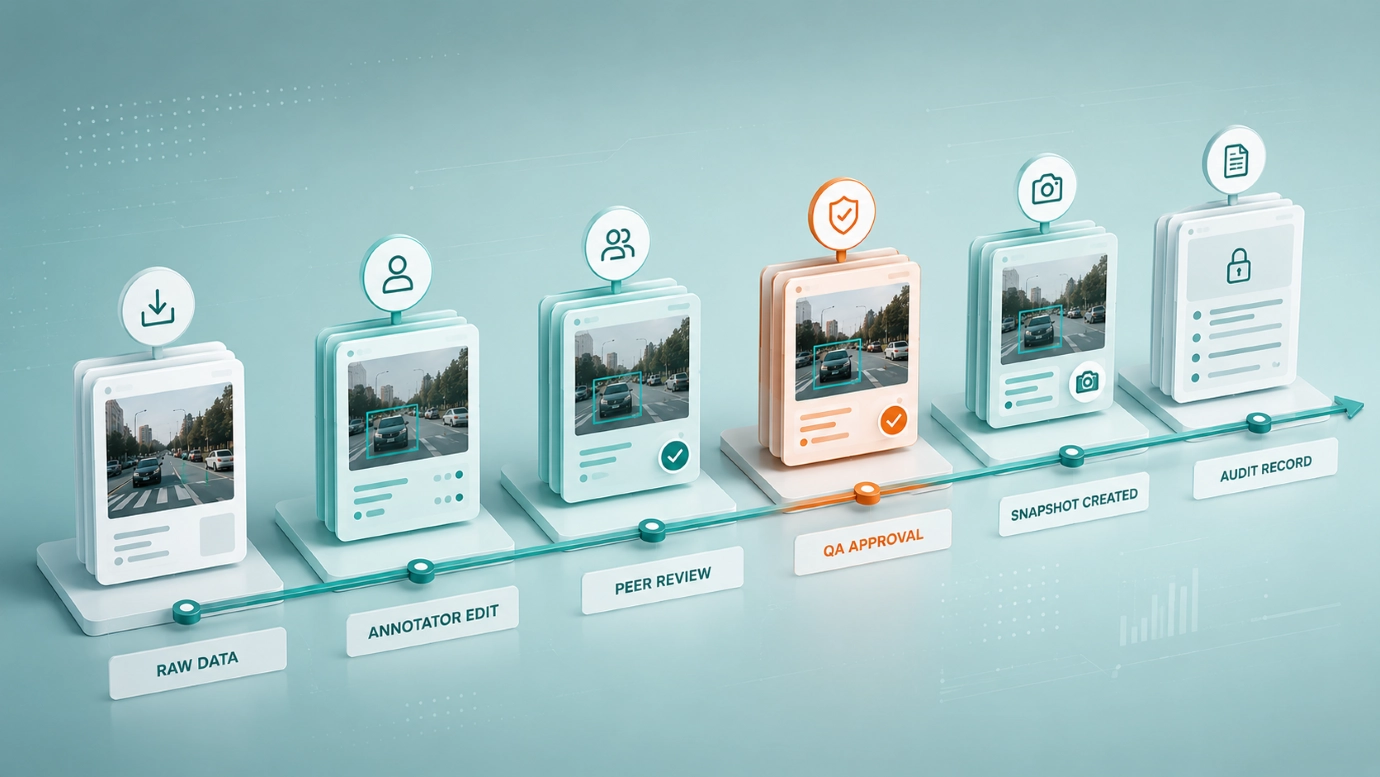

Dataset lineage is the record of how every label in a training dataset came to be: who created or changed it, when, why, and which dataset version it ended up in. Without it, a model trained on Monday can behave differently from one trained on Friday, and nobody can explain why, because the raw files look the same while hundreds of labels have quietly changed.
Production training data is never static. Guidelines get updated, reviewers correct each other, taxonomies grow, and models send uncertain examples back for relabeling. Each of these changes is legitimate. The problem starts when they happen without a record.
On a project with millions of items and dozens of annotators working for months, a missing record turns simple questions into investigations. Why did accuracy on one class drop after the last retraining? Which guideline version was used for the batch that a client is now questioning? Who approved the change?
This article explains why annotation data changes, what lineage tracks, what goes wrong without it, which components a working setup needs, and how teams build governance around dataset history. Dataset lineage works together with dataset versioning: versioning freezes the dataset at specific points, and lineage explains every change between them.
Think of lineage as a family tree for every label: from the raw file, through each annotation and review decision, to the dataset release used for training. In data annotation, it is what turns a changing collection of files into an asset you can explain, audit, and reproduce.
Without that record, every regression becomes guesswork.
Why Annotation Data Changes Over Time
In a mature machine learning project, a dataset behaves like a product: it gets maintenance, fixes, and new releases. Six sources of change come up in almost every annotation program: guideline updates, reviewer corrections, adjudication outcomes, taxonomy changes, edge-case discoveries, and model feedback.
Guideline and taxonomy changes. Projects start with a basic rule set, and real data quickly exposes cases it does not cover. An e-commerce categorization project might begin with ten product classes and need fifty subcategories a month later.
Applying the new classes only to future files is not enough; older labels must be revisited too, and every one of those edits needs a record. Updated guidelines also only work if reviewers apply them the same way, which is why reviewer calibration matters as much as the rule change itself. Reviewer corrections and adjudication. Senior reviewers catch mistakes and misreadings in the first pass.
On hard items, several experts may disagree before an adjudicator makes the final call. If the system simply overwrites the old value, the reason for the correction disappears, and with it the information you need to improve training materials and spot recurring confusion.
Model feedback. Production models flag low-confidence examples, and engineers send them back for relabeling. When the corrected labels return to the training set, they replace older ones, which is another change that needs a record.
None of these changes is a problem in itself. They only become one when they are invisible.
What Dataset Lineage in Data Annotation Means in Annotation Operations
In data engineering, “data lineage” usually means tracing how data moves between systems and transformations. In annotation, the focus is different: it is about the human and model decisions that change what a label means. Annotation lineage records every state of every label, not just where the file travelled.
True annotation traceability requires answering four critical questions for every single data point in your repository:
- It identifies who changed a label, whether it was a human annotator, an automated model, or a QA manager.
- It logs exactly when the change occurred.
- It documents why the change happened, linking the edit to a specific guideline shift or error correction.
- It verifies which version contains the update, placing the file within a specific release.
Answering these four questions is what separates lineage from storage. Many teams assume that keeping labels in a cloud bucket or database is enough, but a standard database shows only the current value of a field and overwrites what was there yesterday.
Lineage treats every change as a new event: instead of overwriting a value, the system appends a record and keeps the previous state. That is what lets engineers rebuild the exact dataset a model was trained on six months ago.
The Risks of Poor Traceability
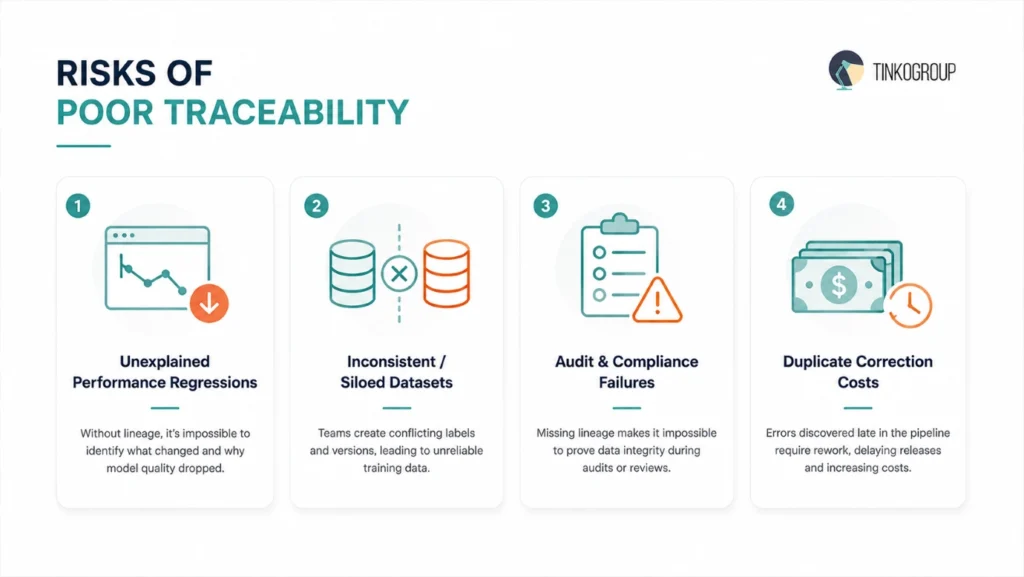
When a team treats training data as a single static pool, small changes pile up unnoticed. Three kinds of damage show up most often.
Errors that would be easy to fix at the label level become expensive once they reach production. Teams that scale data annotation without losing quality usually rely on exactly this kind of change history.
Unexplained Performance Changes and Model Regressions
An engineering team retrains an object-detection model, and accuracy on one class drops by several points. Was it the code change, or did a QA team relabel thousands of images last week? Without lineage, nobody knows, and debugging turns into trial and error.
Systematic label errors are especially hard to find this way. In a 2025 study of high-consequence models, models still looked accurate in validation with up to 25% wrong labels, because the validation data contained the same errors. Only a record of how labels changed shows where such errors came from.
With lineage, the team compares the two dataset versions, sees which labels changed and why, and finds the cause in hours instead of days, without rewriting model code that was never broken.
Inconsistent Datasets and Duplicate Corrections
Without a shared change history, two teams can fix the same errors in different environments, then argue about which copy is the real one. When the people who know the context leave, the context leaves with them.
A typical case: an automated script labels thousands of “winter coats” as “spring jackets.” Engineers fix it in a test sandbox; an ops team, working from customer complaints and without a common change log, spends a week fixing the same items again. The company pays twice for one fix. When tools do not share history, this is a symptom of annotation workflow fragmentation.
Audit Failures and Regulatory Vulnerabilities
Regulators increasingly expect companies to show how training data was prepared and checked. The EU AI Act requires data governance practices for training data of high-risk AI systems and automatic record-keeping for those systems, and the NIST AI Risk Management Framework treats documentation of data provenance as part of managing AI risk.
If a client or regulator questions a model’s behavior, an annotation audit trail lets you show which data was used, who labeled and reviewed it, and which rules applied. Without it, you cannot tell whether a flaw came from one annotator, a labeling script, or an outside contractor, and you cannot prove the opposite either.
Key Components of Annotation Lineage and Label Version Control
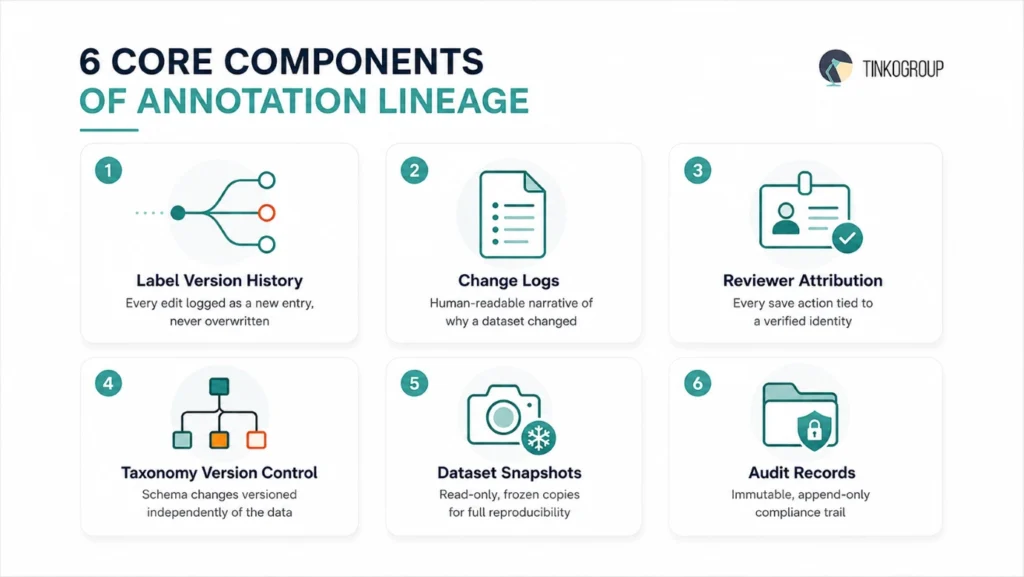
A working lineage setup has six components. Each one answers a different question, and they only work together: if one is missing, the chain breaks.
Label Version History
Every item keeps its own history. If an annotator moves a bounding box, changes a class, or shifts a transcript timestamp, the system stores both the old and the new value instead of overwriting.
This works like version control for code. If a script or a group of annotators damages a batch, the team rolls back only the affected items and keeps the rest of the work. Tools such as DVC or lakeFS handle dataset-level versioning; label-level history usually lives in the annotation platform itself.
Change Logs
Item history shows what changed; a change log explains why. It is the human-readable story of how the dataset evolved, written at the level of batches and decisions.
A typical change log entry contains structured metadata, including:
- The specific business justification for the modification batch.
- The total volume of files impacted by the update.
- The version number of the annotation guidelines used to govern the new edits.
- The internal ticket or governance authorization ID that approved the change.
For example: “Updated 14,000 text items to follow the revised Q3 content moderation policy on borderline offensive speech; guidelines v3.2; ticket GOV-118.” One line connects thousands of small edits to the decision behind them.
Reviewer Attribution
Every save is tied to a user ID, a role, and permissions, whether the change came from an annotator, a reviewer, or a model. It is also what makes annotation adjudication traceable: you can see who overrode whom and on what grounds. Attribution supports three tasks:
- Performance analysis. Teams can isolate specific annotators or automated models that exhibit high error rates, enabling targeted retraining or software patches.
- Security auditing. Administrators can verify that only authorized people modify sensitive training classes, which helps prevent insider tampering or accidental corruption. Our guide to data annotation security covers access controls in more detail.
- Bias tracking. If a specific reviewer consistently overrides consensus decisions on subjective tasks, managers can audit their work to ensure personal biases are not degrading the objectivity of the training set.
Taxonomy Version Control
The taxonomy (the set of classes, attributes, and their relationships) changes as the project grows, so it needs its own versions.
When “Vehicle” is split into “Sedan,” “SUV,” and “Truck,” the schema gets a new version, while older dataset releases stay linked to the schema they were built with. Without that link, code that reads an old release with the new schema misinterprets its labels.
Dataset Snapshots
A snapshot is a read-only copy of the dataset at a specific moment. Training should always run on a snapshot, never on a live dataset that annotators are still editing.
Snapshots make training reproducible: if a model behaves strangely two months later, engineers load the exact data it was trained on and know that no later edits have changed it. Taking a snapshot is also the natural moment for an annotation audit before retraining, which checks the whole dataset before it is frozen and used.
Modern dataset versioning tools store only the differences between versions, so frequent snapshots do not multiply storage costs.
Audit Records
Audit records bring everything together: item history, change logs, attribution, and snapshot identifiers, kept for internal compliance and external audits.
Store them in append-only form, so entries can be added but not quietly edited later. If a client or regulator asks how a lending or diagnostic model was trained, the audit record shows the step-by-step history of the human and model decisions behind its data.
How These Elements Create Traceable Workflows
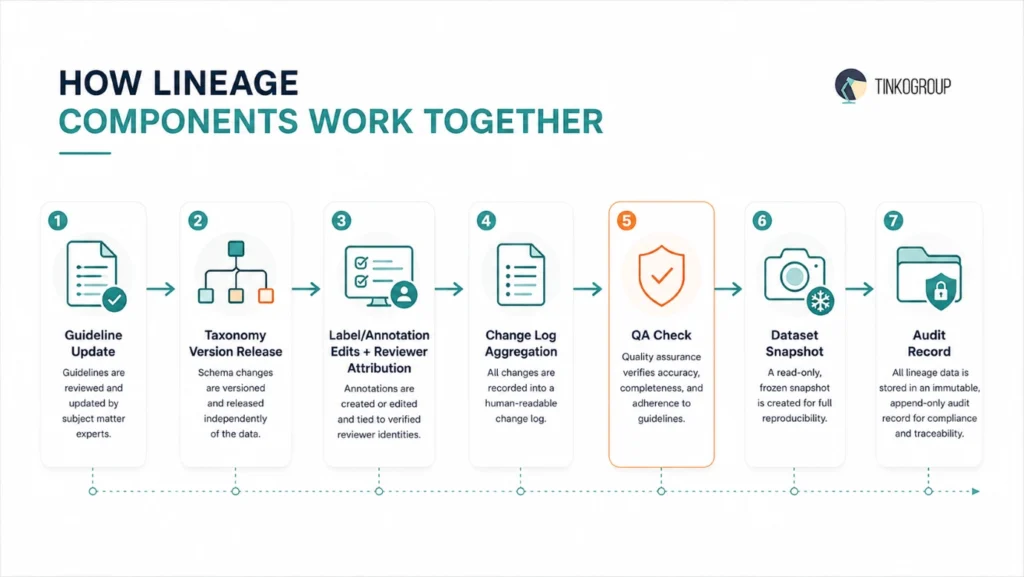
Here is how the six components work in sequence. A team decides to update its labeling guidelines, and the taxonomy gets a new version that records the new rules. (If you are new to the basics of labeling, start with our data annotation guide.)
As annotators and models edit items under the new schema, label history stores each change and attribution records who made it. The change log groups these edits and explains the reason. Once the batch passes QA, the dataset owner creates a new snapshot.
Its identifier goes into the audit record, and every training run references it. Months later, anyone can trace a model back through the snapshot, the change log, and the individual edits to the policy decision that started them.
That chain is what turns a constantly changing set of files into a dataset you can trust.
How Dataset Lineage Supports QA and Model Investigations
Lineage pays off when something goes wrong in production. Instead of only debugging code, engineers can look at how the data changed.
Investigating regressions. When a retrained model fails a performance check, the team compares its snapshot with the one used for the last good model.
The difference often points straight to the cause, for example, a bulk update that swapped two labels on a critical subset. The team reverts those edits and retrains, instead of spending days on manual checks.
Reviewing disputed labels. On subjective tasks, two experts can look at the same medical scan or financial document and disagree. Lineage keeps the whole discussion, not just the final decision.
When a model fails on edge cases, engineers can check whether humans also struggled with the same items, which tells them whether to fix the model, the guideline, or both.
Validating retraining data. Before a new training run, lineage shows exactly what changed since the last release, so reviewers can focus on the changed items. This fits naturally into the broader annotation QA process, and it keeps the team audit-ready before a client or regulator asks.

Reliable Data Services Delivered By Experts
We help you scale faster by doing the data work right - the first time

Building Annotation Governance Around Dataset History
Tools record history; people decide what is allowed to change. Lineage only works when it is backed by clear rules.
Reviewed changes. No single person should push a large change into the main dataset alone. Every significant batch edit or guideline change goes through peer review, and on projects with their own sign-off steps, these reviews become part of custom annotation workflows.
Clear ownership. One person, usually an annotation program manager or data governance lead, owns each dataset release: they review the accumulated changes, confirm QA targets were met, and sign off.
Release notes. Each release lists how many labels were added, changed, or removed, and which guideline version applied.
Escalation records. Questions about edge cases and their answers are stored with the data, not in chat threads.
Retention. Depending on your industry, you may need to keep old snapshots and audit records for years. Decide how long before the project starts, not when an auditor asks.
How Tinkogroup Builds Traceability into Annotation Operations
At Tinkogroup, we build traceability into how our teams work, not only into the tools we use.
For every item, you can see who labeled it, when, and which QA steps it passed. Each batch comes with a change log that records which guideline version was applied and what was corrected during review.
When your training metrics shift, you can open these logs and see how guidelines were applied across batches, instead of guessing. Edge cases follow a structured escalation path: every question, decision, and client clarification is recorded and kept alongside the data, so the reasoning behind a label is never lost.
This keeps the history of your training data consistent and ready for internal reviews or client audits.
Conclusion
Dataset lineage gives AI teams a clear record of how their training data evolved: who changed each label, when, why, and in which version. As model architectures become more standard, the quality and history of the data behind them become the real difference between teams.
Without that record, teams lose time chasing bugs in the wrong place, struggle to reproduce good training runs, and have little to show when a client or regulator asks how a model was built.
Start small: version your taxonomy, keep a change log for every batch, train only on snapshots, and record who approved each release.
Those four habits deliver most of the value of dataset lineage, and you can add the rest as the program grows.
Organizations need to figure out if their annotation workflows give enough visibility into dataset history tracking and label evolution. If your existing pipelines are not giving you the visibility you need into your data’s history, it is time to upgrade your training data governance infrastructure and partner with specialists who value full transparency.
What is the difference between dataset lineage and dataset versioning?
Dataset versioning freezes the dataset at specific points as snapshots or releases. Dataset lineage records what happened between those points: who changed each label, when, why, and which version contains the change. You need both, because versions without lineage tell you that something changed, but not why.
Why is dataset lineage important for regulatory compliance?
Regulations and frameworks such as the EU AI Act and the NIST AI Risk Management Framework expect companies to document how training data was prepared, checked, and changed, especially for high-risk systems. Lineage provides the annotation audit trail, including label updates, reviewer decisions, QA results, and dataset releases.
Can dataset lineage improve model performance?
Not directly, but it helps teams find the causes of performance changes much faster. Engineers compare dataset versions, see which labels changed, and tell data problems apart from code problems, which leads to more reliable retraining.
Why is data lineage important for trustworthy enterprise AI?
Trust in an AI system depends on being able to explain how it was built. Lineage lets a company show which data trained a model, who labeled and reviewed it, and which rules applied, so mistakes can be traced, fixed, and explained to clients and regulators.
What workflows reduce confusion over the latest dataset version?
Train only on named, read-only snapshots; give each release one owner who signs it off; publish short release notes with the guideline version; and keep a single change log that every team uses. Then “the latest version” always means one specific, documented release.