
Every production machine learning team eventually runs into a barrier in its annotation feedback loop. An annotation team flags the same failure pattern three times during QA. Reviewers document it clearly, but the finding sits in a report for two weeks before an ML engineer even opens it. By the time anyone reacts, the next batch has already been labeled under the same assumptions, and the model is retrained with the same weakness still baked in.
This gap exists because many AI teams treat data production as a separate silo. They collect valuable insights during quality assurance (QA) but struggle to translate them into model improvements quickly. Instead of an interconnected system, they face recurring model errors and repeated edge cases. The result is a slow iteration process where disconnected operational teams work in isolation.
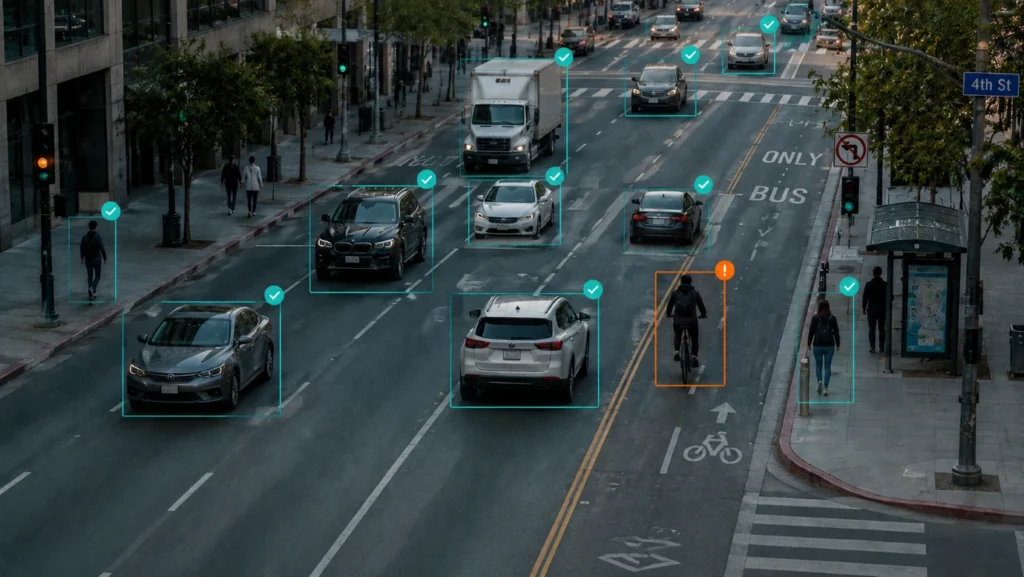
This isn’t unique to any one industry. Enterprise document processing teams see this when a contract-extraction model keeps missing the same clause type. Autonomous vehicle programs see it when a perception model keeps confusing two similar object classes in low-light conditions. Market research operations see it when a sentiment classifier drifts as new slang enters social listening data. In every case, the underlying issue is the same: the annotation team already knows what’s wrong long before the model team gets a chance to act on it.
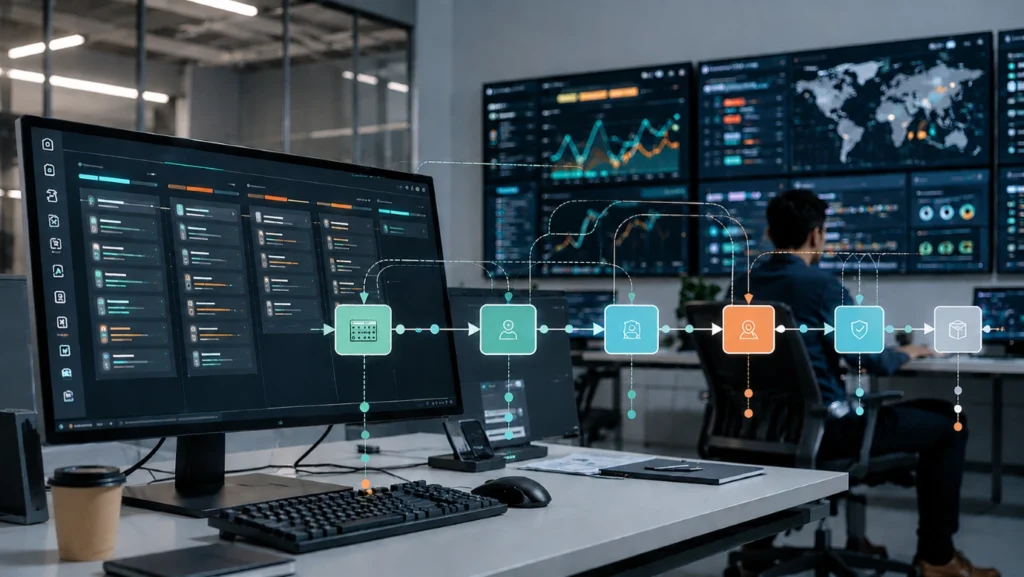
To break this cycle, organizations must build a tight annotation feedback loop. This loop connects annotation operations, quality review, and model improvement into a single workflow. The thesis is simple. The faster annotation insights reach model teams, the faster organizations can improve model performance and reduce recurring errors.
Production AI systems cannot afford linear, isolated data paths. When operational speed drops, the competitive edge erodes. The article below details exactly how enterprise AI programs eliminate that latency across the lifecycle of a deployed model.
The cost of a slow loop is rarely visible on a single dashboard, which is part of why it persists. A recurring error that takes six weeks to reach a retraining decision doesn’t show up as one large incident. It shows up as a slow trickle of support tickets, a handful of dissatisfied enterprise customers, and an ML team that assumes the model is simply at its performance ceiling. Only when someone lines up the annotation logs against the support queue does the real pattern, and the real cost of the delay, become visible.
Where the Annotation Feedback Loop Breaks Down
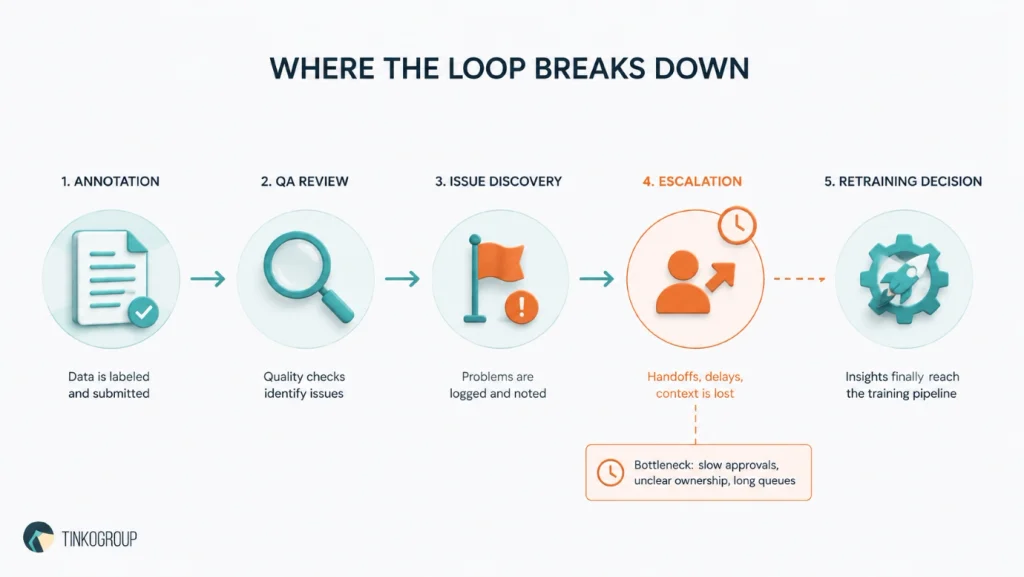
Why does this system fail so often? In most companies, the annotation feedback loop breaks down due to structural silos. Annotation teams find errors daily. But ML engineers only see the final dataset batches at the end of a quarterly sprint. This delay means engineering teams remain blind to critical data anomalies until it is too late. When information travels through an organization at a glacial pace, the AI feedback cycle stalls, and models running live applications become increasingly detached from real-world data distributions.
Siloed Teams and Fragmented Ownership
Data labelers work under one manager. Data scientists work under another. When annotators notice that a new production edge case is confusing the model, they lack a direct channel to tell the engineering team. Without shared ownership, annotation operations become a one-way street instead of a collaborative cycle.
This deep organizational divide fosters distinct micro-cultures with entirely different operational objectives. Labeling vendors or internal data operations teams are typically evaluated on total volume and throughput under strict cost constraints. Meanwhile, enterprise ML teams are judged on system accuracy, latency, and operational performance. Because neither side shares a unified metric for tracking feedback velocity, critical observations regarding systemic model failures rarely cross the organizational boundary.
This communication breakdown compounds across the development lifecycle. When an annotation program manager focuses entirely on reducing the cost-per-label, they naturally incentivize workers to process tasks as quickly as possible. Under these conditions, an annotator who pauses to document a complex, recurring failure mode is effectively penalized for dropping their hourly throughput. There is no formal process to route these front-line discoveries. As a result, data operations teams have little choice but to fix the label locally and move on to the next task in the queue.
Consequently, the ML engineering team remains unaware of the underlying issue. They continue to run automated training pipelines on massive, homogeneous data batches that fail to address the specific edge cases causing real-world errors. This gap turns annotation into a fragmented process, working against the goal of continuous model improvement. A well-defined annotation feedback loop gives both teams a shared process for turning recurring labeling issues into actionable model improvements.
Delayed QA Reporting
Quality assurance shouldn’t just measure labeler accuracy. It should also measure model failure modes. Unfortunately, traditional QA reports focus only on internal worker scores. They hide valuable behavioral data from the engineers who actually build the models.
When a quality review team aggregates data at the end of a long verification cycle, the resulting report usually highlights annotator error rates, labeling speed, and guideline alignment. These figures help manage the workforce, but they obscure the exact patterns where the model misinterprets input.
For instance, if an autonomous-vehicle model consistently confuses a specific type of roadside barrier with a pedestrian, that insight stays buried in review logs instead of reaching engineering. Without a clear path for annotation issue escalation, this kind of pattern can repeat for months before anyone notices.
Unclear Retraining Triggers
When should a model be retrained? Many teams do not have an answer. They retrain on a fixed schedule, such as the first Tuesday of the month, regardless of whether the data pipeline contains the corrective examples needed to fix a specific bug.
A calendar-based schedule pushes teams into an inefficient cycle. Compute clusters spin up to train new iterations on datasets that offer little statistical novelty. When a real distribution shift occurs, the production system keeps degrading for weeks while everyone waits for the next scheduled window. Without data-driven parameters, and without a shared definition of retraining readiness, companies waste compute resources while extending their exposure to known bugs.
A team that defines retraining readiness clearly avoids both failure modes. One useful definition sets a minimum count of validated new edge cases plus a signed-off dataset diff before a run is approved. That single rule prevents training too often on stale data, and it also prevents training too rarely once a real gap has already opened up.
Architectural Disconnection Across Platforms
The architectural mismatch across systems often worsens this problem. Labeling tools log issues in unique, unstandardized text fields. Production monitoring stacks record raw vector drift or confidence drops. Because these formats stay incompatible, manual work is constantly required to move information between them. This forces highly paid ML engineers to spend days parsing spreadsheets instead of fixing engineering flaws.
A monitoring platform might flag an anomaly through a drop in prediction confidence or a shift in latent vector space. When that signal reaches an annotation system, the labeling interface often strips away that engineering context. So a reviewer sees a generic sample rather than a flagged anomaly. Losing that context destroys the diagnostic value the flag was supposed to carry.
Turning Annotation Insights into Actionable Model Feedback
Mature organizations build structured communication between annotators, reviewers, QA teams, domain specialists, and ML engineers. A domain specialist reviewing medical scans or legal clauses often catches a nuance a generalist reviewer would miss, so their input needs the same structured path into the loop as anyone else’s. Together, these roles turn raw observations into actionable annotation QA insights, and that shift is what separates a real model feedback workflow from a pile of scattered QA notes.
Structured Error Reporting and Escalation Workflows
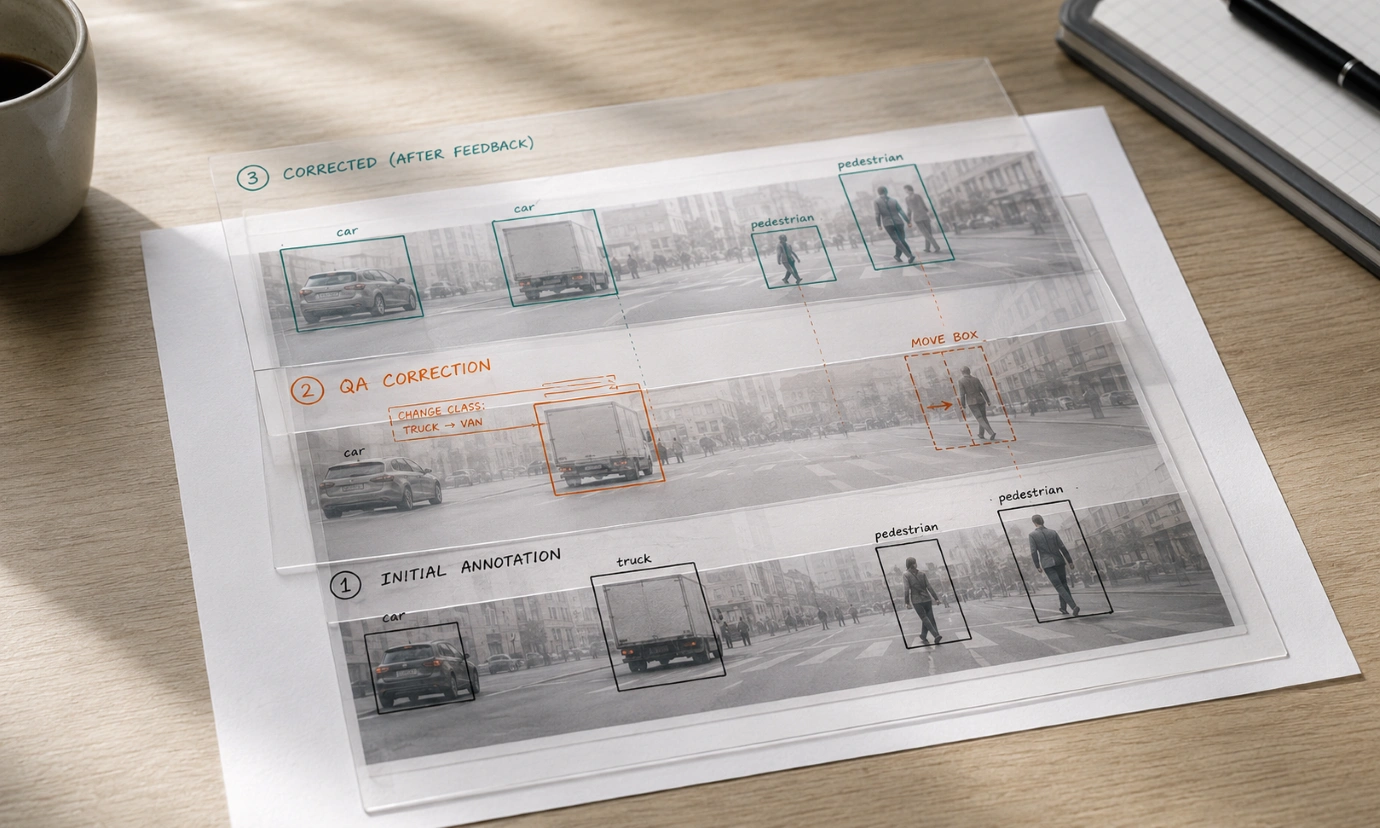
When a reviewer finds a consistent model error, they should not just fix the label. They need to categorize the error using a standardized taxonomy.
- Edge case tagging. Labeling instances where the model exhibits systemic confusion.
- Concept drift alerts. Marking incoming production data that no longer matches original training distributions.
- Ambiguity flags. Highlighting inputs where human experts disagree, signaling a need for clearer guidelines.
Consider a concrete case: reviewers flag the same document-classification error twelve times in a single week. Under a structured system, that pattern gets tagged as a recurring edge case and attached to three representative samples. It is marked as a dataset-coverage issue and routed to the ML team’s backlog with a 48-hour service level. Without that structure, the same twelve flags sit scattered across individual QA notes, each treated as an isolated fix.
Feedback Dashboards and Review Meetings
Engineers should not have to dig through raw CSV files to find errors. Centralized feedback dashboards display real-time trends showing where the model fails most often. Weekly cross-functional meetings allow data operations leaders and ML engineers to review these trends together. This collaboration ensures the annotation-to-retraining workflow is visible to both sides instead of buried inside separate tools.
Standardized taxonomies act as a common language. When data operations teams mark a data slice as an adversarial distribution shift, the ML system ingests that metadata directly. The engineering team can then group related issues, estimate business impact, and route them to the right queue without manual delay.
Building a Faster Model Retraining Workflow
Shortening the cycle requires an optimized model retraining workflow. This workflow reduces the time between discovering an error, updating the dataset, making a retraining decision, and releasing the updated model. Treated well, this workflow becomes a repeatable AI model iteration cycle rather than a one-off project each engineer reinvents from scratch.
Not every flagged issue belongs on the same track, though. A single mislabeled image is a labeling issue: the reviewer fixes it and moves on. A pattern where several annotators interpret the same instruction differently is a guideline problem, and it calls for a clearer guideline, not a retraining run.
A gap where the model has simply never seen a category of input, such as low-light warehouse footage, is a dataset-coverage issue that needs targeted collection. Only a recurring, validated failure, the same mistake showing up across batches and times, justifies a full retraining cycle.
Mixing these four categories together is one of the most common reasons a model improvement workflow stalls. Teams either retrain too often on noise, or they sit on a genuine, recurring failure simply because nobody sorted it into the right bucket first. An effective annotation feedback loop helps teams distinguish routine labeling corrections from dataset gaps and model failures that require retraining.
Automation in the Retraining Data Pipeline
A modern retraining data pipeline treats training data iteration as a continuous, automated process rather than a manual file transfer. When a threshold of new edge-case annotations is met, the pipeline packages the data, runs validation checks, and queues the dataset for the next training cluster on its own.
Prioritization Frameworks for Validation Readiness
Not all errors are equally important. Organizations prioritize bugs based on their business impact. A failure affecting a core product feature needs an immediate patch, while an error in a rare, low-traffic feature can wait for a monthly cycle. In an insurance claims model, for example, an error that misclassifies a high-value claim type deserves faster attention than one affecting an edge case seen twice a quarter. Clear prioritization like this keeps teams from spending compute resources on minor updates.
Automated orchestration removes most of the manual overhead in dataset preparation. Instead of a person running validation checks by hand, the pipeline verifies consistency, label compliance, and class balance on its own. This shortens the backlog and lets models accept updates with minimal human intervention. Teams that reach this level of automation typically report validation readiness in hours rather than the days a manual process usually takes.
Human-in-the-Loop Feedback as a Continuous Improvement System
The work doesn’t end at deployment. Continuous model improvement depends on a standing human-in-the-loop feedback system that continuously monitors production behavior after launch.
Monitoring Post-Deployment Behavior
Once a model is live, it meets messy real-world data. Teams use uncertainty sampling to route low-confidence production predictions back to human reviewers, which surfaces new failure modes before they affect a large share of users.
In healthcare AI, this shows up clearly. A clinical document classifier trained on historical intake forms can perform well for months until a hospital network changes its form layout. Production monitoring flags a spike in low-confidence predictions. Human reviewers confirm the model is misreading the new field structure. That finding becomes the basis for a targeted annotation batch rather than a blanket retraining pass. By incorporating production findings into the annotation feedback loop, teams can address emerging data issues before they become persistent model weaknesses.
Driving Data Scaling for Machine Learning
Adding millions of random samples to a dataset is expensive and often wasteful. Smarter data scaling for machine learning uses human feedback to choose the right data. By identifying specific gaps in the model’s knowledge, teams can source and annotate only the examples needed to close those gaps.
Human Feedback Annotation for LLMs
For teams working with large language models, this loop matters even more. Human feedback annotation for LLMs, including reinforcement learning from human feedback (RLHF), helps align model outputs with human intent. Reviewers rank responses, correct hallucinations, and flag unsafe text, shaping model behavior far more directly than raw text ingestion alone. This is one of the clearest examples of a training data feedback loop in practice. Every ranked response becomes a labeled signal that reshapes how the model responds the next time around.
This kind of review turns human input from a generic filtering step into a targeted diagnostic tool. Instead of reviewing generic, clear-cut items, reviewers focus on high-value anomalies, which lowers operational cost while raising the value gained from each newly labeled item.
Metrics That Measure Feedback Loop Efficiency
Raw annotation throughput, images labeled per hour, says little about ML workflow optimization. What matters is how fast an insight moves from discovery to action. High throughput is close to useless if labeled data sits idle in storage for months.
An operation that produces a million labels a week but takes ninety days to get them into the active training set is still working with stale data. Real velocity is temporal: how fast a production insight changes live system behavior, not how many labels pile up in cold storage. The table below summarizes the core indicators worth tracking. Each one measures a different point where the loop can stall.
| Metric | What it measures | Why it matters |
| Time-to-escalation | Hours between a flagged error and its arrival on the ML team’s desk | Keeps issues actionable while context is still fresh |
| Time-to-owner assignment | Hours between escalation and a named person accepting responsibility | Prevents issues from stalling in a shared inbox with no clear owner |
| Time-to-retraining | Time between an approved retraining trigger and the compute job starting | Reveals bottlenecks in dataset preparation, not just labeling |
| Feedback adoption rate | Share of flagged issues that lead to a real dataset update | Below roughly 40%, it signals a disconnect between operations and engineering priorities |
| Retraining frequency | How often verified updates reach production | Distinguishes a routine background process from a rare, high-risk event |
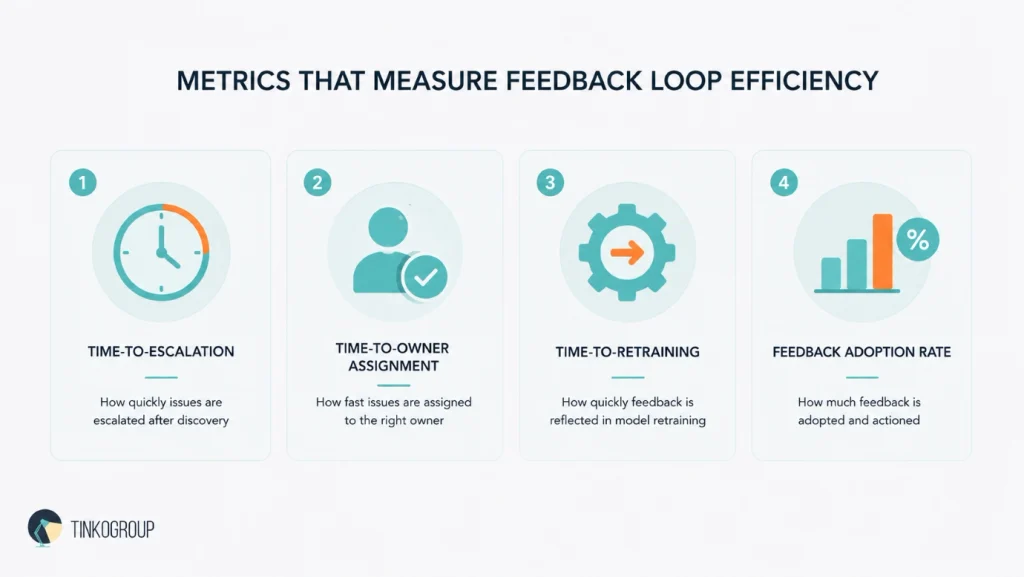
When time-to-escalation is short but time-to-retraining stretches into weeks, the bottleneck sits in the engineering validation pipeline, not the labeling pool. Tracking these figures, rather than throughput alone, is what tells leadership whether the feedback loop is actually working. It forms the foundation of any meaningful retraining readiness assessment. A quarterly review of these four numbers, shared between data operations and engineering leadership, usually surfaces the bottleneck faster than any single dashboard alert.
Tinkogroup’s Approach to Annotation Feedback Loops
Tinkogroup builds operational workflows that close the gap between data teams and engineers. The company’s approach keeps iteration speed high for enterprise AI programs across North American and European markets. The approach centers on data-centric AI workflows. Instead of treating labeling as a one-time production task, every project is set up to keep feeding structured signals back into the client’s own model development cycle.
Practical Data Operations
Tinkogroup avoids treating annotation as an isolated production step. Teams use structured QA reporting to catch model errors early. Every anomalous data point gets tagged with a clear category, so ML engineers can see exactly why a model is struggling, rather than just that it is.
That structure typically includes three layers. The first is detailed tagging of the environment and context around each flagged item. The second is a review step that maps recurring anomalies against known performance limits. The third is an error-origin tag attached to every corrected label, so downstream systems can prioritize high-value inputs automatically. Engineering teams receive pre-sorted data slices as a result, instead of raw, disorganized batches.
Seamless Engineering Collaboration
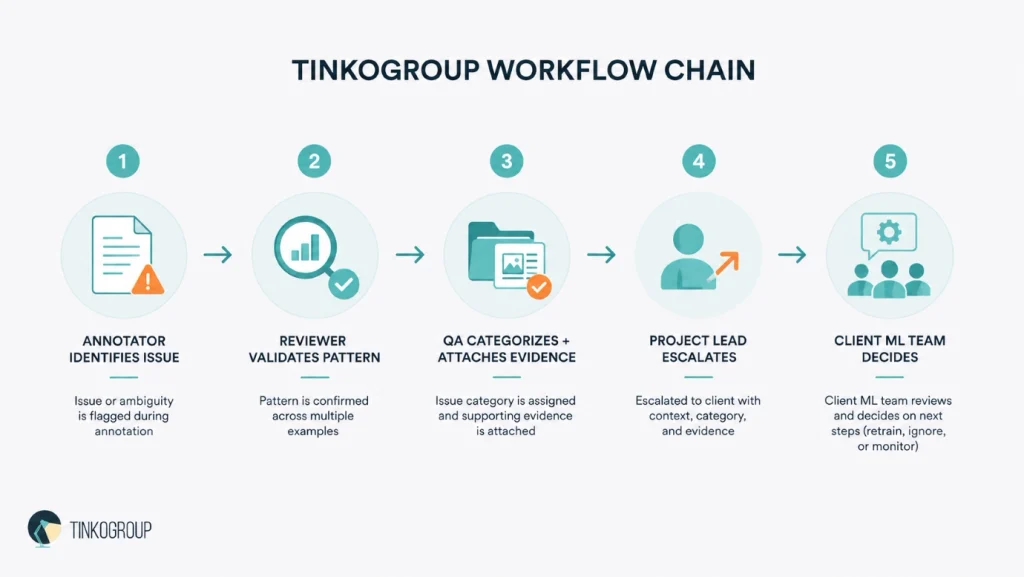
Through proactive escalation, Tinkogroup makes sure critical data anomalies don’t get lost. In practice, the workflow looks like this. An annotator identifies a recurring issue, and a reviewer validates the pattern across several samples. QA categorizes the issue and attaches supporting evidence, while a project lead escalates it with full context. From there, the client’s ML team decides whether the fix belongs in the guidelines, the dataset, or a retraining run.
This kind of managed annotation operations model connects directly into a client’s own tracking systems. Issues sync automatically into tools like Jira, GitHub, or Slack, and annotation formats convert into the client’s preferred schema without manual file handling. Shared QA dashboards then give both sides visibility into inter-annotator agreement, error trends, and dataset readiness, so neither team has to ask the other for a status update.
Conclusion
Fast model improvement requires more than collecting labels. Organizations need to shorten the path between annotation, quality review, issue discovery, retraining, and deployment. The goal isn’t to send every annotation observation straight to an ML engineer, it’s to build a workflow that filters, validates, prioritizes, and routes the right feedback quickly.
A mature annotation feedback loop turns annotation operations from a downstream production step into an ongoing source of model-development intelligence. Take a close look at your pipeline. Where do insights actually stall: in escalation, in prioritization, or in the retraining decision itself?
Look honestly at your annotation feedback loop. How long do useful insights sit before anyone acts on them? Is ownership for escalated issues clearly assigned? If recurring failures keep resurfacing in your production AI systems, talk to Tinkogroup about a managed annotation workflow or a pilot project built around a faster feedback loop.
What is an annotation feedback loop in machine learning?
An annotation feedback loop is a structured process that connects data labeling, quality assurance, issue reporting, and model improvement. Annotators and reviewers identify recurring errors or data gaps, document their findings, and pass validated evidence to ML engineers. The engineering team then determines whether to update annotation guidelines, improve dataset coverage, or retrain the model. This process helps teams address recurring failures instead of repeatedly correcting individual labels.
When should an annotation feedback loop trigger model retraining?
Model retraining should be considered when a recurring model failure has been validated and the team has collected relevant corrective examples. A single mislabeled item usually requires a label correction, while inconsistent interpretations may call for clearer annotation guidelines. If the model lacks examples of a particular input category, targeted data collection may be more appropriate. Retraining becomes justified when the evidence indicates a persistent model weakness that the updated dataset can address.
Which metrics help measure annotation feedback loop efficiency?
Teams can track time-to-escalation, time-to-owner assignment, time-to-retraining, and feedback adoption rate. These metrics reveal how long it takes for an issue to reach the right team, receive an owner, enter the retraining process, and result in an actionable dataset update. Reviewing these indicators together helps identify bottlenecks between annotation operations and ML engineering. The goal is to shorten the path from validated findings to model improvements, rather than simply increasing annotation volume.