


Everyone wants to launch AI products fast, and most teams learn these lessons the hard way.
Picture a mid-sized annotation program six months in: what started as one specialist team of eight has grown into three distributed groups working across time zones. Throughput doubled, but QA scores started drifting. One group flags a blurry product photo as “unusable”, another accepts the same type of image without comment. The guidelines haven’t changed. The reviewers have just started interpreting them differently, and nobody has a shared reference to settle who’s right.
A good model needs clean labels, and that starts with reliable annotation QA benchmarks. Yet, poor AI training data quality silently undermines many enterprise AI programs. Weak QA lowers quality. But it also creates a cascade of business problems:
- Annotation rework – teams spend days fixing the same examples.
- Reviewer disagreement – no ground truth leads to constant edge-case debates.
- Operational inefficiency – quality checks become bottlenecks rather than safeguards.
- Dataset instability – label distributions shift between cycles, eroding trust.
- Model reliability risks – fragile models fail unpredictably in production.
In practice, the impact can be significant. For a team of five, even a 15–20% rework rate can translate into several person-days each week spent fixing work instead of moving the dataset forward. That’s the cost of a missing QA benchmark.
Annotation QA benchmarks are structured datasets and validation rules used for annotation performance evaluation and consistent labeling. When they’re missing or weak, workflows drift. Annotators interpret guidelines differently, and reviewers dispute edge cases with no shared ground truth. Teams flag, return, and relabel batches long after marking them “done.” A single rework cycle on a mid-sized AI project can easily cost thousands in wasted time and delays.
The real problem is trust. As guidelines shift, teams keep retraining on the same ambiguous concepts, and confidence in the dataset erodes with every cycle – eventually reaching revenue.
A strong annotation QA benchmark breaks this cycle and turns labeling into a repeatable system. Reviewer disagreements decrease, operations become smoother, and every label is checked against a shared standard. In a fast, precise industry, strong benchmarks let teams build strong datasets. Without them, even the most promising AI model will slowly break down and become expensive.
This article covers what makes annotation QA workflows reliable, how teams apply them daily, and what goes wrong when benchmarks are weak.
What Makes Reliable Annotation QA Benchmarks
An annotation QA benchmark is not simply labeled data. It is a checked reference set used to measure how consistent labeling is. If teams treat it like normal labeled data, they can end up trusting results that seem right but are wrong.
Characteristics of Effective QA Benchmark Systems
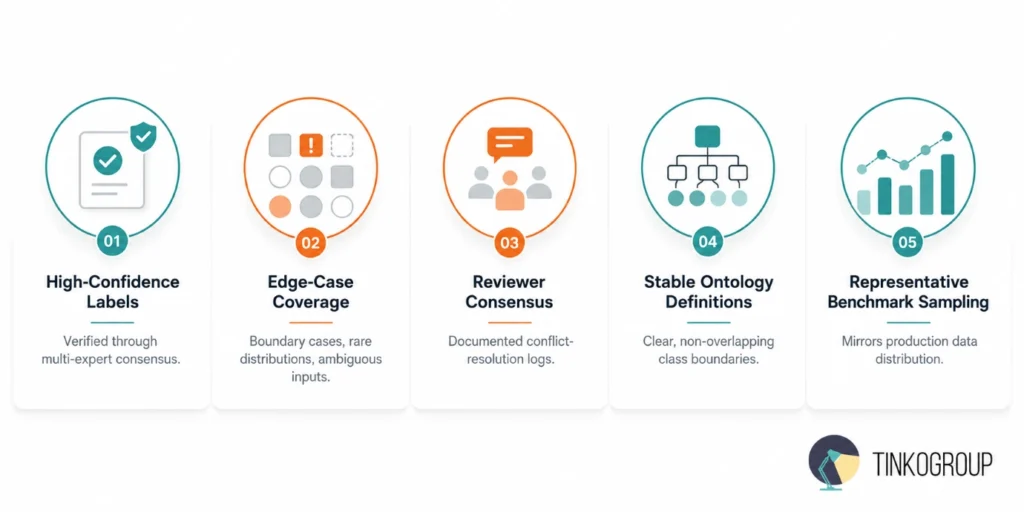
Scalable annotation QA benchmarks share a few non-negotiable properties:
High-confidence labels. The core of any benchmark dataset is absolute accuracy. Senior QA teams verify every label, polygon boundary, and named entity tag through multi-expert consensus matrices and programmatic validation scripts. If a benchmark contains even a 0.5% error rate, it can flag correct annotators as wrong and damage trust in the system.
Research highlights the stakes: even in widely used benchmark datasets, at least 3.4% of labels are inaccurate, and ML engineers already dedicate over 80% of their time to data preparation and labeling. A benchmark with even minor errors creates a false quality baseline.
Edge-case coverage. Standard data points are easy to label consistently. A resilient benchmark must intentionally contain boundary cases, rare feature distributions, low-contrast environments, and multi-class ambiguities. When annotators interact with complex edge cases, the system reveals hidden gaps in their understanding before those errors compromise real-life performance.
Reviewer consensus. Senior QA architects must reach complete consensus before any asset enters the annotation QA baseline. Teams must document consensus in clear conflict-resolution logs that explain why each label is correct. Without such documentation, the benchmark becomes just another opinion.
Stable ontology definitions. An annotation QA benchmark depends on a clearly defined ontology. Teams must define classes, attributes, and relationships so they stay clear and do not overlap. If class boundaries stay unclear, the benchmark cannot produce stable and repeatable results.
Representative benchmark sampling. Building reliable benchmark datasets for annotation means mirroring the broader statistical profile of production data. It should skew slightly toward complex edge cases to test skill limits, but it must preserve distribution ratios of sensor types, linguistic dialects, metadata tags, and file formats seen across the live project.
Let’s take an e-commerce product categorization pipeline. A weak benchmark may only test obvious cases like “men’s cotton t-shirt” → Apparel. But real inventory is messy. A solid QA benchmark would include high-confidence labels for tricky items: Is a “yoga mat with carrying strap” sports equipment or a travel accessory? It would cover weird edge cases, such as misspelled titles like “shooes,” products that fit into two categories (a laptop sleeve that also holds a tablet), or regional terms (“trainers” vs. “sneakers”).
The benchmark would also pull a realistic mix: maybe 70% standard products and 30% oddballs like pet Halloween costumes. Without such a system, reviewers argue endlessly, and the model quietly misroutes thousands of listings a week.
The Risks of Weak Benchmark Systems
Deploying uncalibrated benchmark datasets creates immediate risks:
- Misleading QA signals. An uncalibrated benchmark creates a false sense of success. Teams may see a 99% QA pass rate, but the model still performs poorly because the benchmark doesn’t reflect real-world complexity.
- Inconsistent reviewer interpretation. Without clear benchmarks, reviewers rely on their judgment. One reviewer may approve work that another rejects, which creates confusion and lowers team morale.
- Unreliable validation workflows. Automated checks don’t work well when the baseline data is weak. They raise false alarms, forcing senior engineers to spend hours reviewing them manually.
- False confidence in dataset quality. A high score on a simple benchmark can create false confidence. Teams deploy models, thinking the data is solid, but performance drops quickly in real-world conditions.
Why Annotation QA Benchmarks Should Evolve
Annotation QA benchmarks should never remain static. They must evolve alongside the software and data ecosystems they support:
Annotation Guidelines ──► Model Requirements
▲ │
│ ▼
Production AI Workflows ◄── Edge-Case Discovery
When models make mistakes in production, teams should add those examples to the QA benchmark so they can catch similar issues in the future. As labeling rules and product requirements change, the benchmark should change too. Without updates, the benchmark quickly becomes outdated and less useful.
How Annotation Teams Use QA Benchmarks in Daily Operations
Many treat annotation QA benchmarks as simple reference documents. But it’s actually a tool that teams use every day for annotation consistency. Built into daily workflows, annotation benchmarking catches mistakes earlier and reduces decision bottlenecks:
Hidden validation tasks. The most direct use is also the most invisible. Every annotation batch includes a small number of benchmark examples, usually around 3–5% of the total tasks. Annotators don’t know which items are real production data and which are test questions. If someone mislabels a benchmark example, the system flags it instantly. Teams don’t have to wait for reviews or argue over mistakes. A failed example triggers an immediate alert and action.
Onboarding assessments. New annotators don’t touch live data until they’ve passed a benchmark-driven test. The onboarding exam is built entirely from the benchmark pool. Candidates must label 50–100 benchmark examples across different difficulty levels. The system compares their answers against the high-confidence ground truth. A passing score (usually 95%+) means they’re ready. Failing means more training. This removes guesswork from hiring and certification.
Spot-check workflows. Reviewers don’t inspect every label. They use benchmark-anchored spot checks. A reviewer pulls a random sample of completed work, but the system automatically includes several benchmark examples in that sample. If the annotator passed the hidden benchmark tests but failed on a spot-check benchmark, the reviewer knows something shifted. Maybe the guideline changed. Maybe the annotator got tired. Either way, the benchmark provides an objective anchor.
Benchmark validation checkpoints. Every major batch goes through a validation checkpoint before delivery. At this point, the QA lead reviews a sample of the batch against the benchmark as part of a formal quality check. The batch passes only if it meets a predefined benchmark score (e.g., 98% alignment on core categories, 90% on edge cases).
QA escalation triggers. When an annotator continuously fails benchmark tasks, the system flags the issue automatically. Teams don’t have to wait for someone to notice it. If the problem repeats, a senior QA lead reviews the case to find the cause. The guidelines may be unclear, the annotator may need more training, or the benchmark may need an update. The goal is to catch and fix problems early before they affect more work.
What the Benchmark Reveals Over Time
Over time, annotation QA benchmarks reveal systemic problems that daily checks miss:
- Annotation drift. When benchmark pass rates gradually decline over weeks, it usually means guidelines have shifted, but training hasn’t caught up. The numbers don’t lie.
- Reviewer inconsistency. Show the same benchmark sample to two reviewers. If they disagree on which annotator errors are real, the problem isn’t the annotators but the reviewers. Benchmark data makes that visible.
- Recurring edge-case failures. If the same benchmark example fails repeatedly across different annotators, that example isn’t the problem. It’s the guideline or ontology that you need to fix.
- Low-confidence annotation patterns. Some annotators fail only on certain semantic categories (e.g., sentiment labels on sarcastic sentences). Benchmark breakdowns by category reveal these weak spots.
The annotation QA baseline is a must for daily operations. If you work without it, you work blindly.
Common Benchmarking Failures That Damage Annotation QA
Building a benchmark system is only half the job. If you build the system on wrong assumptions, it can do more harm than good – it approves bad data, masking problems that only surface in production models. Here are the most common ways that annotation QA benchmarks can break down.
Outdated benchmark samples. A benchmark created during project kickoff and never touched again is a disaster. Guidelines always evolve, and new edge cases appear. But the old benchmark still reports 99% pass rates, so everyone believes quality is fine when it’s absolutely not.
Overly simplistic validation tasks. Some teams build benchmarks using only the easiest data. Such an approach makes the test too simple. Annotators pass easily but then struggle with real, harder work. The benchmark stops being a real quality check, and difficult cases never get properly tested or fixed.
Weak edge-case coverage. A benchmark without edge cases creates a blind spot. Annotators focus only on easy examples and rush through the hard ones. Reviewers miss more mistakes because the system doesn’t test difficult cases. Such a dataset looks fine on the surface but has hidden problems underneath.
Inconsistent reviewer consensus. If senior reviewers never agree on the benchmark, it can’t resolve disputes. One reviewer may say an example is correct, another may disagree, and there’s no record to settle it. Such a benchmark doesn’t solve conflicts but creates more disagreement.
Poor ontology governance. When category definitions change but the benchmark doesn’t, it creates false errors. Annotators follow the new rules, but the benchmark still uses the old ones. So the system marks correct work as wrong, wastes review time, and reduces trust in the results.
Benchmark systems that fail to reflect production complexity. Occasionally, a benchmark tests only clean, simple examples, but real data is messy and inconsistent. Models train on the clean cases, then fail when they face real user inputs. Such a benchmark doesn’t reflect reality.
What Weak Benchmarks Do to Your Pipeline
Weak annotation QA benchmarks can quietly break the whole workflow.
False QA confidence. Scores look high, but real problems remain hidden.
Example: A team reports a 98% QA pass rate, then sees the model fail on messy user-generated text two days after launch.
Annotation inconsistency. Different annotators label the same thing in different ways.
Example: One annotator tags a sarcastic customer review as “positive sentiment.” Another annotator, looking at the same text, tags it as “negative.”
Dataset quality degradation. Small errors build up over time, batch after batch.
Example: Each new annotation round adds a 2–3% error rate. After ten rounds, nearly a quarter of the dataset is unreliable.
Reviewer confusion. No clear ground truth, so reviewers rely on guesswork.
Example: Two senior reviewers disagree on whether a blurred product image counts as “damaged packaging.” The benchmark has no example to settle it, so the debate drags on for hours.
Unreliable validation outcomes. Automated checks stop being useful.
Example: The QA system flags 15% of a batch as errors, but manual inspection shows 12 of those flagged items are actually correct. The team wastes days chasing false positives.
The Hidden Business Costs
Weak benchmarks generate direct, measurable costs. Teams retrain on the same material because the lessons don’t stick. When problems show up late, they delay releases. Reviewers spend too much time on debates instead of real checks. Over time, small label issues make models less stable.
All of these factors lead to more rework, more delays, and higher costs. In the end, weak annotation quality assurance makes everything slower and pricier. The return is measurable: for every dollar invested in data quality, enterprises typically avoid 5–10× in failures, compliance penalties, and rework costs.
QA Benchmarks vs Inter-Annotator Agreement – Why Enterprise Teams Need Both
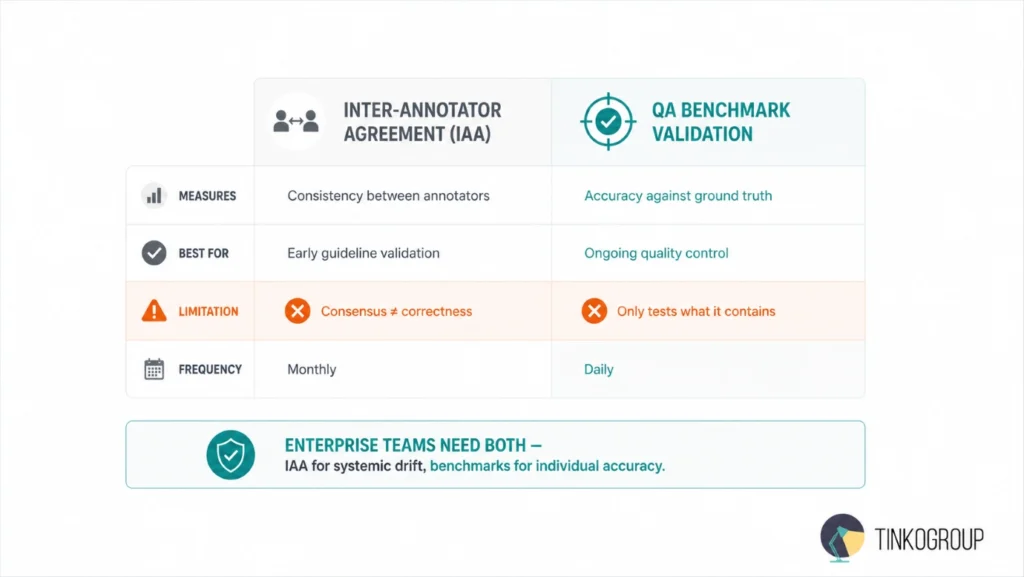
Some teams claim that their inter-annotator agreement can reach 90% and more. It seems to be a good sign, but it’s not always so. High agreement between annotators doesn’t automatically mean the labels are correct. Here are two distinct tools that serve different purposes: QA benchmark validation systems and inter-annotator agreement metrics.
Inter-annotator agreement (IAA) measures consistency between human labelers. Two or more annotators label the same items. You calculate how often their answers match. High IAA means the team interprets guidelines similarly. Low IAA means confusion or ambiguous rules.
QA benchmark validation compares annotator labels against a high-confidence ground truth. The benchmark contains pre-labeled examples that are verified as correct. When an annotator’s label matches the benchmark, they pass. When it doesn’t, they fail, regardless of what other annotators think.
Where Each Approach Works Best
IAA is great in the early stages. If you run IAA on small samples during guideline development, it will reveal ambiguous categories before full production starts. It’s also useful for spotting outlier annotators, someone whose labels consistently diverge from the group.
QA benchmarks work best for ongoing quality control. Once the benchmark is built, it provides an absolute, stable reference. Hidden validation tasks catch errors in real time, and release gates prevent bad batches from shipping.
The Operational Limitations
IAA has a blind spot. Annotators can perfectly agree and still be wrong. Imagine a guideline that says, “tag all images with dogs.” But the correct requirement is “tag all images with any animal.” Every annotator follows the wrong rule. IAA hits 100%, but the dataset is useless. That’s why IAA alone never guarantees dataset accuracy or production-ready quality.
Annotation QA benchmarks also have limits. They only test what they contain. If the benchmark lacks certain edge cases, these are blind spots that remain without control. Benchmarks also require maintenance. An outdated benchmark gives false confidence.
Why You Need Both Methods
Dataset validation workflows need the combination of both methods. Use IAA to:
- Validate if guidelines are clear
- Identify ambiguous categories
- Measure team alignment over time
Then use QA benchmarks to:
- Catch individual annotator errors against ground truth
- Measure work against a known standard
- Settle disagreements when reviewers have different opinions.
Here’s a practical example. A team runs weekly IAA checks on a 50-item sample and consistently sees agreement above 90%. Everything looks fine. But the benchmark shows a different result. Hidden validation tasks show that three annotators repeatedly mislabel the same product category. Because they all make the same mistake, IAA doesn’t catch it. The benchmark does. After retraining those annotators, the team improves dataset quality.
Now consider the opposite situation. A team relies on benchmarks but never checks IAA. The benchmark shows a 97% pass rate, which sounds great. But team-wide IAA is only 68%. Annotators interpret many non-benchmark items differently, which leads to inconsistent labels across batches. In this case, the benchmark alone can’t reveal the problem.
High reviewer agreement does not guarantee benchmark integrity. Annotators could agree on a wrong standard. And high agreement does not guarantee production-ready quality, because consensus around bad labels still produces bad data. Run IAA monthly for systemic drift. Run benchmark checks daily for individual errors. One without the other leaves a gap.

Reliable Data Services Delivered By Experts
We help you scale faster by doing the data work right - the first time

Scaling Annotation QA Benchmark Systems Across Enterprise Teams
A benchmark that works for five annotators breaks at fifty. Just imagine a situation – a remote reviewer updates a benchmark example without notifying anyone, and the entire QA baseline breaks overnight. Enterprise-scale QA benchmark governance requires different infrastructure, not just more reviewers. As operations grow, the benchmark needs infrastructure to manage complexity across languages, teams, and shifting ontologies.
In enterprise annotation, real-time IAA scoring per task type, annotator, and project lets teams catch quality drift before it becomes a model problem, but only if benchmark governance keeps pace with operational scale.
Governance Across Four Dimensions
Multilingual datasets. A benchmark built on English text won’t catch errors in Japanese or Spanish. Each language needs its own benchmark set, because ambiguity travels differently across cultures. A sarcastic phrase in German might not be sarcastic in French. Big teams must use language-specific benchmarks and local senior reviewers for each one.
Distributed reviewer teams. When reviewers work in different countries and time zones, it becomes harder to keep everyone aligned. Over time, different teams may adopt different labeling standards. To avoid these issues, teams need one shared benchmark that everyone follows and regular reviewer calibration to make sure everyone interprets labels the same way.
Long-term annotation projects. In long projects, labeling quality slowly changes over time. People who join later may label differently from those who started earlier. A benchmark helps keep everyone consistent, but only if it is updated regularly. That’s why teams review and refresh benchmarks every few months and add new real-world examples.
Evolving annotation ontologies. Categories don’t stay the same. For example, a “toy” category may evolve into “plush toys” and “electronic toys.” When such a shift happens, the benchmark also needs to change. Old examples can become outdated or confusing. You should update the benchmark to match the new categories and store old examples.
Governance Processes for Large Projects
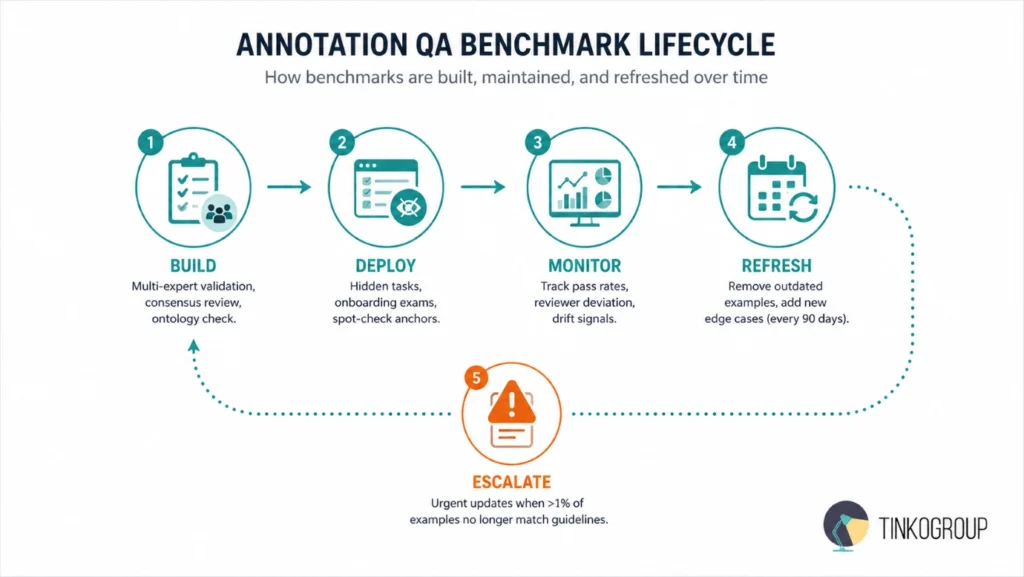
Benchmark refresh cycles. Every benchmark needs to be refreshed periodically. You should set refresh schedules for all projects. Each cycle removes examples that no longer reflect production data and adds new ones from recent edge cases.
Edge-case incorporation. When a reviewer finds a confusing example, it gets added as a possible benchmark item. A process then records it, sends it to a senior annotator, and checks it with other reviewers to agree on the correct label. Without this process, tricky cases just stay stuck in review and never get resolved properly.
Benchmark version control. Every benchmark change gets a version number. Annotation tools use a specific version when testing work. This makes results consistent when you compare batches over time. Without this feature, it’s hard to track changes or hold anyone accountable.
QA ownership structures. One person or a small team should own the benchmark. They decide what gets added, when versions change, and how categories are mapped. If ownership is spread too widely, standards slowly drift and become inconsistent.
Long-term dataset consistency management. Over time, benchmarks build up team knowledge. Teams record why tricky examples were labeled a certain way, including disagreements and how they were resolved. This way, you avoid the same debates.
Why Governance Gets Harder at Scale
As your project grows, you will face three problems. Reviewers increase, so it becomes harder to keep everyone aligned. Labeling rules change more often because more people are involved. And datasets become more specialized, so general benchmarks stop being useful.
Strong annotation governance does not remove these issues but gives you more control. It supports annotation performance evaluation across large and complex datasets, so teams can track quality in a consistent way over time. At the same time, it plays a key role in reviewer performance monitoring, especially in distributed teams where consistency can drift across time zones and projects. Without governance, your annotation QA benchmarks become tools no one fully trusts.
Tinkogroup’s Approach to Annotation QA Benchmarks Governance
Building a benchmark is difficult. Keeping it reliable across thousands of annotators and dozens of languages is harder. Here’s how we do it at Tinkogroup:
- Benchmark dataset validation
Every example in our annotation QA benchmarks goes through a four-stage training data validation process before it enters the active pool.
- A few senior annotators label the item independently.
- A consensus algorithm flags any disagreement.
- A QA architect reviews flagged items and documents the final ground truth.
- A validation script checks the example against the current ontology for category conflicts. Nothing enters the benchmark without passing this benchmark validation process.
- Edge-case incorporation
Edge cases don’t wait for long review cycles. We have weekly sessions where QA leads check the most confusing cases from the past week. Each case gets a severity score. Serious issues, which cause reviewer disagreement or model errors, are added to the benchmark within 48 hours. We handle smaller issues in a monthly update.
- Benchmark refresh cycles
Full benchmark updates happen every 90 days. Each update removes outdated examples, adds new real-world edge cases, and rechecks a small sample to make sure rules still match. If more than 1% of examples no longer match the current guidelines, the team does an urgent update.
- Reviewer disagreement escalation
When two reviewers disagree, the system first checks the benchmark for a similar example. If it exists, that example decides the answer. If not, a senior QA expert reviews the case, sets the label, and adds it to the next benchmark update.
Maintaining Consistency Across Large Operations
We also run weekly reviewer calibration sessions. All active reviewers label a sample of 20 benchmark examples. The system compares results against ground truth and flags reviewers who deviate. Those reviewers receive targeted coaching within 24 hours, not at the end of the month.
For multilingual work, each language has its benchmark set managed by a local QA lead. A central team checks all languages once a month to make sure standards stay consistent, using the same types of tricky examples for comparison. This matters most for multilingual enterprise datasets and regulated AI projects, where a single mislabeled edge case can trigger compliance review.
Human-in-the-loop QA stays as the final check. Automated benchmarks catch common errors, but QA experts review any cases where confidence drops below 80%. This mix catches issues that automated checks miss.
Scalable QA governance needs clear roles. Each project has one benchmark owner. Each language has a local checker. Each quarterly update has a release manager. Everyone knows exactly who is responsible for what. This setup strengthens quality control in data annotation and keeps it at a high level as the team grows.
Conclusion
Reliable annotation QA benchmarks are no longer optional. They are the foundation that supports consistent reviews, accurate datasets, and reliable AI systems at scale. Without them, even well-funded annotation operations drift into inconsistency, rework, and eventual model failure.
Good QA benchmark systems make live annotation work smoother and more predictable. They give every annotator and reviewer a clear, shared standard to follow, which keeps labeling consistent across shifts, teams, and languages. When disagreements happen, reviewers can use benchmark ground truth to resolve disputes based on facts, not opinions. That removes the back-and-forth that slows batch delivery.
Strong benchmark systems also catch mistakes early, before those errors propagate through batches. Teams spend less time on retraining and revalidating labels. The result is lower operational waste, faster release cycles, and significantly more stable AI models in production.
Your investment in benchmarks today protects your production pipeline tomorrow. Investing a few weeks in up-front governance can save you months of downstream damage.
Ready to fix your annotation QA before it becomes a model problem?
- Audit your current benchmark governance for hidden gaps.
- Build structured benchmark datasets for consistent labeling.
- Scale your QA operations without losing accuracy.
- Request a pilot QA review with Tinkogroup.
What are annotation QA benchmarks?
Annotation QA benchmarks are reference datasets and validation rules that have been verified and are used to measure annotation accuracy against an established ground truth. They help teams maintain consistent labeling, detect reviewer drift, and improve overall data quality throughout AI training projects.
How often should annotation QA benchmarks be updated?
Annotation QA benchmarks should be reviewed continuously and refreshed on a regular schedule, typically every 90 days. However, urgent updates may be necessary whenever new edge cases appear, annotation guidelines change, or production data reveals recurring labeling errors.
What is the difference between annotation QA benchmarks and inter-annotator agreement?
Inter-annotator agreement (IAA) measures how consistently multiple annotators label the same data, while annotation QA benchmarks measure whether those labels are actually correct by comparing them with verified ground truth. Enterprise annotation teams use both methods together to achieve reliable quality control and maintain high annotation accuracy.