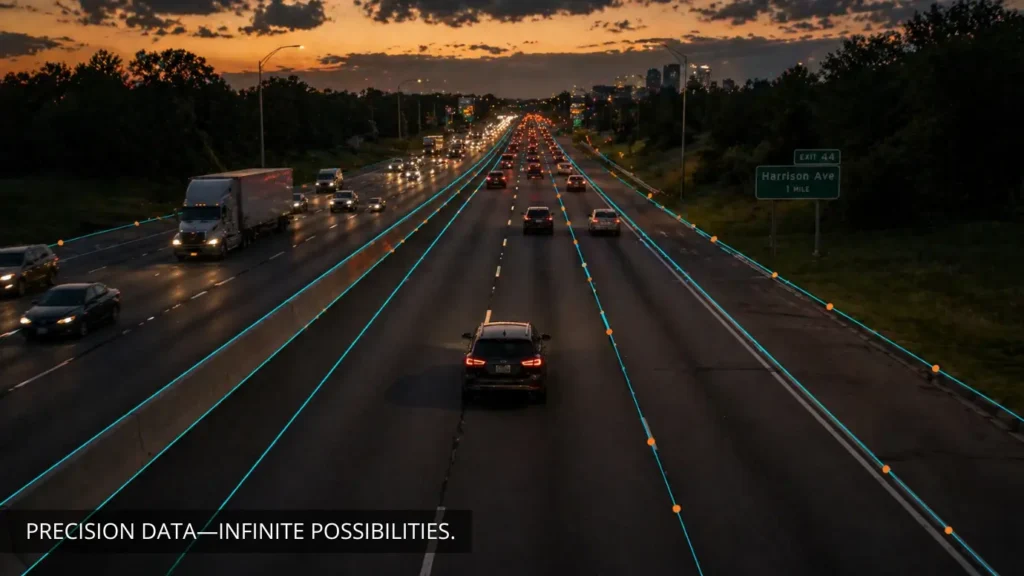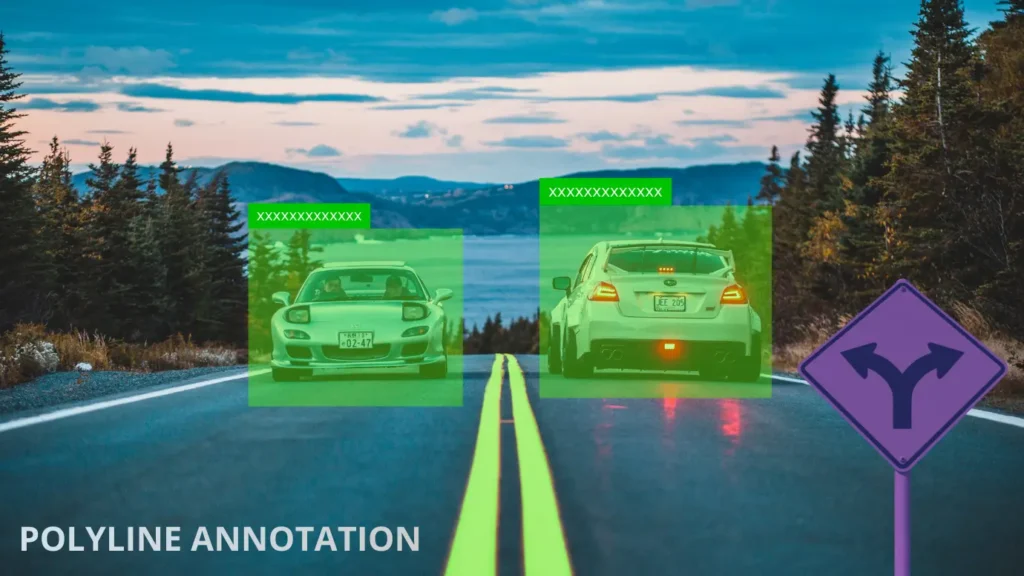
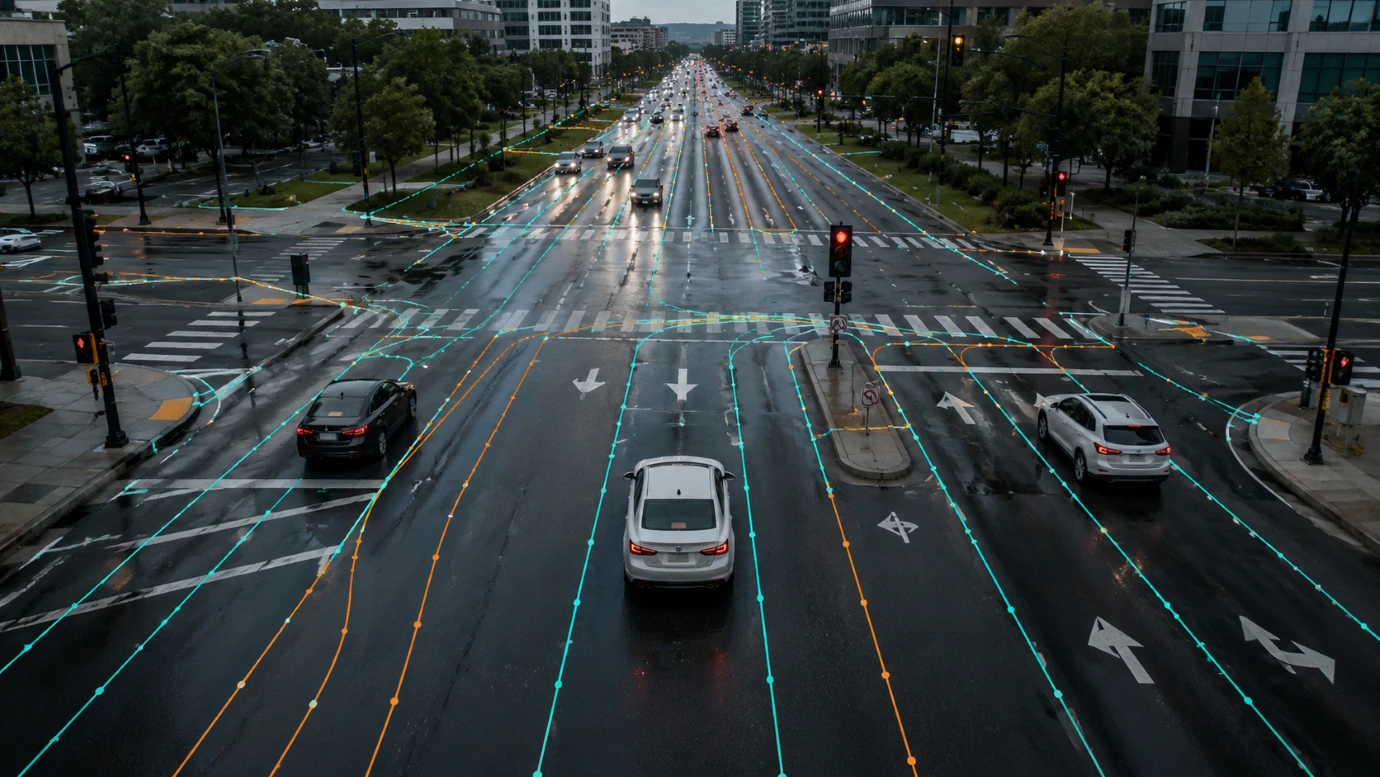

An ADAS engineering team validates its lane-detection model on clear daytime footage, and the results look strong. Performance drops sharply once the same model meets construction zones, faded lane paint, and nighttime driving. When we look more closely at the training dataset, we see the real problem. The lane boundaries were correctly labeled frame by frame, but they moved and disappeared in longer video sequences. The model never learned to track a lane through time, only to recognize one in isolation.
The autonomous driving sector has moved from the theoretical exploration phase into an era of rigorous commercial deployment. And lane tracking video annotation has become one of its most critical data engineering requirements. High-capacity machine learning frameworks, Level 2+ Advanced Driver Assistance Systems (ADAS), and Level 4 autonomous commercial fleets now navigate public roads alongside human drivers.
In this safety-critical domain, vehicle perception systems cannot afford mistakes. Computer vision models for edge devices depend heavily on the quality, density, and mathematical precision of their underlying training data. When a neural network ingests noisy, inconsistent, or poorly structured datasets, its downstream predictions become erratic and hazardous. Clean data is the asset that determines public road safety.
Road geometry and lane boundaries form the foundational structure of safe vehicle navigation. A vehicle must understand where it can legally and physically drive at any given millisecond. This requirement is met through a specialized data engineering pipeline: Precision Polyline and lane tracking video annotation.
This operational process involves the frame-by-frame vector labeling of lane boundaries, continuous driving paths, and complex road structures within high-resolution video streams captured by vehicle camera matrices. Unlike static image labeling, this methodology processes a continuous data stream where spatial coordinates link directly to temporal progression and vehicle dynamics.
Enterprise AI teams must establish high-precision lane tracking video annotation pipelines for enterprise AI development. Video annotation processes that ensure precision are essential for reliable perception systems, safer autonomous navigation, and scalable AI model development.
At long camera distances, small mistakes of just one or two pixels can cause big problems with where the camera is placed on the asphalt. These discrepancies break path-planning logic and cause unstable vehicle behavior. Engineering teams must build rigorous data factory pipelines that maximize production throughput without sacrificing geometric accuracy.
Why Lane Tracking Video Annotation Is Critical for Autonomous Systems
Training an autonomous navigation engine on isolated, disjointed photographic images is technically unfeasible. The real world is a continuous, fluid environment. An onboard computer in the vehicle processes active video streams at 30 or 60 frames per second. This means that the control loops of the computer are completely dependent on changing time conditions.
A single image frame cannot capture vehicle velocity variations, body roll from uneven road surfaces, or optical distortion from rain droplets on a camera lens. Modern autonomous systems therefore depend on continuous video understanding, not isolated image recognition.
Machine learning models depend on lane tracking video annotation to predict environmental changes and maintain stable spatial awareness over time. This is why lane tracking in video is so different from single-frame labeling: the model has to learn continuity, not just recognition.
High-fidelity lane tracking video annotation serves as the mathematical foundation for training deep neural networks to maintain spatial awareness across complex driving scenarios. This process drives four mobility verticals:
ADAS levels L2+ and L3. Lane Keep Assist (LKA), automated highway lane changes, and adaptive cruise control require flawless boundary detection to eliminate dangerous, jerky micro-steering corrections.
Highly automated vehicles (level 4 and 5). Urban robotaxis have to manage multi-lane intersections where physical markings often disappear. To do so, they need virtual trajectory lines that are based on implicit road logic.
Smart mobility systems. Automated municipal shuttles and public transport platforms operate in dense traffic zones where path calculations must be accurate to within a centimeter to ensure safe curb alignments.
Robotic yard navigation. Automated freight trucks and distribution yard tugs work within unique industrial geometries bounded by non-standard barriers, curbs, and temporary transport lanes.
Temporal consistency and motion-aware annotation directly affect AI decision-making accuracy. If a human annotator treats a continuous video file as a disjointed sequence of independent images, small spatial variations inevitably occur. The vector points of a polyline might sit on the outer edge of a painted line in frame 20, shift to the center in frame 21, and move to the inner edge in frame 22.
This sub-pixel variation creates high-frequency spatial noise known as dataset jitter. This noise, once ingested by a perception system, causes false braking events, erratic steering wheel vibrations, and control loop failure.
In production pipelines, stable lane IDs and spatial coordinates must hold across thousands of consecutive frames. This discipline, which enterprise teams increasingly call temporal lane tracking, relies on professional annotation. Thus, lane tracking video annotation becomes a critical component of modern autonomous navigation systems.
Challenges in Precision Polyline and Lane Tracking Annotation
If every highway mirrored a freshly paved European motorway under clear midday sunlight, data engineering teams would not face scaling bottlenecks. In production, driving in the real world has many tricky situations that make standard automation tools useless.
Video labeling for lane detection becomes complex because of environmental, optical, and physical degradation. Accurate lane tracking video annotation requires both temporal consistency and precise polyline placement throughout every sequence. Any video lane annotation team working at scale runs into the same five categories of interference.
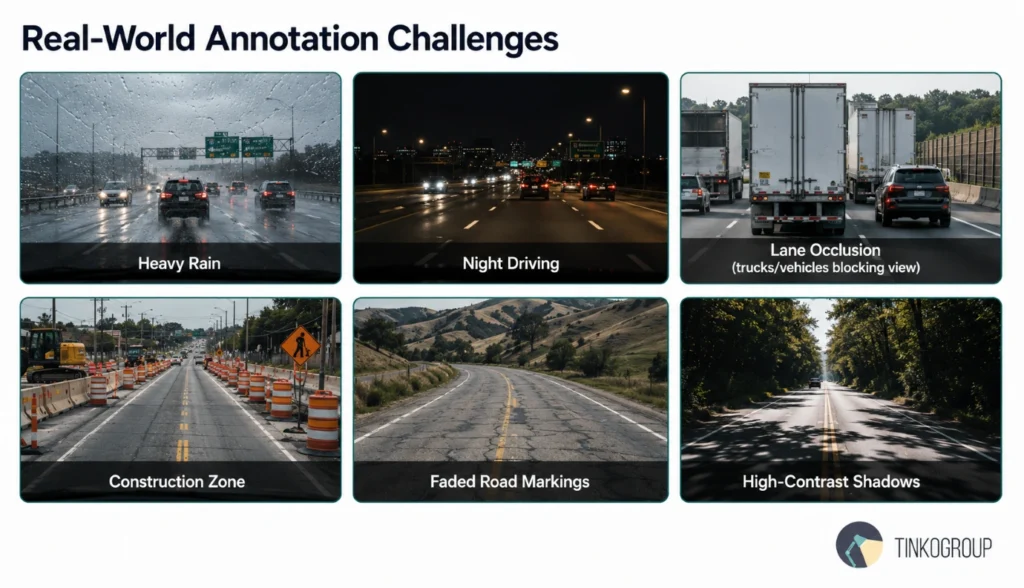
- Dynamic shadows and high-contrast lighting. As you drive through dense tree lines or under bridges, patches of intense glare and deep shadows appear and disappear. This makes automated edge-detection filters mistake shadow lines for lane boundaries.
- Severe weather conditions. Heavy rain turns asphalt into a highly reflective mirror that distorts headlamp beam patterns. Meanwhile, snow covers the paint, so people who are marking lanes have to use physical barriers or the wheel tracks of vehicles that are already on the road to figure out where lanes are.
- Low-light and nighttime sequences. Camera sensors introduce significant grain and electronic noise under low-light conditions, while oncoming headlamps generate lens flares that obscure low-contrast lane markings.
- Physical lane occlusions. Heavy commercial trucks, shifting traffic, and crossing pedestrians block a camera’s line of sight, requiring annotators to maintain lane tracking IDs through blind spatial interpolation across multiple seconds of footage.
- Degraded road infrastructure. Faded thermoplastic paint, pavement cracks filled with dark tar, abandoned construction lines, and chaotic layouts of traffic cones introduce extreme geometric ambiguity.
Maintaining a highly accurate polyline annotation across long video sequences requires substantial manual effort and strict operational discipline. The camera’s perspective matrix is constantly changing because the chassis moves over bumps and the body rolls during sharp turns. Because simple annotation software doesn’t have camera-motion compensation algorithms, static vector lines move away from the real lane boundary over time.
These challenges expose the limits of fully automated annotation systems. Automated pre-labeling tools work only within their trained domain. When working on roads with complicated layouts, like white and yellow paint lines that overlap, automated models don’t work. They either terminate the vector paths prematurely or connect random asphalt artifacts together.
Feeding unverified automated outputs into safety-critical models corrupts training data, and the consequences on public roads can be catastrophic.
Frame-by-Frame Video Annotation Workflows for ADAS Datasets
Developing production-ready training datasets for Advanced Driver Assistance Systems (ADAS) requires a highly systematic data engineering workflow. Annotation teams cannot draw vector lines arbitrarily, they must follow rigid geometric and spatial rules to handle complex road typologies safely. When processing raw vehicular footage, data annotation factories deploy specialized workforces to track and label a wide array of dynamic road features:
- Complex lane transitions. Labeling the precise pixel coordinate where a single highway lane broadens into two separate pathways or where deceleration lanes split from the main road geometry.
- Unmarked intersections. Mapping virtual path extensions through wide, unpainted urban crossings where physical markings completely disappear.
- Variable curve radii. Increasing vector point density to map the exact geometry of sharp mountain switchbacks, highway off-ramps, and winding rural roads.
- Multi-Lane Highways. Managing up to eight parallel traffic lanes simultaneously while preserving unique tracking identifiers across long distances.
- Dynamic road geometry. Adapting tracking matrices to sudden elevation changes, crests, and road dips that compress the camera’s perspective and alter focal plane lines.
To maintain structural consistency across thousands of frames, annotators rely heavily on polyline annotation techniques. Instead of bounding boxes or broad polygon masks, annotators use precise, connected linear nodes. The density of these nodes scales with road geometry. On flat, straight highways, nodes are placed farther apart to maximize throughput. On sharp turns or complex merges, the point density increases exponentially to capture the exact curve radius.
Enterprise-grade data production lines implement a multi-stage validation framework to guarantee tracking integrity. These quality controls make lane tracking video annotation suitable for safety-critical ADAS applications.
- Temporal validation. Looking at video clips one after the other to find sub-pixel drift or vector line sagging.
- Sequence consistency checks. Ensuring that a lane tagged as “Lane Index 1” maintains that exact semantic identity throughout the entire file.
- Frame continuity auditing. Checking keyframe transitions to make sure there aren’t any sudden changes in space or vector angles.
- Multi-tier QA review pipelines. Independent data auditors verify every vector coordinate against ground truth parameters before export.
Think what this means for a single ten-minute highway clip. The footage first goes through preparation and calibration to correct lens distortion. A first annotator drops down the polyline nodes over the clearest stretches of the sequence, and the tool propagates/interpolates those nodes through the intervening frames. A second annotator fixes manually the point where the interpolation drifts, often close to a curve or a merge.
QA validates the full sequence forward and backward before a lead reviewer escalates any road structure that doesn’t fit the existing guideline, such as a newly painted temporary lane. Only then does the clip move to delivery.
Standard image classification and ADAS video annotation are not the same discipline. While static image labeling isolates single moments, video processing demands a deep understanding of temporal progression and kinetic movement.
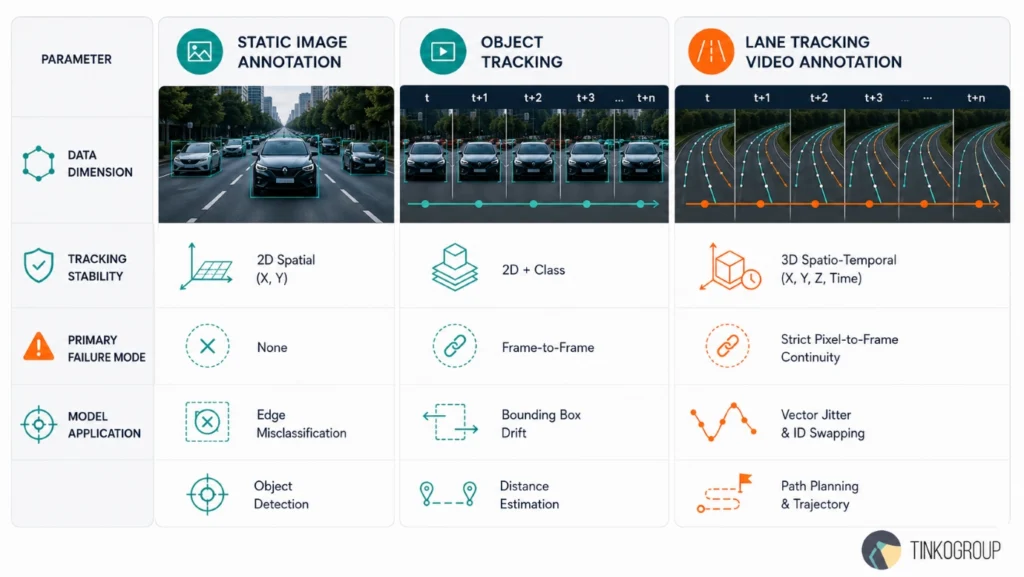
| Technical Parameter | Static Image Annotation | Object Tracking (B-Box) | Lane Tracking Video Annotation |
| Data Dimension | 2D Spatial (\(X, Y\)) | 2D Spatial + Class (\(X, Y, W, H\)) | 3D Spatio-Temporal (\(X, Y, Z, \text{Time}\)) |
| Tracking Stability | None (Single Frame) | Frame-to-Frame Overlap | Strict Pixel-to-Frame Continuity |
| Primary Failure Mode | Edge Misclassification | Bounding Box Drift | Vector Jitter & ID Swapping |
| Model Application | Object Detection | Proximity & Distance Estimation | Path Planning & Vehicle Trajectory |
Why Human-in-the-Loop Validation Remains Essential
Foundation models are often pitched as capable of labeling their own video data with full precision. In safety-critical deployments, fully automated data loops carry risks that aren’t obvious until something fails. Machine learning models excel at processing high-volume, standardized datasets under ideal conditions. But they completely lack the contextual reasoning required to parse rare, chaotic real-world events.
This fundamental limitation makes human-in-the-loop video annotation a requirement that no serious deployment can skip in enterprise data engineering. Human reviewers catch what machines miss.
Automated lane-tracking algorithms frequently suffer from localized tracking drift. This occurs when an automated tool slowly slides away from the physical lane boundary over a sequence of 200 or 300 frames due to changes in light reflection or asphalt texture.
A professional human annotator identifies this drift instantly, placing corrective keyframes to snap the polyline back to its precise position.
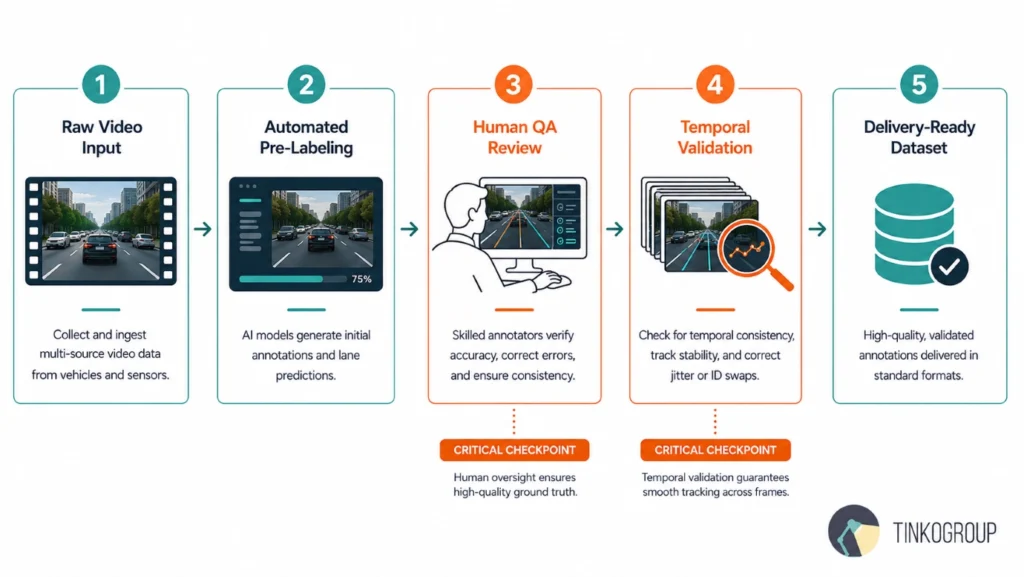
Human verification teams perform several high-value functions within an enterprise data pipeline:
- Correcting tracking drift. Overcoming errors caused by severe vehicle chassis pitch, yaw, and camera vibrations.
- Validating lane continuity. Maintaining smooth vector lines across complex, unpainted urban junctions where automated models fail.
- Resolving edge-case ambiguities. Making definitive decisions on non-standard road markers, such as temporary orange paint in European construction zones.
- Eliminating dataset hallucinations. Removing false-positive lines generated by automated tools when they misinterpret old skid marks or tire tracks as active lanes.
Models trained on unverified data fail on public roads, sometimes catastrophically. Poorly validated training data results in unpredictable vehicle behavior, causing delayed product launches and failed compliance audits. Incorporating a robust human-in-the-loop video annotation framework keeps ground truth data accurate and closes the gap between automated drafts and road-ready deployment.
Best Practices for High-Precision Video Annotation Projects
Successfully managing a large-scale computer vision video annotation project needs three things to work: clear rules, trained personnel, and rigorous QA. Without strict operational guardrails, large datasets quickly become chaotic, inconsistent, and unusable for deep learning models.
Every business data project starts with a single deliverable: a clear, complete annotation guideline. This is called the project’s lane boundary annotation standard. Successful lane tracking video annotation projects rely on standardized annotation rules that every reviewer follows consistently. These manuals serve as living documents, each one filled with visual examples of every possible road scenario. An enterprise-level playbook must explicitly define:
- Vector geometric placement. Specifying whether the polyline must sit precisely on the inner edge, outer edge, or mathematical center of the painted road line.
- Continuity protocols for occlusions. Defining how to extend virtual lines when a lane boundary is temporarily hidden behind a merging commercial vehicle.
- Temporal tolerance thresholds. Setting the biggest difference in pixels that can occur between two consecutive video frames, which is usually less than 1.5 pixels.
- Edge-case escalation trees. Providing clear instructions for annotators when they encounter unmapped roads, ruined pavement, or conflicting construction layouts is essential.
Running a large distributed workforce demands real operational infrastructure. High throughput must never come at the expense of accuracy. Enterprise projects must deploy specialized AI video annotation quality assurance pipelines. This means dividing the workforce into distinct operational tiers.
Junior annotators handle initial vector placement and point alignment. Senior specialists review frame-by-frame adjustments and perform deep temporal interpolation. Finally, dedicated QA managers perform random statistical audits across data batches before final delivery. Separating production from validation builds an internal check system that holds quality steady across millions of frames.
Frame-level checks alone would have passed a recent 40-minute suburban dataset outright: every individual frame showed a technically correct polyline. A sequence-level audit caught what the frame-level checks missed – the lane identity had silently swapped after an occluded merge. So the model would have learned to associate the wrong lane ID with the wrong physical lane for almost ninety seconds of footage. Only reviewing the sequence as a whole, not frame by frame, surfaced the error.
How Annotation Quality Impacts Autonomous System Performance
How safe an autonomous vehicle is in the real world depends directly on how well its training data is structured. Labeling accuracy is directly related to how stable the vehicle is under control on the road. If an annotation factory delivers Inconsistent or sub-pixel distorted work, it causes the vehicle’s onboard software to behave erratically, which can lead to dangerous performance on public roads.
Structural Degradation Across the Software Stack
Small changes in a tracking sequence that aren’t fixed can cause errors at many levels of the software stack for an autonomous vehicle. These points of degradation make safety limits less safe:
- Lane departure warning and lane-keeping systems. If polylines shift by even two pixels between consecutive frames, the vehicle perception models interpret this noise as a sudden lateral vehicle drift, triggering false steering corrections.
- Path planning engines. When lane boundaries are marked poorly at intersections, the routing engine cannot calculate a clean trajectory, resulting in sudden braking or illegal positioning.
- Autonomous navigation logic. Minor spatial errors in the dataset prevent the vehicle from centering itself properly within its lane, which is highly dangerous during high-speed highway driving.
- Vehicle perception models. Poorly labeled video sequences train the neural network to ignore valid road boundaries, leading to catastrophic system disengagements when the vehicle encounters real-world infrastructure.
For example, at a highway merge, inconsistent labels between consecutive frames can train a model to view the same stretch of road geometry in different ways in the same clip. In this case, the routing engine either stops working or has to recalculate while the merge is happening. This is normal on a test bench but not acceptable on a real highway.
Reducing Algorithmic Error with Precision Datasets
High-quality lane detection video datasets generated through rigorous lane tracking video annotation significantly reduce perception errors, false detections, and AI hallucinations. When an autonomous system trains on precise, clean data, it develops a stable understanding of road geometry. The deep learning model learns to ignore visual noise like tire marks, old tar lines, or rain reflections.
This clear understanding allows the vehicle to navigate safely, creating a smooth and predictable ride for passengers. High-quality automotive AI training data is not optional, it is a safety requirement.

Reliable Data Services Delivered By Experts
We help you scale faster by doing the data work right - the first time

Secure and Scalable Video Annotation for Enterprise AI Projects
As autonomous driving companies expand their active test fleets, their data throughput needs grow exponentially. A small, internal team of data scientists can easily manage a few thousand images. However, processing thousands of hours of high-resolution drive logs requires an entirely different approach to operations.
Managing Logistical Bottlenecks in Production Pipelines
Enterprise AI teams require scalable video annotation services to handle massive data volumes while ensuring security. As dataset volumes increase, lane tracking video annotation becomes a core component of enterprise autonomous driving pipelines. Security is a primary concern since road footage contains sensitive information like license plates and pedestrian faces. Thousands of hours of sequential data need robust and secure version control systems to track data changes over different model training cycles.
The Enterprise Procurement Security Framework
When global automotive vendors and Tier-1 suppliers (including increasingly German automotive technology providers and other Western European mobility platforms) are searching for an external data partner, they score the candidates on a tight security checklist.
GDPR and CCPA compliance sit at the center of it: the data factory must feature automated pipelines that strip or blur license plates and human faces before the video frames ever reach an annotator’s screen. Workstations must operate in secure, monitored environments, with local storage, USB drives, and secondary screens physically and digitally blocked.
Enterprise agreements also require clear, legally binding Service Level Agreements that cover both turnaround times and strict accuracy thresholds. Such as a minimum 98.5% geometric accuracy rate and less than 0.5% ID swapping across all delivered lane detection video datasets.
A true enterprise data partner must possess the organizational capability to scale up a dedicated workforce rapidly without diluting quality. When one ADAS client’s team scaled from a dozen annotators to several dozen within a single quarter, they ensured temporal consistency by onboarding every new annotator through paired review with a senior specialist. This process was implemented before the new annotators touched production frames solo, rather than relaxing the QA sampling rate.
When a major vehicle manufacturer prepares a massive model update, the annotation partner must be able to deploy hundreds of vetted, highly trained spatial analysts within weeks to handle the spike in volume.
Why do leading AI companies choose to outsource large-scale autonomous systems data annotation workflows? The answer is specialization. Managing a large workforce involves significant operational overhead, including payroll, staff training, and the management of annotation software. A dedicated vendor runs the data pipeline, allowing engineering teams to focus on product building.
How Tinkogroup Supports Precision Lane Tracking Video Annotation
At Tinkogroup, we do not view data labeling as a simple, repetitive task. We approach video annotation for autonomous driving as a disciplined engineering practice. We know that the safety of future passengers relies on the precision of our vectors. This is why we built a highly responsive, enterprise-scalable data factory specifically tailored to meet the exacting standards of autonomous vehicle video annotation developers throughout the USA and Europe.
Core Pillars of the Tinkogroup Infrastructure
We don’t use generalized crowdsourcing. Instead, we build dedicated, long-term project teams within a structured internal workflow:
Pillar 1. Dedicated annotation teams. We assign permanent, dedicated teams to your project. These specialists master your unique guidelines, ensuring long-term consistency across your datasets.
Pillar 2. QA-driven workflows. We use a multi-tiered validation pipeline. An independent QA specialist reviews every video sequence before it leaves our secure facility.
Pillar 3. Human-reviewed datasets. We combine advanced pre-labeling tooling with rigorous manual video annotation services. This lets us move fast on volume without losing sub-pixel accuracy.
Pillar 4. Enterprise scalability. Our infrastructure is built to handle heavy data demands. Whether you need to process 100 hours of video or 10,000 hours, we can quickly scale up our operations to match your development timeline.
A typical lane-tracking engagement moves through this exact structure. An annotator places initial polylines across a batch of highway clips. A senior reviewer checks that batch for drift and continuity before passing it to a dedicated QA lead. The QA lead runs the sequence-level audit and either releases the batch or escalates specific frames back to the annotator with a written note on what to fix. The same three-person loop repeats for every batch delivered, whether the project runs to 50 hours of footage or 5,000.
Advanced Human-in-the-Loop Workflows
Our proprietary human-in-the-loop validation methodology balances operational execution speed with total geometric accuracy. We don’t treat automation and manual review as competing methods; we run them as a single pipeline. Automated object-tracking models generate initial polyline and vector estimations across raw video sequences.
Our human workforce then reviews these drafts, focusing on low-confidence segments, optical occlusions, and harsh environmental edge cases. Targeted focus further maximizes production throughput and avoids polluting the training data with errors.
Our infrastructure supports a wide range of multi-modal annotation types required by today’s machine learning teams. These workflows range from simple polyline video annotation for highway lane tracking to complex 3D LiDAR point cloud semantic segmentation for spatial object detection.
Our analysts want perfect alignment between 2D camera vectors and 3D point cloud coordinates when working with fused sensor data. Such an alignment gives your model precise depth, volume, and velocity information in complex driving scenarios.
The same infrastructure covers the entire spectrum of modalities that a lane-tracking program eventually touches. Spatio-temporal polyline tracking keeps unique IDs stable and aligns sub-pixel coordinates along long, continuous highway streams.
For LiDAR projects, our teams label million-point point clouds to isolate drivable surfaces, physical curbs, and roadside barriers. Those 3D clusters are also synchronized with the 2D polylines of the camera such that the depth and velocity data are perfectly aligned. To build the dense semantic segmentation, a model needs to identify drivable boundaries on its own for unmapped urban environments without reliable lane paint, dynamic freespace masking is used.
Tinkogroup offers the operational agility, secure data management, and high-volume video processing power you need to scale your machine learning training operations. It connects directly to the client cloud repositories via secure REST APIs, allowing for fast ingestion and export of data without the risk of local file storage.
Our annotation teams work in physical clean rooms, ISO 27001 compliant, to protect your proprietary software and intellectual property in the data cycle. We apply the same operational discipline, structural rigor, and absolute precision to your enterprise data pipelines that your engineers apply to your core codebase. Investing in professional lane tracking video annotation helps engineering teams improve model accuracy while reducing costly retraining cycles.
Conclusion
Safe autonomous systems depend on precision at every level of the development stack. As vehicle perception models grow more complex, their reliance on high-quality training data increases. Video annotation for ADAS systems provides the foundation for modern autonomous mobility. Without precise lane tracking and temporal validation, even the most advanced neural networks cannot navigate the real world safely.
Managing these large data pipelines internally can quickly overwhelm an engineering team, distracting them from their primary goal of building exceptional autonomous systems. A dedicated annotation partner covers scale, security, and accuracy, so your team doesn’t have to. It allows your team to focus on innovation while ensuring a steady flow of high-quality training data.
Ready to optimize your training pipelines? Contact the team at Tinkogroup today to request a comprehensive consultation, discuss your unique dataset requirements, or set up a high-volume pilot project. Let us build the flawless AI training data for autonomous systems your models need to navigate the world safely. Visit our data solutions page at Tinkogroup data annotation services to see more about our capabilities.
What is lane tracking video annotation?
Lane tracking video annotation is the process of labeling lane boundaries continuously across every frame of a driving video. Unlike static image annotation, it preserves lane identities, spatial accuracy, and temporal consistency throughout the sequence, making it essential for training ADAS and autonomous driving models.
Why is lane tracking video annotation better than annotating individual images?
Individual images capture only isolated moments, while lane tracking video annotation teaches AI models how lane boundaries change over time. This enables perception systems to understand vehicle movement, road geometry, and lane continuity in real driving conditions.
Why is human review important in lane tracking video annotation?
Although automated tools can generate initial labels, they often struggle with construction zones, faded lane markings, nighttime driving, severe weather, and occlusions. Human reviewers fix tracking drift, keep lane IDs consistent, and check temporal accuracy, which makes the training datasets safer and more reliable.