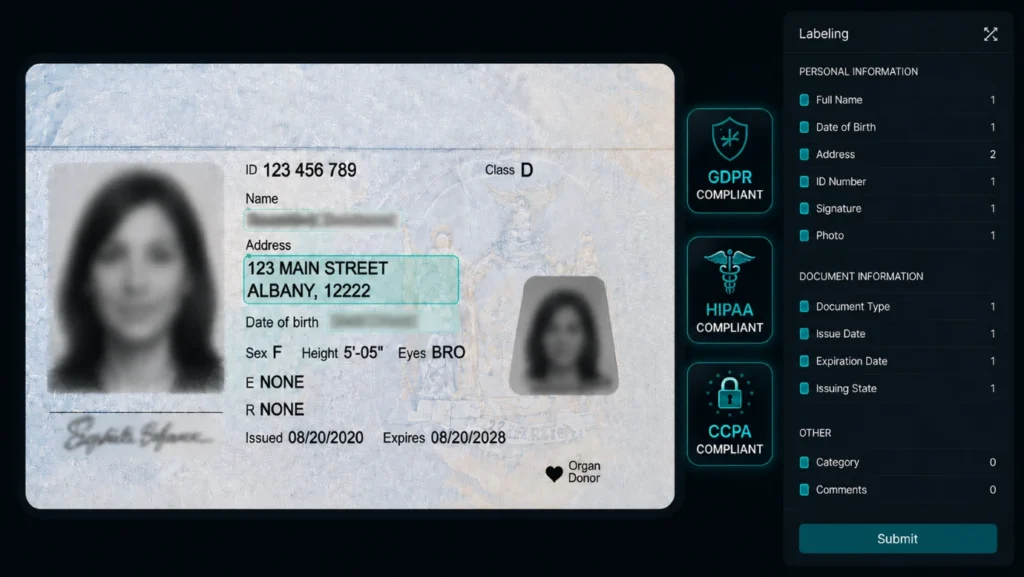


A European healthcare or financial services company is ready to outsource a large annotation or document-processing workload to a GDPR-Compliant data services provider. The vendor can meet the required volume and price. Procurement still has to answer harder questions first: who can actually access the data, and where is it processed? How are subcontractors governed, and what happens when a record needs to be corrected or deleted?
GDPR-Compliant data services providers are no longer optional vendors for European enterprises. They are the difference between a clean AI pipeline and a regulatory investigation. A few years ago, engineering teams could train machine learning models on datasets scraped from the public web with little scrutiny over data provenance. That approach no longer survives contact with the EU Artificial Intelligence Act.
For modern enterprises operating within or expanding into the European market, regulatory alignment is no longer an afterthought that corporate lawyers handle. It has become a foundational engineering and infrastructure requirement.
Every machine learning initiative, automated data processing pipeline, and business process outsourcing project immediately turns into a legal liability if it involves the personal data of EU citizens. Any data leak, unredacted dataset, or accidental ingestion of Protected Health Information (PHI) or Personally Identifiable Information (PII) into commercial LLMs can cripple a brand.
Global regulatory authorities have already levied billions in cumulative penalties, according to the GDPR Enforcement Tracker. Modern enforcement now focuses directly on automated data pipelines, unvetted training sets, and non-compliant machine learning architectures.
Enterprise AI Compliance Risk Matrix
| Regulatory Framework / Enforcement Type | Maximum Penalty Exposure | Operational Core Requirement |
| General Data Protection Regulation (GDPR – Article 83) | Up to €20,000,000 or 4% of global annual turnover, whichever is higher. | Strict protection of consumer rights, data minimization, and a verified legal basis for all processing operations. |
| EU Artificial Intelligence Act (Non-compliance with Prohibited AI) | Up to €35,000,000 or 7% of global annual turnover, whichever is higher. | Continuous bias logging, metadata tracking, and data provenance verification for high-risk deployments. |
| Administrative Enforcement (Data Provenance Failure) | Mandatory algorithmic disgorgement and permanent deletion of model weights. | Complete lifecycle logging from raw ingestion up to the final trained neural network layers. |
Why AI Governance and Privacy Regulations Have Converged
The full implementation of European digital laws has created a strict, multi-tiered oversight system. Standard GDPR mandates protect fundamental consumer rights, including the right to erasure, data minimization, and strict limits on processing. The newer EU AI Act adds obligations specifically for developers of high-risk AI deployments. These guidelines heavily impact automated systems used in:
- Automated medical screening, diagnostic software, and patient triage.
- Employment hiring algorithms, workforce monitoring, and credit scoring.
- Insurance risk underwriting, algorithmic claims validation, and financial profiling.
- Critical infrastructure management, autonomous transit, and industrial robotics.
In this environment, secure data handling is a survival requirement, not a compliance formality. If an enterprise AI model is trained on improperly gathered data or processes sensitive user records without documented consent, European Data Protection Authorities (DPAs) can do more than issue heavy fines.
They can order algorithmic disgorgement, forcing a company to delete the trained weights of its machine learning models. AI governance now demands a verifiable audit trail from the moment a human touches a file to the final model configuration.
The Evolution of Compliant Outsourcing Partnerships
Enterprise data workloads scale into millions of multi-modal files, and processing them entirely in-house with core engineering staff is economically unviable. This has driven a sharp rise in demand for compliant outsourcing partnerships.
The old outsourcing playbook, cheap crowdsourced marketplaces, or unvetted freelance networks in unregulated jurisdictions no longer works for enterprise needs. Transferring corporate files or user logs to unverified third-party platforms is a clear trigger for regulatory investigations.
Advanced data annotation and document processing architectures rest on three pillars:
- Compliance and security. Audited, isolated processing setups that eliminate data leakage, prevent unencrypted cross-border transfers, and control access permissions.
- Scalability of operations. The proven capacity to scale secure human workforces to label millions of data objects monthly without missing timelines.
- Human-in-the-loop quality assurance. Trained human operators who validate outputs, catch labeling bias, and resolve edge cases scripts cannot handle.
Together, these three pillars are what separate reliable GDPR-compliant data service providers from vendors that simply add a GDPR mention to their homepage.
Choosing the right provider among GDPR-compliant data services providers directly impacts operational security, model quality, and enterprise risk management. An unverified partner can cost a company its access to the European market.
How to Evaluate GDPR-Compliant Data Services Providers
Evaluating GDPR-compliant data services providers requires more than checking whether a vendor has a GDPR statement on its website. For an enterprise buyer, signing a boilerplate Data Processing Agreement (DPA) is only the beginning of due diligence. Legal alignment on paper does not stop a database breach, and it is not the same as day-to-day GDPR data processing services discipline inside a vendor’s own operations.
Technical procurement leaders need a framework that analyzes actual operations rather than marketing claims:
- GDPR documentation and accountability. Continuous data mapping, documented Article 30 records, and a named Data Protection Officer (DPO). Providers should actively manage data subject access requests (DSARs) and provide deletion audits. For vendors that also serve North American companies processing EU data, CCPA readiness is worth checking separately. It should not double as a European compliance criterion.
- Secure infrastructure. Zero-Trust Network Access (ZTNA), so enterprise data never sits on an unvetted endpoint. Virtual Desktop Infrastructure (VDI) with Data Loss Prevention (DLP) that blocks local caching or USB exports.
- Workforce management. Crowdsourced freelancers on residential networks are an unacceptable risk. Enterprise projects need contract-bound personnel with background screening and privacy training.
- QA systems and SLA reliability. Multi-tier data quality assurance checks with Service Level Agreements (SLAs) covering accuracy targets, spot-checking, and turnaround times.
- Handling of sensitive datasets. Medical imagery, insurance claims, and financial logs need hardware-level isolation, biometric entry, clear-desk policies, and network nodes that block external routing.
On paper, a provider can pass every item above and still create risk in practice. One common failure: every reviewer gets standing access to a full dataset instead of task-scoped access, or subcontractors join through informal handoffs never named in the DPA. The checklist matters less than whether a provider can show, on request, exactly who touched a record and why.
The Failure of Compliance in Isolation
A vendor can have flawless legal documentation and still compromise your pipeline if it lacks scalability and human validation. If a compliant provider cannot ramp up production to millions of files monthly, your release schedule stalls.
Scalability without structured QA is just as risky: automated scripts accelerate labeling but miss subtle data drift and systemic bias. The right partner sits at the intersection of legal protection, scalable infrastructure, and human oversight.
Top GDPR-Compliant Data Services Providers in Europe
The European data services landscape includes a wide range of GDPR-compliant data services providers, each with a different operational model, workforce structure, and approach to data security. Below is an objective review of seven prominent AI data annotation vendors in Europe serving enterprise AI, machine learning, and data governance teams in the region.
Tinkogroup
Tinkogroup is an established, high-precision data annotation vendor in Europe and one of the more established managed data services Europe providers, offering GDPR-compliant data annotation services for complex data processing initiatives.
Core expertise. High-precision computer vision annotation, multi-modal semantic segmentation, NLP text labeling, and structured database enrichment.
Industries served. Autonomous driving, medical technology, insurance, enterprise e-commerce, and logistics.
Operational strengths & AI capabilities. Fully managed in-house teams, an audited 99% historical precision rate, multi-layer video annotation, and LLM fine-tuning support.
Compliance positioning. European data protection compliance, ISO-aligned operations, local data node management, and internal DPO oversight.
Potential considerations. Best evaluated against your specific volume and turnaround needs rather than generic marketplace pricing.
Mindy Support
Although Tinkogroup has fully in-house teams, Mindy Support uses regional hubs to build scalable teams. Mindy Support is an established European BPO and data annotation company that uses structured delivery hubs across Eastern Europe.
Core expertise & industries. Large-scale 2D/3D image annotation, document digitization, and data entry for automotive, agri-tech, and retail clients.
Operational strengths. A large regional talent pool, rapid scalability, and established client communication frameworks.
Compliance positioning built around GDPR-aligned workflows, local site security protocols, and enforced non-disclosure terms.
Potential considerations. Ask directly which GDPR-related commitments are contractual versus marketing language, and how subprocessors across hubs are disclosed.
TELUS Digital AI Data Solutions

TELUS Digital pairs global reach with dedicated European footprints, specializing in high-volume consumer tech deployments.
Core expertise & industries. Multilingual text translation, audio data collection, and search relevance tuning for Big Tech, telecom, and device manufacturers.
Compliance positioning. Global security architecture with localized European data residency and corporate-level governance. And with CCPA readiness relevant to its North American companies that specifically process EU data.
AI/data capabilities. LLM human preference fine-tuning, automated red-teaming assistance, and voice recognition dataset curation.
Potential considerations. Built for high-volume consumer workloads. Confirm dedicated-team availability for narrow, specialized annotation needs rather than assuming it by default.
CloudFactory
CloudFactory combines a cloud-native platform with managed workforce configurations across Europe and global delivery hubs.
Core expertise & industries. Continuous data entry, bounding box tagging, and video frame processing for e-commerce, logistics, and mapping.
Operational Strengths. Flexible subscription pricing, standardized worker training, and API-driven workflow integration.
Potential considerations. The platform-first model suits standardized, high-throughput tasks; judgment-heavy annotation may need extra QA layers on top.
DataVLab
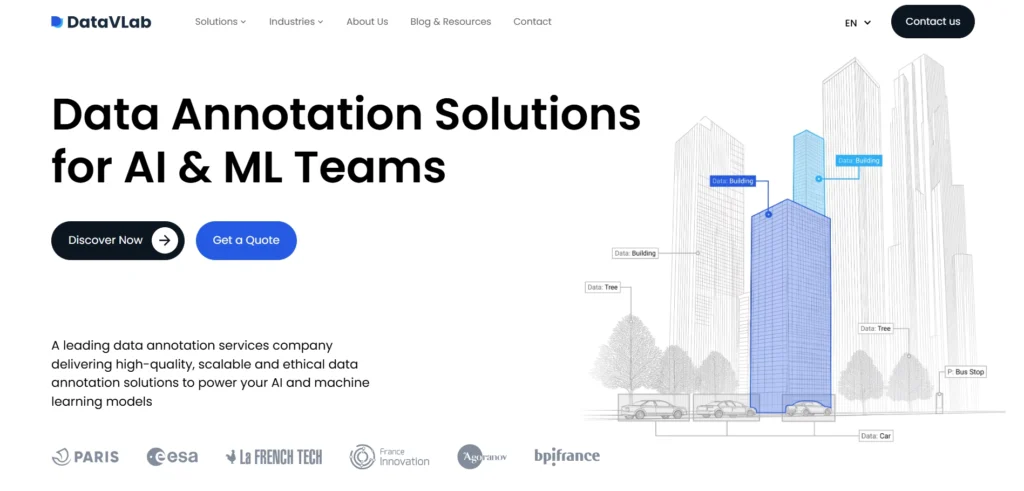
DataVLab is a technical, outsourced data operations provider based in France, originating from aerospace and geospatial imaging work.
Core expertise & industries. High-resolution geospatial annotation and aerial telemetry structuring for aerospace, environmental monitoring, and defense logistics.
Compliance positioning. Regional processing inside France, non-disclosure structures, and sandboxed developer environments.
Potential considerations. Domain strength is geospatial and aerospace. Buyers outside those verticals should confirm relevant experience first.
Responsible Annotation Services

Based in the German-speaking region (DACH), Responsible Annotation Services is an ethical, regional enterprise annotation services partner built around inclusive workforce models.
Core expertise & industries. High-precision annotation and bias audit tracking for public sector, medical diagnostics, and legal tech.
Operational strengths. Neurodivergent experts, including individuals on the autism spectrum, bring strong attention to detail and pattern recognition.
Potential considerations. As a smaller, mission-driven provider, confirm your capacity for large or fast-scaling volumes directly, rather than assuming it based on case studies alone.
Your Personal AI (YPAI)
YPAI delivers contextualized behavioral and personal data tuning for localized mobile systems and human-centric applications.
Core expertise & industries. Conversational transcription and behavioral logging for smart home, health tech, and virtual assistant developers.
Compliance positioning. End-user consent tracking, isolated local data routing, and anonymized profile processing, with CCPA relevance where YPAI also serves US clients.
Potential considerations. Its focus on consumer and mobile use cases means enterprise buyers with regulated, document-heavy workloads should verify fit before treating it as a like-for-like alternative.
Compliance vs. Scalability: Where Providers Differ
GDPR-compliant data services providers can run fundamentally different business models. Selecting the right architecture means balancing scalability with your organization’s legal risk tolerance. Selecting the right architecture means balancing scalability with your organization’s legal risk tolerance. When managing secure data annotation outsourcing initiatives, providers generally fall into three categories.
Architectural Classification of Data Services
| Structural Metric | Platform-Driven Providers | Managed-Service Vendors | HITL-Focused Outsourcing Teams |
| Workforce Model | Crowdsourced/freelance network | Full-time dedicated/in-house staff | Permanent Fixed Internal Squads |
| Data Access | Distributed Remote Nodes | Isolated On-Premises/VDI | Restricted Secure Workstations |
| Quality Control | Algorithmic Consensus Checks | Multi-tier Human Inspection | Manual Edge-Case Validation |
| Compliance Focus | Basic Encryption-in-Transit | Zero-Trust/Biometric Hubs | Customized DPA & SLA Controls |
AI-Focused Annotation Vendors (Platform-Driven)
These vendors treat data preparation as a software optimization problem, routing workloads to large, distributed crowdsourced networks. They scale elastically. Pipelines can expand within hours by distributing micro-tasks across thousands of contributors.
The cost is security: crowdsourced workers often access private datasets from home computers using home connections, and it’s almost impossible to stop screen captures or copying without permission, even with browser-level protections. Usually, automated consensus checks use the same piece of data sent to several workers, with voting algorithms choosing the label. That works for simple tasks but falls short of enterprise compliance expectations.
Cloud-Native Enterprise Providers (Managed-Service Vendors)
Managed-service vendors bridge software optimization and physical security, combining proprietary annotation tools with vetted delivery hubs. They run Zero-Trust Network Access (ZTNA) models, so data stays in cloud-hosted repositories and workers access files only through VDI layers, with nothing saved locally.
This level usually includes checked processes, custom API integrations, and standard contractual clauses (SCCs) for cross-border transfers. It also has hardware-level security like biometric access and clean-desk environments.
Human-Powered Data Operations Companies (HITL-Focused Outsourcing Teams)
Human-in-the-loop (HITL) European outsourcing providers focus on training their employees and ensuring they know the subject well. They do this by building permanent teams instead of using a rotating group of people. For quality control, structured, multi-tier human review is used. Over the course of multi-year projects, dedicated teams learn your labeling rules and how to handle unusual situations.
Why Human-in-the-Loop Workflows Matter for GDPR-Sensitive Projects
Legal and structural holes can appear if you only use AI to clean, organize, or hide datasets.
The Material Risks of Pure Automation
Automated sanitization tools work on statistical probability, not real understanding, which creates real gaps across regulated industries:
- Healthcare. Scripts often miss personal details in unstructured files, redacting a patient’s name but overlooking a tracking number stamped onto a scan.
- Legal tech. Text-masking models misread legal context, overlooking corporate names or contract IDs buried in litigation files.
- Insurance and finance. Pipelines miss contextual links, such as birthdates, zip codes, and transaction times that, together, re-identify a person.
How Human QA Protects Enterprise Data Pipelines
Human-in-the-loop data services add a layer of oversight that automation alone cannot provide.
| Multi-Tier HITL Operational Pipeline | ||
| Pipeline Phase | Core Operational Activities | Technical & Compliance Objective |
| Step 1. Automated Processing | AI pre-labeling scripts run pattern-matching and baseline masking across raw data files. | Speed up mass file ingestion and flag repetitive data patterns. |
| Step 2. First-Tier Human Review | Data operators verify automated labels and clear visible PII. | Fix initial automated errors and establish a clean, compliant data layer. |
| Step 3. Senior Quality Audit | Senior analysts cross-check for hidden bias and process complex edge cases. | Reach production-grade precision and handle nuanced context. |
| Step 4. Compliance Validation | Data Protection Officers run final sanitization audits before export via secure APIs. | Confirm compliance before data enters model training environments. |
Data consistency. Human evaluators keep indexing uniform across data assets, preventing rule drift from confusing models over time.
Compliance handling. Review teams flag and remove accidental PII exposures before data enters public training models.
Edge-case detection. Human judgment catches rare scenarios and anomalies that help build more resilient models.
Enterprise Use Cases for GDPR-Compliant Data Services
Enterprise data processing services need to be scalable, legally compliant, and flexible across platforms. Sensitive information can’t be handled with rigid one-size-fits-all workflows.
Cross-Industry Enterprise Workflows
| Industry Vertical | Primary Data Workload | Core Operational Bottleneck | Critical Compliance Risk |
| Enterprise AI & Tech | Multi-modal model training | Scaling millions of files without dropping precision. | Ingestion of unmasked consumer PII into training weights. |
| Banking & Finance | Document processing & OCR | Extracting data from complex, low-resolution forms. | Exposure of financial records, IBANs, and national IDs. |
| B2B Marketing | CRM data enrichment | High error rates from automated web-scraping scripts. | Processing corporate contact information without consent. |
| Healthcare | Medical image annotation | Sourcing specialized experts to read complex scans. | Exposing personal identifiers via patient records. |
| Insurance | Claims workflow review | High volumes of messy, unstructured user files. | Leaking private personal accident or health data. |
| Legal Tech | Corporate contract auditing | Slow, costly manual internal reviews. | Accidental disclosure of protected client information. |
Training computer vision or fine-tuning LLMs both depend on precise, clean data. Vetted partners process raw video, voice, and text within secure, monitored environments, keeping pipelines fast without the leakage risk of unmanaged handling.
Scalable data processing services transform legacy records and invoices into structured, machine-readable databases. Supported by secure data processing services infrastructure, files remain encrypted in transit and at rest.
For B2B data enrichment, automated web scrapers often return outdated information and create compliance issues. Dedicated human-in-the-loop teams verify contact details and clear duplicates instead.
Medical, insurance, and legal workflows increase the risk even more. Crowdsourced workers who haven’t been checked out should never put labels on medical images or work on corporate contracts. For spikes in volume in these areas, it’s safer to use dedicated review teams with strict non-disclosure terms.

Reliable Data Services Delivered By Experts
We help you scale faster by doing the data work right - the first time

How to Choose the Right Data Services Provider in Europe
Selecting a long-term partner means looking past price-per-task metrics toward enterprise data labeling services infrastructure, staff expertise, and day-to-day operations at potential European data processing companies.
Core Procurement Checklist
| Evaluation Priority | Verification Method | Enterprise Target Standard |
| Compliance Certifications | Request independent third-party audit reports. | Active ISO 27001, SOC 2 Type II, and audited GDPR records. |
| Secure Infrastructure | Audit system architecture and access methods. | Zero-Trust networks and full VDI deployment. |
| Workforce Expertise | Review internal screening and onboarding files. | Full background checks and mandatory privacy training. |
| QA System Transparency | Inspect live accuracy dashboards and error loops. | Multi-tier human validation with continuous feedback loops. |
| Pricing Transparency | Check for hidden management or platform costs. | Clear, predictable per-hour or per-task pricing models. |
| Communication Protocols | Evaluate project management and support setup. | Dedicated account teams with documented escalation paths. |
Before relying on a vendor’s own claims, ask directly:
- Who can access the dataset, and under what permissions?
- Where will processing actually occur, and are local downloads restricted?
- Which subcontractors are involved, and how are they disclosed?
- How is access removed when a team member leaves the project?
- How are incident escalations handled? What evidence exists beyond marketing speak for the claimed controls?
The Real Cost of Cheap Outsourcing
Low-cost, crowdsourced platforms in unregulated regions often tempt procurement teams.
Low price alone does not reveal whether a provider can maintain data controls, QA, and supervision as project complexity grows. And cheap vendors typically cut exactly those layers to hit their price point. If a provider cannot name every person with access to your data, it is not truly compliant, and a single leak can cost millions, erasing any short-term savings.
Conclusion
Navigating the European data ecosystem means balancing technical agility with regulatory alignment. Enterprises that treat compliance as a checklist item end up in enforcement reports, while those that build enterprise data privacy workflows into their daily operations do not.
Relying on unverified crowdsourced networks or unmanaged platforms creates compliance liabilities, introduces systemic data biases, and exposes organizations to regulatory fines.
The most reliable GDPR-compliant data services providers combine four elements:
- Operational scalability. Scaling pipelines from thousands to millions of files without hitting bottlenecks.
- Enterprise-grade security. Physical and digital protections, including biometric access and secure VDI.
- Human-in-the-loop (HITL) validation. Contract-bound specialists who catch edge cases and reduce algorithmic errors.
- Transparent QA workflows. Real-time metrics on precision rates and error-correction pipelines.
Technology leaders and CTOs can scale their models while managing corporate risk by putting these pillars at the top of their lists.
Build Your Secure Data Infrastructure with Tinkogroup
Tinkogroup helps enterprises navigate the operational demands of the European market with managed, internal data teams operating in secure environments, reducing the risks tied to traditional data outsourcing.
Its secure AI training data workflows integrate with your development pipelines, protecting your brand’s reputation while delivering clean, precise datasets. Whether you’re fine-tuning language models, annotating medical imagery, or processing sensitive corporate records, transparent QA processes keep projects on schedule and within budget.
Ready to protect your enterprise from data liabilities? Review your current data-handling requirements, compare provider controls against what’s outlined above, and request a pilot project with Tinkogroup to see how a compliant, managed workflow fits your pipeline.
What makes a data services provider GDPR-compliant?
A GDPR-compliant data services provider should be able to demonstrate more than a Data Processing Agreement. Enterprises should verify how data is accessed, where processing takes place, how employees and subcontractors are governed, and how data subject requests and deletion are handled. Secure infrastructure, documented accountability, controlled access, and transparent audit processes are also important parts of a compliant operation.
How do I choose the right GDPR-Compliant Data Services Provider?
Start by evaluating the provider’s compliance documentation, infrastructure, workforce controls, QA processes, and ability to handle sensitive datasets. Ask who can access your data, where processing occurs, whether local downloads are restricted, which subcontractors are involved, and how access is removed when employees leave a project. These checks help distinguish operational compliance from marketing claims.
Can GDPR-compliant data services scale to millions of files?
Yes, but scalability should be evaluated together with security and quality assurance. A provider needs the workforce capacity and infrastructure to process large volumes without weakening access controls or QA. For enterprise workloads, the strongest model combines scalable operations, secure infrastructure, and human-in-the-loop validation rather than relying on volume alone.