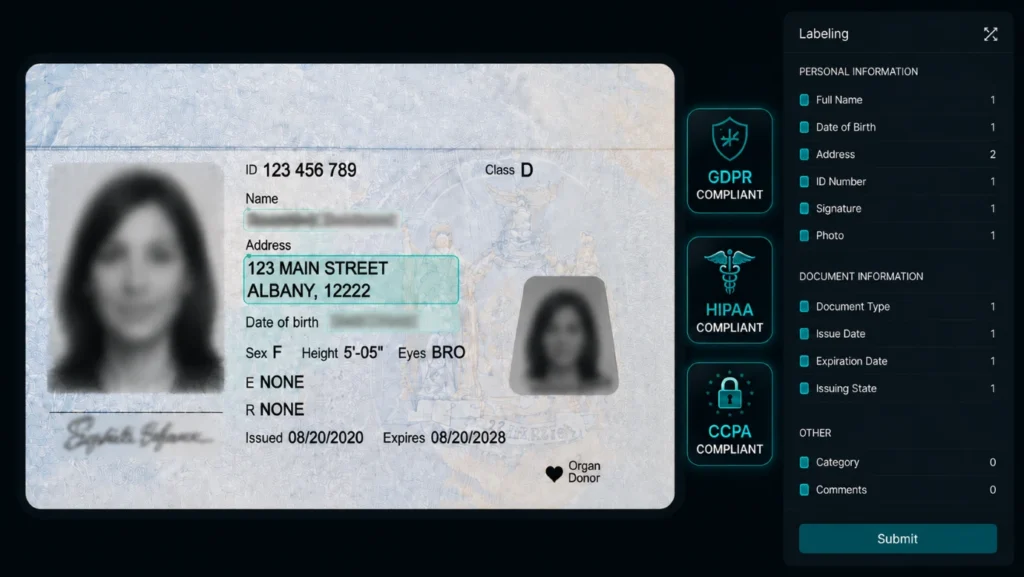
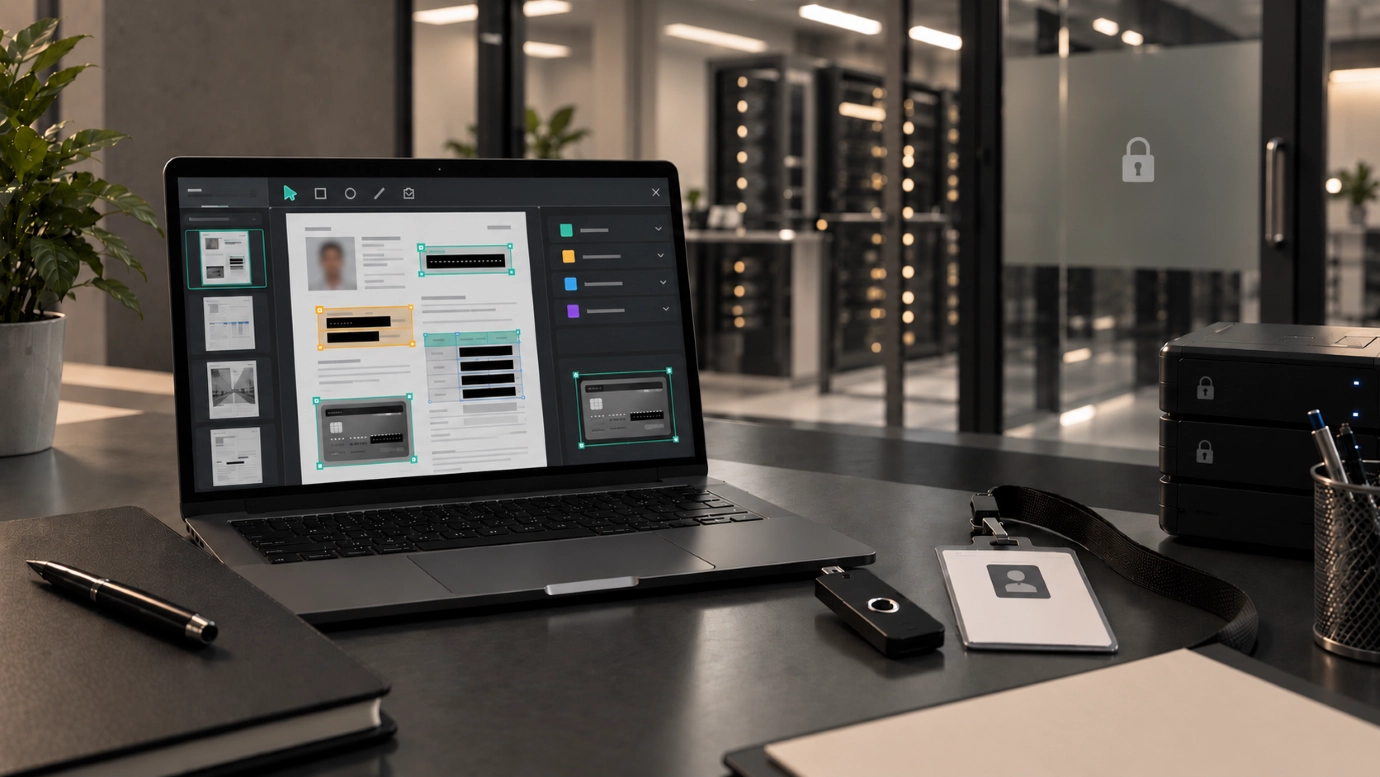

Modern AI applications for the US and EU enterprise market often run on sensitive data. And most of that data eventually needs SOC 2-compliant data annotation before a model can use it safely. A fraud detection model requires actual transaction histories with account numbers. A medical diagnostic tool needs real patient histories. An insurance underwriting system processes policy details and personal identifiers.
Many organizations understand the risks and strengthen internal controls to protect this data. They implement encryption, access management, and audit logging. Yet, when these same organizations scale their AI initiatives, they often outsource a critical step: annotation. That handoff exposes sensitive customer records to third parties and can create a dangerous security gap.
This situation has serious implications. A regional commercial bank completed its annual SOC 2 assessment. The audit verified that internal data stores, cloud infrastructure, and employee access permissions met the organization’s SOC 2 requirements.
Weeks later, the bank’s ML team has initiated a project to extract key terms, customer account numbers, and transaction metadata from millions of scanned loan agreements. They decided to hire an external provider to handle the labeling volume on schedule. The compliance director immediately asked whether the external vendor can guarantee SOC 2-compliant data annotation.
Annotation often involves human review, distributed teams, and external workforces. This introduces things that are difficult to control: local downloads, weak access controls, insufficient auditability, and the potential for data leakage. Effective SOC 2-compliant data annotation requires controls that protect sensitive information throughout the entire labeling workflow, from initial access to final delivery and deletion.
This situation is common across enterprise AI programs. Most companies have strong internal security controls. But when it’s time to outsource data annotation, vendor security often gets less attention. If that vendor doesn’t follow the same standards, it can weaken the company’s overall compliance.
A compliance program is only as strong as the vendors that handle your data. Outsourcing annotation work doesn’t transfer compliance responsibility, it only extends it beyond your organization’s walls.
This article walks through what that means in practice when you are choosing a SOC 2 data annotation vendor. Annotation work often introduces risk that isn’t obvious on the surface. So, this article breaks down what to look for in a partner and what separates a vendor with real operational controls from one with a well-designed sales deck.
What Is SOC 2 and Why It Extends Beyond Your Own Organization
SOC 2 (System and Organization Controls 2) is a security framework created by the AICPA in 2010 for organizations that handle customer data. This includes cloud providers, SaaS and annotation companies, and many other service providers. SOC 2 works across five Trust Services Criteria: security, availability, processing integrity, confidentiality, and privacy. In simple words, it’s an independent health check for sensitive data security.
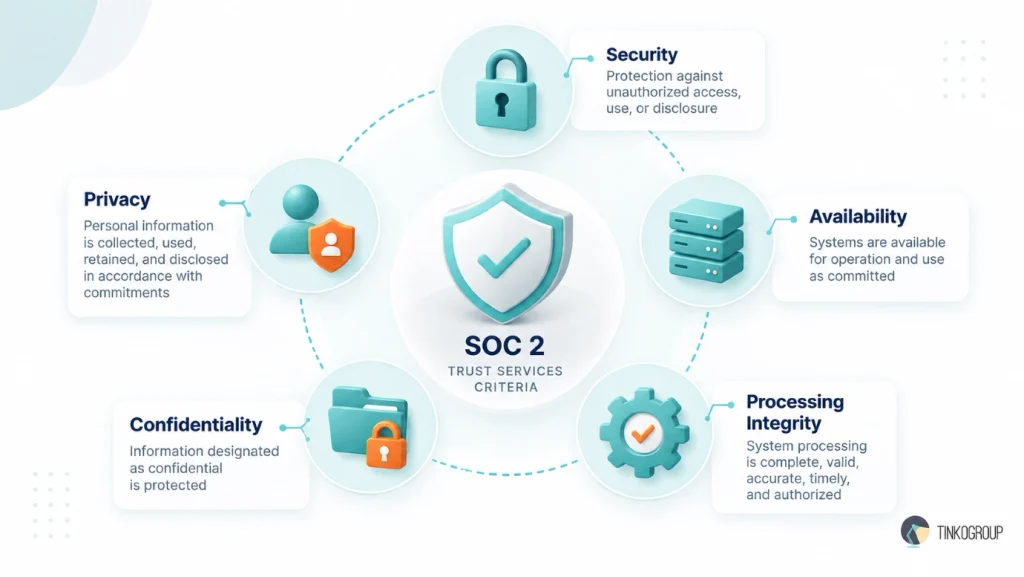
Auditors may use SOC 2 to check any organization that stores, processes, or transmits sensitive data on behalf of their clients. They don’t look only at what happens inside your company. They also want to know how you work with vendors that have access to your data. That means auditors also check how you select vendors, how you check if they meet security requirements, and how confident you are that your data remains protected after it leaves your walls.
The security criterion is typically the primary focus for most organizations. It covers the controls that prevent unauthorized access, system breaches, and data loss. But SOC 2 isn’t something you complete once and move on from. It checks operational accountability, which means it verifies whether controls work over time, not only exist on paper. Type I audits evaluate design at a single point. Type II audits test operating effectiveness over a sustained period, often six to twelve months. A well-designed control that fails in practice provides no real protection.
Data annotation deserves close attention for exactly this reason. When you outsource annotation, you are giving another organization access to sensitive information. And your security controls may be strong, even as a vendor with weak processes introduces new risks.
Your annotators will see your raw data. They will work in an environment you do not control, on platforms you did not build. If their access controls are weak, your data is exposed. If their audit trails are incomplete, you cannot reconstruct what happened. And a data breach becomes your problem.
Why Annotation Vendors Are Part of the Compliance System
When you outsource annotation, your vendor becomes part of your compliance program. Their security practices become part of your overall compliance. That is why SOC 2 also looks at how organizations choose, monitor, and manage third-party vendors. CC9.2, the trust services criteria control for vendor and business partner risk, requires organizations to assess, monitor, and manage third-party relationships. Auditors want to see evidence that you evaluated your vendors’ security practices, not simply signed a contract and moved on.
Certification alone does not eliminate SOC 2 vendor risk. You need to know how your vendor handles your data, limits access, and keeps projects secure. For SOC 2-compliant data annotation, buyers need evidence that these controls operate consistently, not simply assurances that the vendor follows security best practices.
The right partner is one whose security practices match your compliance requirements. Their operational controls become part of your compliance ecosystem. Their failures can trigger audit exceptions, regulatory scrutiny, and reputational damage. This is why vendor risk assessment matters at the procurement stage. You must be sure their operational practices can withstand the same scrutiny your internal controls face during a SOC 2 audit.
The Vendor Risk Problem in SOC 2-Compliant Data Annotation
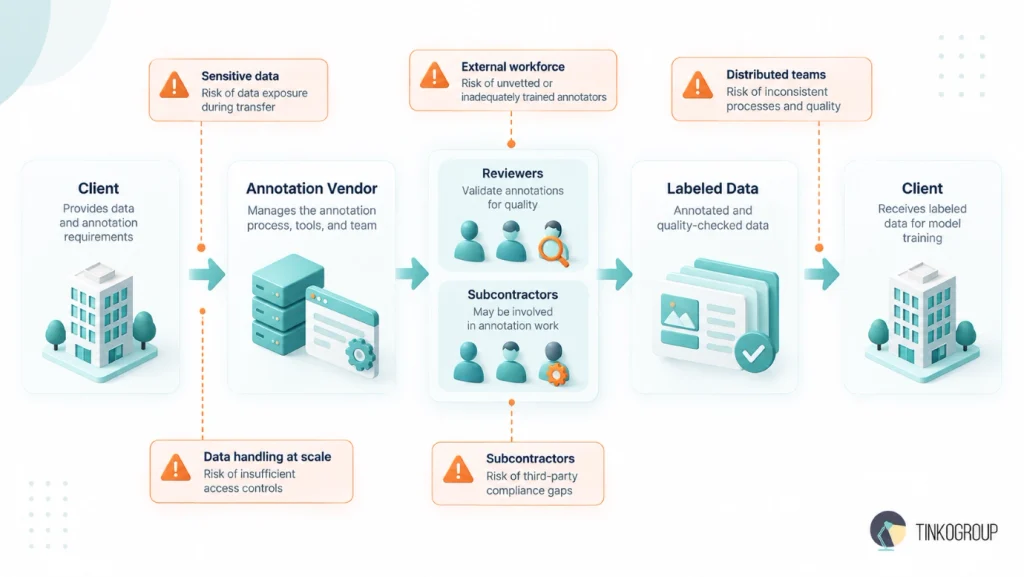
Annotation projects introduce compliance risks that differ from most other forms of outsourcing. An external workforce gains direct access to source material. Datasets sometimes contain tens or hundreds of thousands of records, images, or documents. You cannot avoid human review, so people see content that automated systems might never surface.
Teams are often distributed across the globe, and your data enters third-party systems for processing and temporary storage. In SOC 2-compliant data annotation, vendor risk assessment should account for every party, device, and system that may access or process client data. These conditions create a distinct risk profile that procurement and security teams must seriously address. Some of the biggest risks include:
External workforce access. Annotation projects involve dozens or hundreds of reviewers, often distributed across multiple locations and time zones. Each reviewer needs direct access to your data to perform their task. This is not a system administrator who may view logs occasionally. These are individuals who will open, examine, and label thousands of individual records over weeks or months. Every one of those individuals represents a potential control gap.
Volume. An annotation project may process tens of thousands of documents, images, or records. If a single record is mishandled, it is a breach. When hundreds of reviewers handle thousands of records each, the probability of an incident grows fast.
Human review. Annotators must understand the content they are labeling. A medical coder reviewing patient scans needs to see the images clearly. A financial analyst reviewing loan documents needs to read account numbers and transaction details. You cannot always anonymize the data for annotation, because the meaning is in the details. The work requires full access, but this creates risk.
Distributed teams. Reviewers may work from home offices, coffee shops, and co-working spaces, using personal devices or vendor-provided laptops on various internet connections. Each connection is a potential entry point for unauthorized access. Each device is a potential storage location for downloaded data.
Third-party handling. Annotation vendors often subcontract work to other providers or use crowdsourced platforms to increase capacity. Each additional party in the chain increases exposure as your data moves through more hands. If your primary vendor has strong controls but their subcontractor does not, it’s a giant risk for your data.
If you have ever run a vendor risk assessment, you know the painful outcomes. These include unauthorized access by annotators who shouldn’t have visibility into a given batch, data leakage through informal channels, local downloads onto personal devices, and data access controls that are role-based on paper but not enforced in practice. Worse, there are often no annotation audit trails showing who touched what and when.
Real-World Incidents That Illustrate the Stakes
Healthcare – Change Healthcare (2024)
Healthcare providers and pharmacies hired Change Healthcare for claims processing. In 2024, a ransomware attack on the vendor exposed the data of more than 100 million people. Even though the breach happened at the vendor, healthcare organizations still had to deal with all the consequences.
Financial Services – Evolve Bank & Trust (2024)
This company provided banking infrastructure for fintech companies such as Wise, Affirm, and Mercury. After Evolve suffered a cyberattack in 2024, several fintech companies had to notify their customers because data held by their banking partner had been exposed.
Insurance – Infosys McCamish Systems (2024)
In 2024, life insurance software vendor Infosys McCamish Systems lost the personal information of more than six million people. It showed how outsourcing core processing functions can expose insurers to third-party risk.
Legal – Thompson Coburn (2024)
In 2024, a breach at the law firm’s network exposed sensitive information, leading to a lawsuit against Thompson Coburn and one of its healthcare clients. It demonstrates that organizations also face third-party risk when outsourcing legal services.
The above shows clearly why annotation vendor compliance matters well before the first label. The compliance considerations start at procurement and continue through project completion and data deletion.
What to Look for in a SOC 2-Compliant Data Annotation Partner
When you choose your annotation vendor, you usually see their marketing promise first. Contacts and marketing pages can claim anything. You need to examine operational controls during a vendor security assessment. The vendor’s actual workflows, permissions, and oversight mechanisms can withstand the same scrutiny your internal controls did during a SOC 2 audit. This section covers the critical areas for secure data annotation.
Access Controls in SOC 2-Compliant Data Annotation
Access controls are foundational to SOC 2-compliant data annotation because they determine who can view sensitive data and under what conditions. In annotation, they determine who sees what data and under what conditions. Role-based permissions restrict access to only those who need it for their specific task. Least-privilege access means annotators see only the data required for their assignment. A project lead may see all data, while a junior annotator sees only a subset. Many vendors implement permissions at the team level rather than the individual level, and it’s risky.
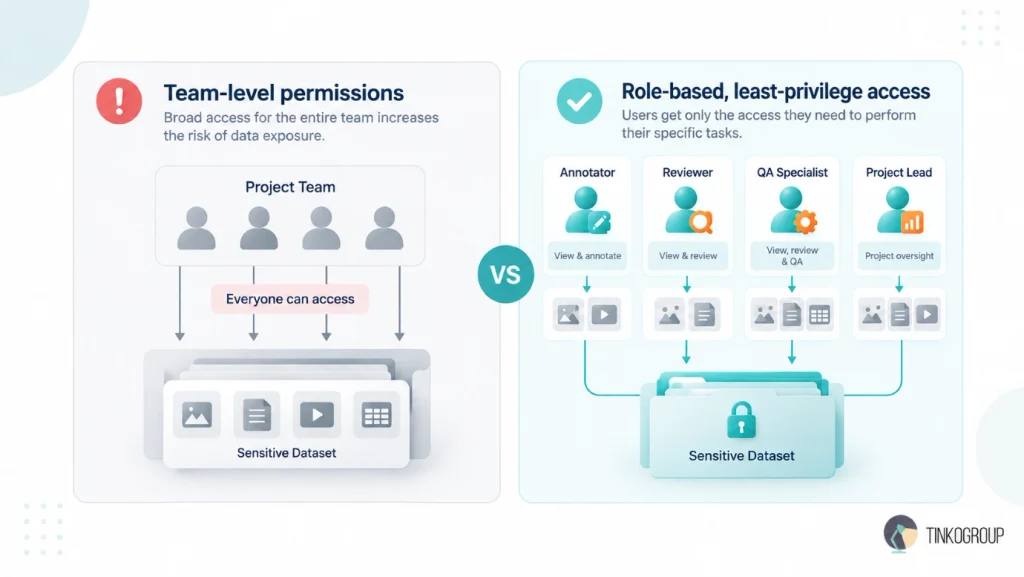
Also, consider the devices annotators use. Controlled-access workstations with USB blocking and no-download policies show mature security. Vendors that rely on crowdsourced workers with personal devices present significant risk. You must see endpoint controls, not just cloud permissions. Screen capture restrictions, device management, and network monitoring all matter. If an annotator can download a local copy of your data to a personal laptop, your compliance program is weak.
On a recent enterprise engagement, a bank required per-user access logs for every annotator who touched a loan document, not just team-level permissions. That level of granularity is what SOC 2 auditors expect to see.
Data Handling Policies
Data handling policies govern how data moves, where it lives, and what happens to it after the project ends. Storage controls should include encryption at rest (AES-256 minimum) and in transit (TLS 1.2+). Transfer restrictions should prevent data from moving outside approved environments. These safeguards are essential to SOC 2-compliant data annotation, particularly when projects involve regulated records, restricted data residency, or strict deletion requirements.
Some vendors offer remote storage integration, where annotators view assets served directly from your cloud storage to their browser. In this model, private data never passes through the annotation platform’s backend. This eliminates the need to transfer copies of sensitive data to the vendor.
Retention policies specify how long data is kept and how deletion is confirmed post-delivery. Vague answers about where data resides during annotation or how deletion is confirmed are concerning. Ask for documented retention schedules and deletion confirmation. If the vendor cannot produce this, you cannot demonstrate control over the data lifecycle.
A healthcare client requiring proof of deletion within 30 days of project close should receive a signed deletion certificate instead of a verbal assurance.
NDA and Confidentiality Practices
The vendor should sign a Data Processing Agreement. This document covers data handling obligations, breach notification timelines, subprocessor notification requirements, and data return and destruction on termination. Workforce confidentiality should extend to all personnel with data access, including contractors. For regulated industries, this is non-negotiable. For SOC 2-compliant data annotation, contractual safeguards should define how the vendor and its workforce protect confidential information and respond to potential incidents.
A Business Associate Agreement for PHI requires specific HIPAA language. For financial data, the agreement should address GLBA requirements. Legal AI workflows require privilege protection language. Do not accept a standard NDA. Get an agreement designed for your regulatory obligations.
A medical imaging project involving PHI should trigger a signed BAA before a single scan reaches an annotator, not after the project has already started.
Audit Trails and Operational Transparency
Audit trails are essential to SOC 2-compliant data annotation because they help organizations establish who accessed, modified, or processed data and when. A record of who labeled what, when, and under which guideline version is essential for demonstrating provenance to a regulator or internal validation team. Detailed audit trails should track every user action, data access event, and system change. When an auditor asks who touched what data and when, the vendor should show documentation immediately.
Look for platforms with complete audit logs, change documentation, and annotator-level tracking. Ask to see sample audit logs, and if the vendor cannot provide them, they are not tracking what matters.
During a SOC 2 Type II review, an auditor may ask a vendor to reconstruct exactly which annotator touched a specific record and when. A vendor without per-user logs cannot answer that question.
GDPR Alignment as an Additional Trust Signal
The vendor’s hosting location and legal jurisdiction are critical if you must comply with GDPR. Platforms headquartered in the EU and hosting data in EU data centers make GDPR-aligned data annotation easier to demonstrate to auditors. Request the vendor’s GDPR documentation and verify their data processing agreements.
If the vendor cannot meet GDPR requirements, they probably cannot meet SOC 2 privacy criteria either. The two frameworks overlap in their treatment of data subject rights, breach notification, and lawful processing.
A European insurer annotating policyholder data should confirm the vendor’s storage location before the project starts. Routing EU personal data through a non-EU data center can create a GDPR issue independent of the vendor’s SOC 2 status.
Evidence Buyers Should Request
Security claims are easy to make. You need real evidence to support your vendor security due diligence. Before you sign a contract, ask to prove their security processes and day-to-day operations:
| Document to Request | What It Proves |
| Access control documentation | Who can access data, and how permissions are managed |
| Workflow documentation | How data moves through the annotation process, step by step |
| Incident response procedures | How security incidents are handled and reported |
| Data retention and deletion policies | How long data is stored and how it is securely deleted |
| Security questionnaires (SIG, CAIQ, or a custom one) | A structured, comparable view of the vendor’s controls |
| SOC 2 Type II report or equivalent assessment | Independent verification that controls operated effectively over time |
| ISO 27001 certificate, if applicable | Scope of operations and locations the certification covers |
| List of subprocessors | Where your data is actually processed or stored, beyond the primary vendor |
For SOC 2-compliant data annotation, these documents provide a more useful basis for vendor evaluation than security claims published on a website alone. You will understand whether the vendor has the data governance controls and processes needed to support SOC 2-compliant data annotation.
Questions to Ask Before You Sign
Compliance-conscious AI teams often use checklists to evaluate annotation vendors. They ask questions that surface the operational realities and show whether a vendor can support your compliance program. Here is an example of a structured checklist you can use.
Data Access and Permissions
Who can access the data? The answer demonstrates the vendor’s security maturity. A vendor that cannot clearly define who has access lacks the granular controls your SOC 2 audit will require.
How do you restrict access? Ask about role-based permissions and least-privilege access. Also check if they revoke access immediately when a project ends or an annotator leaves.
Do you allow downloads? This is critical. If the response is yes, check how they prevent data from leaving the device. Many vendors allow downloads by default. The secure ones prevent them entirely.
Monitoring and Auditability
What monitoring exists for data access and system changes? It’s vital to know who accesses what and when. Vendors without real-time monitoring cannot detect or respond to unauthorized access promptly.
How do you maintain audit logs? Ask for an example of such a log. If the vendor cannot provide sample audit logs, they are not tracking what matters. Always opt for those with complete audit logs.
Workforce and Training
How do you train annotators? Ask about onboarding procedures, ongoing training, and testing. Annotators must understand what data they are handling, why it is sensitive, and what happens if they mishandle it.
What background checks do you perform? Annotators should undergo background screening for sensitive data. Ask what checks are conducted, who conducts them, and whether they are repeated periodically.
What is the annotator turnover rate? High turnover creates security risks. New annotators require training and supervision. Experienced annotators who leave may retain knowledge of your data or processes.
Incident Response
How do you handle incidents? Ask for the incident response plan. Breach notification timelines should be explicit in the contract.
What is the breach notification timeline? For GDPR and many state privacy laws, breach notification must occur within 72 hours. Your vendor’s timeline should match these demands.
Privacy and Compliance
What privacy controls exist? Pay attention to how the vendor handles personally identifiable information and how they minimize data visibility.
Do you sign a Data Processing Agreement? This document means GDPR compliance. It defines how the vendor handles data, reports breaches, and manages subprocessors.
What subcontractor do you use? Annotation vendors often subcontract work. Ask for a complete list of subcontractors and their locations. Each one adds another layer to third-party risk management.
Where do you host data? Ask about hosting locations and whether data ever leaves the approved jurisdiction. Vendors that cannot guarantee data stays within specific regions create compliance risk.
These questions help buyers assess whether a vendor’s security practices are suitable for SOC 2-compliant data annotation before granting access to sensitive datasets.
Expert Tip: Security questionnaires often honestly show annotation vendor due diligence. Don’t hesitate to ask for these. Clear, detailed answers indicate that a vendor takes compliance seriously. Pay attention to unanswered questions or references to “standard practices” without documentation. The quality of the questionnaire response is often a leading indicator of the quality of the vendor’s security program.
Compliance Signals That Matter More Than Marketing Claims
Never make security certifications your decision factor. A certification confirms that a vendor has passed an audit. But it does not show how the vendor manages security on a daily basis. Experienced procurement and compliance teams ask for operational evidence. These are documented secure annotation workflows. The table below shows the difference between common marketing claims and the evidence you should look for.
| Marketing Claim | Operational Evidence to Request |
| Secure workflows | Workflow documentation showing how data moves through the annotation process and where security controls are applied |
| Enterprise data security | Documented security procedures and audit records that demonstrate how security controls operate in practice |
| Strict access controls | Access governance policies defining user roles, permissions, and access approval processes |
| Fast incident response | Incident response processes and escalation procedures describing how security incidents are detected, reported, and resolved |
| Audit-ready operations | Annotation audit trails showing who accessed data, what actions were taken, and when those actions occurred |
| GDPR-ready | Data retention policies, deletion procedures, and a signed Data Processing Agreement (DPA) |
A vendor supporting SOC 2-compliant data annotation should be able to substantiate its security claims with documented controls, audit records, and evidence of consistent execution. Clear documentation gives you a much better picture of how the vendor works and how seriously it takes your data.
How Tinkogroup Supports Compliance-Conscious Organizations
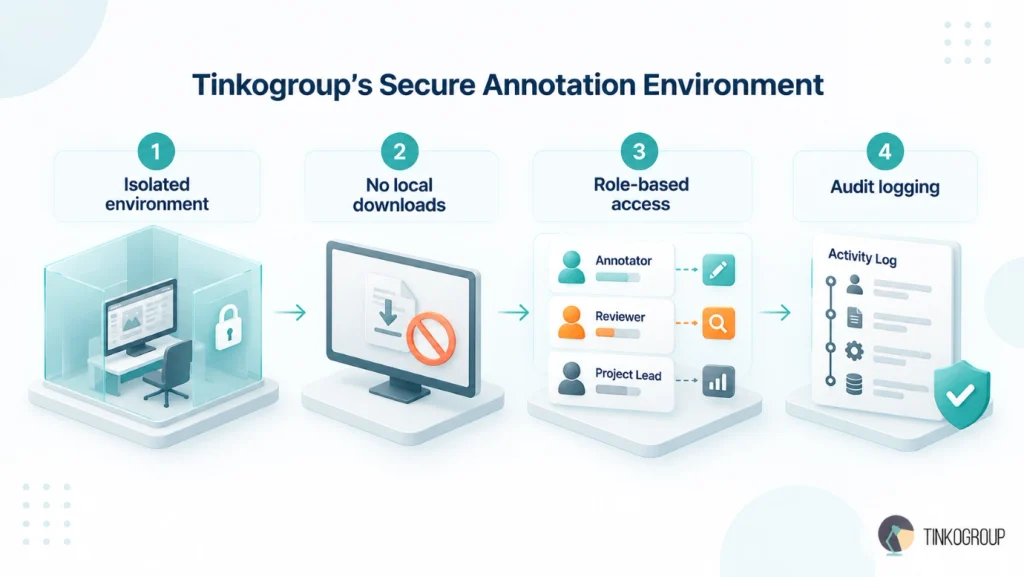
Enterprise organizations require annotation vendors to have solid security and operational accountability, whether or not they hold a SOC 2 certification. They must be sure that the vendor’s workflows, permissions, and oversight mechanisms are strong. Tinkogroup follows security controls and governance practices for data annotation security. For clients evaluating SOC 2-compliant data annotation, the relevant considerations include how access is restricted, how activity is recorded, and how project-specific security requirements are documented.
Access Governance
Tinkogroup enforces strict identity management across all annotation teams. Personnel access project environments under the principle of least privilege. It means annotators only see the data assets for their current task. Role-based permissions prevent unauthorized file sharing across project teams. Plus, account access is revoked immediately upon project completion.
Secure Project Environments
We run projects in isolated environments where unauthorized data exports cannot happen. Tinkogroup configures labeling workflows to disable local file downloads, restrict clipboard operations, and prevent unmonitored local caching. Data streams directly into secure labeling interfaces, and we never store anything on unauthorized local endpoints.
Confidentiality Practices
Our team completes background checks and signs NDAs before they access client data. For highly sensitive projects, we use custom security procedures, for example, dedicated hardware configurations and special onboarding modules. This enables us to meet complex internal compliance rules.
Auditability and Transparency
Tinkogroup keeps the entire data lifecycle visible. Platform interaction, user login, label modification, and project export events are recorded in system logs. This level of traceability gives clients full visibility into how we handle their data. Plus, they always have clear documentation for internal compliance audits.
Alignment With Client Security Requirements
Tinkogroup adapts its operational workflows to match each client’s security parameters. An enterprise may require dedicated IP allowlists, localized storage options, or custom data retention schedules. We always align our workflows with client requirements.
Tinkogroup applies the same security principles to every project, whether it’s image, text, video, or audio annotation. We also use the same principles for data validation and enrichment. Every project is different, but the same approach applies: limit who can access the data, control how it is used, and keep a clear record of who handled it. Tinkogroup provides the operational controls, governance practices, and documented evidence needed to support compliance programs.
Conclusion
SOC 2-compliant data annotation does not stop at organizational boundaries. When you outsource data annotation, you extend your compliance perimeter to include the vendor’s operations. Control failures on their side become your audit exceptions. A security gap in their workflow becomes regulatory risk in your compliance program.
When you choose an annotation vendor, you should first evaluate how secure your potential partner is. It is part of your compliance. You must ensure that sensitive data stays protected when it leaves your environment and enters an annotation workflow.
Always look beyond certification claims. Check if the vendor’s operational practices match your annotation compliance requirements in real life. A vendor’s website may look reliable, but the real evidence lies in documented processes. These are access policies, audit trails, data handling procedures, and incident response processes.
The strongest annotation partners are not those who make the biggest security promises. The strongest partners can show you exactly how they protect your data: who has access, why they need it, and when that access is removed. They are ready to sign Data Processing Agreements and guarantee only the right people can work with your data.
So, incorporate vendor compliance reviews and security assessments into your annotation partner selection processes. Ask the hard questions before you share your data, not after an incident occurs. Your compliance program depends on it.
Ready to take control of your external data workflows? Review your vendor security requirements with Tinkogroup’s operational specialists. Explore Tinkogroup services – our secure workflows and access controls support enterprise compliance programs.
What is SOC 2-compliant data annotation?
SOC 2-compliant data annotation refers to annotation workflows designed to support a client’s security and compliance requirements through documented access controls, secure data handling, monitoring, and incident response procedures. Whether these controls are sufficient depends on the client’s obligations and the vendor’s actual operating practices.
What should buyers check in a SOC 2 Type II report from an annotation vendor?
Buyers should review the report’s scope, assessment period, services covered, and any exceptions identified by the auditor. They should also verify whether the controls described in the report apply to the specific annotation environment and data-handling processes used for their project. For SOC 2-compliant data annotation, a report alone does not replace a review of project-specific risks.
Why should buyers review an annotation vendor’s subprocessors?
Subprocessors may access, store, or process project data as part of the annotation workflow. For SOC 2-compliant data annotation, buyers should understand which third parties are involved, what data they handle, and what security and contractual safeguards apply to them. Reviewing subprocessors helps identify potential risks that may not be apparent from evaluating the primary vendor alone.