


Many AI teams make the same mistake. When an AI project is going well, they want to move quickly. When everything seems to be working with a small dataset, the next instinct is to label much more data. So, they gather more data, invite more annotators, and begin large-scale labeling. It makes perfect sense: if a few thousand labeled samples performed well, then hundreds of thousands should make the model even better. But scaling rarely works that simply.
When teams scale annotation without testing their process, small issues can quickly turn into big problems. This is a painful secret of data annotation – scaling mercilessly exposes every hidden weakness in your workflow. Unclear guidelines start contradictions between annotators, edge cases make labeling less consistent, and quality drops. Even minor issues may grow into bottlenecks that paralyze your workflows.
If you discover these failures after production begins, their cost is often three to five times the original annotation budget because of re-annotation, delayed roadmaps, wasted compute, and lost stakeholder trust. Experienced ML teams rarely scale annotation overnight. They first validate their people, workflows, quality controls, and annotations.
An annotation pilot project serves exactly this purpose. It’s a simple way to test your annotation process before you roll it out on a larger scale. You don’t label thousands or even millions of samples but start with a small portion of the dataset to see if everything works well.
The idea is to recreate the real annotation process as closely as possible. You use the same tools, annotation guidelines, review process, and enterprise annotation workflows with a much smaller dataset, often only 1–5% of the total volume. This approach reveals problems early and allows the team to make improvements at the right time.
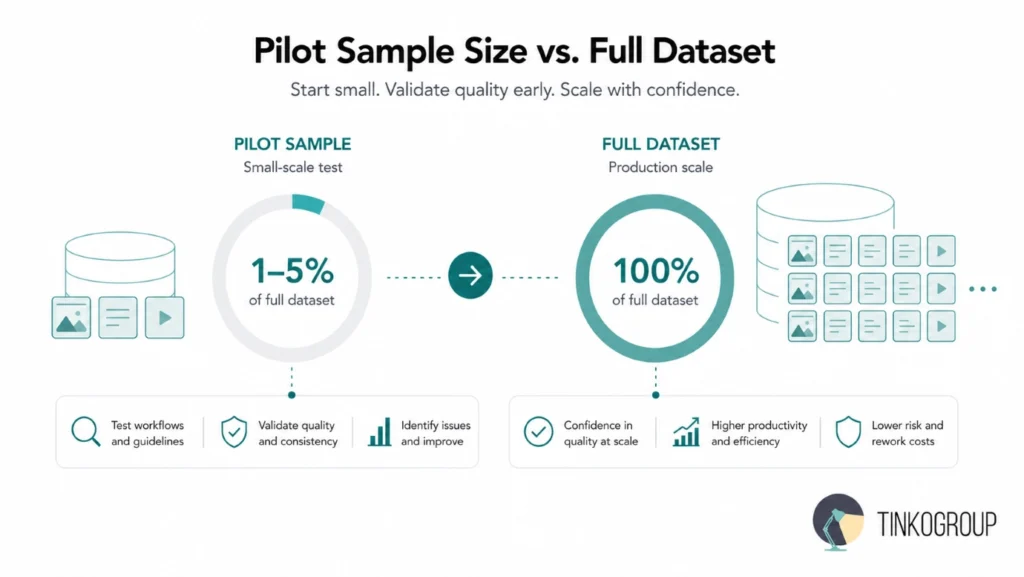
This article walks readers through a practical checklist for planning and running an effective data annotation pilot. It covers how to set clear success criteria, evaluate workflows and annotation quality, analyze results, and identify issues that should be resolved before moving to production-scale data annotation.
Why an Annotation Pilot Project Matters Before Scaling
Deadlines often dictate their rules, and AI teams scale without proper annotation quality validation. They label thousands of samples within weeks, and everyone feels good about their progress. Then the quality assurance team runs a deeper check and discovers something troubling: a significant portion of the labels are inconsistent. Different annotators handled the same types of inputs differently, and now the dataset has a quiet but persistent quality problem deep into it. What happens next is painful.
First, the team must find out what went wrong. The problem could have been unclear annotation guidelines, incorrect annotator interpretation, or even a confusing labeling scheme. That investigation alone takes time. Then comes the really hard part: they should do something with the data that’s already been annotated. This all together means extra work, higher costs, and delays. Many AI teams have experienced these problems:
Large‑scale rework. When you spot quality issues late, you have to go back through everything and re-label, re-review, and re-validate. Often, it’s like repeating everything from scratch, and this takes time, increases costs, and can delay the entire project.
Guideline revisions. If you change the guidelines after a large amount of data has already been labeled, earlier annotations become tricky. You have to decide whether to relabel the old data or continue with an inconsistent dataset, and neither option is ideal.
Retraining delays. If the data isn’t ready, model training has to wait. Every day spent on data correction means a lost day. And in the world of AI, even short delays cost huge money.
QA overload. Quality reviewers should verify the work, not constantly fix it. Overall model quality suffers when reviewers spend more time correcting mistakes than checking for them.
Inconsistent dataset quality. It’s the quietest but most dangerous problem. When some parts of a dataset are well‑labeled and others aren’t, the model learns the wrong patterns. It performs well on some inputs and poorly on others, and you simply cannot trust its predictions.
All of these problems share a common feature: they’re much easier to spot and fix when the dataset is still small. That’s why a thoughtful annotation pilot project is so important.
What Happens When Teams Skip a Data Labeling Pilot
If all of this sounds theoretical, consider what happened to two real-world projects that scaled without proper training data validation.
Udacity Self-Driving Car Dataset. When the team at Roboflow reviewed around 15,000 images, they discovered that about one in three contained annotation errors. Some labels didn’t include cars, pedestrians, and cyclists, and some other images had incorrect or duplicate bounding boxes. They even found images with no annotations at all. It shows how annotation mistakes can go unnoticed until someone takes a closer look. A poorly trained self‑driving car can quite literally lead to human fatalities.
IBM Watson for Oncology. This system was designed to help doctors with cancer treatments. IBM invested over $5 billion in it and employed up to 7,000 people. However, investigations later found that Watson sometimes suggested incorrect or even unsafe treatment options. One of the main reasons was poor data. The system relied heavily on hypothetical cases and the opinions of a small group of doctors. So, it struggled to deal with real clinical situations. IBM sold Watson Health for around $1 billion, with a 4 billion loss.
Defining Success Criteria Before the Pilot Starts
Teams often run a pilot incorrectly. They simply test data, and if all has gone well, they believe they’re ready to scale. You are not ready for scaling if you don’t know what you want to achieve. It’s difficult to understand whether an annotation pilot project is successful or not without clear metrics. A good pilot should prove that your annotation process is ready for larger volumes of work. This annotation readiness assessment covers several areas:
Quality Targets
Establish a threshold for accepted annotations. For this, you need to compare a sample of the pilot data against a Gold Standard or Ground Truth dataset curated by senior ML engineers. For instance, a computer vision project requires a minimum of 95% Intersection over Union (IoU) precision for bounding boxes, or a medical NLP project demands 98% accuracy on clinical entity extraction.
Agreement Targets
Multi-annotator AI training data workflows require consensus among annotators. You must set strict targets for inter-annotator agreement (IAA) and use statistical metrics such as Fleiss’ Kappa, Cohen’s Kappa, or simple percentage agreement. For most projects, an IAA of 80-90% is a reasonable target, but this varies by task complexity.
Escalation Thresholds
Some samples will always be difficult to label, and annotators should know when to pass them to a reviewer or project lead for clarification. Define an acceptable escalation rate (e.g., less than 2% of total tasks), and if annotators exceed it, your data is not ready for scale.
Throughput Expectations
You should know your production speed. Calculate the average time required to complete a single annotation unit. Factor in task complexity, tool usability, and breaks. This will help you estimate the length of the full project and whether you have enough annotators for it. It’s critical for planning and budgeting for production scale.
Turnaround Objectives
Set realistic timelines for the entire annotation process, from task assignment to final review. The annotation pilot project will show potential delays and workflow bottlenecks before they become bigger problems during large-scale annotation.
Data Coverage Targets
Your pilot dataset should represent the full range of real-world conditions. This includes edge cases, rare classes, different lighting or quality levels, demographic diversity, and domain-specific variations. Good coverage prevents nasty surprises when you scale to production data.
These measurable success criteria create objective standards. They show whether the workflow, guidelines, tools, and people are truly ready for scale and areas that still need fixing.
What to Test During an Annotation Pilot Project
An annotation pilot project should stress-test every component of your annotation operation before full-scale production begins. Like a rehearsal before a live performance, it helps teams uncover problems, measure performance, and refine workflows before annotating the full dataset. This phase evaluates much more than the dataset itself. It tests your annotation guidelines, tooling, quality assurance process, reviewer workflows, and team coordination to ensure everything works together at scale.
Here’s how this works in practice. Say you have to build an AI model that analyses customer support tickets for a large e-commerce company. The model must classify incoming tickets into five categories: refund requests, delivery issues, product questions, account problems, and technical complaints. You need to start with annotation workflow testing before you annotate 100,000 historical tickets. Here’s an example of how to run a quick pilot with 1,000 tickets and what to test.
Annotation Guidelines
On day one, the team hands their annotation guidelines to five annotators. On the same day, annotators face the first issue: they are not sure how to classify a delivery issue or an incorrect product question. The guideline says “delivery issues cover shipping problems” but doesn’t mention incorrect items. The team adds a decision tree: if the item is wrong, classify it as a delivery issue. If the item is correct but broken, classify it as a product question. By day three, that type of question drops off. The annotation pilot project revealed guideline gaps that would have caused chaos at scale.
Label Taxonomy
Halfway through, the team notices annotators label multi-issue tickets differently. For example, a customer wants a refund for a late delivery. Some classify these as refund requests, others as delivery issues. The problem is that the labeling rules don’t explain what to do when a ticket covers more than one issue. The team adds a simple rule: choose the label that matches the customer’s main request, and record additional issues in a notes field. The pilot revealed a problem that could create massive inconsistency at scale.
Edge Cases
On day four, an annotator flags a ticket: “I want to return my order #12345.” The order doesn’t exist because the customer simply mistyped the number. The team creates another rule: if the order number is invalid, classify as an account problem and add a note. Later, annotators see another edge case when a ticket combines delivery and technical issues. Each edge case you catch during the pilot is one less surprise waiting in the full 100,000-ticket dataset. All documented edge cases become part of the guidelines.
Reviewer Workflows
By day five, the two reviewers are overloaded with work. They’re reviewing slower than annotators are producing. The backlog grows to 200 tickets. The team shifts to a tiered approach, where minor issues get brief corrections and major issues get detailed feedback. They don’t check everything but review only 20% of annotations. The backlog disappears by day seven. The team immediately spots a problem that would seriously slow down annotation at scale.
Escalation Processes
In the first three days, annotators escalate around 15 tickets per day because they’re unsure how to label them. When the team reviews these cases, they notice that most questions are about telling the difference between ticket categories. The guidelines aren’t clear enough. The team updates them with clearer definitions. Escalations drop to 4 per day. The pilot revealed that high escalation volume happened because of unclear guidelines, not annotator incompetence.
QA Procedures
Next, the QA team reviews a random sample of annotated tickets and finds that 12% need corrections. They also measure inter-annotator agreement to understand whether annotators follow the guidelines. Annotators have to label the same set of 50 tickets. They agree on 78% of the labels, which is below the team’s target of 85%.
Most disagreements happen in the same categories where QA found the most errors. The team provides additional training and updates the guidelines with more examples. When they repeat the test, agreement improves. The pilot revealed quality issues before they affect the entire dataset. This is why training data quality assurance should start during the pilot instead of waiting until production. Early quality checks prevent the same mistakes from spreading across thousands of annotations.
Dataset Coverage
During the pilot, the team notices that 80% of the tickets are Refund Requests and Delivery Issues. Only 5% are Technical Complaints. However, in the full dataset, technical complaints make up 15% of all tickets. The annotation pilot project doesn’t reflect the real data very well. They need to add more technical complaint tickets and check if annotators label them correctly. It’s critical to test all types of data, not only the most common ones. Otherwise, you may miss important problems until production starts.
Annotation Tooling and Workflow Handoffs
By day eight, the annotation slows down. Instead of loading a ticket in two seconds, it now takes ten. As a result, the number of tickets each annotator finishes daily decreases. The team investigates and discovers that the tool is loading the entire ticket history, even though annotators only need the customer’s first message. They update the tool to load only the necessary information, and the slowdown disappears. The pilot catches this problem before it affects the full annotation project.
These stages of the pilot find weaknesses in your guidelines, workflows, tooling, and quality processes before they affect thousands of annotations.
Evaluating Annotation Pilot Project Results
An annotation pilot project doesn’t automatically mean you’re ready for production. The next step is pilot dataset evaluation. You must review the results to decide whether you are really ready to scale. And this decision should be based on several metrics:
- Annotation quality. Check a sample of annotations against labels approved by experts. If one category has many more mistakes than the others, dig deeper. You need to identify and fix the errors before scaling.
- QA pass rate. Measure how many annotations pass quality review without requiring corrections.
QA pass rate = (Annotations that pass QA ÷ Total annotations reviewed) × 100
If the pass rate is low, you should investigate the root cause.
- Reviewer agreement. Ask two reviewers to evaluate the same annotations. If they regularly disagree, the review criteria aren’t clear enough. Reviewers should reach similar conclusions when they apply the same quality standards.
- Inter-annotator agreement (IAA). Have multiple annotators label the same set of samples and compare the results. High agreement means the labeling instructions are easy to understand. Low agreement usually points to ambiguous guidelines or overlapping labels. Don’t look only at the final score, but track if agreement improves after you make amendments.
- Dataset consistency. Similar examples should receive the same labels, and every category should be represented correctly. If annotators keep confusing the same two labels or one category appears much less often than expected, it’s a sign that you need to improve the workflow.
- Rework volume. Measure how many annotations required correction after review.
Rework rate = (Corrected annotations ÷ Total annotations reviewed) × 100
A low rework rate shows the annotation process is stable.
- Escalation frequency. Count how often annotators ask reviewers for help. A few escalations are fine. But if the same questions appear repeatedly, the guidelines need more examples or clearer definitions.
Everyone wants their pilot to succeed. You’ve invested time and money. But if the numbers say you’re not ready, trust them. A pilot project that finds problems isn’t a failure but a win. It caught those issues before they became expensive disasters at scale. Scaling before you’re ready is very expensive. Be honest about what the data is telling you, and let that guide your next step.
Common Warning Signs That a Project Is Not Ready to Scale
Not every annotation pilot project ends successfully. If you see problems, they won’t disappear when you annotate more data. In most cases, the problems will only grow larger and more costly to fix. Here are some important issues to watch for:
| Metric | Example Target | What If It’s Below Target? |
| Annotation quality | ≥95% | Review the guidelines, label taxonomy, and annotator training. |
| QA pass rate | ≥90% | Too many annotations require corrections. Investigate the source of the errors. |
| Reviewer agreement | ≥90% | Reviewers aren’t applying the same quality standards. Calibrate the review process. |
| Inter-annotator agreement (IAA) | ≥85% | Annotators interpret the guidelines differently. Clarify the instructions or labels. |
| Rework rate | <10% | Reviewers spend too much time correcting annotations instead of validating them. |
| Escalation frequency | <5% of tasks | Annotators regularly encounter cases that the guidelines do not cover. |
| Dataset consistency | ≥95% label/taxonomy consistency across the dataset (below 90% signals a workflow gap) | Similar examples are labeled differently, or some categories are underrepresented. |
| Annotation throughput | At or above 90% of planned target, stable throughout the pilot (below 70% signals a tooling or workflow issue) | Large productivity swings may indicate workflow or tooling problems. |
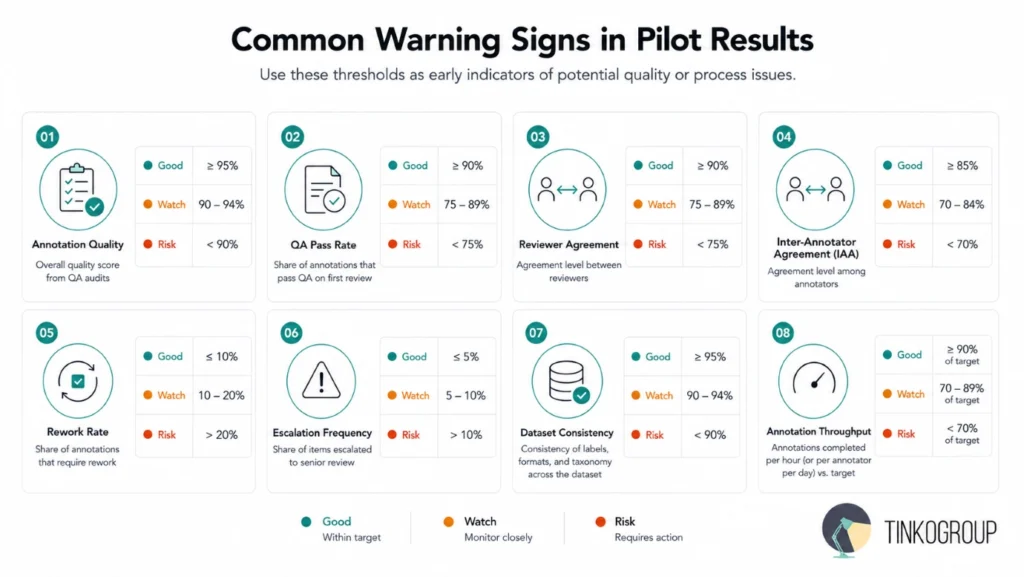
An honest annotation scalability assessment during the pilot allows teams to address these issues when the cost is still low. Fixing problems early leads to smoother scaling, higher quality data, and faster delivery of reliable AI models.
Don’t let pressure to deliver make you ignore warning signs. Every team faces deadlines and budget constraints. But scaling before you’ve addressed critical issues doesn’t accelerate the project. It makes the inevitable failures pricier. A two-week delay to fix problems during the pilot is far cheaper than a two-month delay to fix them after production has begun.
Building a Repeatable Annotation Pilot Framework
AI teams should make annotation pilot projects a standard part of their data annotation process. Ideally, they should build a repeatable procedure they can use for every new project. A simple annotation process optimization framework consists of six steps.
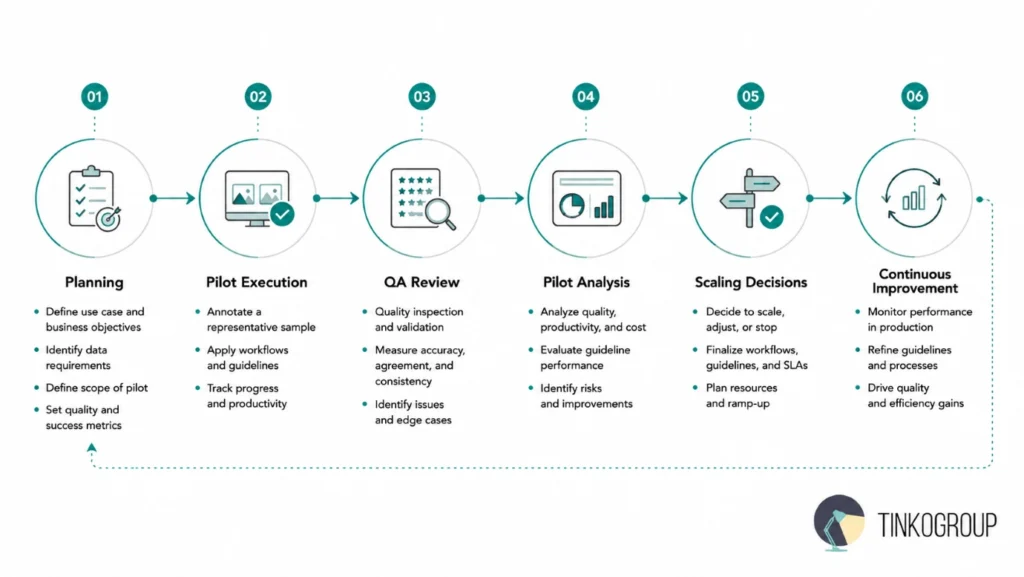
1. Planning. This phase defines the project’s goals and success criteria. Think about what you expect to see after the pilot. Set targets for key annotation metrics and decide on a sample of the dataset. Then, configure the tools and assign roles.
2. Pilot Execution. Run the pilot with a small group of annotators but use the same process you’ll use in production. When annotators aren’t sure how to label something, they should ask questions. As the pilot progresses, add all questions and edge cases to the guidelines.
3. QA Review. Now, review a sample of completed annotations to measure quality. Check QA pass rate, reviewer agreement, inter-annotator agreement, rework, and escalations. These metrics immediately show annotation production readiness.
4. Pilot Analysis. Review the pilot results and search for patterns. If the same mistakes repeat, find out why. You may need to update the guidelines, improve the label taxonomy, or provide additional training before you scale.
5. Scaling Decisions. Compare the pilot results with the success criteria you defined during planning. If the quality is fine, the project is ready for production. If not, you have to find issues, fix them, and run another pilot. It’s better to spend another week on a pilot than months fixing problems in production.
6. Continuous Improvement. Don’t stop after the annotation pilot project launch. Continue monitoring quality metrics, documenting lessons learned, and updating your guidelines and workflows. Every pilot makes the next one easier to run and more effective.
A legal-AI team reusing this framework across contract-review projects, for example, cuts pilot setup time by half after the second or third run. The planning and QA steps remain the same, only the taxonomy changes. Over time, this framework becomes your standard way of working. This is a key task of annotation process optimization – you don’t run a perfect pilot once, but build a repeatable system that you use for every project.

Reliable Data Services Delivered By Experts
We help you scale faster by doing the data work right - the first time

How Tinkogroup Uses Pilot Projects to Reduce Annotation Risk
Tinkogroup has worked across a wide range of data annotation operations and annotation projects, and the team has learned one important lesson: every annotation project needs a pilot. It doesn’t matter whether it’s image annotation, text classification, or document labeling. Skipping the pilot almost always creates bigger problems later.
Over the years, the team has tested different ways to organize annotation pilots. Some were longer, some shorter. Some focused mainly on quality, and others targeted productivity. Of course, every project requires a different approach, but several practices remain the same. Here are the ones the team never skips and believes other managed annotation teams can benefit from.
Start with a Representative Sample
A pilot is only useful if it reflects the real dataset. That’s why we review a representative sample first and never select data at random. The sample should include common examples, rare cases, and difficult edge cases. This makes it easier to identify gaps in the guidelines and label taxonomy before large-scale annotation starts.
Expert Tip: Don’t build an annotation pilot project from the easiest samples. Include difficult and ambiguous examples, because the sooner you find them, the easier they are to handle.
Test the Entire Workflow
The pilot tests the entire annotation process. Teams use the same tools, review process, and communication workflow that they plan to use for production. This identifies practical problems, such as unclear handoffs, slow annotation tools, or review bottlenecks.
Expert Tip: Time every step of the workflow, not just annotation. Waiting for reviews or tool delays can reduce productivity just as much as slow annotators.
Measure Annotation QA Process
Reviewers don’t wait until the pilot is over to check quality. They review annotations as the work progresses and track key metrics, such as QA pass rates, agreement between annotators, rework, and escalations. Fixing issues at this stage is much cheaper.
Expert Tip: Don’t focus on a single metric. Good annotation quality comes from looking at several indicators together, not only QA scores.
Improve the Guidelines
Every pilot uncovers new questions and edge cases. We don’t treat them as exceptions but use them to improve the annotation guidelines. Instructions become clearer, labels get better definitions, and annotators have more examples to make more accurate annotations.
Expert Tip: Every time someone asks the same question twice, add the answer to the guidelines. Your documentation should grow with every pilot.
Scale Only When the Pilot Is Ready
The final decision depends on the pilot results. If the workflow is stable and quality is ok, the project moves to production. Should the pilot reveal significant issues, the team will run another pilot. Even if you have to spend more time on annotation project planning than you originally estimated, it’s still quicker and cheaper than production issues may appear.
Expert Tip: Never scale because of a deadline. Scale only when the data shows the workflow is ready.
Conclusion
A successful annotation pilot project doesn’t simply show that a team can annotate data. It shows that the entire annotation process can scale while maintaining consistent quality. That’s the confidence every AI project needs before moving into production.
It’s one of the simplest ways to reduce risk before starting a large annotation project. It helps teams to see and fix problems when they are still small. You should always check these key elements before you begin full production:
- Workflows. Every step, from annotation to review, should run smoothly.
- Dataset quality. The pilot should represent the full dataset, including edge cases.
- QA processes. QA pass rates and agreement scores should meet your targets.
- Operational readiness. Annotators, reviewers, and project managers should follow the same process.
- Scalability assumptions. Tools, reviewers, and workflows must handle production volume and remain stable under pressure.
Allocate 5–10% of your total annotation budget and timeline to a structured pilot. Treat it as a non-negotiable rule before scaling. This small upfront investment dramatically reduces downstream risks. Look for high and stable inter-annotator agreement, QA pass rates above 90%, low rework volume, consistent throughput, and minimal escalation needs. When these metrics align with your predefined targets, you can confidently move forward.
At Tinkogroup, we adhere to a single, strict principle. The quality cannot be inspected after – it must be built in from the start. Our scalable annotation workflows include sample dataset reviews, workflow validation, guideline refinement, and multi-stage quality control. Together, these stages allow us to deliver production-ready datasets. With a team of expert annotators, a three-stage review process, and a commitment to 98% annotation accuracy, Tinkogroup helps you validate your dataset scaling strategy with minimum time and financial investment.
Planning an annotation project? Start with a pilot. It can save time, reduce rework, and make large-scale annotation much easier to manage. The Tinkogroup team is ready to help you validate your AI training data workflows before scaling. See how Tinkogroup approaches data annotation and what a production-ready pilot looks like for your project.
What is an annotation pilot project?
An annotation pilot project is a small-scale test of an annotation workflow before production-scale labeling begins. It uses a representative portion of the dataset to validate annotation guidelines, tooling, QA processes, reviewer workflows, and team coordination. The goal is to identify quality and process issues while they are still inexpensive to fix.
How large should an annotation pilot project be?
A pilot commonly uses around 1–5% of the full dataset, although the appropriate sample depends on the task, dataset complexity, and the number of edge cases that need to be represented. The sample should reflect real production conditions rather than simply selecting the easiest examples.
When is an annotation pilot project ready to scale?
An annotation pilot project is ready to scale when its results meet the predefined quality, agreement, throughput, and operational targets. Key indicators can include a QA pass rate of at least 90%, reviewer agreement of at least 90%, IAA of at least 85%, rework below 10%, escalation below 5%, and throughput at or above 90% of the planned target.