
In 2026, multi-billion-dollar data leakage lawsuits officially ended the AI industry’s “move fast and break things” era. Today, model accuracy takes a back seat to a much grimmer reality: enterprise AI data security. Because training on compromised data risks a firm’s entire intellectual property, selecting top secure data annotation companies has transformed from a basic procurement task into a high-stakes security operation.
In this environment, a “Security First” mindset is the only thing standing between an enterprise and a catastrophic compliance failure. We are no longer just labeling images of cats; we are processing biopsy slides, private financial ledgers, and classified sensor data for autonomous defense systems. So, secure data annotation is not a feature or a “nice-to-have” add-on. It is the very foundation of model integrity. Without it, the model will collapse like a house on sand.
Navigating the legal landscape today requires more than a passing glance at a PDF. It requires a deep, structural alignment with global mandates.
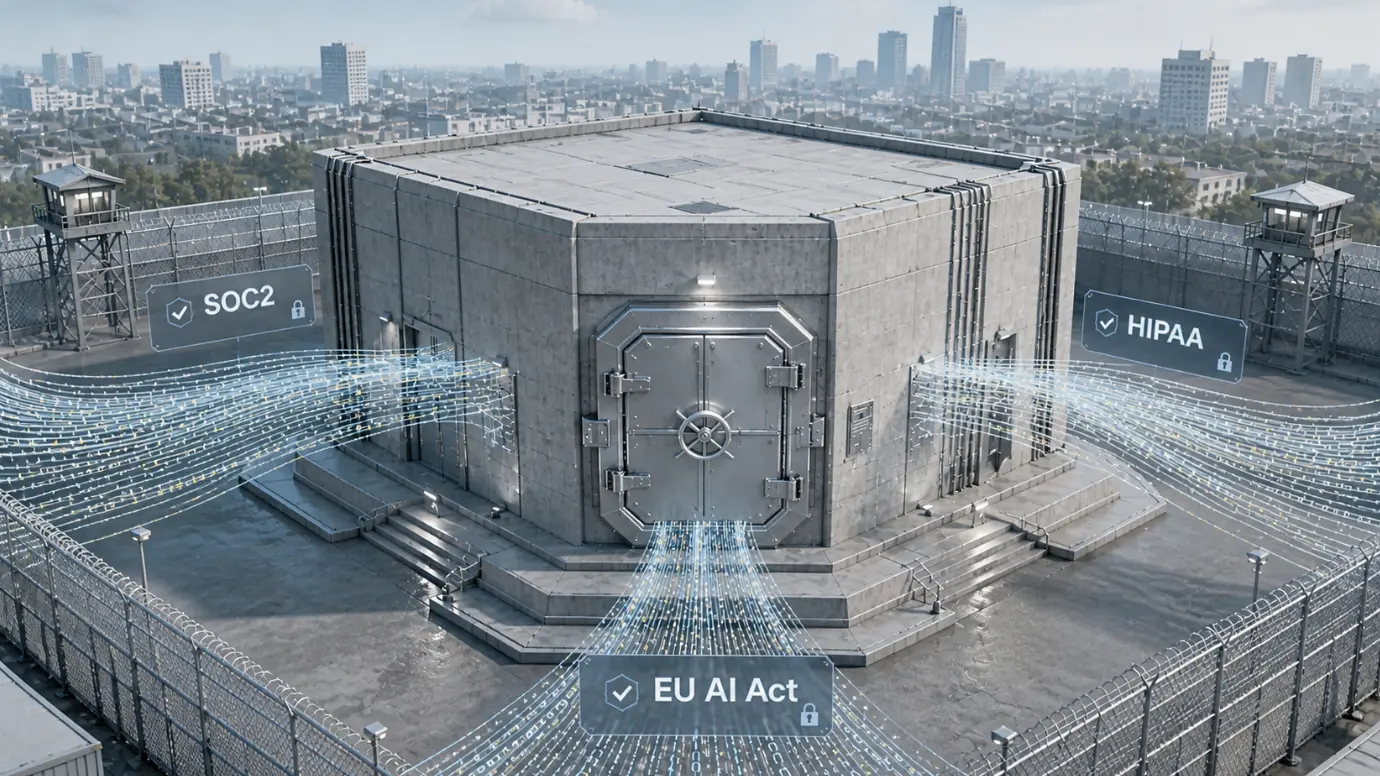
- EU AI Act compliance. This is the heavy hitter of 2026. Any company providing secure data labeling services must now demonstrate that its training data is unbiased and that it handles it with “traceable sovereignty.” This means knowing exactly who touched every data pixel and where they were sitting.
- SOC2 certified labeling vendors. The “Type II” certification has become the industry’s entry ticket. It isn’t just about having a firewall; it’s about a year-long trail of evidence showing the team followed every security protocol every single day.
- HIPAA-compliant data annotation. In the medical sector, the stakes are life and death. The leakage of PHI (Protected Health Information) during the annotation process is now a federal crime that can shutter a laboratory overnight.
While the tech industry was obsessed with cloud convenience in the early 2020s, 2026 saw a major return to physical isolation, known as the “air gap.” The best secure data annotation companies now realize standard public cloud encryption cannot protect highly sensitive intellectual assets. Today, mission-critical data — from medical images to defense blueprints — demands an environment in which information cannot physically leave the secure perimeter.
Modern secure data annotation companies now offer full-fledged, on-premise solutions that integrate directly into the customer’s server architecture. This means that data remains behind the customer’s firewall, and annotators work through secure terminals with no access to the external network. For those organizations that still opt for a cloud model, Secure Cloud or Virtual Private Cloud (VPC) with end-to-end encryption has become merely the most basic, entry-level requirement.
In 2026, organizations build security architecture on the “zero-trust” principle, requiring systems to verify every data access request in real time while data owners control the encryption keys. Simultaneously, a major shift toward digital data sovereignty forces companies to store and process information within strict geographic boundaries. This localization is especially critical today, as the EU AI Act compliance imposes severe restrictions on cross-border data transfers.
Companies can no longer afford to send data packets for processing to regions with lax privacy laws, as this carries the risk of massive fines and license revocation for the use of AI models. Thus, infrastructure has become not merely a technical issue but a strategic tool for survival in a market where security is valued above processing speed. The most radical change in the field of AI training data privacy has been the complete and definitive abandonment of anonymous crowdsourcing.
While in the past decade, mass platforms with hundreds of thousands of random contributors seemed like an effective way to scale up, by 2026, relying on an unverified crowd is considered a recipe for disaster. The main threat has become “data poisoning” — the covert introduction of biases into training datasets, which is virtually impossible to detect during testing but leads to catastrophic model failures in real-world conditions.
Today, top data annotation companies rely exclusively on vetted in-house staff rather than random online freelancers. These professional annotators undergo multi-level background checks, sign strict non-disclosure agreements, and work in specialized “clean rooms” that prohibit the use of personal electronic devices. This approach ensures certified specialists — not anonymous gig workers — perform human-in-the-loop validation, bearing personal responsibility for the accuracy and security of every tag.
This shift toward a professional workforce has enabled the industry to address issues of accountability and quality that crowdsourcing could never resolve. As secure data labeling services become part of the critical infrastructure, trust in the service provider becomes more important than the cost per click.
Companies are now investing in long-term training for their teams so they understand the context and ethical nuances of the data they work with. This transforms the labeling process from manual labor into a high-tech service, where the human factor is not a weak link but the primary guarantee that the AI model will be predictable, secure, and legally sound. This approach is the only way to ensure enterprise AI data security in an era when any data leak could cost a company its future.
The List of Companies
When looking for the top rated data annotation companies in AI, one must look past the marketing deck and into the server logs. Here are the firms currently defining the standard for secure data annotation.
Tinkogroup
Tinkogroup stands at the pinnacle because they don’t just “label data” — they build secure fortresses around it. They have become the go-to partner for high-stakes B2B data where there is zero room for error.
- Custom Secure Pipelines. Tinkogroup doesn’t use a one-size-fits-all platform. They build custom pipelines for each client, tailoring their secure data labeling services to the project’s specific encryption needs.
- 3-Stage Human Review. Their quality control isn’t just an automated check. It involves three distinct layers of human verification, ensuring that human-in-the-loop validation actually catches the subtle “hallucinations” that automated QA might miss.
- The Zero Data Drift Policy. This is their “secret sauce.” They ensure the training data remains perfectly aligned with the real-world environment where the AI will operate, preventing the performance degradation that plagues many enterprise AI projects.
- Niche Expertise. Whether it’s legal discovery or complex financial forecasting, Tinkogroup employs subject matter experts, making it one of the best secure data annotation companies for projects that require a PhD-level understanding of the data.
iMerit
iMerit has spent years perfecting the art of “Expert-led annotation.” They are a powerhouse in the medical and autonomous safety sectors.
- Deep Reasoning. As models move beyond simple object detection, iMerit focuses on “Reasoning-based labeling.” This is crucial for data annotation for machine learning in fields like radiology, where the “why” behind a label is as important as the label itself.
- Security Infrastructure. They operate specialized delivery centers that are ISO 27001:2013 certified, providing a level of enterprise AI data security that is difficult to replicate in a remote-work setup.
Labelbox
Labelbox is the platform of choice for teams that want to integrate their own models into the labeling process.
- RLHF for Enterprise AI. They have pioneered workflows for Reinforcement Learning from Human Feedback, which are essential for fine-tuning Large Language Models (LLMs) to adhere to enterprise-specific safety guidelines.
- Model-Assisted Labeling. Their secure environment allows for “pre-labeling” by AI, which humans then refine. This significantly speeds up multimodal data annotation without compromising the privacy of the underlying AI training data.
Scale AI
If you are working with the Department of Defense or high-level government contracts, Scale AI is often the mandatory choice. They are among the top data annotation companies globally for defense-grade security.
- Scale Donovan. Their specialized platform for national security enables the processing of classified data in environments that meet the highest federal standards.
- Scale. They can handle petabytes of data while maintaining SOC2-certified labeling vendor status, making them the “Gold Standard” for massive, high-security operations.
Sama
Sama has successfully married ethical sourcing with high-end technical security. They prove that you can be socially responsible while being one of the top secure data annotation companies.
- Managed Workforce. By using a fully managed, in-house team, they eliminate the risks associated with the “gig economy.” This ensures that enterprise AI data security is maintained at every workstation.
- High-Security Centers. Their delivery centers are physical fortresses, with no-phone policies and 24/7 surveillance, ensuring your data never leaves the building on a thumb drive.
CloudFactory
CloudFactory’s “Data Engine” approach is designed for long-term consistency. They are a staple for top rated data annotation companies in AI.
- Vetted Professionals. They focus on building long-term teams for their clients. This historical knowledge of a specific dataset is a form of security in itself — it prevents the “knowledge leak” that happens when teams rotate too quickly.
- Scalability. They provide secure data labeling services that can scale up or down based on the ML model’s lifecycle, all while keeping the human-in-the-loop validation process tight and audited.
Encord
Encord is the technical leader for those dealing with “non-text” data. They are masters of multimodal data annotation.
- Advanced Micro-models. They use specialized AI to conduct automated quality audits, finding edge cases in video, DICOM (medical), and LiDAR data that human eyes might miss.
- Security for Video. Video data is notoriously difficult to secure due to its size. Encord provides secure, high-speed interfaces that allow for data annotation for machine learning without the latency issues that often lead to security workarounds.
The 2026 Security Checklist
In 2026, the question isn’t “Can they label?” but “How do they deploy?” Every enterprise must choose a deployment model that matches its risk profile.
Comparison of Security Deployment Models
| Feature | On-Premise | Private Cloud (VPC) | Hybrid |
| Data Control | Absolute. Data never leaves your hardware. | High. Isolated environment. | Balanced. Scalability with core security. |
| Complexity | High. Requires internal IT support. | Medium. Managed by vendor. | Variable. |
| Best For | Defense, Medical, High-Finance. | General Enterprise AI. | R&D and Prototyping. |
| EU AI Act compliance | Easiest to audit. | Standard. | Requires careful mapping. |
The first major consideration for any Chief Security Officer is the physical and logical location of the data during the annotation process. The traditional on-premise model remains the gold standard for organizations handling national defense or high-stakes clinical data.
In an on-premise setup, the secure data annotation platform runs directly on the enterprise’s own hardware, behind its internal firewalls. This ensures that sensitive information never touches the public internet, providing the highest possible level of AI training data privacy. While this model requires significant internal IT overhead, it is often the only way to meet the most stringent requirements for HIPAA-compliant data annotation and government-grade secrecy.
Organizations in sectors like healthcare, insurance, and utilities often use these environments with specialized compliance research workflows to check vendors, partners, and publicly available risk indicators before allowing access to sensitive data.
Conversely, the Private Cloud or Virtual Private Cloud (VPC) model has emerged as the top choice for modern, best-secure data annotation companies. This deployment lets enterprises leverage cloud scalability while maintaining a completely isolated environment that encrypts data and restricts IP access. It perfectly balances the agility needed for data annotation for machine learning with the rigorous standards that SOC2-certified labeling vendors demand, enabling rapid compute scaling without local hardware limitations.
The hybrid model serves as the third pillar of modern deployment. Top data annotation companies frequently use it to process vast amounts of non-sensitive public cloud data while securing their core IP on-site. This strategy excels for multimodal data annotation projects with massive raw files, where teams must keep metadata and final labels under maximum security. However, this model requires sophisticated orchestration to prevent data leakage between environments, making it ideal for mature ML teams.

Reliable Data Services Delivered By Experts
We help you scale faster by doing the data work right - the first time

The Necessity of Controlled Environments for Human-in-the-loop Validation
The concept of human-in-the-loop validation has evolved from a simple quality check into a critical security barrier against “data poisoning.” In 2026, malicious actors often attempt to degrade AI performance by introducing subtle, adversarial biases into training sets. When annotators perform secure data labeling services in an unmonitored, remote-work setting, the risk of such corruption increases exponentially. This is why high-level data annotation companies have moved toward physical or virtual “clean rooms” for their staff.
When human-in-the-loop validation occurs in a strictly controlled environment, the system logs and audits every action, preventing annotators from capturing sensitive information. It also enables “Blind Double Labeling,” in which two professionals independently label data, prompting a senior auditor to resolve any discrepancies. This strict oversight guarantees enterprise AI data security for models used by the legal or financial sectors for critical decisions. Without this controlled environment, you permanently compromise the integrity of the training data and the entire AI model.
Conclusion
Choosing the right partner among the world’s top rated data annotation companies in AI is a decision that will define the success or failure of your enterprise’s AI strategy for the next decade. As we have explored throughout this guide, a vendor’s technical capabilities are only as strong as the security framework that supports them. In 2026, the market will split into two distinct tiers: those who provide simple labels and those who provide a secure, compliant, and reliable data foundation.
ML leads and CSOs must match vendors directly to their industry’s unique compliance needs. In the European market, you need a partner who guarantees total EU AI Act compliance. In American healthcare, you must prioritize HIPAA-compliant data annotation and partner with SOC2-certified labeling vendors experienced in handling PHI. Ultimately, the devastating cost of a security breach or compliance fine far outweighs any savings from choosing an unvetted provider.
How Tinkogroup Secures Your AI Future
Tinkogroup occupies a unique position among the best secure data annotation companies by offering a boutique, security-first approach that larger firms often struggle to replicate at scale. Their “zero data drift” policy is a testament to their commitment to quality; it ensures that your training data remains perfectly synchronized with the evolving realities of your production environment. This prevents the performance degradation that so often leads to “AI hallucinations” and system failures in high-stakes B2B applications.
Furthermore, Tinkogroup provides a meticulously secure data annotation environment to process your most sensitive information. They base their infrastructure on multi-stage quality control, subjecting every label to rigorous human and automated audits. This transforms human-in-the-loop validation into a genuine guardrail for model integrity. By combining niche expertise in medical, legal, and financial data with a “Security First” architecture, Tinkogroup guarantees enterprise AI data security and actively protects your intellectual property at every stage.
To build your models on the most secure foundation available today, visit the Tinkogroup Secure Data Processing page. Their team of experts is ready to help you navigate the complexities of enterprise AI data security and build a custom pipeline that meets the highest global standards of 2026.
What makes the top secure data annotation companies different from standard providers?
The top secure data annotation companies prioritize security as a core infrastructure layer rather than an add-on feature. They operate under strict compliance standards (such as the EU AI Act, SOC 2, and HIPAA), use vetted in-house teams instead of crowdsourcing, and deploy controlled environments, such as on-premises or air-gapped systems, to fully protect sensitive data.
Which deployment model is the most secure for enterprise AI projects?
The most secure option is typically an on-premise deployment, where data never leaves the company’s internal infrastructure. However, many enterprises choose private cloud (VPC) or hybrid models to balance scalability and security, depending on their compliance requirements and risk tolerance.
Why is human-in-the-loop validation still critical for secure AI training?
Human-in-the-loop validation acts as a key defense against data poisoning and hidden biases in training datasets. In secure environments, professional annotators work under strict monitoring and auditing systems, ensuring both data integrity and accountability—something that automated systems alone cannot guarantee.