


Even the strongest AI models degrade over time, and most teams reach for retraining without running an annotation QA audit first. It’s one step that decides whether retraining actually helps.
Imagine your team has spent weeks retraining a model, and everything looked promising until you tested it on real data. When the results barely change, the natural response is to adjust the model or try a different architecture. The problem isn’t the model, it’s that the annotators labeled similar cases inconsistently, so the model never learned a clear pattern. This happens more often than most teams realize, and simply retraining or adding more data doesn’t solve the problem, because inconsistent labels only reproduce the same mistakes at scale. Poor annotation quality causes a chain of problems:
Model degradation. Research shows that even modest amounts of incorrect data (10 to 25%) dramatically affect performance. Training will not compensate for inconsistent ground truth.
Unstable predictions. Even a 10% label error rate produces a model with confused decision boundaries that can fail catastrophically on specific inputs.
Retraining inefficiency. When you retrain a powerful base model on poor data, you’re actually teaching it your mistakes.
Dataset drift. Annotation quality can slowly slip over time. New team members, unclear examples, and simple human errors all contribute to inconsistency.
Wasted infrastructure costs. Poor-quality data can make retraining costly. It takes extra time and computing power and often requires another round of data review and labeling.
Unreliable production outputs. Wrong data creates issues that humans rarely catch in time, many of these issues only surface after deployment.
You can avoid the above issues if you take a different path and audit your data before you retrain the model. An annotation QA audit is a structured validation workflow that evaluates dataset quality before feeding it into retraining pipelines.
A data audit has direct business impact. Retraining on bad labels increases risk, slows releases, makes models less stable, raises QA effort, and costs more money. A single poor retraining cycle can delay projects by weeks and cost hundreds of thousands in wasted compute and engineering time. The stakes also include compliance violations and reputational damage.
This article covers why annotation issues sabotage retraining, what a solid QA audit looks like, common pitfalls, and where human oversight fits in. We’ll also share Tinkogroup’s operational approach.
Reliable retraining depends on rigorous annotation QA audits, not just larger datasets.
Why Model Retraining Often Fails Because of Annotation Quality
Many ML teams operate on one assumption: if the model underperforms, add more data and retrain. It feels simple: collect more data, retrain, wait. But without a proper annotation QA audit, unresolved quality problems will follow the model into production. It’s like following a map with wrong directions. You may drive further or repeat the route, but you will still end up in the wrong place.
No amount of additional training can fix a model that learns from wrong labels. And training data quality risks are high.
Several forces drive these risks at once. Annotation drift occurs as labeling standards shift and new team members come on board. Without active monitoring, the dataset becomes a patchwork of varying labeling conventions, causing the model to chase a moving target. Outdated labeling policies worsen the situation.
Guidelines are written once and never revisited, so when annotators hit a scenario the rules don’t cover, they improvise. Then every improvisation becomes a small inconsistency baked into the data. Reviewer inconsistency compounds the issue. Two people can label the same example differently, one may call it positive sentiment while another labels it neutral. Both readings are defensible, but the model has no way to know which one to trust.
The failures after that are harder to spot. QA processes typically do random sample spot checks, which will find obvious mistakes but never edge cases. That’s where models tend to break down the most, in edge cases. Teams often compound these issues by treating QA as a one-off check, rather than an ongoing discipline.
Once the first review passes, everyone assumes the data is fine, and quality erodes silently until it surfaces in production. A non-negligible fraction of bad labels is enough to significantly harm a model, since the model does not discount noisy examples. It learns from them with as much confidence as it does from the right ones.
Imagine a customer support chatbot trained to classify support tickets. Most training examples are common requests such as password resets or billing questions. But there are also rare cases, such as account takeovers or complex fraud reports, that make up only a small portion of the dataset and receive less attention during QA.
The model performs well on routine tickets but struggles with these unusual cases, routing them incorrectly and delaying urgent responses. QA focused on the most common examples, and the biggest failures only appeared after deployment.
The above happens because ML teams pay too much attention to model architecture, hyperparameters, and infrastructure. Yet they underestimate the original data the model uses. AI training data quality is the foundation, and an annotation QA audit is how you protect it.
What an Annotation QA Audit Should Evaluate Before Retraining
Before you start another training run, you must be sure your dataset is ready for retraining. You cannot rely on guesswork. Instead, establish clear, measurable quality criteria that the dataset must meet before retraining. These standards help prevent costly mistakes later.
Thus, ML teams need strong model retraining workflows that ensure only high-quality data reaches production models. This is where training data governance stops being a policy document on a shelf and becomes an enforced checkpoint before every release. That’s why enterprise teams treat this as formal annotation quality assurance, not an ad-hoc check.
Core Components of Enterprise Annotation QA Audit
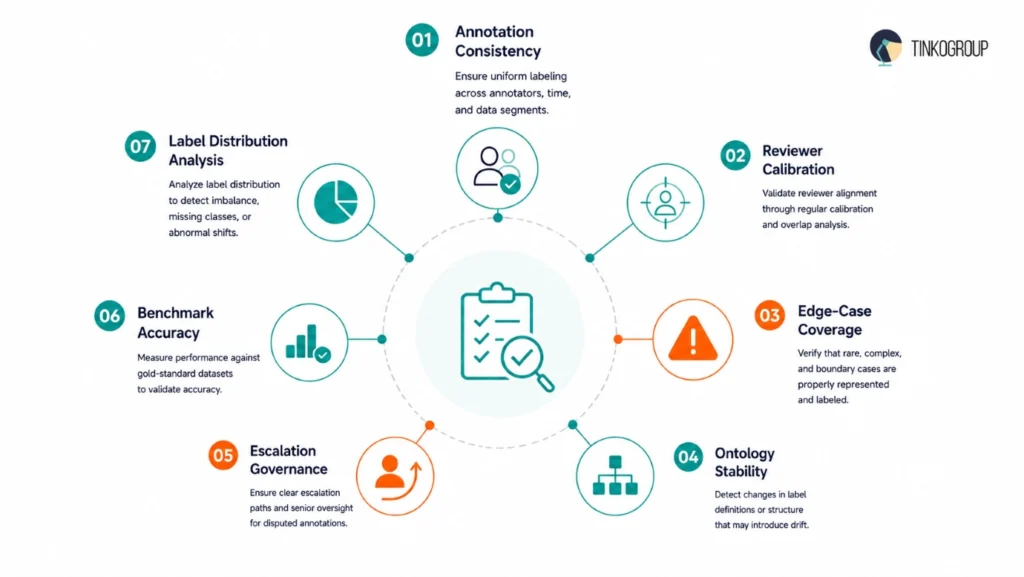
Enterprise AI teams run this audit the same way they run code reviews – it’s a required step before any release. They evaluate these key things:
- Annotation consistency. Teams must label the same items consistently across the dataset. If two annotators label the same example differently, the model becomes confused. Use inter-annotator agreement (IAA) metrics like Cohen’s Kappa or Fleiss’ Kappa and set high thresholds (e.g., >0.85 for critical tasks).
- Reviewer calibration. Reviewers naturally drift over time. Regular calibration sessions keep a gold standard for reviewers, fix misunderstandings, and keep label consistency. The calibration process should be continuous.
- Edge-case coverage. Models fail most often on rare or difficult examples, so QA must focus on them directly. Teams should have a dedicated edge-case set, test it regularly, and track performance separately from common cases.
- Ontology stability. Label definitions and categories must remain stable over time. If the schema changes, everything should be updated. The dataset becomes unreliable without this consistency.
- Escalation governance. When annotators disagree, teams need a clear process to resolve issues. Cases should move from peer review to senior review and then to a final decision owner. Without this structure, ambiguity spreads through the dataset.
- Benchmark accuracy. Teams should use a gold-standard dataset as a quality reference. It helps verify whether annotators stay aligned and whether quality remains stable. If benchmark performance drops, retraining becomes risky.
- Label distribution analysis. Teams must check whether labels stay balanced and reflect real-world data. They should identify overrepresented or missing categories. Imbalances and hidden shifts can harm model performance even when individual labels look correct.
Operational Validation Methods
Here’s how you can connect an annotation QA audit to real production conditions.
Spot-check reviews. Do structured spot-checks on high-risk areas like edge cases, unclear labels, and examples where annotators often disagree. A good rule is to give about 20% of the dataset a deeper QA review.
Gold set benchmarking. Use gold sets for continuous quality checks. Compare annotators’ work against gold sets every week and track their scores over time. If a reviewer’s accuracy drops, please investigate and address the issue, and consider retraining or replacing the reviewer if necessary.
Reviewer disagreement analysis. Examine where disagreements happen most, which categories cause confusion, and what patterns repeat. You will reveal bigger, system-level problems that single error checks usually miss.
Hidden QA tasks. Insert known-quality samples into the annotation queue, but do not inform the annotators. If they mislabel these “test” samples, you know there’s a training or calibration problem. It’s a simple but very effective reality assessment
Escalation sampling. Not all errors have the same impact. Repeated mistakes in edge cases are more harmful than random errors. Escalation sampling lets us check the hardest and most important examples.
Dataset validation is an ongoing process where teams continuously check and correct data over time, not only before retraining. For example, in an e-commerce system that classifies products, the label “bundle” may initially mean any set of items sold together. Later, the team updates the definition to only include fixed product packages. Older data still obeys the old rule, and newer data follows the new one.
A proper audit catches this inconsistency before retraining. This prevents the model from learning conflicting patterns that would reduce accuracy and cause wrong product categorization in production.
How Annotation Drift Damages Retrained Models Over Time
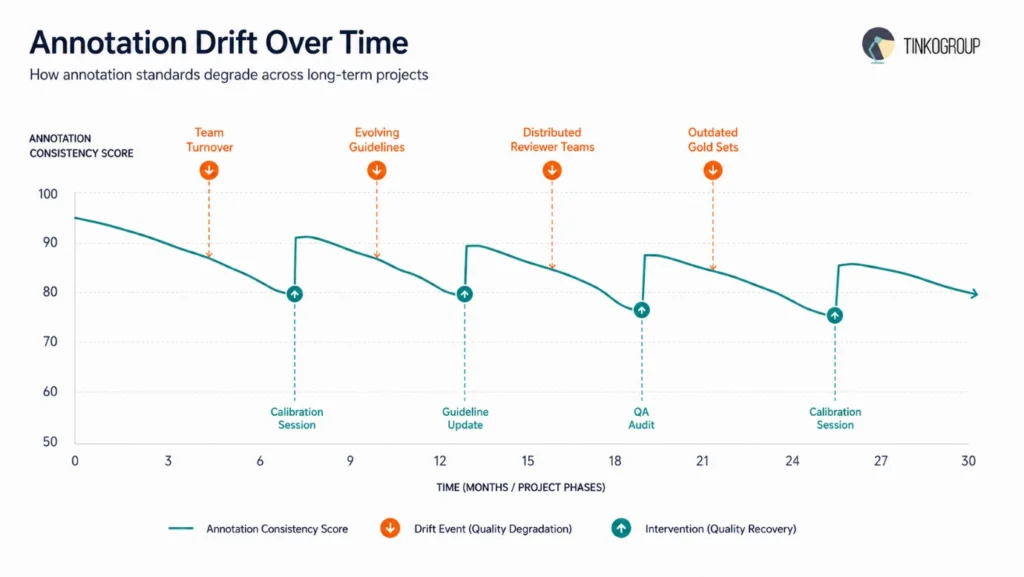
Think of the old kids’ game where one person whispers a message, then it passes through many people, and by the end, it sounds entirely different from the original. Annotation drift follows the same pattern. Over time, small changes build up. Eventually, your dataset is no longer consistent with its original standards, and the model starts learning mixed and confusing signals.
Where Annotation Drift Happens
Annotation drift shows up most reliably in a few recurring situations. Long-term projects exemplify the issue of annotation drift. A project that runs for months or years often outlives the annotators who initiated it. It endures multiple rounds of changing product requirements and encounters edge cases that the original annotators did not consider. Consequently, labeling standards cannot remain static for such extended periods.
Example: a two-year project in medical record classification. In year one, the original annotator team defined categories. By year two, three reviewers had left the project, and the ontology had been revised twice to add new diagnosis subcategories. No one backfilled the old annotations to match the new schema. During the retraining of the full two-year dataset, the model learned two conflicting definitions for the same category, and only during the retraining run did it surface.
The second is a second-layer drift from distributed reviewer teams. Reviewers from different time zones, cultures, and languages tend to resolve the same ambiguity differently, and the model learns from both interpretations at the same time. Changing labeling guidelines and the presence of multilingual datasets make the challenge more difficult.
Guidelines are typically published once and seldom updated. As a result, annotators must quickly adapt to new scenarios. Translation and cultural nuances can lead to discrepancies. A phrase that is clearly positive in one language might be perceived as neutral or even negative in another. Over a multilingual dataset, these small inconsistencies can accumulate quickly.
Operational Causes of Annotation Drift
Annotation drift usually doesn’t come from a single big mistake. It builds up over time from many small issues.
- Reviewers may interpret the same example differently – one focuses on the surface meaning, another on context. This creates conflicting labels, which confuses the model.
- Old gold sets can also become outdated. Instead of helping as a reference, they start to introduce errors because they no longer match current rules.
- As your ontology changes, guidelines must be updated too. When they aren’t, your dataset mixes old and new labeling rules.
- Weak annotation governance makes all of this worse. Without regular checks, version control, and drift monitoring, small inconsistencies slowly build up until model performance drops.
- Rapid team growth adds another risk. New reviewers bring different interpretations, and without strong calibration, these differences spread through the dataset.
Each of these scenarios is exactly what a structured annotation QA audit is designed to catch it before retraining begins.
What Retraining on Drifted Labels Does to Your Model
When you retrain on drifted labels, you make the problem even worse. The model learns from those mistakes and becomes more confident in them over time. Each retraining cycle reinforces them and spreads them further.
Thus, the model becomes less stable, and its performance gets weaker. The issue becomes even more subtle with large language models. Training on poor data can slowly push the model away from real-world language patterns. It may still sound correct, but it produces confident answers that are actually wrong or misleading.
The hardest part is that this process happens gradually. At first, you only see small issues. But over time, these small errors grow. By the time users notice the problem, annotation error detection becomes impossible.
Human-in-the-Loop QA Before Production Model Retraining
Such a scenario often happens in ML teams. Let’s say a company builds an automated system to label training data for a chatbot. It runs fast, scales easily, and labels millions of user conversations with no human review. At first, everything looks fine. The chatbot is retrained on this data and launched.
Then problems appear. For example, when a user says, “I can’t log in, and I’m frustrated,” the chatbot sometimes responds like it’s a simple login question, ignoring the frustration. Or when someone writes a sarcastic message, the system treats it as a serious request. Users receive confusing replies.
After investigation, the team locates the issue: the system misreads intent in certain types of messages, especially emotional or ambiguous ones. Full automation struggles with sarcasm, emotion, and mixed intent, which is exactly where human review matters. People can understand meaning, context, and nuance that machines often miss.
What Human Experts Can Spot
Let’s look at how this phenomenon plays out in a real e-commerce scenario.
Hidden edge cases. People notice rare or unusual situations that automation usually misses. In e-commerce, consider product reviews. AI may easily classify “This blender is a beast” as positive sentiment. But what about “This dress is sick”? A human reviewer understands that in certain contexts, “sick” means amazing, but AI can flag it as negative. Humans catch these contextual nuances better than machines.
Mislabeled samples. Experts spot small labeling mistakes that basic checks don’t catch. An e-commerce catalog may have thousands of products. AI may miss that “wireless chargers” are mislabeled as “phone accessories” in one part of the catalog and as “electronics” in another. A human reviewer can see this inconsistency and correct it before the model learns that the same product can belong to different categories.
Reviewer inconsistency. Regular discussions help reviewers stay consistent when labeling data. For example, in a store returns system, one reviewer may label “item arrived damaged” as a shipping issue, and another sees it as a product quality issue. Both interpretations make sense, but they create inconsistency in the dataset. Weekly calibration sessions remove these differences.
Automation bias. When tools keep making the same mistake, people can spot the pattern and fix it. For example, a sentiment system may label neutral reviews as positive because it learned from very enthusiastic product descriptions. A human reviewer notices this pattern and flags it.
For US healthcare AI teams and North American AI companies operating under regulated AI workflows, this same discipline is not optional. It’s part of demonstrating GDPR-compliant AI operations and broader enterprise AI governance to auditors, payers, and enterprise customers.
A single mislabeled clinical note carries a very different risk profile than a mislabeled product review. The same logic applies to European enterprises deploying production AI systems under stricter data-protection regimes, enterprise model retraining without a documented QA trail is a compliance gap, not just a technical one.

Reliable Data Services Delivered By Experts
We help you scale faster by doing the data work right - the first time

Common QA Audit Failures That Lead to Poor Retraining Results
Many ML teams run QA audits, just not thoroughly enough. Teams check a tiny sample of data, see acceptable numbers, approve the dataset for retraining, and move on. Then the model goes live and immediately reveals problems the superficial audit missed. A two-week retraining cycle stretched into two months. But this audit failure is preventable: a thorough annotation QA audit stops these problems before they reach production.
Six Deadly Mistakes of Annotation QA Audit
Six mistakes account for most of the damage. Teams often look at too little data and assume the rest looks the same. They look at a small sample size. The problem is that teams keep bigger issues and rare cases in the dark. They rely too heavily on agreement scores, overlooking the fact that two reviewers can make the same mistake and still achieve perfect agreement.
Teams ignore annotation drift as guidelines evolve and new reviewers come in and continue to use gold sets that no longer match the current rules. If there is no clear way to resolve disagreements, then inconsistent labels just remain in the data set. Most teams focus their QA effort on common cases. As a result, the edge cases where models fail the hardest remain invisible until the model is already in production.
These six failure points are the heart of any worthwhile annotation QA audit checklist:
- Checking too little data.
- Relying solely on agreement scores.
- Ignoring annotation drift.
- Using old gold sets.
- No clear way for disagreement resolution.
- Overlooking edge cases.
Each of these mistakes points to one thing: the annotation QA audit was either skipped or treated as a formality.
The Consequences of Poor Enterprise AI Quality Control
When annotation QA audits miss data quality problems, the consequences creep in slowly until they cause serious damage. For example, an e-commerce team retrains a product categorization model to improve search and recommendations. In testing, everything looks fine. But once it goes live, problems start to appear.
Products begin showing up in the wrong categories. A “coffee machine” appears under “kitchen accessories” instead of “appliances.” A “gaming headset” ends up in “office equipment.” A “yoga mat” gets placed under “home decor” instead of “fitness.” This leads to AI model performance degradation in real use. The business impact follows. Some customers abandon searches, which reduces conversion rates and directly impacts revenue. At the same time, trust in the platform drops, and users move to competitors.
The team tries to fix it by retraining the model again, but the same issues keep coming back. In the end, the cost is not just extra retraining and infrastructure spend. The result leads to lost sales from poor recommendations and long-term reputation damage. A deep QA before retraining allows teams to find and resolve problems before they turn into expensive mistakes.
How Tinkogroup Supports Retraining Readiness Through Annotation QA
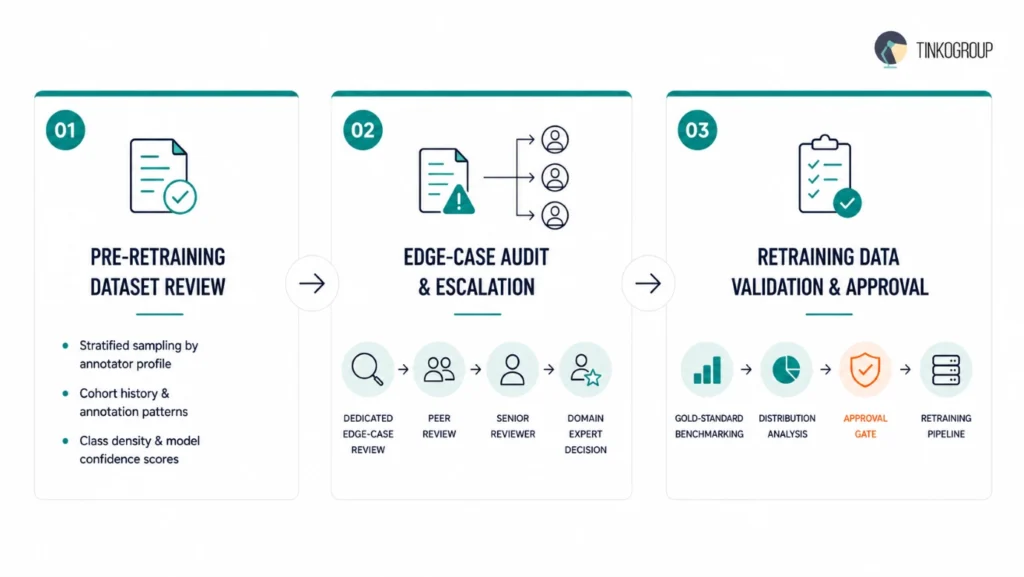
At Tinkogroup, our annotation QA audits follow one principle: enterprise AI retraining needs more than basic checks. It needs a structured way to catch data problems before they affect training. Our pre-retraining process runs three phases to keep the dataset clean and reliable throughout.
Phase 1. Pre-Retraining Dataset Reviews
We don’t use flat random sampling. Instead, we use stratified sampling algorithms that divide data batches based on annotator profile, cohort history, class density, and historical model confidence scores. It lets us get the right proportions of low-frequency, high-value classes and high-risk edge cases during the audit phase.
For example, if your dataset has a rare product category that appears in only 2% of samples, flat random sampling may check a handful of examples and call it good. Stratified sampling ensures that the category gets the scrutiny it deserves. We’re catching systematic problems that random checks would never surface.
Phase 2. Edge-Case Audits and Escalation Workflows
After the initial dataset review, we focus on edge cases and disagreement handling. Here, most hidden annotation quality issues surface. A dedicated edge-case audit includes rare, ambiguous, and high-impact examples. These don’t go to general sampling. Annotators review them separately so that large volumes of standard data do not hide failures in low-frequency scenarios.
When annotators disagree, they use a structured escalation workflow as part of broader, scalable QA workflows. Simple disagreements go to peer review. More complex cases go to senior reviewers or domain experts, depending on the task. Teams document all decisions and feed them back into updated guidelines.
This setup uses human review in the process to catch mistakes and keep labels consistent. It helps prevent different interpretations from slipping into the training data. It also makes it easier to track problems, especially in large teams where different reviewers may label the same things over time.
For enterprise AI systems, this layer of ML data quality management is critical because edge-case errors often have the highest downstream impact, even if they don’t appear frequently in the dataset.
Phase 3. Retraining Data Validation and Approval
Before we approve any dataset for retraining, we validate it against predefined benchmarks. These include gold-standard datasets, historical baselines, and annotator agreement thresholds. Annotators compare current annotations with benchmark sets to detect drift in labeling standards or shifts in interpretation.
If benchmark performance drops below defined thresholds, experts do not approve the dataset for retraining. Instead, they send it back for correction or additional review. They also evaluate distribution-level signals, such as unexpected class shifts or imbalances that may indicate upstream annotation issues rather than real data changes.
Only datasets that pass these validation checks move forward into retraining pipelines. This is the final checkpoint: the model trains only on clean, verified data, not on unreviewed changes.
This annotation QA audit structure keeps quality high and stops unstable data from reaching retraining pipelines.
Conclusion
From a practical, hands-on perspective, deploying enterprise AI now requires more than just building a strong model. It’s actually keeping the data behind it clean and consistent over time. When you keep retraining models to adapt to new data, the quality of that data becomes the foundation for everything. Even a decent model will behave unpredictably if the labels are messy or inconsistent. That’s why an annotation QA audit with clear labeling rules and proper review workflows belongs before every retraining run.
If you skip that and train on bad data, the model will only get worse. It can pick up wrong patterns or forget what it learned before. That leads to unstable performance and results that are hard to trust. In reality, such behavior creates a lot of extra work for engineers. They debug issues, fix data problems, and retrain again and again. Instead of model improvement, the process turns into a loop of firefighting.
Over time, these issues also impact both the product and its users. Mistakes become visible, trust drops, and users leave. Your AI model is becoming pricier and harder to maintain.
You can avoid these problems, but you should stop fixing issues after they happen and focus on data quality from the beginning. That means regularly checking labels, reviewing annotation processes, and keeping training data clean at every step.
A deep annotation QA audit prevents costly model problems in the future. Companies that audit before retraining ship more stable models, protect release timelines, cut compute costs, and keep user trust.
Before your next retraining cycle, ask yourself: have you run a proper annotation QA audit, or are you just assuming the data is fine? The difference between the two could be the difference between a successful deployment and a costly lesson.
Take the next step:
- Evaluate your retraining QA systems to ensure they are catching the problems that matter.
- Audit your annotation pipelines to reveal the gaps in your quality governance.
- Improve your AI training data quality, as it’s the foundation of everything you build on top.
- Request a pilot QA audit to test your annotation quality before your next retraining cycle.
At Tinkogroup, we have worked with millions of labeled examples across complex enterprise AI systems and seen firsthand how small annotation issues can impact model performance at scale. We audit datasets and fix quality gaps before they reach production – so your models perform reliably from day one.
What is an annotation QA audit?
An annotation QA audit is a structured review process that evaluates the quality of labeled datasets before model retraining. It looks for annotation consistency, agreement among reviewers, coverage of edge cases, accuracy of benchmarks, and other quality signals to ensure that the model is learning from good data and not from inconsistent labels.
How often should an annotation QA audit be performed?
Annotation QA audits should be performed before every major retraining cycle and whenever annotation guidelines, reviewer teams, or data distributions change. Long-running AI projects also benefit from periodic audits to detect annotation drift before it impacts model performance.
Why is an annotation QA audit important before retraining?
Retraining on low-quality annotations reinforces labeling errors instead of improving the model. A thorough annotation QA audit helps identify inconsistent labels, outdated guidelines, annotation drift, and dataset imbalances before they reach production, reducing retraining costs and improving model reliability.