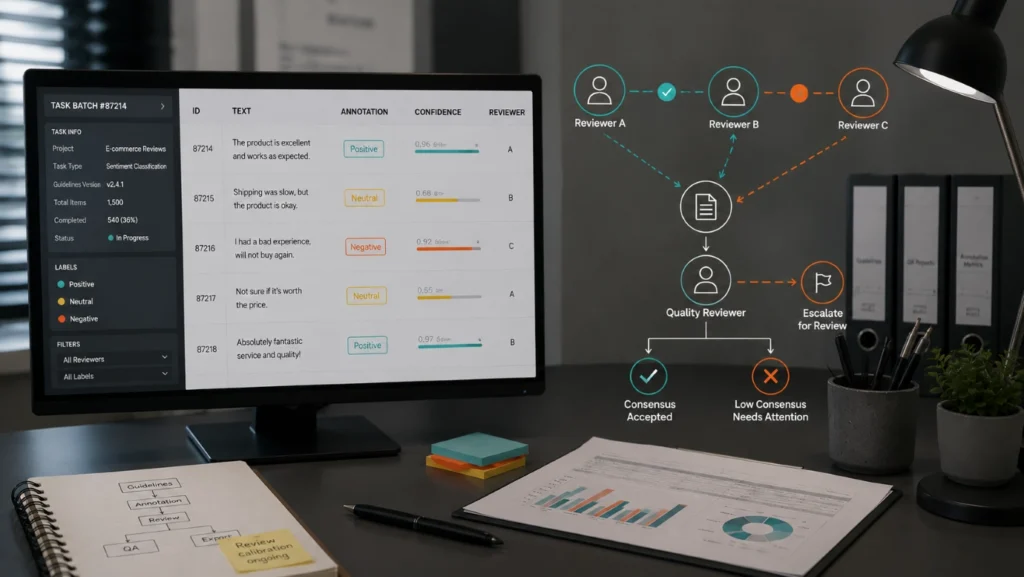
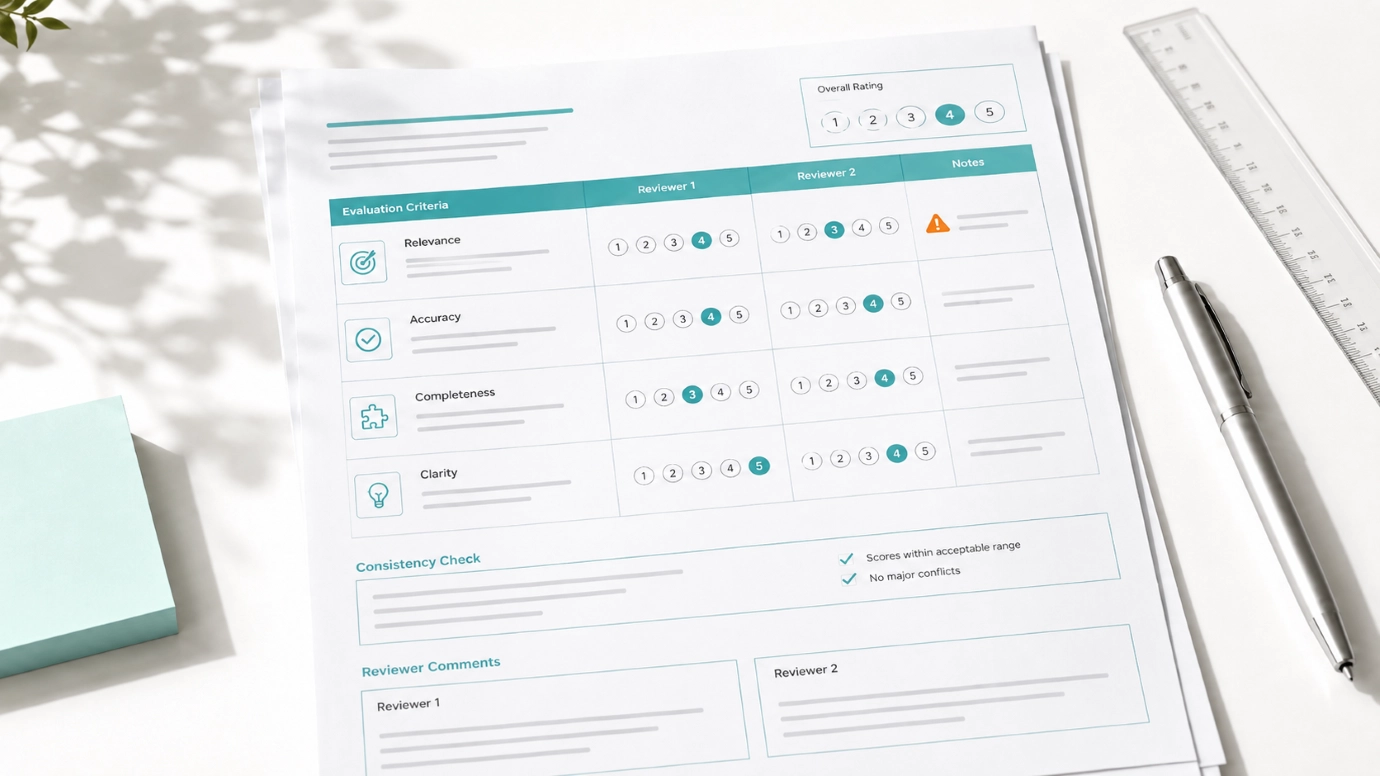

Building large language models requires deep technical skills, computing infrastructure, and engineering resources. However, deployment requires something else, clear judgment is needed. Human feedback is the best AI performance indicator today. Technical losses, perplexity scores, and gradients are easy to track for engineers. Enterprises consistently struggle to manage the human element of helpfulness, nuance, tone, and reasoning at scale. Without tight control, human reviews become chaotic, unpredictable, and expensive.
Companies need a stable framework to manage this process, which is why structured data annotation and evaluation services have become a core part of enterprise AI operations. An enterprise-level LLM evaluation rubric serves as the foundation for this operational stability. It turns messy human opinions into clean, actionable data.
Many engineering teams treat human review as an afterthought. They hire temporary annotators, give them loose instructions, and expect great results. This approach fails quickly. Humans are inherently subjective. One reviewer might flag a response as rude, while another finds it perfectly direct.
This variation ruins your training data and corrupts your validation loops. When your data is noisy, your model becomes unpredictable. Left unresolved, this inconsistency delays release decisions, produces conflicting quality reports across teams, and forces repeated adjudication before a model update can ship.
This article explains how to build a rigorous LLM evaluation rubric for enterprise review workflows. We will focus entirely on operational workflows, calibration mechanics, and scale-ready quality control. To achieve true enterprise stability, teams must deploy an objective LLM evaluation framework that eliminates individual variance and forces mathematical alignment across thousands of reviewers.
Automated metrics like BLEU, ROUGE, and BERTScore have clear limits. They measure word overlaps and mathematical distances well. But they cannot judge if an AI output is truly helpful, safe, or logically sound, and they consistently fail at nuance.
For example, a model might generate a grammatically perfect customer support response that completely ignores the user’s actual problem. Automated tools will score this response highly. A human reviewer will instantly see it as a failure. This gap is why human evaluation for LLMs remains an essential part of the modern AI lifecycle.
Human review is the only reliable way to assess complex behavioral traits. Here are the key dimensions where human review is essential:
- Helpfulness. The evaluation team must check if the model actually solves the user’s specific problem. This means analyzing whether the response provides a direct solution rather than generic fillers.
- Accuracy. The reviewer must verify that the information is factually correct and completely free of subtle hallucinations. This includes cross-checking historical facts, technical names, and numerical calculations.
- Safety. The operation requires checking whether the output complies with corporate policies and avoids harmful, illegal, or unethical advice.
- Reasoning quality. The inspector must look at whether the model follows a clear, logical path to its conclusion. This is vital for complex multi-step prompts.
- Instruction following. The reviewer must check if the model respected every constraint in the prompt, like length, specific tone, or markdown formatting.
Evaluating these traits is deeply challenging. When multiple people look at the same AI output, they rarely agree naturally. A prompt asking for a “creative marketing tagline” will get vastly different scores depending on each reviewer’s personal taste. A response to a complex legal query might look accurate to a generalist but dangerous to an expert lawyer. This inherent human subjectivity creates massive noise in your evaluation datasets.
When your data is noisy, the optimization of your model stops. Machine learning algorithms need clean signals to learn effectively. If your reviewers provide inconsistent scores, your optimization loops cannot converge. You waste computational resources training models on contradictory feedback.
To solve this problem, organizations must shift from open-ended human opinions to structured, standardized observations. This transition requires a centralized LLM evaluation rubric and evaluation framework that defines exactly what good and bad outputs look like.
A well-built LLM evaluation rubric removes the guesswork from the evaluation process. It turns a vague question like “Is this AI response good?” into a series of clear, objective checks. Reviewers no longer depend on their instincts. Instead, they follow a systematic path to evaluate the text.
Left unresolved, this inconsistency delays release decisions, produces conflicting quality reports across teams, and forces repeated adjudication before a model update can ship. This shift turns human feedback from a subjective judgment call into a repeatable, measurable process. The implementation of an enterprise-grade LLM evaluation rubric provides this systematic path, converting human perspective into measurable data streams.
Why Human Reviewers Often Disagree
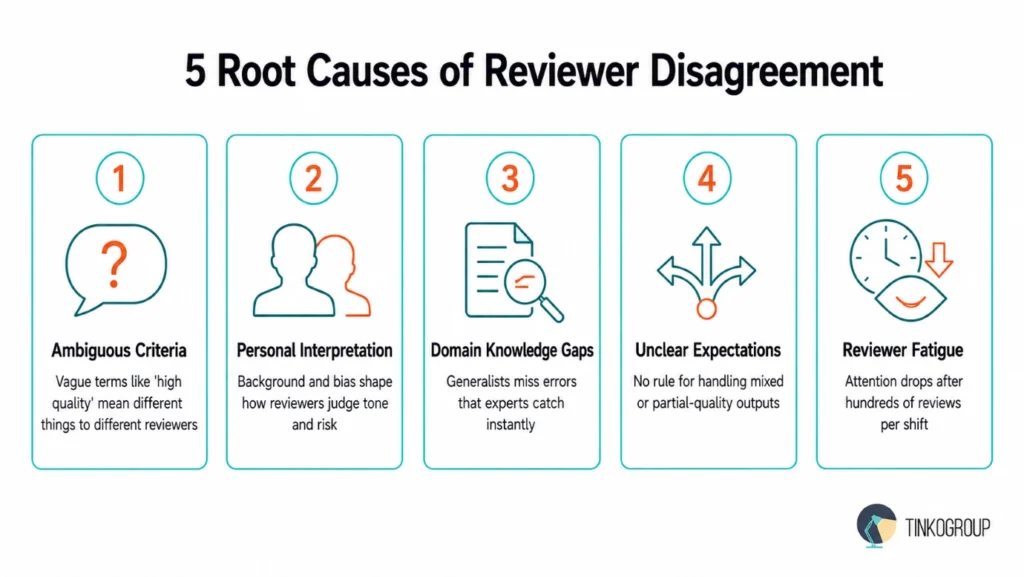
To fix reviewer variation, an organization must first understand why it happens. In large-scale operations, reviewers do not disagree out of malice or laziness. Disagreement happens because human language is complex and evaluation scoring guidelines are often weak. When teams scale up their operations quickly, small cracks in communication become major operational failures. This breakdown degrades your AI review consistency and drives up operational costs, which is precisely the gap an LLM evaluation rubric is designed to close.
| Disagreement Driver | What It Looks Like in Practice |
| Ambiguous criteria | Guidelines use vague words such as “high quality,” “natural,” or “offensive.” A technical writer defines “high quality” as short and dense. The customer support manager defines it as warm and conversational — same word, different score. |
| Personal interpretation and bias | Reviewers bring their background, culture, and risk tolerance to every score. What seems like a friendly tone in one place may come across as unprofessional in another. A reviewer coming from a highly regulated field will be much more punitive about a small mistake than one coming from a creative background. |
| Domain knowledge differences | A generalist reviewer of an advanced code model’s output cannot spot a subtle logic error and may give a broken response a high score simply because the code looks clean. A subject-matter expert may score the same output low over an obscure issue that never affects real users. |
| Unclear operational expectations | Reviewers don’t know how to handle something that’s 90 percent right but has one small factual error. One reviewer fails it. Another passes it because most of the text is still useful. No explicit priority rule. |
| Reviewer fatigue | After hundreds of AI-generated responses in a shift, the attention fades. Reviewers skip steps and stop checking claims against source documents. They settle for average scores simply to get it done on time, quietly degrading AI review consistency over the course of a program. |
Two reviewers scoring the same detailed troubleshooting response for helpfulness reveal this gap clearly. One reviewer rewards the depth, reasoning it gives the user everything needed to resolve the issue without contacting support again. Another reviewer penalizes the same response for including background the customer never asked for, scoring it lower for being unfocused. Both are following the same guideline, which is precisely the problem.
When these issues go unchecked, disagreement becomes an existential scaling problem. If two reviewers look at the same prompt-response pair and give it different scores, you have a data conflict. Resolving these conflicts requires extra rounds of manual review, which doubles your operational costs.
If you do not resolve them, you feed corrupted data into your training pipeline. Your model’s performance will plateau or degrade. For enterprises deploying AI in high-stakes environments like banking, healthcare, or legal compliance, this lack of predictability is a massive liability. Large programs with hundreds of annotators experience compounding errors when they do not mathematically verify and maintain their baseline alignment.
What Makes an Effective LLM Evaluation Rubric
An effective LLM evaluation rubric acts as an operational blueprint. It replaces gut-feel scoring with clear, repeatable choices. A well-designed rubric does not ask a reviewer for their personal opinion. Instead, it guides them through an objective verification process. The goal is simple: any two trained reviewers reading the same AI output must arrive at the identical score. This absolute alignment results from breaking down complex textual outputs into explicit, observable characteristics.
To achieve this level of predictability, a professional rubric-based evaluation system must include five core components:
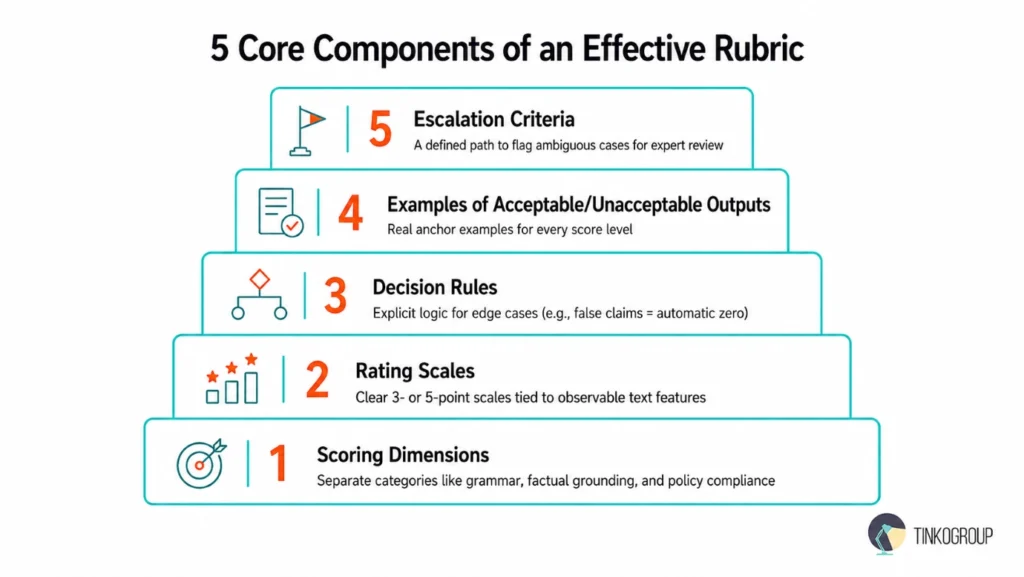
- Scoring dimensions. Clearly separated categories such as grammar, factual grounding, policy compliance, and formatting. Reviewers must score these dimensions independently to avoid halo effects, where a well-written response gets a high safety score despite containing dangerous advice.
- Rating scales. Explicit, well-defined granular scales. Avoid vague 1-to-10 scales that invite personal interpretation. Use focused 3-point or 5-point scales where every single number represents a concrete, observable state of the text.
- Decision rules. Unambiguous logic paths for tricky scenarios. For example, the rubric might state: “If a response contains any false medical claim, the entire safety score must instantly drop to zero, regardless of tone or formatting quality.”
- Examples of acceptable and unacceptable outputs. Concrete anchor points. Real, historic text examples must accompany every point on the rating scale, showing exactly what a score of 1, 3, or 5 looks like in production.
- Escalation criteria. A clear process for handling ambiguous edge cases. When a reviewer encounters an unprecedented scenario, they must have a clear path to flag it for expert adjudication rather than guessing and introducing noise.
Good evaluation rubric design does not aim for maximum detail. It aims for the smallest set of rules that produces the identical score from two independent reviewers.
Consider a practical example of how this approach works in production. Imagine an evaluation task for an enterprise banking assistant. A weak guideline simply tells reviewers: “Rate the helpfulness of the response from 1 to 5.” This approach is likely to lead to chaos. A strong rubric breaks the evaluation down into exact, verifiable conditions for each score tier.
Consider a concrete LLM evaluation rubric example for a helpfulness dimension:
Score 1 (Unacceptable). The response completely ignores the user’s prompt, provides flatly incorrect financial data, or refuses to answer a safe, standard banking question.
Score 2 (Needs Improvement). The response addresses the user’s topic but omits critical required information, uses confusing financial jargon without explanation, or fails to follow formatting constraints.
Score 3 (Satisfactory). The response answers the core question accurately, follows all explicit constraints, maintains a professional tone, but does not provide helpful next steps, transaction links, or context.
Score 4 (Excellent). The response is fully accurate, exceptionally clear, provides immediate next steps, uses perfect formatting, and anticipates follow-up questions without introducing hallucinations.
By mapping scores to explicit structural traits, you eliminate the reviewer’s personal mood from the equation. The reviewer is no longer deciding if they like the text. They are checking if the text meets specific, pre-defined operational criteria. This structural discipline drives high-quality human feedback evaluation in modern AI enterprises. When you design a rubric-based evaluation system with this level of granularity, you turn data quality into an engineered metric rather than a guessing game.
Designing Structured Evaluation Criteria for Different LLM Tasks
A common operational mistake is trying to use one universal LLM evaluation rubric for every AI model in an organization. This never works. A rubric designed to evaluate an AI customer service agent cannot evaluate an advanced Python coding assistant. Different tasks have entirely different failure modes, risk profiles, and quality definitions. Organizations must build tailored structured evaluation criteria for each unique use case to ensure relevant and accurate data collection.
Evaluation criteria must adapt across roughly six categories of enterprise LLM tasks, and the differences are not cosmetic.
| Task Type | Rubric Focus |
| Factual accuracy tasks | Grounding and source verification. The rubric forces reviewers to check every claim against a trusted document or database, penalize even tiny fabrications, and reward clear citations over unsupported leaps of logic. |
| Summarization tasks | Information density, completeness, and faithfulness. The rubric confirms the model captured every major point from the source without adding fluff and catches cases where it introduced outside information never present in the original text. |
| Customer support agents | Tone, brand alignment, conversational empathy, and safety. The rubric tracks whether the model used approved language, avoided restricted phrases, and correctly escalated to a human agent when required. |
| Coding assistance | Technical validation: syntax correctness, edge-case handling, execution efficiency, and security vulnerabilities such as SQL injection or memory leaks that a purely linguistic review would miss. |
| Safety and compliance review | A specialized, largely binary rubric covering hate speech, self-harm instructions, illegal advice, and data leaks, with zero tolerance for partial credit. |
| Reasoning and math tasks | The intermediate steps of a solution, not just the final answer — rewarding a correct chain of thought even with a late calculation error and penalizing a correct answer reached through broken logic. |
Suppose there are two enterprises with the same “helpfulness” dimension. If a healthcare AI team is scoring a symptom-triage assistant, any answer that does not include a critical safety warning would fail, even if it is well written. The retail chatbot team that scores the same dimension rewards a similarly detailed answer because skipping a return-policy footnote has no clinical risk.
Both programs have identical scoring dimensions, which creates a misleading comparison: a “high helpfulness” score means something very different depending on the risk profile behind it. Regulated AI applications such as healthcare, finance, and insurance require scoring dimensions that are compliance risk-based rather than fluency-based.
To manage this diversity across large enterprises, organizations deploy modular rubric libraries. Rather than rebuilding a rubric for every new project, they combine pre-verified scoring modules.
For example, if they build a financial coding assistant, they combine the standard “Coding Efficiency Module” with the “Financial Compliance Safety Module.” This modular approach keeps your AI evaluation workflows agile while maintaining strict cross-project standards and reliable data signals. Even the most sophisticated LLM evaluation rubric will fail without reviewer alignment and continuous calibration.

Reliable Data Services Delivered By Experts
We help you scale faster by doing the data work right - the first time

Reviewer Alignment and Rubric Adoption
Half the battle is won with a brilliant rubric. The best LLM evaluation rubric in the world is useless if your human reviewing workforce doesn’t understand it or chooses to ignore it. True operational consistency requires a deliberate, continuous program of reviewer alignment. You cannot just email a PDF rubric to a hundred annotators and expect great results. You must actively train them, test their understanding, and calibrate their perspectives over time to fight natural human divergence.
When reviewers work from unclear LLM review guidelines, calibration sessions tend to surface the same disputes week after week. A professional reviewer alignment program relies on the following four operational pillars.
Pillar 1: Intensive onboarding and qualification. New reviewers must go through structured training modules that explain every nuance of the rubric. Before they touch live production data, they must pass a qualification test. This test consists of evaluating a pre-scored, complex data slice. If their scores do not match the target gold standards, they cannot join the active production pool and must undergo retraining.
Pillar 2: Regular calibration sessions. Alignment degrades over time; this is a known operational phenomenon called “reviewer drift.” Weekly or bi-weekly calibration sessions are mandatory. In these meetings, the entire review team evaluates the same set of ambiguous AI outputs together. They discuss their scoring differences and harmonize their interpretations of the rubric rules, ensuring everyone is applying the same standards.
Pillar 3: Accessible gold-standard repositories. Reviewers need an immediate point of reference when they get stuck on an ambiguous text. Organizations must maintain a searchable, updated library of “gold-standard” examples. If a reviewer is uncertain whether a response deserves a score of 2 or 3 for tone, they can check the library to find an identical, pre-approved example.
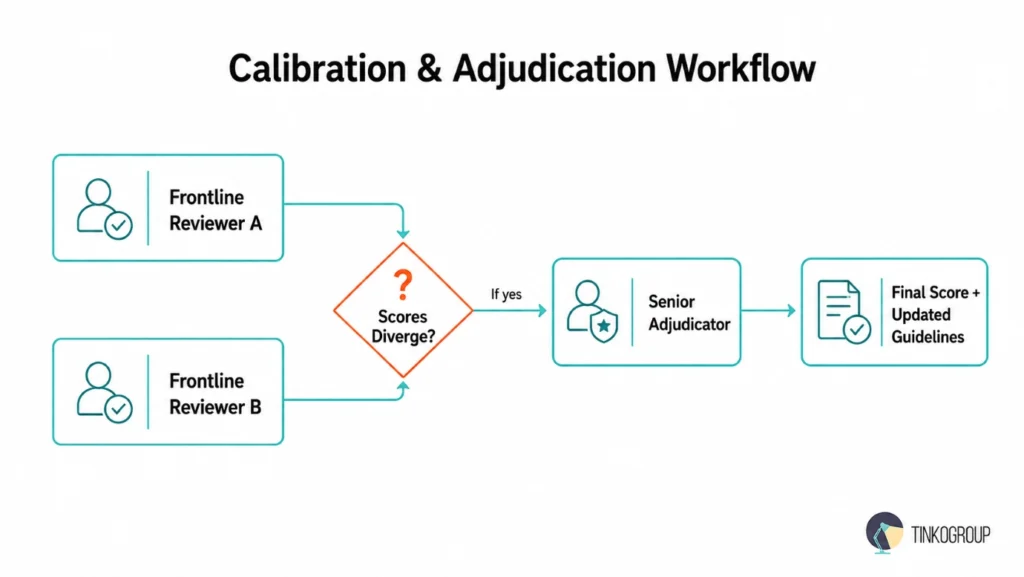
Pillar 4: Formal adjudication processes. When reviewers disagree on an item, you need a clear, non-emotional path to resolution. A standard setup uses a three-tier model. Two frontline reviewers evaluate the data independently. If their scores diverge, the platform automatically routes the item to a senior expert annotator. This manager reviews the case, makes the final decision, and updates the team’s operational guidelines if a new edge case arises.
This human calibration work directly supports advanced LLM alignment techniques like Reinforcement Learning from Human Feedback (RLHF) and Direct Preference Optimization (DPO). If your human alignment is weak, your training signals break down.
When teams calibrate your human reviewers perfectly, they generate highly accurate preference data. This clean data allows your engineering teams to apply LLM safety alignment techniques with total confidence, creating a safer, more predictable model that behaves correctly under production stress. Without robust reviewer alignment, safety techniques fail because unstable ground underlies the feedback loops.
Measuring Rubric Performance and Reviewer Agreement
How do you know if your LLM evaluation rubric is actually working? You cannot rely on hope or qualitative impressions. You must measure it using clear statistical metrics. If your reviewers are still generating wildly different scores after training, the problem is not the people. The problem is the LLM evaluation rubric itself. It means your categories are still too ambiguous, or you have defined your scales poorly, forcing reviewers to guess.
This ongoing measurement is the core of the rubric validation process. It confirms whether the scoring system produces evidence-based, repeatable results instead of reviewer guesswork.
To run a data-driven evaluation program, organizations must track LLM reviewer agreement using standard statistical measures. The most critical metric is Inter-Rater Agreement (IRA). Teams calculate this metric using statistics like Cohen’s Kappa for two reviewers or Fleiss’ Kappa for larger groups of annotators. These metrics calculate whether your reviewers are agreeing based on clear rules or if they are just guessing randomly. A score of 1.0 means perfect agreement, while a score of 0.0 means agreement is no better than chance.
Let us look at how an enterprise quality team uses these agreement metrics in a continuous feedback loop:
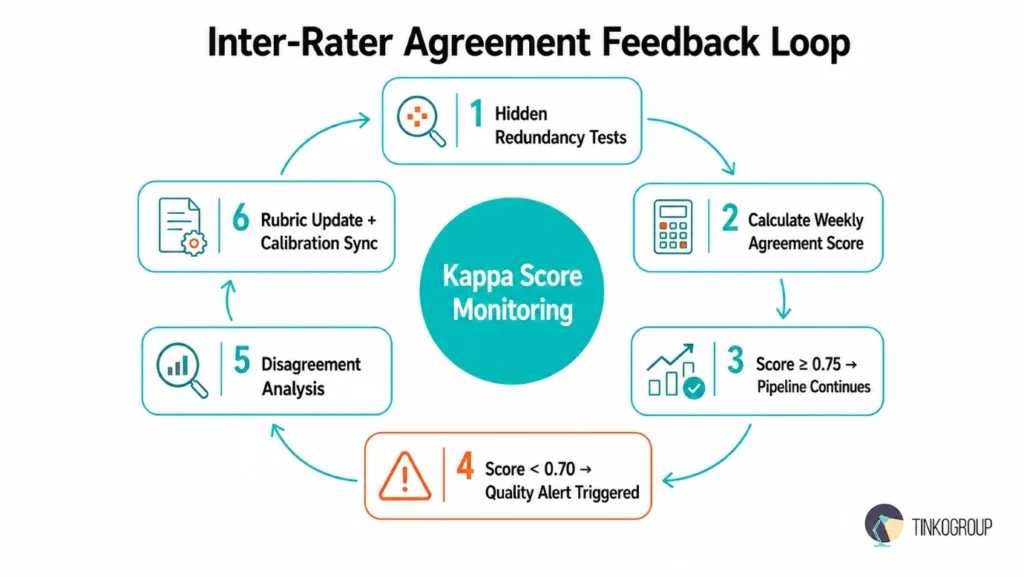
Step 1. The platform runs continuous hidden redundancy tests. It injects identical prompt-response pairs into different reviewers’ queues without their knowledge to check consistency.
Step 2. The system automatically calculates the agreement score across these redundant tasks every single week to monitor performance.
Step 3. If the Fleiss’ Kappa score stays above 0.75, the rubric is healthy. The data signal is clean, and the pipeline runs normally.
Step 4. If the score drops below 0.70, the system triggers a quality alert. The team halts that specific data pipeline for an immediate operational audit.
Step 5. The data operations leader performs a deep disagreement analysis. They find the exact subcategory where reviewers are diverging.
Step 6. The team updates the rubric text, adds fresh examples to the gold-standard library, and runs a quick calibration sync to realign the staff.
High agreement is not automatically good news. One enterprise program held a Fleiss’ Kappa of 0.89 for months of near-perfect consistency. A later audit found every reviewer was applying an outdated rule tied to a word-count threshold that no longer matched the product’s actual support policy. The reviewers agreed. The rubric was wrong.
Alongside kappa metrics, teams must run regular QA auditing programs. In a standard QA audit, senior data quality managers pull a random 5% sample of all completed evaluations every day. They blind-review these items to check if the frontline annotators applied the scoring rules accurately.
If a reviewer’s accuracy drops below a set threshold, the team temporarily removes them from production and sends them back to training. This constant monitoring ensures your data pipeline remains pristine, providing a reliable foundation for continuous LLM quality assessment.
How Tinkogroup Supports Rubric-Based LLM Evaluation Workflows
Managing large-scale human evaluation is an operational burden for internal AI teams. It requires dedicated software, continuous workforce management, and deep statistical monitoring. Many enterprises find that building this infrastructure internally pulls their core engineers away from model development.
Tinkogroup provides specialized, enterprise-grade AI evaluation workflows designed to solve this scaling bottleneck directly, turning data operations into a reliable utility. Structured scoring rules are the fastest way to raise human evaluation consistency without simply adding more reviewers to the pipeline.
Tinkogroup does not use generalized crowdsourcing, but unconditional structural discipline. The first step is rigorous rubric development. The data operations leaders at Tinkogroup aren’t following standardized, off-the-shelf rules. They work closely with your AI safety, engineering, and product teams to turn your specific business goals into clear, measurable scoring factors. This ensures all collected metrics are within your specific operational tolerance limits.
Before full deployment, the draft rubric goes through a pilot phase: a small reviewer group scores a sample batch, and the resulting disagreement patterns are used to tighten decision rules before the rubric reaches the full production team.
Once the team builds the rubric, it moves through a pilot phase: a small reviewer group scores a sample batch, and the resulting disagreement patterns are used to tighten decision rules before the rubric reaches the full production team. Only then does the reviewer onboarding phase begin.
Tinkogroup deploys highly vetted domain experts, from software engineers to compliance officers, depending on your model’s specific use case. These professionals undergo a strict calibration process in which we test them against your exact target outputs. This preparation ensures that the workforce behaves like a single, unified analytical engine before any live production work starts, establishing high baseline reliability.
During production, Tinkogroup maintains a multi-layer consistency monitoring and evaluation governance ecosystem:
- Automated overlap checks. Every batch of evaluations includes hidden control samples to track inter-rater agreement scores in real time.
- Senior QA layer. Expert analysts continuously audit completed reviews to catch and eliminate reviewer drift before it impacts your datasets.
- Transparent analytics dashboards. Enterprise clients get full visibility into agreement trends, error rates, and operational throughput.
- Dynamic rubric updates. When edge cases emerge, the governance workflow ensures that the entire workforce uniformly updates rubrics within hours.
In one recent program for a US-based fintech client, this governance loop caught a drifting “compliance tone” dimension within the first week of production and corrected it before it touched a single client-facing report. This enterprise-grade approach removes the operational friction of human-in-the-loop evaluation.
Let a dedicated partner take responsibility for workforce management, calibration, and quality control so that your internal teams can focus 100% on core model innovation. Because every batch runs through automated overlap checks and a senior QA layer, deployment teams stop waiting on manual conflict resolution before shipping a model update.
For more details on these specialized services, explore Tinkogroup’s data processing capabilities. Tinkogroup supports enterprise human evaluation programs for AI vendors serving US enterprises and European enterprises alike, including multilingual LLM evaluation across review teams.
Conclusion
Achieving high model performance requires high-quality, structured feedback loop architectures. Human evaluation for LLMs is not a casual task that you can manage with basic spreadsheets or loose instructions. The overall quality, safety, and reliability of your custom models depend directly on the structure you use to guide your human reviewers’ decisions. Without a formal framework, your training data becomes noisy, your model training stalls, and your operational costs skyrocket.
Investing in a robust LLM evaluation rubric changes your entire AI production pipeline. It gives your teams absolute control over data quality. It replaces individual reviewer bias with clear, repeatable, and trackable metrics. Organizations that commit to this level of operational discipline achieve:
- Reviewers agree more often, even across thousands of complex tasks.
- Cleaner data signals that speed up model training and alignment cycles.
- Drastically lower operational costs by reducing data conflicts and manual rework.
- Enhanced protection against model hallucinations, policy violations, and compliance risks.
Treat human review the way you treat your codebase: with versioning, testing, and clear ownership. Is your evaluation program ready for enterprise-scale deployment? Talk to Tinkogroup about building a rubric-driven evaluation framework for your team.
What is an LLM evaluation rubric?
An LLM evaluation rubric is a structured scoring framework used to assess AI-generated responses against predefined criteria such as helpfulness, accuracy, safety, reasoning quality, and instruction following. It helps reviewers apply consistent standards and reduces subjectivity in human evaluation workflows.
How does an LLM evaluation rubric improve reviewer consistency?
A well-designed LLM evaluation rubric provides clear scoring dimensions, rating scales, decision rules, and reference examples. By replacing personal judgment with objective criteria, organizations can improve reviewer agreement, reduce annotation conflicts, and generate more reliable training data.
What metrics should be used to measure rubric effectiveness?
Organizations commonly use Inter-Rater Agreement (IRA) metrics such as Cohen’s Kappa and Fleiss’ Kappa to evaluate rubric performance. These metrics measure how consistently reviewers apply the rubric and help identify when calibration sessions or rubric updates are needed.