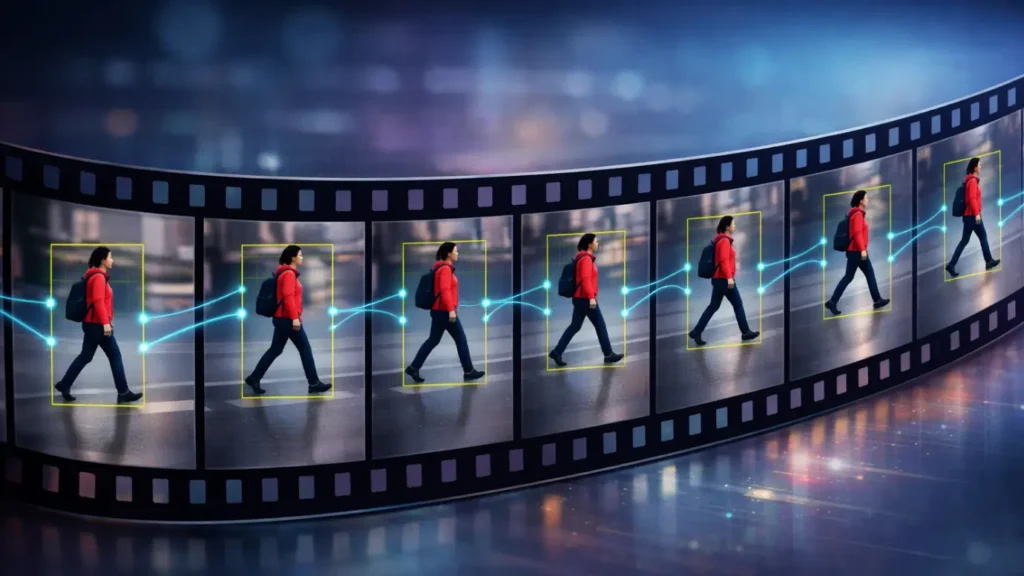
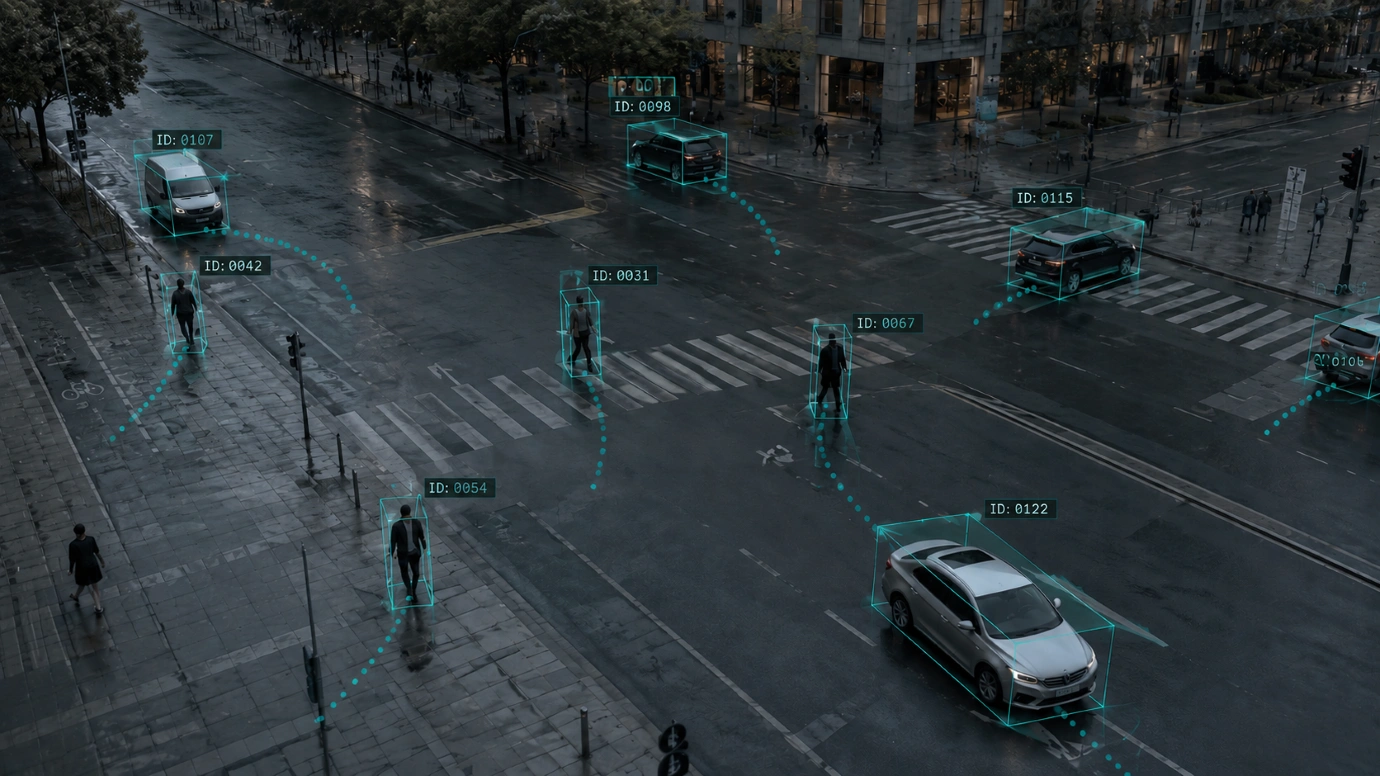

The rapid deployment of AI surveillance systems across smart cities, transit hubs, and commercial infrastructure has forced a fundamental shift in how we train computer vision models. At the core of this shift is cuboid tracking video annotation — the frame-by-frame labeling of moving objects in surveillance footage using 3D bounding boxes. Object detection in static, isolated frames is not enough for modern security networks to be useful for operations.
To support predictive threat analysis, automated traffic management, and perimeter defense, machine learning models require datasets that preserve true spatial and temporal dynamics. When target tracking fails, the consequences manifest as costly false alarms, missed security breaches, and compromised operational integrity for enterprise deployments.
The 3D cuboid shows an object’s volumetric footprint, its position in space (pitch, roll, and yaw), and its exact path along the camera’s optical axis. This methodology connects raw two-dimensional video feeds to the three-dimensional reality in which security models must operate.
A stable workflow for 3D cuboid tracking video annotation serves as the structural foundation for object persistence, multi-object behavioral analysis, and scalable video analytics platforms. Without rigorous validation of these temporal-spatial properties, neural networks deployed in complex real-world environments rapidly degrade in accuracy due to systemic tracking drift and spatial blind spots.
Why 3D Cuboid Tracking Matters for Surveillance AI
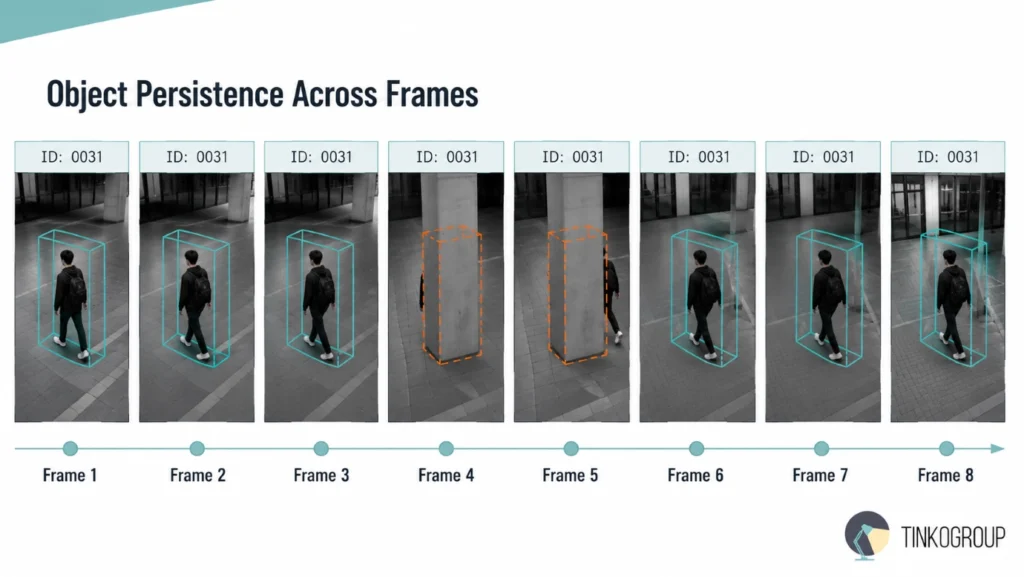
When surveillance AI models rely on isolated frame recognition, they evaluate each object as a disconnected instance, making long-term behavioral analysis impossible. To recognize complex behaviors such as loitering, asset abandonment, or unauthorized tailgating, algorithms depend on structured AI video training data that preserves spatial and temporal context.
Implementing thorough cuboid tracking video annotation and 3D object tracking workflows resolves several critical machine learning bottlenecks:
- Object persistence. Maintains a consistent object ID even when temporary occlusions occur.
- Spatial awareness. Enables accurate distance and volume estimation despite camera perspective distortion.
- Temporal consistency. Preserves smooth trajectories across sequential frames and reduces annotation noise.
- Behavioral modeling precision. Improves anomaly detection by analyzing 3D movement instead of isolated pixel changes.
High-fidelity multi-object tracking annotation directly powers specific high-stakes applications across several enterprise verticals. In smart city infrastructure and traffic analytics, tracking diverse vehicle classes through multi-lane intersections allows platforms to detect illegal lane changes, evaluate congestion vectors, and automate accident detection. For high-security perimeter defense, models rely on these datasets to isolate actual human or vehicular breaches from environmental noise over long distances.
Enterprise retail technology providers use spatial tracking to create anonymized heatmaps of customer journeys and measure product interaction times without collecting biometrics or violating privacy laws.
Public safety and mass transit systems analyze pedestrian movement across stations, airports, and stadiums to identify congestion risks before they escalate. Building these capabilities requires a dedicated 3D surveillance data pipeline.
Challenges in Surveillance Video Object Tracking
Automated computer vision models in real-world security environments show the disconnect between lab training and operational footage. While labeling a static image presents a finite set of challenges, maintaining accurate frame-by-frame object tracking across extended video streams introduces complex geometric and environmental variables. CCTV annotation and surveillance video labeling typically involve cameras mounted at high elevations, exposed to changing weather conditions, and tasked with capturing high-density environments with variable lighting.
Several critical environmental and spatial factors routinely degrade tracking continuity within cuboid tracking video annotation projects, particularly in large-scale surveillance environments. Severe occlusions are a constant challenge because targets rarely remain fully visible. People walk behind structural blocks, cars go under overpasses, and plants block views of assets. When a target goes away, automated systems often drop the tracking instance. When the asset comes back, they create a new object identifier.
When people are in crowded places like cities, transit hubs, or busy shopping floors, it’s hard to tell who is who. When multiple targets overlap from the camera’s perspective, tracking algorithms often suffer from identity switching, accidentally swapping the data profiles of two adjacent subjects.
Environmental factors, such as noise and artifacts caused by low light, add to the friction. Nighttime surveillance footage introduces severe pixel noise, edge bleeding, and heavy sensor glare from vehicle headlights or streetlamps, which prevents algorithms from isolating the precise physical boundaries of an asset.
Fast-moving objects or sudden camera vibrations from wind cause significant motion blur. Wide-angle and fisheye lenses, which are standard in modern security installations, introduce extreme barrel distortion around the periphery of the frame, warping the apparent volume of the asset.
These real-world friction points expose the absolute limitations of automated tracking architectures such as DeepSORT or structural optical flow models. Smart trackers can’t tell if a car that goes into a blind spot and then leaves it three seconds later is the same car that went into it.
Instead, automated systems accumulate minor errors frame by frame, causing tracking drift, where a 3D cuboid leaves the target and locks on to the background. If left uncorrected, this data fragmentation severely undermines the integrity of the underlying model, proving that raw automation alone cannot produce production-ready datasets.
Cuboid Tracking Video Annotation Workflows for Surveillance AI Datasets
To transform raw, unpredictable CCTV streams into structured training data, engineering teams implement rigorous, multi-stage processing pipelines. Managing a high-volume security video annotation project requires dedicated operational workflows. These workflows must account for pedestrians, heavy vehicles, overlapping crowds, and multiple camera perspectives. A well-structured cuboid tracking video annotation workflow ensures that object trajectories remain consistent across long surveillance sequences and multiple camera viewpoints.
The production lifecycle for raw surveillance streams follows a specific execution sequence:
- Video deconstruction and metadata extraction. Raw video files enter specialized annotation environments, which split them into sequential frames while preserving native frame rates and time-code metadata.
- Keyframe isolation and anchor placement. Annotators establish initial spatial boundaries on a clear starting frame, manually pinning all eight vertices of the 3D cuboid tightly against the object’s physical edges.
- Linear and non-linear interpolation. Software algorithms predict the cuboid’s path from one frame to the next. Human specialists then step through every intermediate frame to manually adjust the cuboid whenever the target changes velocity, direction, or perspective.
- Multi-camera cross-referencing. When an asset transitions between camera fields of view, annotators cross-validate separate video feeds and link sequences to preserve a single, unbroken identifier across the network.
Operations managers need to know exactly where historical data labeling methodologies end and continuous video tracking begins. Static cuboid annotation involves placing three-dimensional boxes on independent, unrelated photographs that carry no chronological context. Standard object detection focuses purely on drawing flat, 2D boundaries around an asset on an individual frame, capturing pixel coordinates but discarding volumetric depth and real-world spatial orientation.
Continuous video tracking monitors the size, shape, speed, and orientation of an object over time. This fidelity requires sequence validation and temporal quality assurance workflows. Reviewers don’t just look at how a box looks on a frame. Tracking continuity requires playing back the sequence at variable speeds to keep bounding boundaries rock-solid and structurally unified every fraction of a second.
Why Human-in-the-Loop Validation Remains Essential
Fully automated training data generation is unrealistic in high-stakes security environments. Automated tracking algorithms can handle linear object trajectories in optimal lighting, but they do not have contextual reasoning for real-world entropy. To prevent systemic data corruption from undermining machine learning models, human-in-the-loop video annotation must operate as a core component of the data engineering pipeline rather than a secondary correction layer.
Human validation remains a critical component of cuboid tracking video annotation because human annotators apply contextual reasoning that automated tracking algorithms cannot replicate. While automated systems rely on pixel contrast and optical flow, human reviewers can distinguish real threats from visual artifacts, even in congested, low-contrast surveillance scenes. This ability helps maintain tracking accuracy in situations where automated models are prone to failure.
Human intervention is the only reliable method for correcting specialized algorithmic errors that occur during long-form video processing. Automated models frequently suffer from tracking drift, a phenomenon where the boundaries of a three-dimensional box gradually expand or shift away from the target over a sequence of fifty or sixty frames. A person reviewing the work notices this gradual loss of quality right away and locks the cuboid back to its exact physical limits.
Human validation also resolves complex identity gaps after prolonged occlusions. When a pedestrian enters a subway station restroom or walks behind a massive structural column, emerging two minutes later, an automated tracker completely loses tracking continuity and generates a new entity ID.
A human in the loop uses their physical build, clothing patterns, gait analysis, and vector history to re-associate the identity. This keeps the record clean and continuous across the whole data stream. The human workforce gets rid of data fragmentation on a regular basis by taking care of these tricky edge cases. This prevents data fragmentation and maintains enterprise-grade dataset quality.
Best Practices for High-Accuracy Surveillance Datasets
To scale data production to millions of operational frames, structured, repeatable workflows must replace ad-hoc labeling. Daily team guidelines are the first step to effective cuboid tracking video annotation. Without standardized annotation guidelines, annotators may interpret the same scenario differently, introducing inconsistencies into the training dataset. A unified video annotation quality assurance system that writes down every edge case is needed for output to be predictable.
An enterprise-ready annotation guideline must establish explicit, non-negotiable rules for object persistence, trajectory consistency, and temporal validation.
First, the rules need to spell out strict procedures. When this scenario happens, the outside edges of a 3D cuboid have to line up perfectly with the target asset’s edges every single frame.
Second, the document needs to spell out strict rules for how to handle occlusions. Annotators have to keep guessing where a hidden asset is, how big it is, and how fast it’s moving according to a standard enterprise instruction set. The instance will only end when the asset has been more than 90% hidden for more than ninety frames in a row. Thereafter, the instance ends.
Third, rules must ensure ground planes are aligned so that each cube’s base is flat on the road or floor. This lets the vision model correctly figure out distance, depth, and speed.
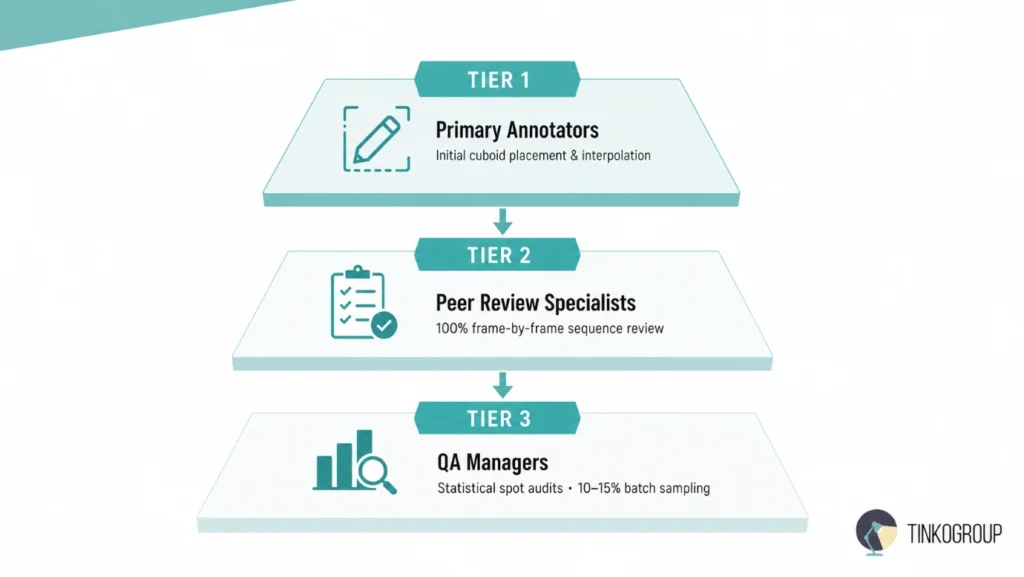
Managing teams across enterprise-scale video datasets requires balancing volume throughput with rigorous quality control pipelines. Operational managers must divide production teams into highly structured, separate levels:
Tier 1 — Primary annotators. Responsible for initial cuboid placement and path interpolation across raw video feeds.
Tier 2 — Peer review specialists. They do a manual check of 100% completed sequences frame by frame. They do trajectory validation to fix tracking drift and identity switches.
Tier 3 — QA managers. They run statistical spot audits on 10–15% of every delivered batch, using automated validation scripts to flag mathematical inconsistencies such as a cuboid suddenly changing volume between adjacent frames. This tiered video tracking QA catches drift before it reaches the client deliverable.
This multi-layered review structure allows organizations to confidently scale their annotation operations without sacrificing data accuracy while achieving high throughput.
Impact of Annotation Quality on Surveillance AI Performance
The quality of cuboid tracking video annotation directly determines the reliability of surveillance AI systems in production. In the high-security vertical, the consequences of training predictive models on low-fidelity or structurally fragmented data manifest immediately as operational failures in localized deployment environments.
When three-dimensional coordinates and entity lifetimes are not accurate, production networks further down the line can’t generalize correctly. This scenario causes security metrics to break and critical blind spots to appear.
Inaccurate tracking across long sequences introduces explicit technical vulnerabilities across all standard security processing layers:
- Compromised threat detection. If tracking parameters suffer from geometric inaccuracies, the model cannot calculate the acceleration or closing vectors of an asset approaching a restricted perimeter fence, resulting in missed breaches.
- Degraded crowd analytics. Fragmented entity trajectories break people-counting logic, leading to duplicate tracking profiles that distort actual density metrics in high-volume transit environments.
- Flawed behavior analysis. Identifying complex threat patterns such as loitering or predictive casing, an algorithm requires highly consistent tracking. Inaccurate bounding data injects random spatial noise into the model, making it impossible to map long-term behavioral vectors reliably.
- Erroneous anomaly detection. When a system cannot differentiate between baseline environmental movement (such as wind-blown foliage or ground reflections) and an actual physical threat due to imprecise tracking limits, the downstream network generates high rates of false positives.
- Compromised security monitoring. High false alarm rates trigger immediate operator fatigue, forcing monitoring personnel to either ignore system notifications or reduce automated alarm sensitivities, creating major gaps in enterprise defense networks.
In comparison, high-precision AI video analytics datasets fundamentally transform the reliability of computer vision video annotation software. When deep learning networks train on dimensionally accurate, human-verified spatial parameters, their underlying statistical reliability stabilizes across diverse lighting and environmental conditions.
This high data quality builds deeper contextual understanding, allowing the model to evaluate how separate entities interact inside a three-dimensional space over extended timelines. Consequently, the predictive accuracy of event detection systems scales, turning pass-through security video analytics networks into proactive defensive systems that accurately flag emerging risks before they manifest in localized facilities.

Reliable Data Services Delivered By Experts
We help you scale faster by doing the data work right - the first time

Scalable and Secure Video Annotation for Enterprise Surveillance Projects
High-throughput data labeling in the surveillance space has to balance massive data volume against rigorous security infrastructure. Because raw CCTV feeds often capture personally identifiable information (PII), vehicle license identifiers, and confidential infrastructure layouts, teams must build data handling protocols into the workflow from day one. Enterprise infrastructure development demands that security compliance operate as a core component of the overarching data lifecycle.
To safely manage large datasets, you need to keep a small operational footprint that meets a number of security standards:
- Strict GDPR and CCPA compliance. Before files go into production, annotation workflows must include automated data anonymization protocols that remove or blur unapproved faces and vehicle registrations. This makes sure that data collection strictly follows international privacy standards.
- Secure CCTV footage handling. Data storage architectures must use encrypted regional cloud instances or air-gapped secure servers, preventing physical file manipulation or local asset saving on unverified devices.
- Enterprise security workflows. Every step of data editing, reviewing, and export must take place on centralized virtual desktops that are protected by Role-Based Access Control (RBAC) and have immutable, end-to-end access logs.
- Scalable annotation operations. Building large datasets requires specialized task allocation systems that distribute workloads across hundreds of verified, long-term specialists while maintaining tracking continuity and timeline keys.
Faced with these stringent requirements, leading machine learning operations managers choose to leverage specialized video annotation services for enterprises rather than maintaining internal labeling departments. An in-house workforce of hundreds of data verification specialists brings massive financial overhead, complex HR management, and operational bottlenecks that slow engineering progress.
Outsourcing data annotation to specialized external partners allows computer vision developers to concentrate on enhancing model architecture and optimizing deployment. This partnership also provides you with access to a safe, ISO-compliant labeling workforce that can grow as needed for production.
Tinkogroup’s Approach to Surveillance Video Annotation
Tinkogroup’s business offer is based on one strict requirement: tracking data that is clean, checked, and delivered on time. Tinkogroup has created a unique, production-ready framework for video annotation for surveillance AI. This is because applications that use security and computer vision datasets cannot tolerate tracking drift or fragmented tracking histories. Tinkogroup trains its specialists to work on enterprise-scale cuboid tracking video annotation projects that involve complex occlusions, dense traffic scenes, and long-duration video sequences.
The company combines high engineering standards with industrial scale to provide dependable, structured data infrastructure to top machine learning teams.
Tinkogroup’s operational methodology stands on several distinct principles optimized for enterprise deployment:
Dedicated project teams. Tinkogroup does not use open crowdsourcing. Every enterprise client receives a permanent, long-term squad of domain-specific annotation specialists. This approach guarantees that complex, custom labeling guidelines stay consistent, resulting in highly consistent data tracking across extensive, long-term data collection campaigns.
Rigorous QA-driven workflows. Quality control runs through every layer of data processing. Tinkogroup enforces a strict multi-tiered vetting framework where peer reviewers inspect every single processed frame to verify bounding fit, tracking stability, and trajectory continuity before the team prepares any dataset for export.
Deep surveillance expertise. Annotation staff train specifically to handle real-world video noise, heavy occlusion vectors, changing lighting conditions, and severe perspective distortions caused by wide-angle security optics.
Sovereign, high-security infrastructure. Tinkogroup operates within highly secure, ISO-compliant data labs designed to match the stringent compliance requirements of US surveillance AI companies and European smart city projects. All operations leverage protected cloud computing and role-based access restrictions, ensuring zero local asset retention.
Advanced HITL methodology. Tinkogroup’s human-in-the-loop framework accelerates total data throughput by tightly integrating manual review pipelines with custom automation tools and maintains over 99.5% accuracy across complex multi-object tracking annotation sequences.
Enterprise scalability & operational flexibility. Whether an engineering team needs to process thousands of hours of high-definition traffic footage for enterprise security platforms or make rapid adjustments to annotation parameters during training. Tinkogroup scales its workforce up or down dynamically, absorbing massive data spikes without compromising final delivery schedules.
Tinkogroup acts as a natural extension of your internal machine learning operations team. This partnership alleviates the administrative challenges associated with raw data preparation. As a result, Tinkogroup provides you with verified, deployment-ready tracking data. This high-quality data directly contributes to reducing model error rates in real-world security environments.
Conclusion
Enterprise-grade surveillance AI training data systems cannot achieve reliable field performance when built upon fragile, unverified training data. As the security sector transitions away from primitive point detection toward advanced, predictive spatial-temporal analytics, the need for clean, high-dimensional dataset labeling pipelines grows critical. Scalable workflows for cuboid tracking video annotation are what make that transition operationally viable.
Success in deploying high-stakes computer vision software relies on achieving perfect object persistence, exact volumetric tracking, and unbreakable timeline consistency under real-world operational stress.
Combining scalable automation with rigorous human-in-the-loop validation enables reliable surveillance AI training. Clear annotation guidelines and experienced data annotation partners help reduce tracking drift, improve model accuracy, and support large-scale deployment.
Optimize Your Production Data Pipeline
Avoid delays in your product launch and ensure your platform’s field accuracy metrics by addressing data preparation bottlenecks, tracking drift, and internal quality control constraints. Partner with a dedicated team that understands enterprise security compliance, data privacy regulations, and complex spatial-temporal annotation frameworks for enterprise security platforms.
If you are ready to enhance your tracking performance and secure clean training sets, explore our specialized, high-fidelity pipelines directly through our data annotation service page. Contact our technical solutions team today to schedule an introductory expert consultation, discuss your exact surveillance dataset configuration requirements, or initiate a dedicated pilot annotation project designed around your operational specifications.
What is cuboid tracking video annotation?
Cuboid tracking video annotation is the process of labeling moving objects in video footage with 3D bounding boxes that follow the object across consecutive frames. Unlike traditional 2D annotation, cuboid tracking captures an object’s position, orientation, depth, and movement over time, making it essential for surveillance AI, autonomous systems, and advanced video analytics.
Why is object persistence important in cuboid tracking video annotation?
Object persistence ensures that the same object retains its unique identifier throughout a video sequence, even during temporary occlusions caused by obstacles, crowds, or environmental conditions. Maintaining tracking continuity helps AI models accurately analyze behavior, predict movement patterns, and reduce identity-switching errors in surveillance applications.
How does quality assurance improve cuboid tracking video annotation accuracy?
Quality assurance improves cuboid tracking video annotation by identifying tracking drift, incorrect object IDs, inconsistent cuboid dimensions, and interpolation errors. A structured review process with annotators, peer reviewers, and QA specialists keeps training datasets high quality, which leads to more reliable object detection, tracking, and behavioral analysis models.