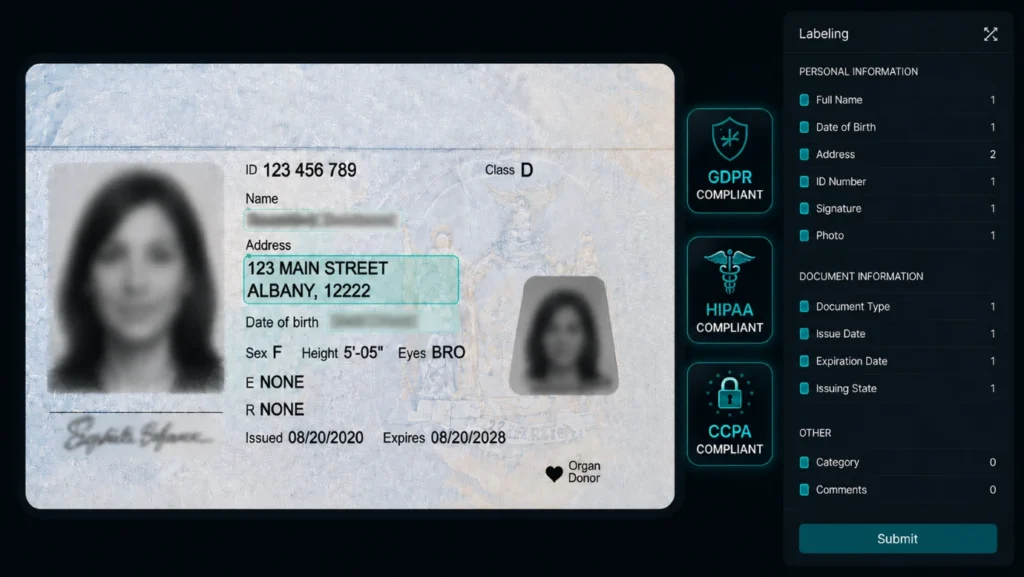


Picture a healthcare AI company outsourcing annotation of a sensitive clinical dataset. Annotators can’t download files, copy text, or freely trade edge cases with reviewers. The project is secure by design. But every one of those restrictions changes how onboarding, collaboration, QA, escalation, and throughput actually work.
Large-scale teams increasingly rely on secure annotation workflows to train AI models on regulated and confidential data. Enterprise AI is no longer something experimental. Modern models make high-stakes decisions in healthcare diagnostics, fraud detection in banking, contract analysis in legal tech, and document processing in many industries.
High-quality annotated data is the fuel for these systems. However, here lies the main contradiction. Datasets grow in volume and sensitivity, and the need for rich, representative training data clashes with strict requirements to protect it. This is why secure annotation workflows have become an operational requirement for enterprise AI teams handling sensitive data.
Regulated, sensitive data demands tight controls, and traditional annotation tools cannot always provide them. Today’s AI teams work with PHI, PII, financial records, and proprietary secrets. This means annotators can’t freely browse, download, or discuss raw files in open platforms. Every interaction must be controlled, monitored, and auditable. This is what privacy-sensitive data annotation looks like in practice.
So what’s driving this? GDPR and HIPAA set the baseline. GDPR requires companies to protect EU citizens’ data – you can collect only what you need, use it for its purpose, and delete it when asked. And this applies to annotation, not only the final model. HIPAA adds similar guardrails for US patient records, demanding strict access logs and restricted viewing. This matters just as much for European enterprise data operations as it does for US healthcare AI companies.
There are also business reasons for secure dataset management. Customers expect privacy, regulators hand out heavy fines, and even one breach can lead to lawsuits and serious reputation damage. So companies introduce their own internal policies, which tightly control who has access to AI data and how they label, share, and store it.
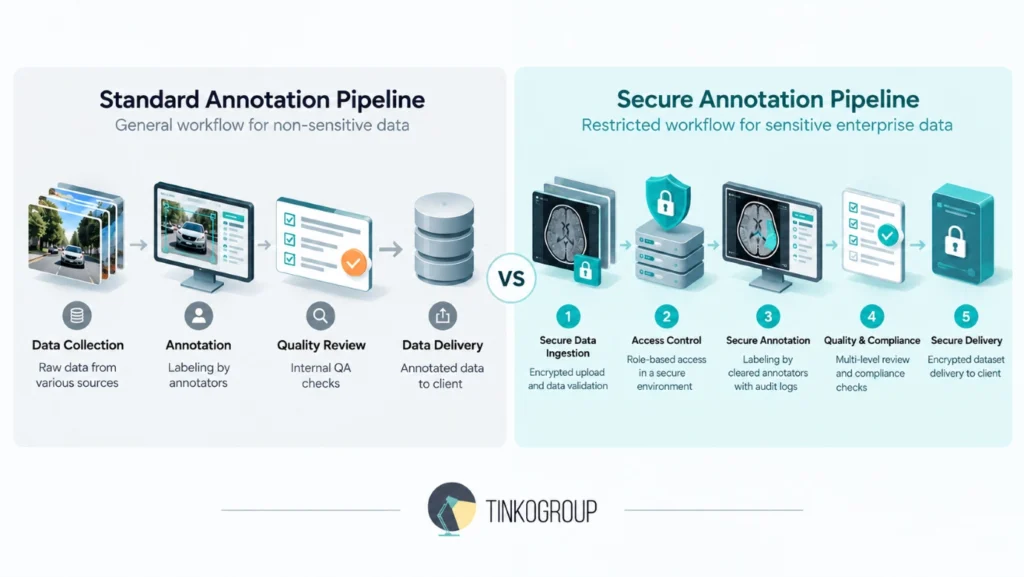
Traditional annotation pipelines assume open access. Large pools of annotators view full datasets, share edge cases easily, and iterate rapidly via cloud tools. Secure annotation workflows are completely different. Companies keep sensitive data in secure environments, such as virtual desktops or isolated systems. They give access only to authorized users, encrypt the data, and record every action to meet security and compliance requirements.
Many believe it’s enough to add stronger cybersecurity tools to existing processes to build secure annotation workflows. It’s not enough. You need a fundamental operational redesign, which covers everything from task design and team structure to quality assurance and governance. This redesign impacts throughput, quality, scalability, and cost, but it is a must for responsible enterprise AI deployment.
What Changes When Annotation Teams Cannot Access Raw Data Freely
In restricted data environments, the familiar rhythms of data annotation change dramatically. These restricted data environments follow a different logic from open annotation pipelines. Traditional pipelines rely on open access. Annotators browse full datasets, pull samples for reference, and discuss nuances in real time. When enterprise AI teams handle regulated or confidential information, this freedom disappears. The workflow becomes slower but much more controlled and easier to audit. These characteristics define how secure annotation workflows operate in practice: access is limited, visibility is controlled, and every interaction can be tracked.
The first major change is limited dataset visibility. Annotators rarely see complete raw records. They see only the specific field or snippet required for their task. Operationally, this means crucial context is hidden. A medical coder, for example, may only see a diagnosis code without the accompanying doctor’s notes. This partial view forces workers to rely on task-specific instructions and enriched metadata. Data access governance makes a sharper focus on the provided elements and reduces the risk of unnecessary exposure.
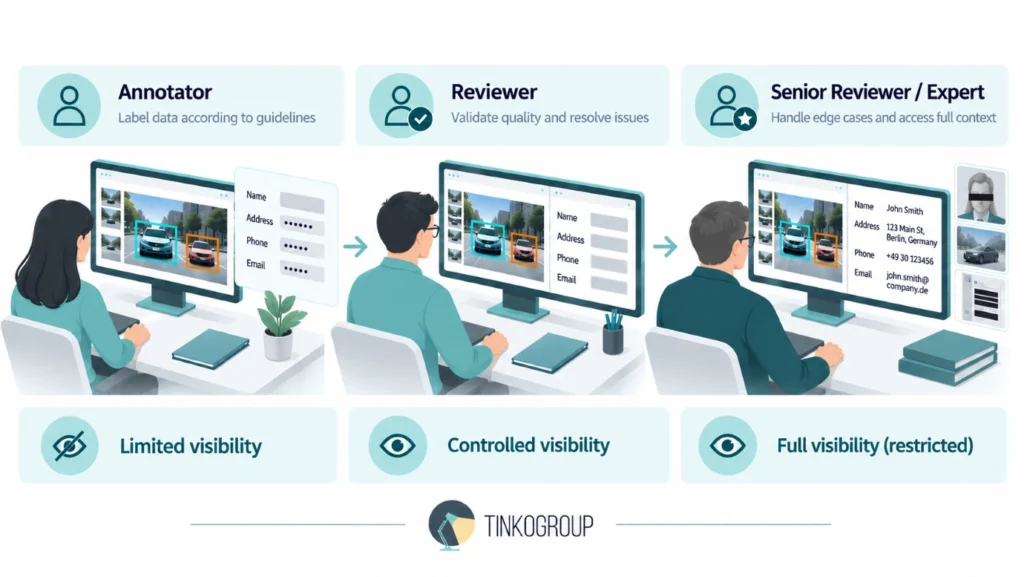
Restricted annotator access influences all further operations. Not every team member receives a key to everything. Junior annotators may view redacted text, and senior personnel access a full version.
Role-based annotation access shapes everything reviewers can and cannot do. A reviewer may check whether a label is correct without seeing the full original file. Instead, they work with only the information they need, such as the annotation, model confidence scores, or a summary of previous reviews. Such segmentation maintains compliance but introduces additional layers of verification.
Onboarding becomes a bottleneck. In restricted environments, you cannot expose raw training data to trainees. So you must build entirely separate, sanitized training sets – artificial datasets that mimic real data without containing actual PII, PHI, or trade secrets. Creating these proxy datasets takes weeks of engineering and compliance review. As a result, secure annotation workflows require onboarding processes that protect the underlying data before workers ever receive access to production tasks.
Daily collaboration also transforms. The ad hoc teamwork disappears. Annotators can’t screenshot a puzzling example, save it locally, or even paste a snippet into a chat.
Say an annotator hits an ambiguous clause in a legal contract but can’t screenshot it or paste it into a chat channel. The workflow needs a secure escalation path that lets a reviewer see the clause without the data ever leaving the controlled environment. Every issue instead gets logged through a ticketing system, which turns a five-minute conversation within a team into a multi-day asynchronous process.
QA friction in secure environments intensifies these challenges. In a traditional workflow, reviewers can see the full data, explain mistakes, and quickly share examples with the rest of the team. In secure environments, that process is much slower. Reviewers often work in separate systems and cannot simply send a problematic example to annotators.
Practical constraints affect almost every step of the sensitive data annotation process. The table below summarizes the main ones and what they mean day to day:
| Constraint | Operational impact |
| Virtual desktops and secure platforms | Annotators work inside a controlled system instead of their computer. They cannot save files locally or use outside tools. |
| No copying or exporting data | Annotators cannot copy sensitive content or download files. Everything stays inside the platform. |
| Separate QA systems | Reviewers often work in a different system from annotators, which makes feedback slower and harder to coordinate. |
| Limited sharing of difficult cases | When annotators find tricky examples, they cannot just send them to teammates. They must report them through forms or tickets. |
| Automatic activity tracking | The system records everything users do, what they open, change, or review. |
These elements make annotation operations significantly more complex. A simple bounding box task in an open pipeline takes minutes. In a restricted setting, it requires session login, permission checks, work within a VDI, logging of actions, and structured handoff for QA. Edge cases need even more time.
The cognitive load increases as workers navigate both the labeling guidelines and the security constraints simultaneously. However, these changes make the process more protected. Annotation transforms from a free-flowing creative process into a disciplined, auditable operation. The workflow becomes slower in places but far more robust – training data meets both quality standards and stringent AI data governance requirements.
Security vs. Scalability in Enterprise AI Annotation Operations
Scaling a standard annotation pipeline is pretty straightforward. You hire more people, buy more software licenses, split up the data, and throughput goes up.
Scaling secure annotation workflows is a completely different subject. Every new location, project, or team member multiplies compliance risk. Secure data annotation doesn’t just slow things down. It completely disrupts the usual scaling playbook.
Regional data laws are one of the biggest constraints on secure annotation operations. You can’t just send data to the cheapest or most available labor pool anymore. GDPR means EU patient data stays in the EU, and US financial data can’t touch foreign servers. So, one global team of 1,000 annotators splits into several smaller regional teams. Each one has its own rules, time zones, holidays, and management overhead. You lose the ability to shift work across regions, and sudden spikes in workload become difficult to manage.
Imagine a project scaling from 20 to 100 annotators. Only a fraction of those 100 can touch the sensitive records, every new account needs formal approval, and QA specialists carry broader permissions than frontline annotators. So, headcount alone doesn’t solve the bottleneck.
Segmented teams become rigid and hard to move. In open environments, any trained annotator can join a different project when needed. In secure environments, that’s impossible. Background checks, project-specific clearances, and compliance certifications lock people into narrow roles. Someone trained on healthcare data cannot simply switch to legal documents. This destroys agility. If one team has issues, you can’t ask for help from another, because those workers lack the right permissions.
Reviewer hierarchies turn into a tangled mess. Standard setups have a flat structure where senior reviewers can look at anything. Secure operations require deep, layered approval chains. A reviewer may have access to one type of data but not another, or to one region but not the next. When you scale to hundreds of reviewers across many projects, data access becomes a major challenge. Resolving permission issues eats up hours of project manager time every week.
Remote work gets much harder to set up. Standard annotation needs only a browser and an internet connection. Secure remote work often requires locked-down virtual desktops, VPNs, and sometimes even company hardware. Scaling this across thousands of distributed workers is a serious infrastructure project. You need enough server capacity, reliable bandwidth, and round-the-clock tech support. Each time a new group of people joins, teams must set up secure access for them and configure everything correctly.
You need more specialized staff. In standard pipelines, you mainly need annotators and reviewers. In secure settings, you also need data protection officers, compliance leads, and privacy engineers for every project. These roles are expensive and hard to fill. One compliance officer may oversee 50 annotators or 200 – their workload depends on the number of projects and data types, not only headcount. This limits how fast you can scale, no matter how many annotators you hire.
Governance makes project management slow and heavy. Every new project requires formal privacy assessments, legal reviews, and security sign-offs before labeling can begin. In standard pipelines, you kick off a project in days. In secure environments, weeks are required. When you scale from 10 projects to 100, it doesn’t mean ten times the work. It means ten times the governance traffic, and that soon becomes the main bottleneck, not the annotation itself.
Permission systems need to be much smarter. Simple role-based access works for small teams but fails at enterprise scale. You need dynamic rules that consider a person’s role, location, project phase, data sensitivity, and even time-based expiry in real time. It demands real engineering resources that standard pipelines never need.
QA escalations get stuck at the top. In open systems, any reviewer can flag an issue to a lead and get a quick answer. In secure environments, escalations must follow strict, auditable paths. Only a small group of senior staff have the clearance to view flagged data. They often become overloaded as volume grows, and QA cycles may get stuck.
When you scale standard annotation, you don’t hire more people. Enterprise AI data security means you add more complexity, infrastructure, and approval layers at every step.
How Human Annotation Quality Assurance Works in Secure Workflows
Human-in-the-loop (HITL) quality assurance is vital in secure annotation workflows, but it must adapt to restricted data access. HITL must use clear rules and controls to protect data and still maintain high label quality and AI data compliance. And you need to completely redesign the QA process.
Let’s take a healthcare AI project where teams annotate chest X-rays to help detect early signs of pulmonary nodules. Each image contains sensitive patient data such as names, IDs, and birth dates, all stored in DICOM files. This data falls under HIPAA regulations, so the platform tightly controls access.
Initial disagreement: Two experienced annotators review the same X-ray independently. One marks a small shadow in the upper left lung as a possible nodule. The other believes it is just a harmless imaging artifact. The system flags this disagreement for review.
Controlled adjudication: A senior reviewer now should resolve the case. But they don’t have the full patient record either, they only see the relevant cropped image and the two labels. They don’t know which annotator made which decision, and they don’t see any patient identifiers. This blind setup excludes bias and also guarantees that no one can reconstruct sensitive medical information from multiple cases. After reviewing the image, the lead concludes that the shadow is likely a true nodule and labels it for further clinical attention.
Escalation to an expert: The case still feels uncertain in terms of classification details, so a board-certified radiologist steps in. The system removes all identifying information and provides secure, time-limited access to only the relevant image section. The radiologist reviews the case, confirms the nodule, and adds additional classification details. Once the session ends, access is automatically closed.
Audit trail: Every step in this process is logged – initial disagreement, review decisions, escalation, and final outcome. These logs create a full record of how the decision was made, which is essential for compliance and future audits. This structured process makes annotation quality assurance possible, even when reviewers can’t see full patient records.
Calibration and consistency: To ensure reviewers are aligned, teams regularly insert synthetic X-rays into the workflow. These images look realistic but contain no patient data and have known answers. Reviewer performance is measured against them to ensure consistency across the team.
Updating guidelines: Sometimes a case reveals a new edge pattern that isn’t available in the guidelines. When that happens, project leads update the instructions and add them directly into the annotation tool. Reviewers see updated guidance in context when they are working on similar cases.
This structured workflow allows teams to process large volumes of sensitive medical images and stay fully compliant with healthcare regulations. Human judgment remains central, but it now operates within a controlled system that protects patient data at every step.
Secure human-in-the-loop data annotation is slower and more structured, requiring many records and documents. It replaces fast, informal communication with controlled, trackable processes. But it brings consistency and quality that are so critical for training AI models. It’s unavoidable for secure AI data operations.
Secure Annotation Workflows for Healthcare, FinTech, and Legal AI
Every organization wants to protect sensitive data, but secure AI annotation workflows are not the same across industries. Healthcare, finance, legal, and enterprise document processing all have different types of data, regulations, and risks. Sensitive data annotation differs across these industries.
Healthcare AI
Healthcare has the strictest controls. Here, annotators most often work with high-resolution medical images (DICOM files), complex electronic health records (EHRs), and clinical trial notes. Each workflow is designed to align with HIPAA or regional health data regulations. Plus, annotation vendors often need to sign Business Associate Agreements (BAAs).
Before annotation begins, companies remove or hide personal information such as patient names, birth dates, and hospital IDs. In medical notes, they replace these details with anonymous placeholders but leave the medical information needed for annotation.
Medical annotation requires deep domain expertise, so the workforce must consist of practicing physicians, radiologists, or senior medical students. These experts usually work from different locations, and companies should give them secure remote access. They use protected online workspaces where data stays inside the organization’s secure environment and disappears when the session ends.
Financial AI
Financial AI systems deal with KYC (Know Your Customer) documentation, credit applications, transaction logs, and proprietary market data. Financial secure annotation workflows are built to align with strict security standards and banking regulations that protect customer and financial data.
Before annotation, companies remove or hide sensitive information, such as bank account numbers, credit card numbers, Social Security numbers, and transaction details.
Instead of exposing real customer records, many organizations create realistic but artificial financial documents. Annotators work with these documents to validate layouts and extract information without ever seeing a real customer’s personal or financial data.
Legal AI
Legal AI providers deal with e-discovery, automated contract lifecycle management (CLM), regulatory tracking, and litigation prediction. They work with documents that are highly sensitive and subject to intense legal protections. The main concern here is the protection of Attorney-Client Privilege and corporate trade secrets.
Annotators only see the part of the document they need to label, for example, a specific contract clause. The rest of the document stays hidden, so they cannot see company names, confidential details, or other sensitive information that isn’t needed for the task.
Legal annotation requires lawyers, paralegals, or compliance specialists. They also sign non-disclosure agreements (NDAs) that carry direct civil liability and operate inside sandboxed VDI platforms.
Enterprise document processing
Administrative data includes invoices, logistics manifests, receipts, HR onboarding paperwork, and internal corporate wikis. The biggest challenge is protecting Personally Identifiable Information (PII) and confidential business information, which can appear anywhere in a document. Secure annotation workflows must follow security standards such as SOC 2 Type II, ISO/IEC 27001, and the company’s data retention policies.
Layout-aware masking automatically finds and hides sensitive information such as bank account numbers, addresses, phone numbers, and employee IDs. Companies often replace real names and numbers with realistic synthetic data and keep the original document layout. Annotators can still label tables, invoices, and other document elements and achieve high enterprise AI data security.
Key Operational Distinctions
| Aspect | Healthcare | FinTech | Legal | Enterprise |
| Primary sensitivity | PHI (patient identity + clinical data) | PII + transaction details | business terms + Proprietary client confidentiality | Varies by document type |
| Data structure | Mixed (text + images + signals) | Highly structured | Unstructured text | Highly varied |
| Key operational friction | Clinical context vs. privacy | Cross-border data flows | Document context vs. access | Volume and variety |
| Escalation path | Medical experts | Compliance officers + senior reviewers | Legal counsel + domain experts | Internal stakeholders |
| Audit emphasis | HIPAA compliance | SOX + financial regulations | Client confidentiality + privilege | Internal governance |
Common Security Failures in AI Data Annotation Operations
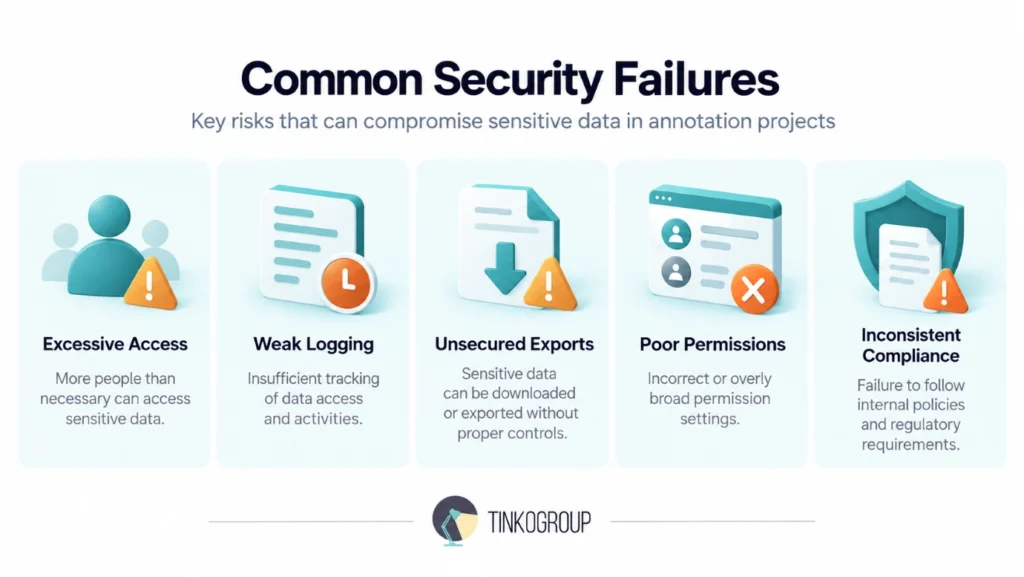
Many organizations know they need to protect sensitive data, but their annotation workflows are still weak. They give more access than needed, struggle to maintain decent quality, or run into compliance issues. These problems affect day-to-day work and can have serious business consequences. The goal of secure annotation workflows is not simply to prevent unauthorized access but to make security part of everyday annotation operations.
Excessive Annotator Access
Annotators often get direct access to the storage of raw datasets. They open up the whole repository instead of serving one task at a time through temporary, time-limited links. If an annotator’s credentials are compromised or if someone turns malicious, they can copy entire datasets in minutes. A single person with access to a cloud storage folder can exfiltrate millions of records before anyone notices. With no source-level control, no one can prove otherwise until an audit forces the question.
You should serve each task individually, with access expiring as soon as the task is complete. No one should ever see more than the single item they need to annotate at that exact moment.
Weak Audit Logging
Many annotation systems log activity at the group level. For example, Team Alpha completed 1,000 tasks today. That sounds useful until something goes wrong.
When a data leak happens, security teams need to know exactly who viewed what and when. Without granular logging, investigations fail. Organizations cannot determine the scope of the breach or satisfy regulatory reporting requirements. They know something was exposed but cannot say precisely what or by whom.
Without detailed logs, teams cannot identify patterns of misuse, track down quality issues to specific reviewers, or successfully pass audits.
Unsecured QA Exports
Data scientists and project managers often export batches of annotation results to analyze outside the secure environment. They download CSVs, run local analyses in apps, or share findings over unencrypted communication platforms.
Most of the time, this isn’t malicious. A QA reviewer exports a small sample for offline analysis simply because the secure environment makes review too slow, and that shortcut quietly creates an uncontrolled copy of sensitive data. This practice completely bypasses the security architecture that protects the original dataset. A single lost laptop, compromised local drive, or intercepted email attachment exposes sensitive customer data or proprietary intellectual property. The export is the most vulnerable point.
Secure analysis tools must be part of the annotation platform itself. Annotators should never move data outside the protected perimeter.
Poor Reviewer Permission Management
As projects scale, permission hygiene often deteriorates. Multiple team members share reviewer accounts. Contractor permissions remain active long after the person has left. New hires receive overly broad access because managers are too busy to define granular roles.
This creates permission creep. Individuals accumulate deep access to historical datasets that have nothing to do with their current work, and the attack surface silently grows.
Insider threats become much easier to execute. Compliance reviews flag unresolved permissions, delaying audits. And when something goes wrong, security teams cannot determine who had access at the critical moment because the access records are a mess.
Inconsistent Compliance Workflows
Different projects may have different compliance standards. Healthcare projects require HIPAA-specific controls. Financial projects demand different audit protocols. Without standardized workflows, security varies from one project to the next. So, some projects may receive rigorous treatment, and others get surface attention. This inconsistency undermines AI data governance. Organizations cannot demonstrate uniform data protection across all their annotation activities.
The hidden business costs of these mistakes are higher than you may imagine. Yes, regulatory penalties from GDPR, HIPAA, or similar rules can be severe. But other costs hurt even more.
Projects often face long delays when security teams discover problems late. You may lose months of development work on fixing compliance issues. In serious cases, you will have to throw away entire annotated datasets and start over. It’s a huge waste of time and money. One single breach can create lasting damage. Future AI projects face extra-long security reviews and slow down innovation for years.
These hidden costs reduce speed, raise expenses, hurt competitiveness, and ultimately weaken the quality and integrity of secure AI training data. Good AI data governance helps avoid these issues. Building secure annotation workflows therefore requires both technical controls and operational processes that remain consistent as projects grow.
Tinkogroup’s Approach to Secure Enterprise Annotation Workflows
Secure data annotation is not a feature you bolt onto a legacy pipeline. We design secure AI annotation workflows around your compliance requirements, not the other way around.
Technical and Operational Framework at Tinkogroup
Deployment inside your secure environment
Our secure annotation workflows can be adapted to your existing infrastructure and security requirements, whether you operate in a private cloud, an on-premises data center, or another secure environment. This approach helps keep your data under your control while supporting efficient, secure data annotation.
Secure workspaces for annotators
Our remote annotators work through secure, access-controlled environments designed to protect sensitive data. Access to project data is limited according to established security requirements, helping prevent unauthorized downloading, copying, or storage of sensitive information on local devices.
Role-based access control
Every team member only sees the data they need to complete their task. Sensitive information is hidden, and different access levels ensure that annotators, reviewers, and project managers only have permission to view what they need.
Complete audit trail
Key project activities and updates can be tracked to help maintain a clear record of changes. Collaborative tools provide visibility into who made updates and when, supporting traceability, transparency, and accountability throughout the annotation process. This creates a clear audit trail: when regulators ask questions, you already have all the answers recorded.
Support for regional compliance
Every project starts with a formal assessment of data sensitivity and regulatory requirements. For projects with strict data residency needs, we set up restricted-access annotation from day one, so sensitive records never leave an approved environment. If the data falls under GDPR, we design the workflow around GDPR-conscious data handling, restricted access, purpose-limited processing, and full audit visibility.
Our secure annotation workflows are ready for audits from the first minute. You have every action logged with timestamps, user identifiers, and data access context. Plus, you can adapt a workflow to your needs for the most sensitive use cases and distributed or cloud-based environments.
Conclusion
Enterprise AI is moving into highly regulated spaces, and old ways of data annotation don’t work anymore. For any organization that takes compliance seriously, open pipelines and free access are no longer an option. You need to protect sensitive data, but you also need to get work done efficiently. You need reviewers to do their jobs, but you can’t let them work without limits. You need quality labels, but you can’t always give annotators the full context. These tensions don’t go away. You have to design around them.
The future of enterprise AI will not be won by those with the largest models but by those who can train their systems on the highest-quality, most secure AI training data. Organizations that get this right don’t treat security as a burden. They incorporate it into the annotation process from the start. Yes, it’s slower. Yes, it costs more. But the alternative, such as a breach, a fine, a destroyed dataset, or years of regulatory scrutiny, is simply unthinkable.
Thinking about secure and privacy-focused annotation for your projects? Whether you’re building your first secure annotation pipeline or improving one that already runs at scale, let’s talk.
- Discuss your secure annotation requirements.
- Evaluate your governance approach.
- Improve sensitive dataset workflows.
- Request a pilot.
At Tinkogroup, this is what we do. We don’t sell cybersecurity products. We build secure annotation workflows that work for real teams with real data and real deadlines.
What makes secure annotation workflows different from standard annotation workflows?
Secure annotation workflows restrict how sensitive data is accessed, viewed, processed, and transferred. Instead of giving annotators broad access to raw datasets, organizations use controlled environments, role-based permissions, limited visibility, activity logging, and secure escalation paths. This protects sensitive data while allowing annotation and quality assurance to continue inside a controlled environment.
How can teams maintain annotation quality when reviewers cannot access the full dataset?
Quality assurance can be redesigned around controlled visibility. Reviewers can receive only the information needed to evaluate a label, while senior reviewers or domain experts receive restricted access to specific edge cases. Secure annotation workflows can also use synthetic data for calibration, structured escalation, and audit trails to maintain consistency without exposing complete records.
How do secure annotation workflows scale without giving more users unrestricted data access?
Scaling requires more than adding annotators. Teams need role-based access, secure workspaces, regional controls, project-specific permissions, formal approvals, and auditable escalation paths. Access should expand according to each person’s role and project requirements rather than giving every new team member broad access to the underlying dataset.