
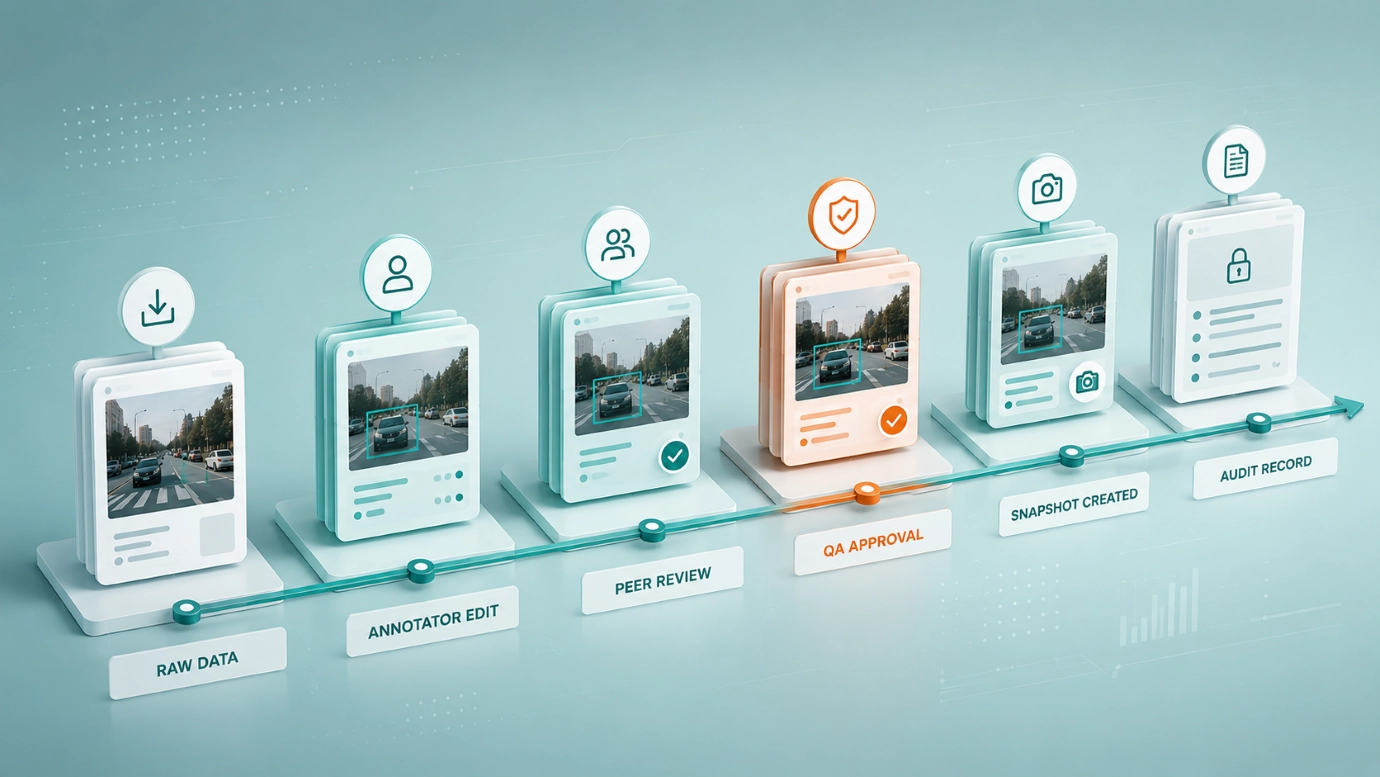

Teams quickly lose sight of their assets if they don’t have a reliable record of changes made in the past. Dataset lineage in data annotation is designed to close that gap. It’s possible for a model trained on Monday to behave very differently from one trained on Friday, even if the raw files look the same. The development cycle stops if the manager can’t explain why some decisions made by people changed between those days.
High-quality artificial intelligence does not rely on a single snapshot of information. Machine learning models depend on vast collections of data that constantly move, shift, and mature. Production-grade training data is never a static asset. That’s why dataset lineage in data annotation has become such an important idea for AI teams in large companies.
Teams continuously refine their inputs to make systems smarter, safer, and more precise. Still, this fluid environment introduces a massive operational challenge for modern enterprises. It’s very hard to keep track of all the changes made to millions of data points by thousands of human annotators over the course of several months.
The resulting blind spot slows engineering velocity, introduces compliance risks, and makes root-cause analysis almost impossible. Organizations update things like labels, guidelines, taxonomies, reviewer decisions, and QA outcomes over time on a regular basis. As all of these factors change together, the complexity grows exponentially. And a typical data repository is an untraceable maze where errors go undetected for long development cycles.
To solve this problem, enterprise AI teams rely on a foundational framework: dataset lineage in data annotation. Think of it as a living family tree for training assets. It gives you a clear picture of how data changes from raw files to highly specific, human-verified instruction sets. Rigorous tracking ensures your organization maintains absolute operational accountability, strict compliance standards, and predictable machine learning performance at every step of the lifecycle.
Without lineage, teams often do not have visibility into why a label changed or what dataset version was used to train a model. That missing link breaks the chain of custody and turns AI development into speculation rather than engineering discipline grounded in empirical data.
Why Annotation Data Changes Over Time
Training sets change constantly because human understanding and business requirements evolve. This continuous evolution is one of the primary reasons why dataset lineage in data annotation is essential for enterprise AI projects. In a mature machine learning lifecycle, a dataset is a living product. It requires regular maintenance, bug fixes, and updates to remain useful. Understanding why these changes happen helps teams build better systems to manage them.
The most common causes of label evolution include guideline updates, reviewer corrections, adjudication outcomes, taxonomy changes, edge-case discoveries, and model feedback.
AI projects usually begin with a basic set of rules for human annotators. As humans review real-world files, they discover edge cases that the original rules did not cover. For instance, an e-commerce categorization project might start with ten basic product classes. Within a month, the team realizes they need fifty subcategories to train a highly precise recommendation model.
When an organization expands a taxonomy, the team cannot simply apply the new rules to future files. The team will need to revisit and update the existing library. Doing so creates a massive wave of label change tracking across millions of data points. The old labels are no longer accurate under the new guidelines, so the historical values must change to reflect the updated business logic.
Quality assurance is another major driver of text and label modification. Initial annotators make their best judgments, but senior reviewers often catch mistakes or subtle misinterpretations.
In complex scenarios, teams use an adjudication workflow where multiple experts debate a difficult file. If an adjudicator overrides a previous decision, the system must overwrite the old value. If the engineering team does not record the original choice, the reasons behind the correction disappear entirely. Tracking this specific history is vital for analyzing annotator performance and refining training materials.
Continuous model feedback loops introduce new waves of edits. Production models regularly flag ambiguous real-world data where confidence scores are dangerously low. Engineers return these unclear files to human annotation teams for prompt re-labeling or verification. When corrected data flows back into the primary training repository, it overwrites old, imprecise entries.
Change is normal in mature annotation programs. Effective dataset lineage in data annotation ensures these changes remain fully traceable instead of becoming hidden sources of model errors. It represents progress, refinement, and the gradual alignment of training assets with real-world complexities.
What Dataset Lineage in Data Annotation Means in Annotation Operations
In traditional software engineering, data lineage shows how information moves from one database to another. In machine learning, annotation data lineage has a much deeper meaning. It focuses entirely on the human and algorithmic decisions that alter the meaning of your training data. It tracks the complete journey of an asset, ensuring that every state of a file is accounted for.
True annotation traceability requires answering four critical questions for every single data point in your repository:
- It identifies who changed a label, whether it was a human annotator, an automated model, or a QA manager.
- It logs exactly when the change occurred, providing an immutable timestamp for the action.
- It documents why the change happened, linking the edit to a specific guideline shift or error correction.
- It verifies which version contains the update, placing the file within a specific, unchangeable release.
Answering these questions turns a simple file directory into an auditable historical log. It gives operations leaders complete clarity regarding the state of their assets at any exact moment, building a foundation of total operational accountability. That is what differentiates lineage from simple dataset storage. Many teams confuse basic storage with proper tracking.
Storing your labels in a cloud bucket or a standard database is not enough. A standard database only shows the current value of a cell. It completely erases what was there yesterday.
Comprehensive tracking requires a system that treats every change as a new historical event. Instead of overwriting an entry, the platform appends a new record while preserving the previous state. Engineers can then reconstruct the exact dataset used to train a model six months ago, with complete reproducibility across all training operations. Without dataset lineage in data annotation, reproducing historical training environments becomes significantly more difficult.
This is where dataset lineage in data annotation becomes essential for maintaining reproducibility and accountability across training pipelines.
The Risks of Poor Traceability
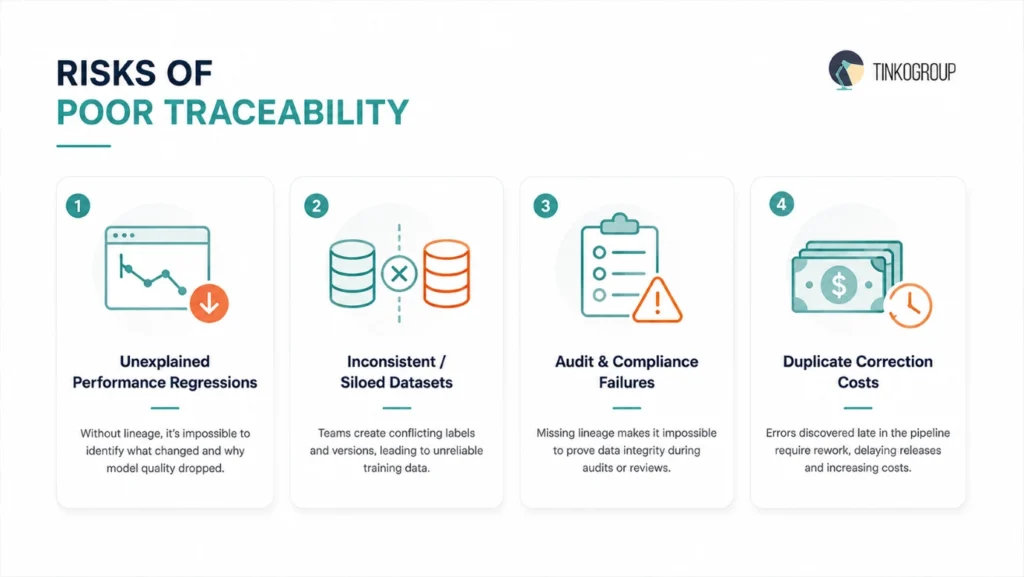
Neglecting to track how your training records change introduces severe operational risks. When an organization treats its training data as a single, static pool, subtle errors compound over time. That lack of visibility slows down production schedules and compromises model reliability, leading to systemic failures across enterprise AI applications.
Without profound visibility into data modifications, minor errors at the annotation level can balloon into macro-level bugs that disrupt production-ready deployments. Treating active data repositories like frozen static files blinds teams to the constant drift of human logic, which fundamentally alters how a model interprets the world.
Unexplained Performance Changes and Model Regressions
One of the most immediate consequences is the appearance of unexplained performance changes and model regressions. Imagine an engineering team trains a new iteration of an object-detection model. Suddenly, the model’s accuracy drops by several percentage points on a specific class of items. Without training data traceability, troubleshooting this issue turns into a massive, frustrating trial-and-error hunt.
The engineers can’t easily tell if the regression happened because of a tweak to the model code or if a QA team relabeled thousands of images last week.
When you lack historical visibility, finding the root cause of a performance drop takes days of manual file inspection instead of minutes of automated log review. Engineering talent ends up trapped in a cycle of speculative debugging, rewriting clean model code to resolve phantom bugs that actually stem from dirty data. Comprehensive dataset lineage in data annotation significantly speeds up root-cause analysis by connecting model behavior to annotation history.
Inconsistent Datasets and Duplicate Corrections
Poor tracking creates inconsistent training datasets and duplicate corrections. An annotation team might spend weeks fixing errors that a separate team already corrected in a different environment, simply because no one broadcast the first fix. Teams then lose time arguing over which file is the true master copy, and when the engineers who hold that context leave, it disappears with them.
A recurring example: an automated system mislabels thousands of “winter coats” as “spring jackets” in a large e-commerce catalog. Engineers resolve it quietly in their own test sandbox. An entirely different ops team, working from user complaints and without a common change log, spends a week re-fixing the same files. The enterprise pays twice for one fix.
Audit Failures and Regulatory Vulnerabilities
A missing annotation audit trail also leaves the firm open to legal challenges, because the firm cannot prove who verified the safety, fairness, and compliance of the data driving their automated choices. With the rise of international standards for AI risk management, companies in regulated AI industries need to demonstrate a complete chain of custody for their training inputs.
If a regulatory body finds algorithmic bias or an inexplicable prediction error, the organization is defenseless because there is no audit trail. Without a history trail, a business can’t isolate whether a flaw is caused by a bad annotator, an uncalibrated labeling script, or a compromised external contractor. That exposure raises the risk of class-action lawsuits, major financial penalties, and long-lasting damage to corporate reputation.
Key Components of Annotation Lineage and Label Version Control
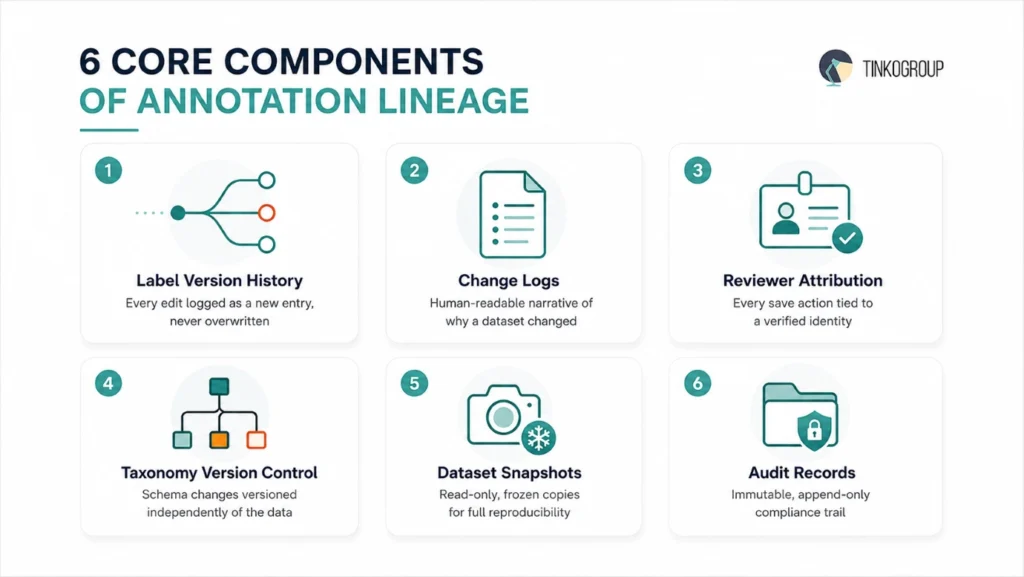
To build a highly reliable, auditable, and enterprise-grade machine learning environment, you need a specific set of interconnected operational components.
These tools must work together seamlessly to capture every modification without slowing down the daily velocity of your annotation workflows. When teams implement these components correctly, they establish a robust protective barrier around your training assets. That barrier is what lets any external auditor, internal compliance officer, or machine learning engineer trace the exact lifecycle of any data point.
A failure in even a single component breaks the entire chain of custody, rendering your data assets untrustworthy. To prevent this architectural decay, mature data operations programs build their workflows around six core technical components.
Label Version History
Every individual data point within an enterprise repository must possess its own independent, granular history. If an annotator adjusts a bounding box coordinate by a single pixel, alters a semantic classification tag, or modifies an audio transcription timestamp, the underlying system must not overwrite the existing data. Instead, it must log both the previous state and the newly proposed state as distinct historical entries.
Micro-level tracking like this operates similarly to code-level versioning in software development. If engineers later discover that an automation script or an uncalibrated group of annotators has corrupted a batch of annotations, the operations team does not have to throw out the whole data set. Engineers can do a targeted rollback by examining the file history and rolling back only the corrupted layers of that particular subset of files. The rest of the valid work remains untouched.
Change Logs
Individual file history shows what changed at a microscopic level, and global change logs explain the systemic, macro reasons for those changes. A change log serves as the human-readable narrative of a dataset’s evolution over time. It answers the broader organizational questions that raw database time stamps cannot tell.
A typical change log entry for an enterprise contains structured metadata, including:
- The specific business justification for the modification batch.
- The total volume of files impacted by the update.
- The version number of the annotation guidelines used to govern the new edits.
- The internal ticket or governance authorization ID that approved the change.
For example, a change log entry might read: “Updated 14,000 text strings to comply with the revised Q3 corporate content moderation policy on borderline offensive speech.” It immediately ties hundreds of millions of small, file-level pixel or text changes to a specific, high-level corporate governance decision.
Reviewer Attribution
A key part of data security and operational quality control is knowing the exact name, role, and level of permissions of the person or system making the change. Reviewer attribution attaches a permanent, verifiable cryptographic signature or user ID to every single save action executed inside the annotation platform. That granular attribution lets operations leaders execute several critical management tasks:
- Performance Analysis. Teams can isolate specific annotators or automated models that exhibit high error rates, enabling targeted retraining or software patches.
- Security Auditing. System administrators can verify that only authorized personnel are modifying sensitive training classes, preventing insider tampering or accidental corruption.
- Bias Tracking. If a specific reviewer consistently overrides consensus decisions on subjective tasks, managers can audit their work to ensure personal biases are not degrading the objectivity of the training set.
Taxonomy Version Control
A taxonomy is the formal hierarchical structure of classes, attributes, and relationships used to label a dataset. In an active enterprise environment, this structure is in a perpetual state of flux as business models adapt and new edge cases emerge. Managing these structural shifts requires rigorous version control over the taxonomy itself.
When teams update a taxonomy, such as splitting a generic “Vehicle” tag into “Sedan,” “SUV,” and “Truck,” the system must version the schema independently of the underlying assets. Doing so keeps legacy dataset versions tied to their original historical schemas.
If this separation does not happen, then systems reading an older version of the dataset will misinterpret the legacy labels. That misreading can lead to severe parser errors or massive data corruption in the machine learning pipeline.
Dataset Snapshots
A dataset snapshot is a frozen, completely read-only copy of your training assets captured at a specific point. In a professional machine learning workflow, engineers must never connect their training infrastructure directly to a live, changing dataset. Doing so introduces an element of chaos that destroys scientific predictability.
By utilizing immutable snapshots, teams can guarantee absolute reproducibility. If a model trained on a specific snapshot exhibits strange behavior two months later, engineers can load that exact frozen state to diagnose the issue. This approach allows teams to remain completely confident that no subsequent human edits have altered the baseline data.
Advanced dataset versioning techniques are a big part of this reliable system architecture. They help manage storage footprints efficiently through delta-sharing and copy-on-write technologies.
Audit Records
Audit records are the final, complete collection of all historical events, change logs, attributions, and snapshot hashes created during the dataset lifecycle. These records are made to meet the strict standards set by both internal compliance committees and outside regulatory bodies.
Businesses need to keep their enterprise audit records in a place that can’t be changed and can only add to them. That way, changing the records after the fact is mathematically impossible. If a government agency asks for proof that an AI system used in lending money or diagnosing illnesses was trained on data that was fair, checked, and legal, the company can give them the full audit record. The record itself provides a step-by-step history of every human and algorithmic decision behind the model’s training data.
How These Elements Create Traceable Workflows
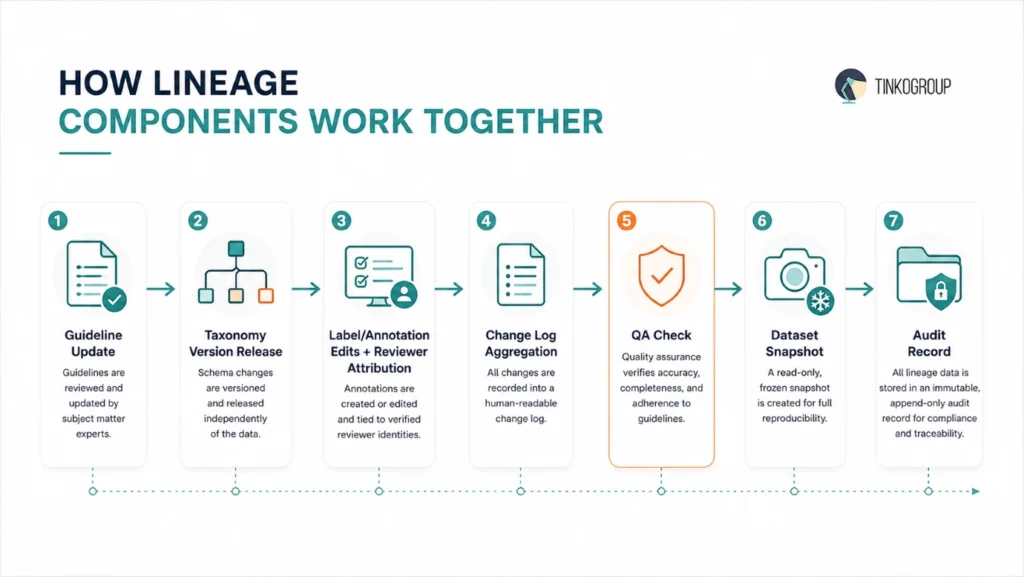
These six components do not operate in isolation. Together, they form the operational backbone of dataset lineage in data annotation programs. The workflow begins when an organization decides to update its labeling guidelines. When you make this choice, the version control system for the taxonomy makes a new release that spells out and lists the new rules.
As annotators and automated systems begin to modify assets under the new schema, the label and annotation version history logs each edit, and reviewer attribution is used to lock down who made each change. Simultaneously, the platform collects these events into the global change logs, providing contextual business meaning for the ongoing technical changes.
Once the modification cycle passes internal quality checks, the data governance lead generates a new immutable dataset snapshot.
The snapshot captures a clean state of the assets and saves its unique cryptographic hash to the permanent audit trail. When a machine learning engineer starts a training run from that snapshot, the platform perfectly preserves the entire history. That history remains immediately discoverable, from the high-level policy change down to the exact individual who verified the last pixel.
Together, this approach turns a shifting set of files into a highly predictable, repeatable, enterprise-grade asset lifecycle – the practical core of annotation lifecycle management.
How Dataset Lineage Supports QA and Model Investigations
The real value of keeping a thorough annotation audit trail is when things go wrong in production. When a deployed model behaves unexpectedly, engineers do not just debug the code. They immediately inspect the historical evolution of the data to find out where anomalies entered the system.
Lineage lets teams investigate model regressions and validate retraining datasets efficiently. When a newly retrained model fails a standard performance check, engineers use lineage systems to run a differential analysis. They compare the snapshot used for the new model against the snapshot used for the successful older model.
With an explicit audit trail, the engineering team can easily see the differences. For example, they might discover that a recent bulk update accidentally inverted the labels on a critical subset of files. Identifying the exact dataset change history allows the team to revert the broken edits instantly, saving days of painful manual troubleshooting.
Lineage also helps teams review disputed labels, audit annotation decisions, and compare dataset versions. Dataset lineage in data annotation makes these investigations possible by keeping track of every decision about an annotation and every change to a dataset. As AI models handle increasingly nuanced tasks, human decisions naturally become more subjective. In enterprise document processing, two expert reviewers might look at the same medical scan or financial document and disagree on the correct tag.
Lineage systems preserve the history of these disputed decisions. Instead of erasing the minority opinion, the system saves the entire debate log.
When engineers look into edge-case failures, they can see if the model is failing on files that humans also struggled to classify consistently. That contextual insight connects annotation history directly to model performance analysis. It allows teams to understand which annotation changes contributed to dataset differences used in model training. Keeping this level of detail also strengthens annotation audit readiness well before a regulator or an enterprise client ever asks for it.

Reliable Data Services Delivered By Experts
We help you scale faster by doing the data work right - the first time

Building Annotation Governance Around Dataset History
Technical infrastructure alone cannot solve data quality issues. Your organization must build clear human operational habits around that technology. True annotation governance links software tools to company policy for long-term data integrity, compliance, and enterprise-wide accountability.
Implementing this standard requires structured approval workflows, version ownership, and strict documentation standards. Businesses should never let a single annotator make big changes to a main training dataset without first checking them out. Every significant batch modification or guideline change must undergo a mandatory peer-review process.
Two often-cited frameworks explicitly expect oversight rather than treat it as a nice-to-have. The NIST AI Risk Management Framework has documented data governance as a core function. And the post-market monitoring rules in the EU AI Act link continued compliance directly to the technical documentation available for a system.
Teams must assign clear version ownership to specific individuals. An Annotation Program Manager or a Data Governance Lead should act as the official gatekeeper for dataset releases. That gatekeeper reviews the accumulated history, verifies that the work meets QA targets, and officially signs off on new production versions. Escalation tracking and retention policies are equally critical as projects expand.
This is where formal annotation change management earns its keep. Teams must accompany every new dataset release with detailed release notes documenting the exact number of labels added, modified, or deleted. These notes must also include the specific version of the annotation guidelines used for the batch.
Organizations must establish clear data retention policies. Depending on your industry, you may have a legal obligation to keep historical training snapshots for years. A sound tracking strategy enables your team to respond confidently to compliance requests, even long after the original project is complete. Traceability only becomes more important at an enterprise scale.
How Tinkogroup Builds Traceability into Annotation Operations
Managing complex dataset evolution takes disciplined operational tooling, not just good intentions. Tinkogroup embeds transparency and traceability into every stage of the annotation lifecycle. Our teams provide a fully documented, auditable history of how those decisions were made.
Our operational practices center on documented QA workflows, change visibility, and reviewer accountability. Our specialist teams meticulously track every single action they take. You can easily identify who labeled a specific file, see the exact timestamp of the decision, and view the precise QA steps that validated the entry.
On a recent client project, we rebuilt a client’s product approval workflow around a structured, checkpointed review protocol instead of ad hoc sign-off. The result: 15,000+ items approved, 5,000+ items entered, and a 95% accuracy rate, with a clear record of who approved what at each stage.
This strict focus on dataset versioning also eliminates guesswork for your engineering teams. If you notice a shift in your training metrics, you can open our comprehensive change delivery logs to see exactly how teams applied guidelines across different batches. That level of granular visibility gives your internal teams the confidence they need to scale production workloads safely.
We emphasize escalation records, version awareness, and total annotation workflow transparency. Real-world data is full of messy exceptions and hard choices. When our teams encounter complex edge cases, we do not guess. We use a structured escalation process that records every single edge-case discussion, policy decision, and client clarification.
We preserve these historical logs alongside your primary data assets. This commitment to training data traceability keeps your underlying data reliable, consistent, and ready to pass strict internal or external corporate audits. To explore how we can bring full clarity and institutional control to your production training assets, visit the Tinkogroup data processing services page.
Conclusion
Dataset lineage in data annotation helps organizations understand how training data evolves. Maintaining a clear, uninterrupted view of this evolution is no longer an optional luxury for engineering teams. As machine learning architectures become more standard, the quality, consistency, and integrity of the data that powers them become the real competitive advantage for any modern business.
Teams find it hard to explain label changes, differences in datasets, changes in model performance, and QA decisions when they can’t find the source. When companies can’t keep track of their changes, they add huge hidden risks to their development lifecycles. They waste time looking for bugs that don’t exist, risk getting fined a lot, and have trouble repeating successful model training runs.
A complete lineage framework removes these operational blind spots, making your data transparent, predictable, and a valuable corporate asset.
For more advanced annotation programs, lineage is more of an operational requirement than a documentation task. If your team knows the full history of every asset, they can try new things more quickly, fix bugs in production more quickly, and confidently put in place automated systems.
Organizations need to figure out if their annotation workflows give enough visibility into dataset history tracking and label evolution. If your existing pipelines are not giving you the visibility you need into your data’s history, it is time to upgrade your training data governance infrastructure and partner with specialists who value full transparency. Talk to Tinkogroup about building a fully traceable data annotation program for your team.
What is the difference between dataset lineage and dataset versioning?
Dataset versioning focuses on creating snapshots or releases of a dataset at specific points. Dataset lineage in data annotation goes further by recording the complete history of every change, including who made it, why it was made, when it happened, and which version contains the update. Together, lineage and versioning improve reproducibility, accountability, and quality control throughout the AI development lifecycle.
Why is dataset lineage important for regulatory compliance?
Many industries require organizations to demonstrate how they collected, reviewed, and modified AI training data. Dataset lineage provides a complete audit trail that documents label updates, reviewer decisions, quality assurance activities, and dataset releases. This transparency helps organizations prepare for audits, support internal governance, and comply with frameworks such as the EU AI Act and the NIST AI Risk Management Framework.
Can dataset lineage improve model performance?
Yes. While dataset lineage does not directly increase model accuracy, it helps teams identify the root causes of performance changes much faster. Engineers can compare dataset versions, review annotation history, trace label corrections, and determine whether regressions were caused by data updates rather than model code. This reduces debugging time and leads to more reliable retraining and continuous model improvement.