


AI models don’t learn to understand the world in isolation. They learn entirely from patterns created by people, and how consistently those people agree with each other, which teams call Inter-Annotator Agreement, determines how clean that training signal is. That means the quality of the training data directly influences the reliability of the model. And this is where the human factor matters. People may interpret text, images, or other data differently. Thus the same data can receive different labels.
Imagine a healthcare AI team that is developing a pathology image classification model. Two expert reviewers have labeled the same set of 1,000 images. Soon, it becomes clear that they disagree on nearly 30% of the cases. Before investing in another round of model training, the team must understand the reason for this disagreement. They need to find the root cause of this divergence and determine whether it’s wrong data, unclear instructions, or an ambiguous task itself.
That’s why Inter-Annotator Agreement (IAA) becomes far more important than other annotation KPIs. It measures how consistently human annotators are labeling the same data. When inter-annotation agreement is high, it suggests that the labeling decisions are clear and that the resulting training signal will be coherent. When IAA is low, it signals ambiguity, confusion, or fundamental problems that simple model tuning cannot fix.
High agreement often indicates clearer training data and more predictable model outcomes.
Annotation agreement is not a simple checkbox metric. It allows organizations to check data quality, improve datasets, and understand whether a model is ready for production. In this article, we’ll explain how inter-annotation agreement helps measure your training data quality and how the right data annotation partner can help you catch problems before they lead to expensive retraining, poor model performance, or failed AI projects.
What Inter-Annotator Agreement Reveals About Dataset Reliability
The idea of annotation agreement is simple. Multiple annotators label the same set of data independently, and then reviewers compare their labels. When annotators consistently arrive at the same decisions, it’s a high inter-annotation agreement score. When their labels diverge, it’s low IAA. These results help you understand your training data consistency.
It doesn’t matter what you are labeling. You can work with images, legal documents, or objects for self-driving cars. The main idea of label consistency is always the same. You assign a group of annotators to label the same data. If you see predominantly the same labels, it’s a sign that the task is clear and the labeling guidelines are easy to follow.
But if you see many labels differ, you have a problem hidden somewhere. Usually, data is difficult to interpret, or the instructions are not clear even if your annotators are experts.
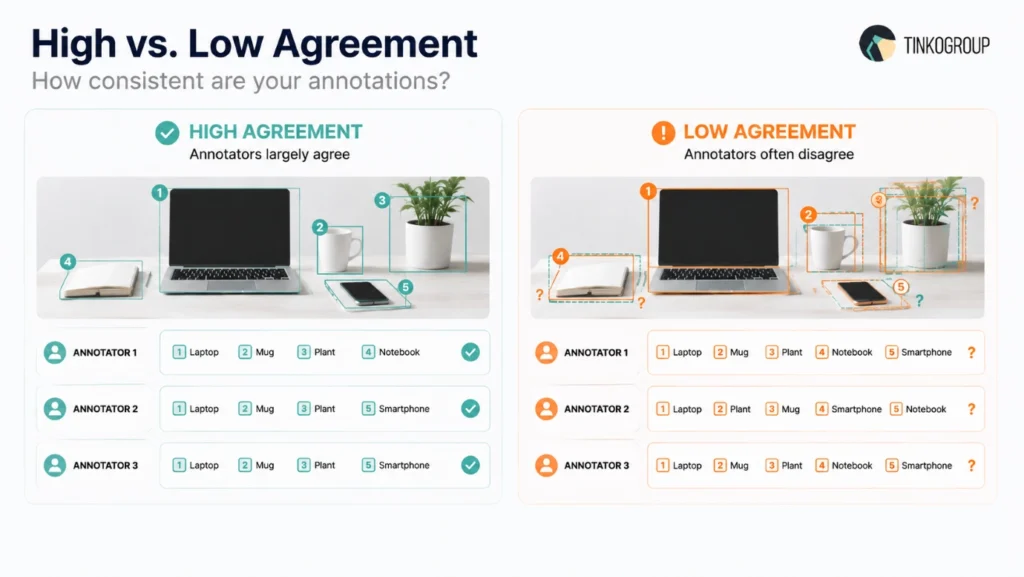
Teams measure inter-annotator agreement using Cohen’s Kappa or Fleiss’ Kappa methods. Both methods compare the actual level of agreement with the agreement that could happen by chance and produce a score from -1 to 1, where higher values are better data quality indicators. Yet, the main insights are behind these scores. Teams also analyze the following:
- Specialists break down agreement by data segment to understand what’s causing the result. Certain image types may consistently trigger disagreement, or specific document sections cause confusion. This segmentation tells teams whether it’s a problem of only edge cases or the entire dataset.
- They study annotator performance profiles. If one person consistently labels differently, that points to a training gap or a different understanding of the guidelines. But when everyone disagrees equally across all categories, the guidelines are weak.
- They watch how agreement progresses over time. If the team becomes more aligned as they gain experience, that indicates progress. But if agreement stays flat or starts sliding, something remains unresolved.
It’s also important to separate systematic disagreements from random ones. Systematic disagreements are predictable. If annotators consistently pick one label over another in certain situations, you can change the guidelines and quickly fix it. Random disagreements are trickier. They often mean the task itself is not clear and requires more fundamental changes. When you have the above insights, you no longer need to guess. The patterns tell you exactly what needs your attention and where.
Why Annotators Disagree
It’s tempting to blame annotators for poor data quality. In reality, it’s not low workforce motivation or lack of skills. There are other factors that drive annotation disagreement:
- Ambiguous instructions. Guidelines that appear straightforward during planning often leave room for interpretation when annotators see real data. Vague language around definitions or decision criteria makes different people apply labels inconsistently.
- Unclear edge cases. Some data is naturally difficult to label. Even experienced annotators may disagree because the correct category isn’t always obvious.
- Subjective interpretation: Many tasks involve nuance. What one person sees as positive sentiment or moderate severity, another may classify very differently based on their personal or cultural context.
- Insufficient training. Without regular calibration sessions or clear examples, annotators develop individual mental models that drift over time.
- Domain complexity. Specialized fields require deep expertise. Even qualified professionals can disagree when subtle details matter.
Real-world cases demonstrate this:
Medical image classification. Research published involved multiple expert annotators and showed that even experienced radiologists and pathologists don’t always interpret medical images the same way. But when teams know these differences, they can refine annotation guidelines and create more accurate datasets for AI training.
Legal document review. The Contract Understanding Atticus Dataset (CUAD) shows how difficult legal annotation can be. Contract clauses often contain several legal concepts or ambiguous wording, and reviewers may interpret them differently.
Sentiment analysis. Google’s GoEmotions dataset showed that people often interpret the same comment differently. Sarcasm, humor, and mixed emotions led annotators to assign different emotion labels, demonstrating how subjective language affects AI training.
Autonomous driving. A nuScenes dataset shows how difficult object annotation can be. In poor lighting, heavy rain, or when pedestrians and cyclists are partially hidden, annotators may assign different labels or object boundaries.
Disagreement is useful. It helps teams spot unclear instructions, difficult examples, and gaps in the annotation process. It provides valuable clues about how to improve datasets and achieve higher AI model reliability.

Reliable Data Services Delivered By Experts
We help you scale faster by doing the data work right - the first time

How Annotation Consistency Affects Model Performance
Inter-Annotator Agreement doesn’t affect only data quality. It also provides an important signal about how consistently an AI model can learn from labeled data and perform on similar examples. If similar data has different labels, the model receives mixed signals and gets confused.
Inconsistent Labels Confuse the Model
AI learns from examples. When similar examples continuously receive the same label, the model knows what to look for. However, when they are given different labels, recognizing the right pattern becomes much more difficult.
Take medical image classification as an example. Before an AI can detect tumors, pathologists first label thousands of scans as benign or malignant. Some cases are obvious, and others have subtle nuances that even experts debate. If one pathologist labels a scan as benign and another labels a similar scan as malignant, both labels end up in the training data. The AI doesn’t know which one to trust and gets confused.
This kind of inconsistency is known as label noise, which becomes a real obstacle for any model and seriously affects accuracy. Monitoring Inter-Annotator Agreement can help teams detect this inconsistency before label noise spreads across a larger training dataset.
Small Labeling Problems Become Bigger AI Problems
Even small amounts of inconsistent labeling affect model performance. Studies show that as labeling errors increase, AI models become less accurate. They produce more false positives and false negatives because they learned from noisy training data.
In production, those mistakes affect real users. A document may be classified incorrectly, a medical image may require unnecessary review, or an autonomous vehicle may hesitate in situations it should recognize with confidence.
This is why AI models work well with straightforward cases but struggle with edge cases. Straightforward examples usually have consistent labels, but complex or borderline cases don’t. The model has learned to handle the clear cases but has no idea how to deal with tricky ones.
Models Inherit Uncertainty from Their Training Data
Each model reflects its training data. If the data contains contradictions, the model learns them. Such a model hesitates, gives inconsistent answers, and fails in tricky situations.
When humans can’t agree on a label, there’s no way to know which label is “correct.” The model inherits this uncertainty. This uncertainty doesn’t disappear during training but becomes part of the model and shows up during real-world use.
Human disagreement limits how well a model can perform. If you keep adding more and more data without improving it, you don’t necessarily make the model any smarter. Instead, you may teach it the same mistakes repeatedly. The model then becomes more confident in wrong answers.
For example, if only 70% of labels are consistent, the model is unlikely to perform reliably above that ceiling on similar data. Only by checking annotation agreement early can you build a stronger foundation for your AI model.
The Role of Agreement in Model Performance Prediction
Many teams assume that adding more examples will automatically improve model performance. But it works only if new data is labeled consistently, or you will only make things worse. A well-labeled smaller dataset often outperforms a larger one filled with disagreements. High agreement reduces label noise, and the model learns better.
Consider healthcare AI. A healthcare AI dataset of 5,000 pathology images labeled with 95% agreement will produce a more reliable tumor detection model than 50,000 images with only 70% agreement. The smaller dataset teaches the model clear patterns. The larger one teaches it uncertainty.
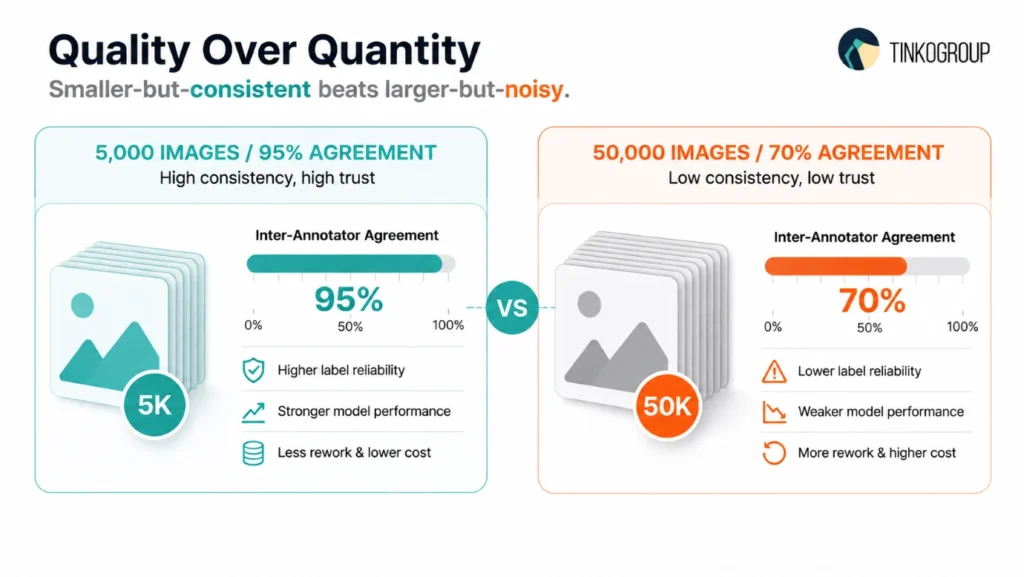
The same holds for autonomous driving. A model trained on 10,000 consistently labeled scenes from autonomous vehicle datasets will handle edge cases better than one trained on 100,000 inconsistently labeled scenes. In the larger dataset, annotators frequently disagreed on whether an object was a pedestrian or a shadow.
This is why teams building production AI systems prioritize dataset reliability before they scale the model. They know that early dataset quality assessment delivers better results than simply adding more data.
Inter-Annotator Agreement as an Early Warning Signal
Smart organizations use Inter-Annotator Agreement (IAA) as an early warning signal for annotation quality. It allows them to identify unclear labels and inconsistent data before they invest time and money in training an AI model. It allows them to identify unclear labels and inconsistent data before they invest time and money in training an AI model. Teams also set agreement thresholds for critical stages:
| Stage | Why teams check agreement here |
| Retraining initiatives | Low IAA on existing data signals that simply adding more labeled examples may increase noise rather than improve the model. Teams pause to refine guidelines or resolve ambiguities first. |
| Dataset expansion | Before scaling from thousands to millions of samples, experts assess model training data quality on current samples first. High disagreement on current samples indicates that expansion could bring more problems and waste significant resources. |
| Production releases | Teams deploy a model only after a thorough IAA review. Strong agreement provides confidence that the model’s learned behaviors will transfer reliably to real-world conditions. |
| Human-in-the-loop deployments | When teams know which data causes the most disagreement, they can send those cases for human review and let AI handle the simpler ones. This improves annotation reliability. |
The best AI teams don’t wait until everything is ready to check its quality. They do annotation quality measurement on a small sample first. And if they find out that the agreement is low, they fix the problems before moving on.
What Agreement Levels Are Considered Healthy?
There is no universal agreement threshold. It all depends on what you are labeling and how high the stakes are. For example, moderate agreement is usually fine for sentiment analysis, because people always interpret tone and emotion in different ways. If your project deals with named entity recognition, you need much higher consistency. The type of task determines the standard.
High-stakes applications need stricter standards. Healthcare AI, legal AI, and autonomous driving require higher agreement than lower-risk projects because mistakes can have serious consequences. For example, a mislabeled medical image or a misclassified legal document can cost lives or millions in fines. Here, teams aim for agreement above 0.80 on Cohen’s Kappa.
Besides, organizations should pay attention to trends and consistency. They need to monitor how agreement improves over time and where exactly disagreements happen. These patterns give a fuller picture.
A dataset with 75% agreement that is steadily improving may have better annotation reliability than the one with 80% agreement that is slowly getting worse. The trend shows if the team is improving or becoming less clear.
Improving Agreement Without Forcing Consensus
When annotation agreement is low, it’s tempting to fix the score instead of the problem. You may ask annotators to follow the majority, let a reviewer make the final decision, or simply replace labels that don’t match. The numbers will improve, but the data won’t. Disagreement tells you something is wrong in your process. If you ignore that and force everyone to agree, you will only hide the problem.
To get better agreement between annotators, focus on making the annotation process itself better.
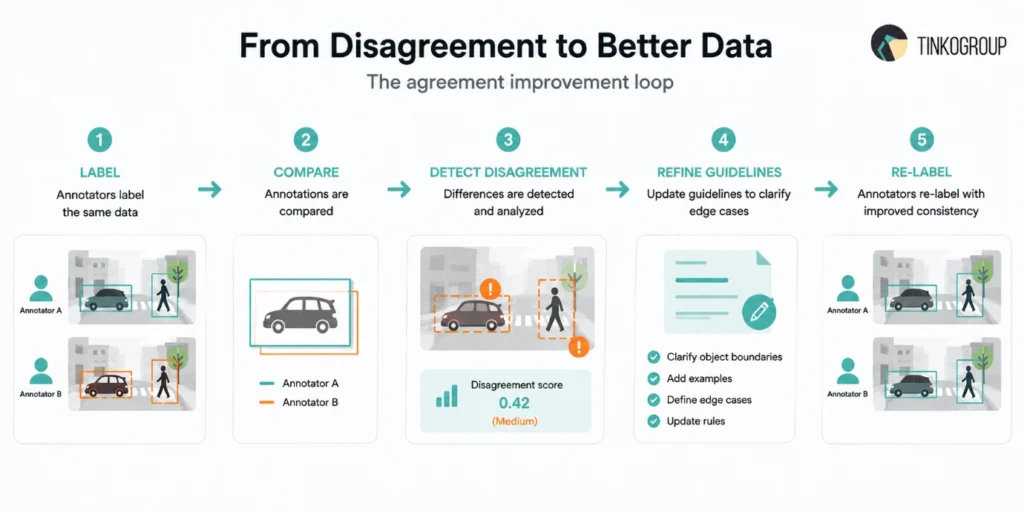
- Update the guidelines. Make the instructions clearer, add more examples, explain tricky situations, and simplify the rules so they are easier to follow.
- Keep a record of difficult cases. Collect challenging examples and their correct labels and save them in one place. This way, annotators have a shared reference and can achieve better label consistency.
- Discuss disagreements together. Regular meetings help annotators see why they made different choices. These talks improve results and often show where the guidelines need changes.
- Set up a review process. If an example is too hard to label, send it to a senior reviewer or expert instead of guessing. Their answer can be added to the guidelines for future use.
- Bring in domain experts when needed. Some projects need special knowledge, so doctors, lawyers, engineers, or other specialists can help solve tough cases and make sure the final labels are correct.
The critical warning is as follows: artificially increasing agreement without addressing underlying ambiguity reduces dataset quality. When teams pressure annotators to agree, they often settle on arbitrary resolutions that don’t reflect the data’s true ambiguity. The dataset looks consistent on paper but contains hidden problems that surface during model training.
The proper approach is to resolve ambiguity, not override it. If people disagree because instructions are unclear, clarify them. If they disagree because a case is genuinely ambiguous, document that and recheck if the labeling scheme needs adjustment. Better to have honest disagreement than forced consensus that hides real problems.
How Tinkogroup Uses Agreement Signals to Improve Dataset Reliability
At Tinkogroup, inter-annotator agreement isn’t something we check only at the end of a project. We use it throughout the entire annotation process because it shows us where the data is clear and where people need more guidance.
We regularly ask several annotators to label the same samples. Then we compare the results. If the IAA score is high, we know the guidelines are working well. But when it drops, we don’t see it as a mistake or blame anyone. We use it as a chance to improve the process.
The first thing we ask is why the disagreement happened. Our specialists investigate what exactly caused the misunderstanding. Sometimes the answer is as simple as adding another example to the guidelines. In other cases, the data reveals a new edge case that deserves its own annotation rule.
Those findings let us improve guidelines. We add new examples, explain edge cases, and clarify the rules so the next person doesn’t run into the same confusion. Over time, the instructions become more complete, and the number of repeated questions naturally goes down.
Some cases need a closer look. When a sample is especially difficult, we pass it to a senior reviewer or a domain expert. Their decision resolves the current case, but it also becomes part of our documentation so the whole team can handle similar examples in the future.
We also monitor how the agreement score changes as the project moves forward. If we notice that it drops, we don’t wait and investigate it immediately. Sometimes it happens because the data has changed, and sometimes the guidelines need another update. Whatever the reason, it’s much easier to fix it early than after thousands of samples have already been labeled.
Our team never aims to get the highest possible score. We aim to build a dataset we can trust. When annotators understand the task in the same way, human annotation consistency grows, and we have a better chance to deliver a reliable dataset.
Conclusion
Inter-Annotator Agreement is easy to file away as one more quality metric among many. But its value goes far beyond a single QA score. Many treat it simply as a number generated during QA, checked off and forgotten. But don’t underestimate the actual importance of annotation agreement. It is one of the earliest data quality indicators that shows whether a training dataset will survive in real life. Unlike many quality checks, it’s available before training starts, not after results come back.
Many teams running enterprise AI programs fully understand this. They don’t ignore IAA and monitor agreement continuously. They dig into disagreement patterns. They refine guidelines, document edge cases, and align their teams around clear interpretations. They identify problems early, before they become expensive and time-consuming to fix.
This approach pays off. Teams that prioritize annotation consistency avoid wasted compute on noisy data. They prevent production failures and build predictable models trained on data that human experts agreed on.
The message for anyone building AI systems is simple: don’t wait until training to find out if your dataset works, and conduct label-quality assessment as soon as possible. Don’t get upset if you reveal a high disagreement score. It’s not failure but diagnostic feedback. Use it to make your guidelines clearer, your annotations more consistent, and your datasets more reliable.
Want to improve your dataset reliability? Tinkogroup turns agreement signals into real improvements. We build our annotation workflows around overlap reviews, continuous monitoring, and systematic ambiguity detection. We deliver datasets you can actually trust to train AI that works. Get in touch to discuss your annotation project!
What is a good Inter-Annotator Agreement score?
There is no single Inter-Annotator Agreement score that works for every AI project. The right threshold depends on the type of data, labeling task, and potential impact of errors. Lower agreement may be acceptable for subjective tasks such as sentiment analysis, while high-stakes applications such as healthcare, legal AI, and autonomous driving generally require stricter consistency. Teams should also look at agreement trends and disagreement patterns rather than relying on one score alone.
How can you improve Inter-Annotator Agreement?
The most effective way to improve Inter-Annotator Agreement is to identify why annotators disagree rather than simply forcing them to reach the same answer. Teams can clarify annotation guidelines, add examples for edge cases, hold calibration discussions, establish a review process, and involve domain experts when specialized knowledge is required. Difficult cases can then be documented and used as references for future annotations.
Why is Inter-Annotator Agreement important for AI training data?
Inter-Annotator Agreement helps teams determine whether human-generated labels are consistent enough to provide a reliable training signal. When annotators disagree frequently, the resulting label noise can make it harder for an AI model to learn consistent patterns and may contribute to poorer performance. Measuring agreement early allows teams to identify ambiguity and improve the dataset before investing heavily in model training.