
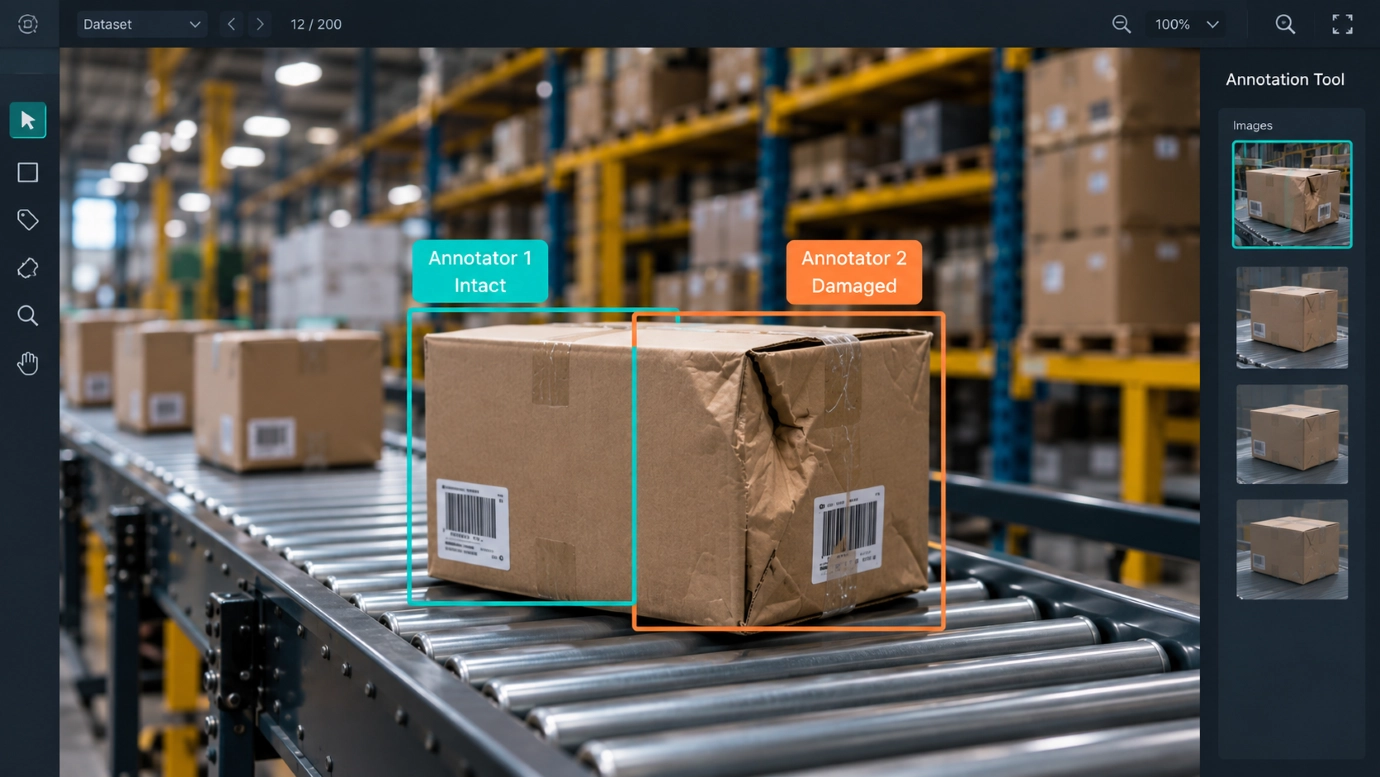

Everyone who’s worked on a large annotation project knows that annotators will not always agree. That’s not necessarily a problem: it’s the reason label consensus workflows exist in the first place. You may have excellent guidelines, but some tasks are simply difficult to classify.
A bounding box may or may not include part of a shadow. A document can contain information that fits two categories. A medical image may show a finding that sits between two labels. Then there are new edge cases that nobody expected when the guidelines were written. Add different levels of experience, domain knowledge, languages, and ways of interpreting instructions, and you’ll understand the roots of disagreement in everyday annotation work. Disagreement itself is a natural thing. But the real problem starts when you cannot handle it.
Imagine an enterprise team processing thousands of tasks every day. There are several annotator and reviewer teams working in parallel, and the project is generally running well. Then the number of disputed tasks starts to grow. Annotators send more questions to reviewers. Reviewers send the harder cases to senior specialists. The escalation queue gets longer, and people keep waiting for decisions before they can move on.
At first, this delay is not noticeable. But when the same thing happens across thousands of tasks, it adds up quickly. Soon, reviewers spend a large part of their time answering questions that they could have resolved earlier. Production queues become harder to manage, and deadlines are burning. And if different teams resolve similar cases differently, those inconsistencies can eventually make their way into the dataset.
That creates another problem. You will have to pay for additional QA, rework, model validation, or even retraining. What started as a small disagreement between two annotators can eventually become a much larger operational cost.
Once disagreement becomes frequent, it needs a process, not a workaround. Label consensus workflows give teams a clear way to resolve difficult cases without holding up production. They define what happens when annotators disagree, which cases can be resolved at the reviewer level, and which ones need specialist input. They also specify who makes the final decision and how that decision is passed back to the rest of the team.
Consensus is not another layer of QA that slows production down. It is a way to keep disagreement under control.
Why Label Disagreement Increases as Annotation Operations Scale
When you scale an annotation project from dozens to hundreds of annotators, the nature of disagreement changes. A simple quality issue that you can manage through spot-checking turns into a complex operational challenge with direct consequences for throughput, cost, and reviewer decision consistency.
Drivers of Disagreement
Larger reviewer pools. The more people work on the same dataset, the more interpretations they make. With five annotators, a reviewer may keep track of common questions and correct inconsistencies quickly. With fifty or more, direct oversight is no longer realistic. Even when everyone receives the same training, people will sometimes make different decisions about unclear cases. Small differences become more noticeable when you process thousands of tasks.
Multilingual teams. People from different backgrounds may interpret the same phrase or situation differently. For example, a comment that one reviewer considers aggressive is often neutral to another because of differences in language or cultural context. The same can happen with images. A team working on data from several countries may interpret certain objects, signs, clothing, or situations differently simply because they know them better.
Domain complexity. A simple image-labeling project may be easy to standardize. But reviewers need specialized knowledge for a medical imaging project, legal document project, or autonomous vehicle dataset. As the task becomes more complex, people are more likely to reach different conclusions.
Evolving ontologies. Annotation guidelines change throughout a large project. A category that seemed clear at the beginning may need to be split into two. When this happens, reviewers who learned the earlier version of the guidelines need time to adjust. If you don’t communicate new rules, inter-annotator disagreement will grow.
New edge cases. A rare situation may appear once in a small dataset. But that same situation may appear every day in a dataset containing hundreds of thousands of tasks. When unusual cases become common, teams can no longer handle them as one-off questions. They need clear decisions, documented examples, and a way to apply those decisions consistently.
Why More Annotators Often Mean More Disagreement
Workforce expansion is necessary for volume, but it also multiplies sources of variation. New reviewers arrive with different levels of domain familiarity. Onboarding programs cannot eliminate every interpretive difference. Reviewer diversity also increases the range of legitimate interpretations. As the volume of data rises, exposure to rare edge cases rises with it.
Take a large computer vision project with road scene labeling tasks. Early batches may contain mostly common vehicle and pedestrian configurations. Later batches introduce unusual weather, construction zones, or rare vehicle types. Reviewers who joined at different stages of the program apply slightly different internal thresholds. The result is serious growth in inter-annotator disagreement, which happens not because the workforce is less skilled, but because the operational surface area has expanded.
Building Consensus Before Escalation Happens
Many programs treat disagreement reactively: annotators disagree, a senior reviewer adjudicates, and the decision is recorded. This works at a small scale but becomes unsustainable as volume grows. A proactive approach works differently. Teams invest in alignment upfront, and the number of escalations drops. Here are five consensus-based annotation strategies:
- Calibration sessions. These are regular meetings where annotators label the same set of sample tasks and compare results. These sessions surface interpretive differences early, before they propagate across thousands of live tasks. They also give project managers visibility into where the guidelines are causing confusion.
- Edge-case libraries. These include a curated collection of difficult examples, each with a documented correct answer and a rationale. When an annotator encounters a similar case in live work, they can reference the library rather than escalating. Over time, the library becomes the program’s institutional memory.
- Benchmark examples. It’s a set of gold-standard tasks embedded in the live queue. When an annotator’s labels on benchmark tasks diverge from the gold answer, the system flags it for review. This helps identify drift before it becomes widespread.
- Reviewer alignment checkpoints. The team should review recent disagreement patterns together in scheduled intervals. These checkpoints catch systematic issues early and help update the guidelines and communicate them across the entire team.
- Decision trees. A documented decision tree removes the need for escalation for recurring edge cases. When an annotator encounters a known ambiguous case, the decision tree tells them exactly how to label it. This reduces escalation volume and ensures consistency across reviewers.
Preventive Consensus Systems
Prevention is much cheaper than resolving the same issue later. When an annotator has to escalate a difficult task, several people may need to review it, make a decision, and update the guidelines or tracking system. It’s only several minutes for one task. But annotation process efficiency suffers because those minutes quickly turn into a major cost and delay across thousands or millions of records.
A good preventive system helps annotators resolve common questions themselves, often in seconds. Effective label consensus workflows help teams resolve recurring questions before they turn into production bottlenecks. Include the following steps in your annotation workflow management:
- Examples of difficult cases. Keep a simple collection of tricky cases and the correct answers. When annotators are unsure, they can check similar examples instead of stopping work and asking a reviewer.
- Regular time with reviewers. Give annotators a chance to discuss difficult questions with a reviewer or team lead. One short discussion can clear up a problem for the whole team instead of answering the same question again and again.
- Simple decision guides and updated rules. When a task is difficult, a short step-by-step guide can help annotators decide what to do. And when the team finds a new type of problem, update the guidelines so everyone knows how to handle it next time.
Label consensus workflows won’t eliminate disagreement entirely because that’s impossible. But they will reduce the number of disagreements that need escalation and prevent disputes.
Designing Efficient Reviewer Escalation Workflows
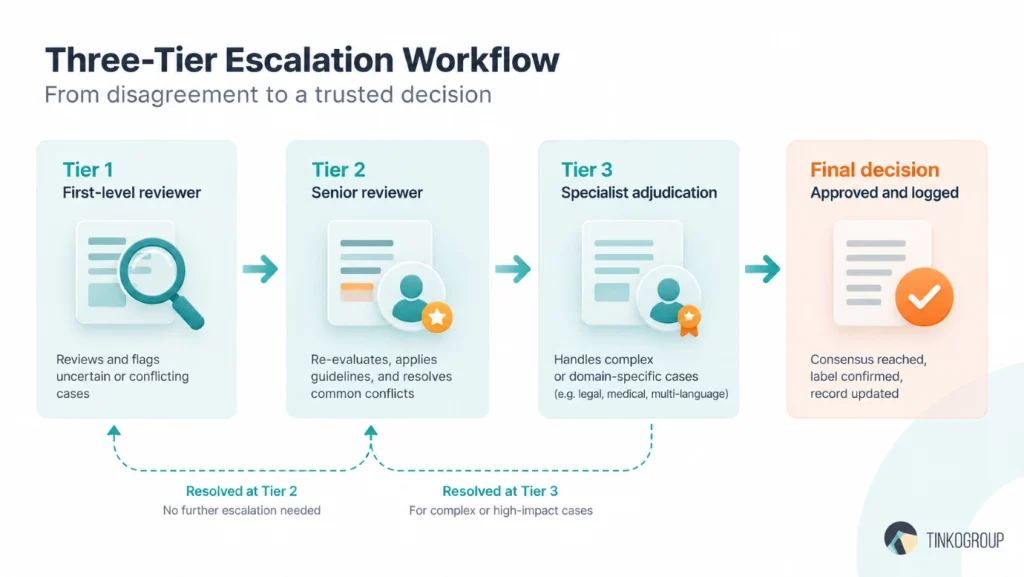
Data annotation projects will always have tasks that are difficult to label. Strong escalation management means having a clear way to deal with them when they appear. A reviewer should not have to wonder who to ask, and a difficult task should not sit in a queue for days because nobody is sure who makes the final decision. Practical reviewer escalation workflows have three tiers:
Tier 1: First-level reviewer review. The first reviewer checks the disputed task against the current guidelines and approved examples. At this stage, the first reviewer can settle many disagreements. If the case is genuinely unclear, the reviewer records what the problem is and sends it to the next level.
Tier 2: Senior reviewer escalation. A senior reviewer compares the task with similar examples, checks the guidelines, and makes a decision when possible. If the same question keeps coming up, they can also flag it for a guideline update.
Tier 3: Specialist adjudication. The regular review team cannot settle some cases. A medical image, legal document, or highly technical dataset may require someone with specific subject knowledge. The specialist makes the final decision for these cases and explains how to handle similar cases in the future.
Defining Escalation Ownership
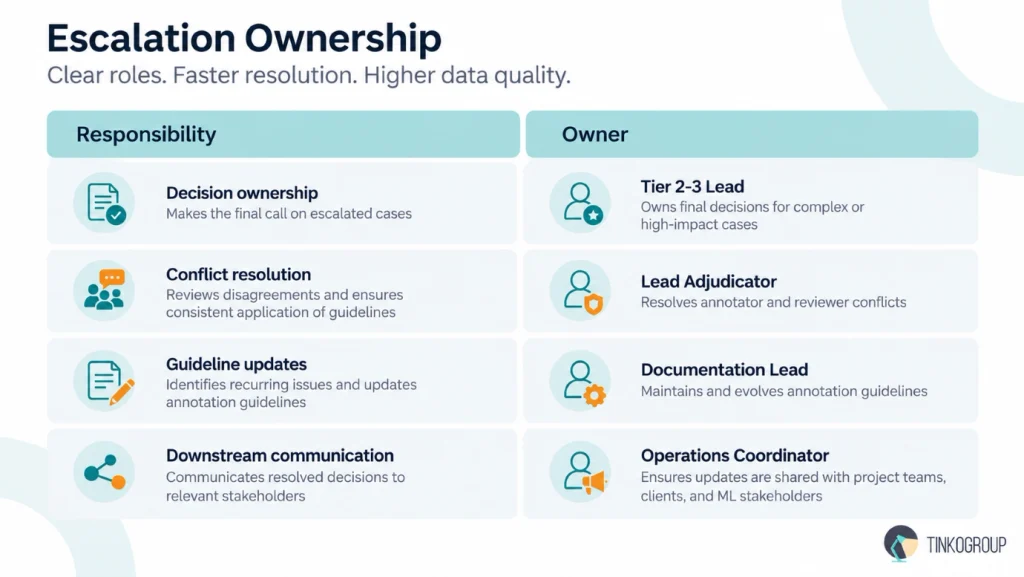
Many enterprise AI programs slow down simply because people on the team often have no idea who handles what. Label consensus workflows must provide clear answers to four questions: who owns the decision on a certain type of disagreement, who has the authority to resolve a conflict between two reviewers, who is responsible for updating the guidelines, and who communicates that final decision back to the reviewers.
Decision ownership. Individual tasks are assigned to specific Tier 2 or Tier 3 leads based on data domain. Every escalated record should have a single human owner responsible for hitting its SLA target.
Conflict resolution. When senior reviewers disagree on a label, a designated Lead Adjudicator makes the final decision.
Guideline updates. Adjudication decisions cannot remain isolated to a single task. A dedicated Documentation Lead takes every final ruling from Tier 3 and updates project instructions.
Downstream communication. A designated Operations Coordinator systematically communicates newly approved precedents back to all Tier 1 annotators to prevent repeat escalations.
Turnaround SLAs
A turnaround SLA is simply a deadline for fixing a tricky task so it doesn’t get stuck. Without deadlines, people naturally skip confusing tasks to work on easier ones. They push aside hard questions, workers get stuck waiting for answers, and project deadlines are off.
Setting clear time limits fixes this: workers know exactly when they need to make a call (for example, 4 hours for a lead reviewer or 24 hours for a specialist). And managers get an alert if a task is taking too long so they can fix the problem before it delays the whole project. Disagreements will always happen, but a clear deadline keeps a project on track. Clear deadlines make label consensus workflows more predictable by setting expectations for review, escalation, and final decisions.
How Label Consensus Workflows Protect Annotation Throughput
Annotation throughput is simply how much work a team can complete in a given time. When disagreements send every task through several review rounds, queues grow and delivery slows. A good consensus workflow sends only complex issues to senior reviewers or specialists. Well-planned annotation dispute resolution allows you to deliver projects on time.
Delivery Planning
Every annotation project should include label disagreement resolution as part of its annotation delivery optimization strategy. It’s a forecast of how many tasks will likely require escalation and what resources it will take. Planning this way lets you manage disagreement instead of reacting to it.
Escalation Capacity
Escalation capacity must match projected disagreement volume. If thousands of tasks are reviewed daily, hundreds may require escalation. Senior reviewers must have the capacity to handle these. It’s an important part of effective annotation throughput management.
Reviewer Allocation
Assign reviewers not only to initial annotation and QA – remember about escalation too. When disagreement spikes, escalation queues grow faster than the team can clear them. Smart allocation means flexible reviewer pools that can deal with escalation as needed.
Queue Management
Monitor queue sizes every day, identify root causes when queues grow, and have emergency plans for spikes. Escalation queues that consistently grow indicate systemic issues, and these issues need immediate attention and workflow redesign.
Throughput Forecasting
Mature teams forecast throughput based on historical disagreement patterns. They know that new task types or guideline updates typically cause temporary disagreement spikes. They plan for these in advance and turn disagreement into a predictable operational factor.
The Cost of Escalation Bottlenecks
When you ignore escalation, its costs show up in a few predictable places. Reviewer idle time is one of the least visible but most expensive. When a first-pass annotator is blocked waiting for an answer, that’s paid time with no output. Delayed escalation queues tend to grow rather than stabilize, because new disagreements arrive faster than old ones get cleared.
Missed deadlines are the next problem, as a dataset can’t ship until you settle all disputed cases. QA overload makes the problem worse, because unresolved disagreement often gets flagged again during quality review and can double the amount of work. These are not abstract costs. They show up directly in delivery dates and project budgets.
Consensus Speed vs. Consensus Accuracy
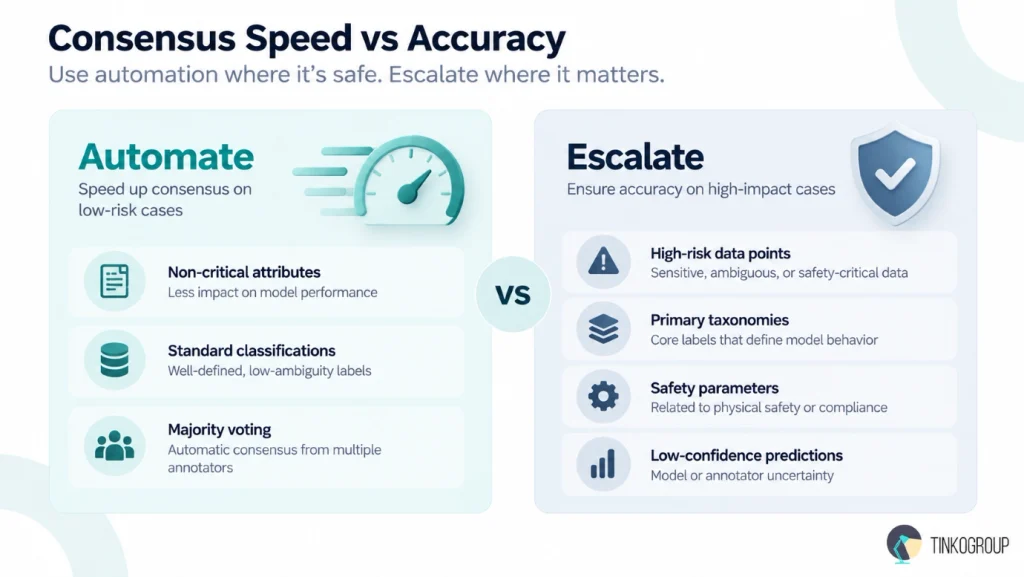
Not every disagreement needs several rounds of human review. Simple or low-risk issues take time to resolve, but resolving them slowly doesn’t always improve the final dataset. A better approach is to resolve straightforward cases quickly and save deeper review for cases that are genuinely difficult or important.
| Approach | When to use it |
| Automate the resolution | For non-critical attributes or standard visual classifications. Predefined algorithmic rules resolve conflicts instantly. For example, majority voting (accepting 2-out-of-3 matching labels) or defaulting to the highest-tenured reviewer’s input to keep production moving. |
| Force escalation | For high-risk data points, primary class taxonomies, core safety parameters, or low-confidence model predictions. |
Simple disagreements should have clear rules that tell annotators what to do. Only difficult or important cases should go to senior reviewers or specialists. This way, the team can keep quality high without slowing down the whole project.
Measuring Consensus Quality Without Creating More QA Overhead
You don’t need a complicated reporting system to track your label consensus workflows. Quality assurance in data annotation doesn’t have to mean more overhead. Your goal is not numbers. You should notice problems early, for example, when disagreements are increasing or escalation queues are getting worse. For this, you need only a few simple metrics. Tracking these indicators helps teams determine whether label consensus workflows are reducing repeat disputes and keeping review queues manageable.
Disagreement Trends
One of the simplest things to track is whether disagreements are going up, going down, or staying about the same. If disagreements increase, something needs attention. The guidelines may no longer match the data, new types of tasks may be causing confusion, or recent training may not have been effective enough. Look at the trend over several weeks or months. If disagreements keep rising, find out why.
Escalation Volume
It is also useful to track how many tasks need extra review. A high number may mean that annotators do not have enough information to make decisions on their own. But a very low number is not always a good sign either. Annotators may be guessing instead of asking for help. The goal is not to have zero escalations. The goal is to have a manageable number of cases that genuinely need another opinion.
Recurring Edge Cases
Pay attention when the same difficult case keeps coming up. If reviewers disagree about the same type of task again and again, that’s a signal. The team may need to add a new example, explain the rule more clearly, or make a specific decision about that case. This can save time later because reviewers will not have to solve the same problem several times.
Reviewer Consistency Trends
Reviewers need to agree with each other too. If two senior reviewers make different decisions about similar tasks, it signals the problem with the guidelines. Check reviewer decisions from time to time to find these gaps.
Consensus Stability
Finally, check what happens after you have resolved a disagreement. The same problem should not come back. If it does, you didn’t explain the decision clearly to annotators or didn’t update the guidelines. Good consensus governance should make repeated disagreements less common over time.
Keep It Operational
Your main focus should be annotation process efficiency: how quickly you resolve disagreements, how much reviewer capacity this resolution takes, and whether annotation throughput holds up. You don’t need complex inter-annotator agreement formulas. Those have their place, but simple, actionable metrics are more valuable for daily operations.
You’re not trying to measure perfection. You’re trying to measure performance. Track enough to know whether your annotation review workflows are healthy, and use that information to make improvements. That’s how you maintain quality without creating more overhead than the measurement itself saves.
Consensus Management in High-Risk Industries
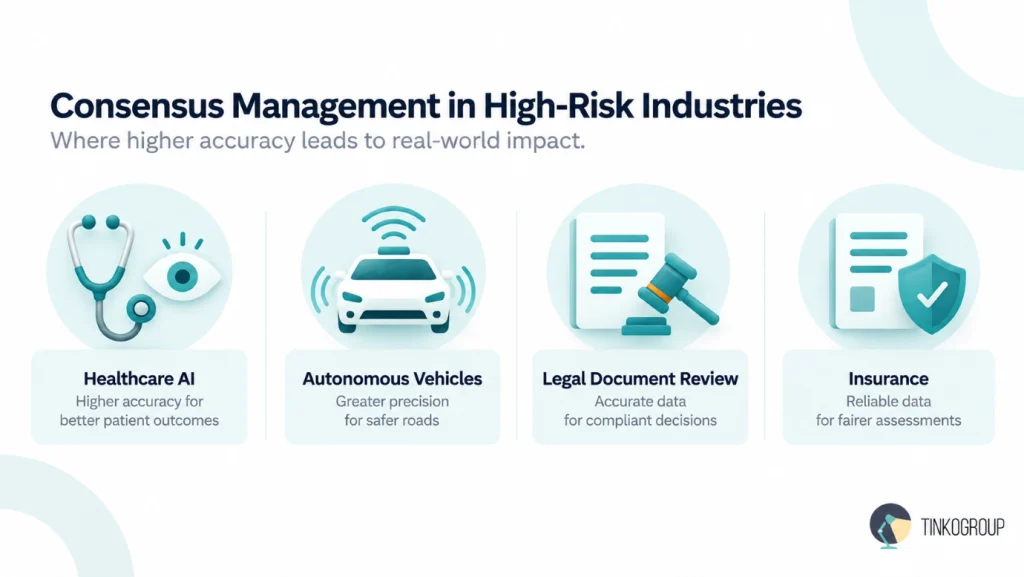
In most annotation programs, unresolved disagreement is a delivery problem. In a smaller set of industries, it’s also a legal and financial one. And the stakes change the true role of label consensus workflows. This concern is especially important for North American AI companies and European enterprises that are under active regulatory scrutiny.
Healthcare AI is the clearest case. A 2024 diabetic retinopathy screening study found that even a small label error rate (1.2% of cases) was enough to distort the model sensitivity by more than 12 percentage points. After correction, the accuracy grew by 12.5%. In a diagnostic setting, a sensitivity gap of that size is the difference between catching disease early and missing it.
Autonomous vehicles increase the risk even more. In the 2018 Uber crash in Arizona, the vehicle’s automated system failed to identify the pedestrian correctly and predict her path. It shows why unusual cases need careful attention when AI operates in situations where mistakes can have serious consequences.
Legal document review has a different concern: teams need to be able to explain how documents were classified and how the review was carried out. In Da Silva Moore v. Publicis Groupe, a US court accepted the use of predictive coding as part of a structured review process. The case is an early example of a court accepting computer-assisted review when the process is properly designed and supported by quality controls.
Insurance has similar concerns. The NAIC’s Model Bulletin on the Use of Artificial Intelligence Systems by Insurers, adopted in December 2023, sets expectations for how insurers should govern and manage AI. It also says regulators may request information about an insurer’s AI systems during an investigation or examination.
When Consensus Decisions Carry Regulatory Consequences
Across all four industries, the pattern is the same: a labeling disagreement that would be a minor QA note elsewhere becomes a documented event here. It’s not enough to resolve the dispute – the resolution needs a clear record of who made the call, what evidence supported it, and why the final label was correct. That’s the difference between annotation quality and annotation quality governance. The first asks whether the dataset is accurate. The second asks whether you can prove it, months or years after the fact, to someone who wasn’t in the room.
In regulated environments, label consensus workflows should preserve the rationale behind each disputed label, including the evidence reviewed and the person responsible for the final decision.
How Tinkogroup Designs Consensus Workflows at Scale
A large annotation project needs more than a good set of guidelines. Once thousands of tasks pass through the workflow each day, teams also need a clear way to deal with questions, disagreements, and unusual cases. Well-structured label consensus workflows give annotation teams a repeatable process for handling these cases while maintaining consistent quality at scale.
Tinkogroup builds this into the annotation process from the start. The team first looks at the client’s data, taxonomy, guidelines, and quality requirements. This helps define what annotators should do in common situations and what should happen when a task does not fit the existing rules. The goal is simple: a difficult task should have a clear next step. Five core operational pillars make that possible:
Reviewer Alignment
Every project begins with clear guideline definition and calibration sessions that demonstrated what correct annotation looks like. Annotators work through benchmark examples that represent both straightforward cases and common edge scenarios. This isn’t a one-time event. The team regularly adds pre-labeled examples to the workflow to make sure reviewers interpret the guidelines the same way and to catch differences before they affect quality. These checks are lightweight and non-intrusive but provide early signals when interpretations are shifting.
These practices make label consensus workflows more reliable by helping teams identify interpretation gaps before they affect production quality.
Escalation Ownership
Some disagreements cannot be solved with the existing guidelines. When that happens, everyone should know who handles the task next:
Annotator → Reviewer → Senior Reviewer → Specialist (if needed) → Final decision
The reviewer handles simple cases. A senior reviewer takes more difficult ones. If a task needs specific knowledge, such as medical or legal expertise, it goes to a specialist. Someone owns the task at every step. An escalated case should never sit in a queue because nobody knows who is responsible for it.
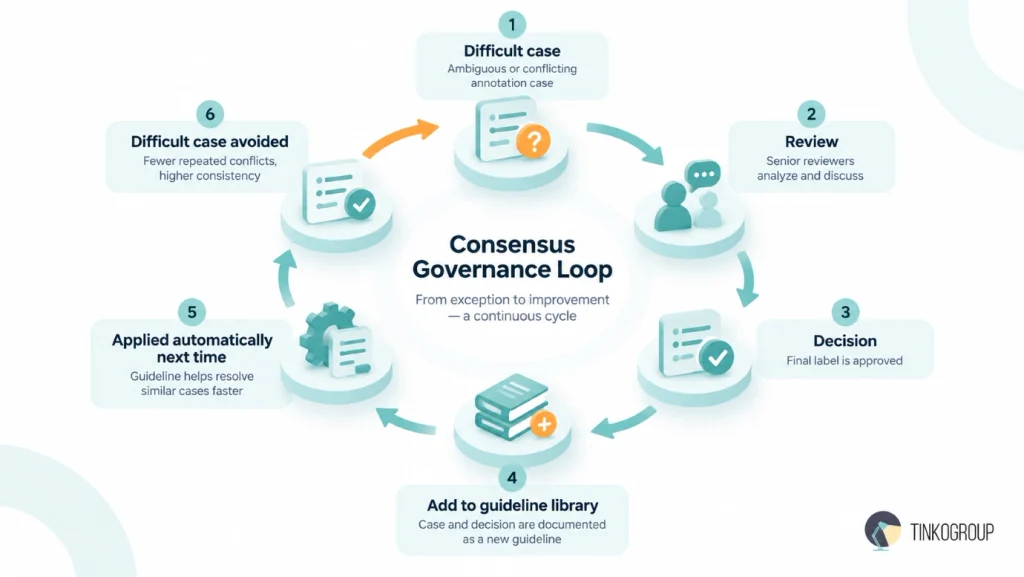
Consensus Governance
A good decision should help with more than one task. Suppose reviewers keep finding the same type of difficult image. They can resolve each case separately, but that means the team keeps spending time on the same question. Instead, the team records the decision and adds the example to the project guidelines or edge-case library:
Difficult case → Review → Decision → Add the example → Apply the rule next time
This is an important part of consensus governance. The team settles disagreements and uses those decisions to make future annotation work easier and more consistent.
Edge-Case Management
Edge cases become more important as a project grows. An unusual image may appear once when the project starts. Later, the same type of image may appear every day because the dataset has expanded or changed. Tinkogroup’s data annotation approach includes edge-case identification, quality control, and feedback loops. These steps help the team spot cases that do not fit the original rules and decide whether the guidelines need an update.
For example, a computer vision project may start with common road scenes. As the dataset grows, reviewers may see heavy rain, partly hidden objects, unusual vehicles, or situations that the original taxonomy does not cover.
Delivery Protection Mechanisms
Consensus decision workflows have to work within the project’s delivery schedule. If thousands of tasks move through the pipeline each day, the project needs enough reviewer capacity to handle the cases that require extra attention. This is where annotation workflow management becomes important.
For example, suppose escalations suddenly increase after the team introduces a new label. More reviewers may not be the right answer. The new label may simply need a clearer definition and better examples. In another case, the guidelines may already be well-defined, but the project may receive an unusually large number of complex cases. There, extra senior or specialist capacity is a better solution.
At Tinkogroup, all scalable annotation operations follow a clear structure, and each person has a clear role. Annotators know where to take difficult tasks. Reviewers know which cases they can resolve themselves. Specialists receive only the cases that actually need their expertise. Project leads can see where queues are growing and address the cause before it affects delivery. The key is to understand what is causing the delay before changing the workflow.
Conclusion
The goal of a large annotation project is not to eliminate disagreement. Some tasks will always be unclear, guidelines will change, and even the most experienced reviewers will sometimes make different decisions. What matters is how your team handles those situations.
A good consensus workflow gives everyone a clear path. Annotators know when to ask for help, and reviewers know when their expertise is sufficient for the resolution. Difficult cases have an owner, and the team knows when to expect an answer.
The process should also protect delivery. If disagreement starts to increase, the team needs enough reviewer capacity to deal with it before queues start to grow. Simple cases should not go through several rounds of review when a clear rule can solve them. More difficult cases can receive the extra attention they need.
The same decisions should also make the next task easier. When the team finds a new edge case, the answer can go back into the guidelines or examples. That way, reviewers do not have to solve the same problem again and again.
This is what effective label consensus workflows look like: defined decisions, defined ownership, and a process that can handle more work without creating more confusion. Disagreement is part of annotation. It does not have to become a reason for missed deadlines or endless rework.
Is your annotation project growing and are disagreements starting to affect delivery? Tinkogroup can help you build a workflow that keeps quality and production moving together.
How do label consensus workflows reduce annotation disagreements?
Label consensus workflows to establish clear rules for resolving disagreements, define escalation paths, and assign responsibility for final decisions. Calibration sessions, benchmark examples, and edge-case libraries help annotators interpret guidelines consistently. When a new type of disagreement appears, documenting the resolution helps prevent the same issue from recurring across future annotation tasks.
When should an annotation task be escalated to a specialist?
A task should be escalated when first-level and senior reviewers cannot resolve the disagreement using existing guidelines and approved examples. Specialist adjudication is particularly important for complex or high-impact cases involving medical images, legal documents, safety-critical data, or highly technical classifications. The escalation process should also define who makes the final decision and how the rationale is documented.
How can teams measure the effectiveness of label consensus workflows?
Teams can evaluate label consensus workflows by tracking disagreement trends, escalation volume, recurring edge cases, reviewer consistency, and consensus stability. These metrics help identify unclear guidelines, inconsistent interpretations, and growing review queues. The goal is not to eliminate every disagreement but to resolve difficult cases efficiently, reduce repeated disputes, and maintain annotation quality without unnecessary QA overhead.