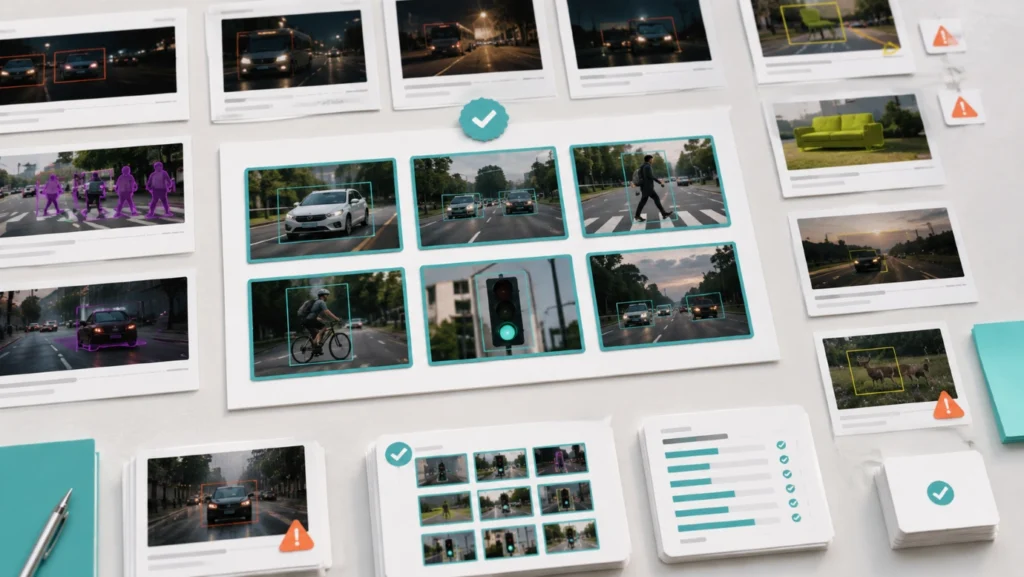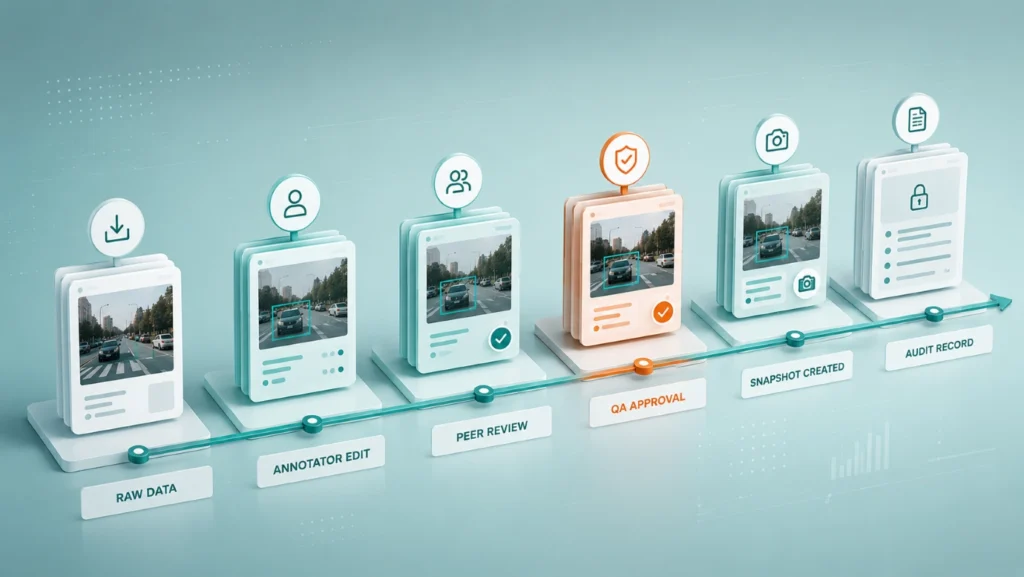


An enterprise annotation project hits its daily labeling target every day this week. Yet each batch takes longer to reach final approval than the one before it. This creeping slowdown is annotation pipeline latency: the buildup of waiting and dependency delays across the annotation lifecycle. Annotators stay productive. Finished tasks just sit for hours waiting on a specialist review, escalations pile up, and the QA queue grows faster than the team can clear it.
Early in an AI development cycle, this problem is invisible. A proof-of-concept model often needs just a few hundred to a few thousand samples. In one location, a small annotation team can informally stay in sync: quick messages, a shared spreadsheet, and a quick answer to an edge case. You keep the turnaround short, and no one has a reason to question the workflow.
That changes when the same project goes to enterprise scale. The size increases from thousands to millions of samples, often simultaneously across multiple data types and formats. Informal habits that worked at a small scale, like manual task assignment, ad hoc communication, and one person clearing every escalation, begin to break down under the new load.
The more annotators, the more variance in speed and interpretation, the more edge cases that need a judgment call, and the more hand-offs between people who’ve never worked together before. The pipeline that flowed so beautifully in testing starts to slow down, batch after batch, and no one has changed a single step of the documented process. Nothing changed on paper, so the usual assumption is that the team needs to work faster. The workflow usually kept pace with the volume moving through it.
Now the project has reached a volume where nobody built the queue design, review structure, or escalation ownership. That gap is what drives annotation pipeline latency at scale. If not addressed, it extends annotation delivery timelines. Data science teams and GPU clusters wait for training data, and product releases depending on the model are held up. It also adds to the cost of QA, because late in a project, rushed reviews tend to uncover fewer errors, not more.
Annotation pipeline latency is usually caused by multiple bottlenecks and slow workers. The design of the workflow determines how work is routed, how review capacity is allocated, and how dependencies between stages are handled. The fix is to move away from ad hoc management to intentional annotation queue management and continuous annotation process optimization. Treat it as annotation project management work in its own right, not as a side effect of hiring more annotators.
What Causes Annotation Pipeline Latency?
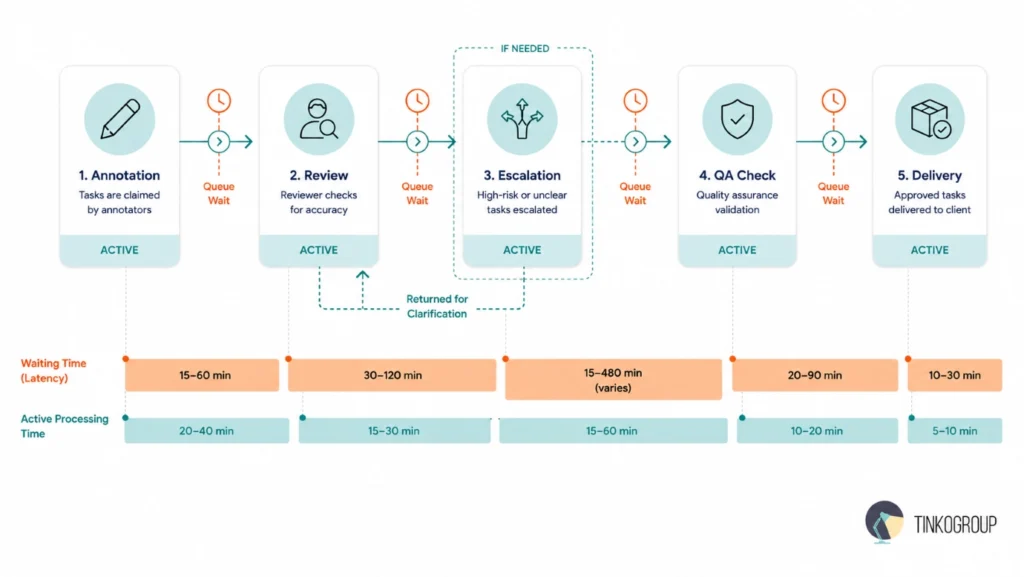
Understanding annotation pipeline latency means looking at how much time a task spends actively being worked on versus how much time it spends simply waiting. In a well-designed pipeline, that wait time stays close to zero. In practice, most large-scale training data projects lose far more time to queues than to the annotation work itself.
The wait usually begins at the front end of the pipeline. When someone assigns tasks manually, splitting files and setting permissions by hand, annotators sit idle while that happens, and the delay repeats every time a new batch arrives. It gets worse when task loads don’t match real annotator speed. Faster annotators run out of work early, while slower annotators fall behind. Most workflows require a full batch to finish before starting the review, so a handful of unfinished tasks held by one slow worker can delay thousands of completed tasks.
Review structure adds another layer of annotation workflow bottlenecks. Many programs funnel 100% of tasks through a single review. If the ratio of the reviewer/annotator is wrong, that stage is the bottleneck. The work piles up faster than it can be cleared. This is compounded by ambiguous cases that go into a shared adjudication queue, and if that queue is not cleared daily, then valuable work can go unresolved for weeks.
For example, a computer vision team may annotate quickly but funnel all ambiguous object classes to one senior reviewer. The rest of the team has spare capacity, but that one person is the bottleneck as the dataset gets more complex. The problem here is the structure that funnels too much through one person.
Healthcare AI projects are a clear example of this pattern. A medical imaging program can read thousands of images a day. But one of the two certified radiologists on the team has to approve any borderline case. These two people set the speed of the project, no matter how quickly the rest of the annotation workforce works.
That same dynamic can be seen in legal AI. A contract review dataset could have dozens of trained annotators labeling clauses. The dependency alone sets the pace for the entire batch through QA if only one lawyer on the team can resolve disputed interpretations. It doesn’t matter how much annotation capacity is waiting idle for that one signature.
Such delays build up gradually. On any given day, a slow shift handoff, a vague instruction in the style guide, looks harmless. But multiply that across hundreds of thousands of tasks, and those little delays are exactly how annotation pipeline latency compounds into real schedule risk. That risk grows fastest as complexity increases, for instance, moving from simple bounding boxes to multi-frame segmentation.
Edge cases deserve a separate mention because they tend to cluster rather than spread evenly. 90% of the dataset can be straightforward. But if the other 10% is reviewed by the same one or two reviewers, the majority of the schedule can be lost. Teams that map where edge cases really cluster, whether that’s a specific object class, language pair, or type of document, can staff for that concentration on purpose. Better than to learn halfway through the job when the queue for one category just stops.
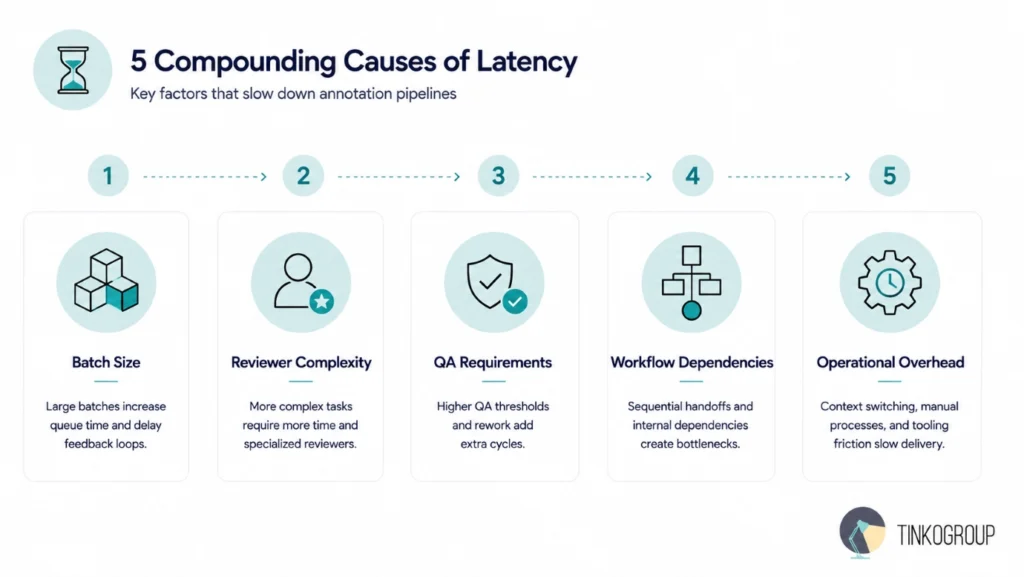
| Factor | Why it slows the pipeline down |
| Growing batch sizes | Large transfers need validation, schema checks, and chunking before work can even be assigned, creating a backlog before annotation starts. |
| Reviewer complexity | High-stakes projects need multi-reviewer consensus, and managing disagreement across overlapping reviews adds real coordination overhead. |
| QA requirements | Strict quality gates mean a batch that fails the precision threshold gets locked and sent back, halting the whole line. |
| Workflow dependencies | Sequential steps, like segmentation only starting after bounding boxes are finalized, mean one delay cascades downstream. |
| Operational overhead | Distributed teams need more coordination time: shift hand-offs, accuracy variance, and ongoing training all pull time away from the pipeline itself. |
Queue Management and Workflow Design in Large Annotation Programs
Workflow architecture has a direct effect on annotation pipeline latency and delivery speed. One undifferentiated task queue can not prioritize what matters. Large annotation programs need structured, tiered queues rather than a single shared pool. Precise annotation pipeline management typically rests on four things working together. Priority-based ingestion allows priority assets to be processed first. Complexity segmentation directs simple and difficult tasks along different pathways. SLA-driven Aging automatically makes tasks close to their due date visible. Dynamic capacity shifting allows real-time adjustments to allocation as workforce availability changes.
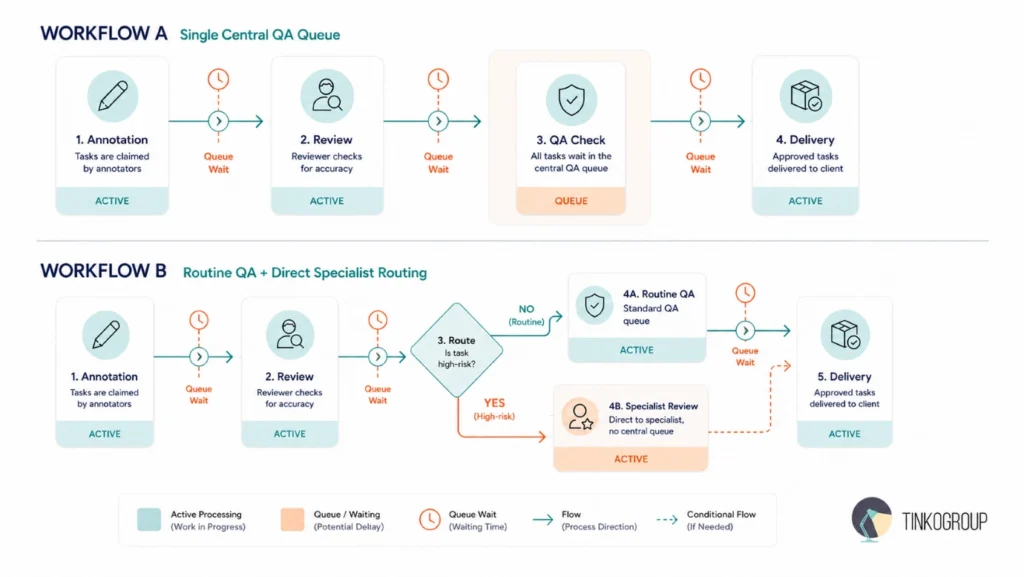
The structure of the queue is as important as the specialization of the reviewer. If every annotator is doing every type of task, it creates cognitive friction and slows everyone down. Routing text tasks to writers and spatial tasks to computer vision specialists cuts decision fatigue and lifts overall annotation throughput. An autonomous vehicle program illustrates why this matters. Lidar point-cloud annotation and traffic-sign classification are completely different skill sets. If you force a single generalist pool to do both, both queues will likely be slower than if you had a dedicated track for each.
Another easy lever to get wrong in either direction is batch size. Getting a hundred thousand jobs into production all at once creates a blind spot. Mistakes can spread quickly before anyone notices.
In contrast, minimal batches require high hand-offs and management overhead. A moderate range of micro-batching keeps the feedback loops tight: quality issues come up fast, instructions get refined in real time, and the backlog doesn’t build up unnoticed. There is no one correct batch size. That depends on how complicated the task is and how much the reviewer can handle. Scalable annotation workflows tend to specify batch size by category rather than one number for all of a project.
Distributed annotation teams working across time zones add cost efficiency but also real coordination risk if not designed carefully. This is where human-in-the-loop operations tend to break down first, since every extra hand-off is one more place a task can sit and wait:
- Time-zone hand-off friction. Without the automation of hand-off protocols, a task done by an Asian team can lie idle for 12-14 hours until it is picked up by a QA team in Europe or North America.
- Multilingual annotation operations need inputs routed automatically to native speakers with the right regional context. Misrouted tasks mean delay and rework.
- Specialist constraints. Certified domain experts are a rare and expensive resource. If the pipeline slows down because of a badly constructed queue, they’re sorting files instead of reviewing.
Insurance claims annotation projects run into this constraint often. To properly label fraud patterns, you need input from analysts who understand claims history. Such analysts usually work across several projects at a time. A queue that sucks them in for routine sorting rather than the judgment calls they are actually needed for is a waste of the one resource the project can least afford to waste.
Without intentional workflow design, teams are always reactive: sub-queues swallow work, specialists waste time on low-value tasks, and communication breaks down at hand-offs. That disorganization, more than the output of any single person, is often the largest contributor to unnecessary delay at scale.
The fix isn’t always more automation. In several programs, the biggest single improvement came from something simple: making queue ownership explicit. When every queue has one named person responsible for its age and size, tasks stop drifting between teams with no one accountable for clearing them. Tooling helps you enforce that ownership, but it doesn’t replace the decision of who to assign it to.
Metrics That Reveal Latency Problems Before Delivery Slips
If you only discover a pipeline is broken when a deadline is missed, that’s a monitoring failure, not just an execution failure. Managers require real-time metrics of annotation workflow efficiency, monitored on an ongoing basis, not post hoc.
Six metrics matter most:
| Metric | What it reveals |
| Turnaround time (TAT), or annotation turnaround time | Baseline pipeline health: the full duration from ingestion to final QA clearance. |
| Backlog growth rate | This metric indicates whether incoming volume is outpacing daily completion capacity, serving as an early warning for annotation backlog management. |
| Queue age | Exactly where in the pipeline tasks are stagnating. |
| Escalation volume | How clear the current style guide actually is. A spike predicts a coming drop in velocity. |
| Reviewer utilization | Whether time is lost waiting for task loading rather than reviewing. |
| Review cycle duration | Whether unclear guidelines are causing “ping-pong” loops between annotators and reviewers. |
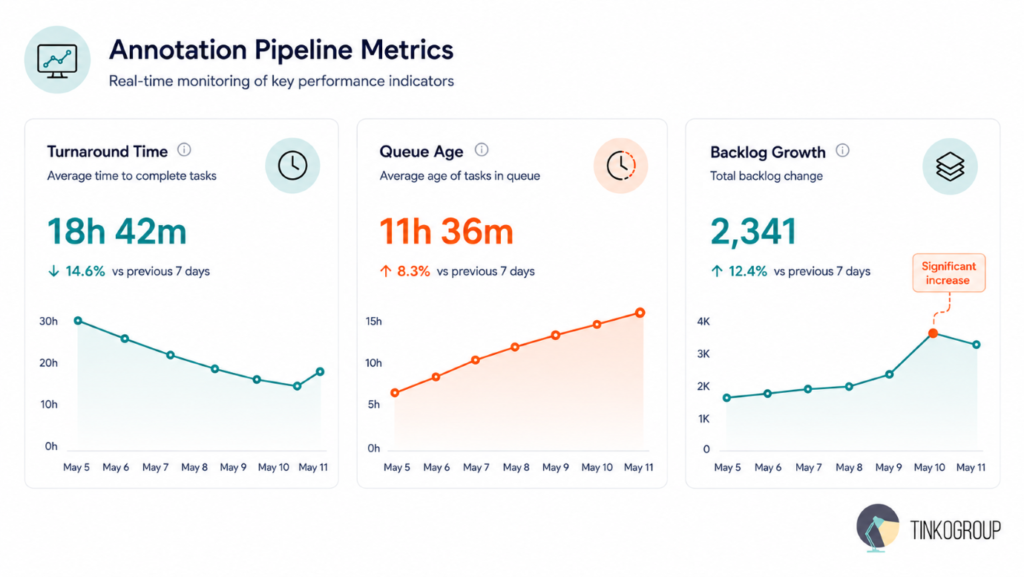
These numbers are only useful when tied to automated triggers. To catch annotation pipeline latency early, an alert should fire when average QA queue age rises more than 15% over 48 hours. That gives the team time to investigate the cause. It might be a spike in complex data or a drop in reviewer availability. Personnel can then be reallocated before the delay cascades into a missed deadline.
Throughput alone masks this type of problem. Twenty thousand tasks on a Friday and your team can still look good. But if the review cycle time doubled that same week, the team is spending double the effort fixing the same errors. That hidden cost manifests itself as a drop in production the next week if no one catches it early.
This is evident as a program for processing enterprise documents demonstrates. One team measured overall throughput weekly and saw consistent numbers for a month straight, so the leadership assumed the pipeline was healthy.
A more granular look at queue age by stage revealed a different picture: time to resolve escalations was up 40% over the same period. The team was pulling reviewers off other work just to maintain the headline throughput number. That masked a real capacity problem until it finally caused a deadline slip on another project.
None of these six metrics requires you to have a dedicated platform to begin tracking. Most annotation tools have timestamps for when assignments are assigned, submitted, and reviewed. This is sufficient to manually calculate turnaround time and queue age if you don’t have a dedicated dashboard yet.
The larger obstacle is typically organizational, not technical. These numbers have to be owned daily by someone, and people need to be reallocated the moment a trend line goes the wrong way, not waiting for a weekly status meeting to bring them up. Sigma makes a related point in its research on annotation speed and scalability: throughput numbers alone tell a team almost nothing about where a pipeline is actually losing time.
Strategies for Reducing Batch Latency Without Sacrificing Quality
Speed and accuracy don’t have to trade off against each other in enterprise AI programs. This is often taken as a given but not an operationality. Cutting QA sampling to hit a deadline just trades visible delay for invisible label noise. Real annotation process optimization compresses latency by fixing the workflow, not by cutting review.
The best way to counter queue stagnation is to dynamically distribute resources. If annotators are cross-trained and can shift into review roles as real-time metrics show imbalance, capacity shifts to wherever it’s needed most. It never sits in one role and lets another queue build up.
Not every task needs the same level of verification. Confidence-based routing routes work down different paths depending on how straightforward they are:
- Automated pre-scoring. Heuristic models assess incoming data to determine probable complexity and confidence levels.
- Single-pass routing. Straightforward tasks route to a single high-accuracy annotator, followed by a rapid automated validation check.
- Consensus escalation. Low-confidence or complex tasks automatically route to a multi-reviewer consensus queue for blind parallel evaluation.
- Expert adjudication. If consensus fails, the system instantly escalates the file to a senior subject-matter expert, bypassing lower-level queues entirely.
This focuses expensive reviewer hours on what matters most and is what reduces batch latency in annotation without sacrificing quality. A prime example is a market research operations team working with open-text survey responses with this model. The routine categorization can be subject to single-pass review, while the ambiguous or sensitive responses go directly to a senior analyst. Average turnaround drops without relaxing the standards for the responses that actually need scrutiny.
Escalations require a channel, not an email thread. When a task is flagged, it should go right off the annotator’s queue and onto the project lead’s dashboard, and the annotator should be able to grab a fresh task immediately. The same ambiguity shouldn’t cause repeated escalations, resolutions need to be looped back into a shared style guide on a regular cadence.
Teams that skip this step end up with the same edge case being escalated over and over again by different annotators, each unaware that someone else had resolved it the week before. That cost doesn’t appear anywhere on the metrics dashboard, but anyone can easily find it if they care to look.
Solid annotation capacity planning also means keeping a buffer of trained, pre-vetted contributors engaged on lower-priority work. If volume spikes or a specific team or region goes offline, that reserve capacity absorbs the shock instead of the deadline slipping.
It’s good to be honest about the tradeoffs here too. But in the short term, removing a review step will almost always improve measured turnaround time. But if that step was there for a reason, the rework shows up later as time saved. It costs more to redo the work than it would have to do the original review.
If a team cuts back on secondary review to meet a Friday deadline, it might get out faster numbers that week and a longer, messier correction cycle the following week. The aim is to remove the waiting and unnecessary handoffs, not the checks that catch real errors. That distinction usually separates genuine annotation process optimization from an effort that just moves the cost downstream.
How Tinkogroup Supports Low-Latency Annotation Operations
Tinkogroup manages enterprise annotation operations as a disciplined supply chain, not a loosely managed service. Each hand-off, queue state, and review step is designed to play a specific role in the pipeline. This is the way data annotation operations look when they are engineered, rather than run informally.
Task assignment runs on a pull-based model instead of static file pushes. As soon as an annotator finishes a task, the system evaluates the current queue priorities and assigns the next most useful task to that annotator. That removes the gaps that come from manual distribution and keeps idle time close to zero.
Same logic for matching reviewers. Tinkogroup does not consider annotators interchangeable. It routes work by area of expertise. If it’s medical data, it is routed to certified clinical professionals, legal and financial content to compliance and financial specialists, and autonomous system data to computer vision reviewers experienced to handle such data. This perfect match of expertise and type of task reduces the time reviewers spend getting oriented. In most programs, that orientation time is a significant, and often forgotten, part of annotation delivery performance.
When disagreements do surface, dedicated adjudicators clear that queue daily instead of letting it accumulate. The underlying cause of each disagreement then feeds directly into targeted retraining for the relevant part of the workforce, so the same ambiguity doesn’t keep coming back.
Clients get live visibility into turnaround time, queue age, and reviewer utilization through a shared dashboard. Forecasting of historical throughput provides realistic delivery estimates instead of optimistic ones. That’s the kind of number procurement teams at enterprise AI programs can actually build a release schedule around, not a best-case figure that slips every quarter.
This kind of operational discipline matters more, not less, as programs get more distributed. Across global AI data operations and large-scale training data projects, generic labeling capacity isn’t enough to hit the accuracy bar most enterprise models require. The workforce must match the domain, and the queue must be designed to avoid time costs.
Conclusion
Increasing headcount is not a common solution for annotation pipeline latency. It comes from queue build-up and sequential dependencies and unclear escalation ownership and the annotation workflow delays that undersized or poorly sized batches tend to produce. As volume increases, all these factors contribute to the problem. It’s not a staffing shortage in itself.
Reducing it consistently involves four key factors:
- Build tiered annotation queue management so priority work doesn’t wait behind routine tasks.
- Put annotation resource allocation on a dynamic footing, with cross-trained staff who can shift where the bottleneck is.
- Track queue age and turnaround time continuously, not just at deadlines.
- Use confidence-based routing so QA effort goes where it’s actually needed.
The goal isn’t to speed up every task individually. It’s cutting down the time valid work spends stuck between non-blocking stages. Teams that get this right deliver model iterations faster, waste less operational budget, and hit release dates more predictably, without lowering the quality bar that their models depend on.
If you’re not sure where your pipeline loses the most time, that’s usually the first thing worth auditing. Check which queues grow fastest, which roles repeatedly become the bottleneck, and whether escalation ownership is actually clear. Explore Tinkogroup’s managed data services to see how a structured pipeline audit and workflow redesign can tighten delivery timelines without cutting quality controls.
What causes annotation pipeline latency?
Annotation pipeline latency is usually caused by queue buildup, reviewer constraints, workflow dependencies, large batches, and operational overhead. Delays often occur between active processing stages when completed tasks wait for review, QA, escalation, or specialist approval. At enterprise scale, these small waiting periods can compound into significant delivery delays.
How can teams reduce annotation pipeline latency without lowering quality?
Teams can reduce annotation pipeline latency by redesigning queues rather than simply removing QA steps. Priority-based routing, complexity-based task assignment, dynamic capacity allocation, and direct routing of high-risk cases to specialists can reduce unnecessary waiting. Monitoring queue age and turnaround time also helps teams identify bottlenecks before they affect delivery.
Which metrics should teams track to monitor annotation pipeline latency?
The most useful metrics for monitoring annotation pipeline latency include turnaround time, queue age, backlog growth, escalation volume, reviewer utilization, and review cycle duration. Tracking these metrics by workflow stage helps identify where tasks are waiting and whether a growing queue reflects higher data complexity, limited reviewer capacity, or a process dependency.